Seppuku Was the Ritual a Samurai Chose Over Disgrace
· 16 min read
Seppuku was the ritual by which a samurai answered disgrace, protested injustice, or followed his lord, and this is the history of how that solemn practice began, what it meant, and how it ended.
Few words from Japanese history carry as much weight as seppuku. For many people abroad it is the first thing that comes to mind when they hear the word samurai. Seppuku was neither a wild act of despair nor a punishment handed out lightly. It was a ritual with rules, witnesses, and a second person standing by, through which a samurai could answer disgrace, protest an injustice, or atone for a failure.
Seppuku means the cutting of the belly, and it was the formal written term for the act. In everyday speech people said harakiri, which uses the same characters in the opposite order. The two words describe the same act, but seppuku was the word of documents and records, belonging to the world of law and honour rather than gossip.
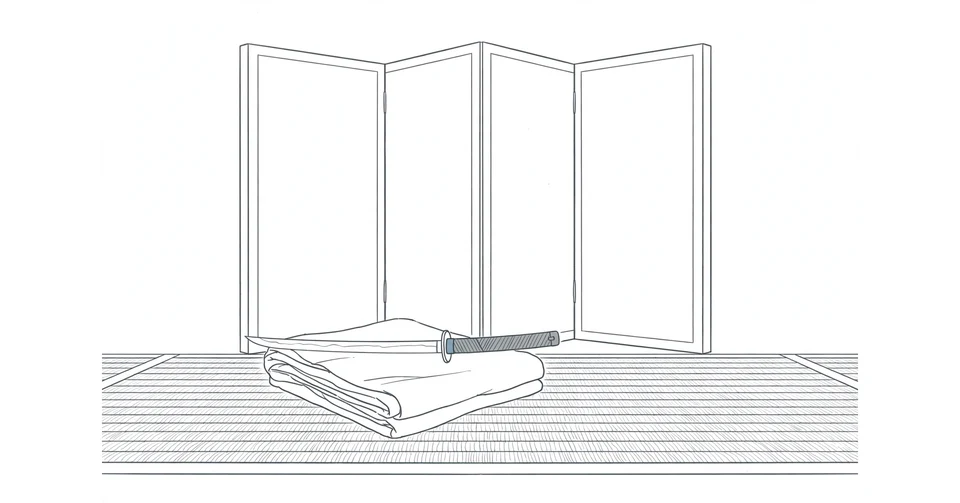
To understand seppuku, look instead at the room around the dying man. Officials were present, a record was kept, and the man beside him with a long sword was usually a trusted friend. The ritual was never only about one man. It was about what his death settled for his family and his clan.
What seppuku meant to a samurai
The belly held a special place in the old Japanese view of the person. The word hara means belly, but it also meant the seat of the soul, the will, and the true feelings. The head could deceive and the mouth could lie, yet the belly, in this way of thinking, revealed a person without disguise. The language still carries that trace: to have hara was to have character.
That belief is the key to seppuku. A samurai who opened his belly was showing that his sincerity could be seen and his honour proved in the most demanding way possible. A quicker death would have served the purpose of dying. Only this act served the purpose of proof. The Samurai Museum Berlin puts it plainly: seppuku was not a romantic gesture but a highly regulated social practice.
Honour here was not a private feeling but a public standing, held in the eyes of a lord, a family, and a clan. A samurai who had failed could not simply carry on, because his failure touched everyone connected to him. Seppuku offered a way to confine that shame to one body, so that the family kept its name, its property, and its place. The frame here was shame, the public loss of status, rather than guilt in the Christian sense. Seppuku was not about sin and forgiveness, and only a witnessed act, carried out correctly, could restore what a failure had broken. I find that logic hard to admire and hard to dismiss. It valued the group above the individual to a degree that feels severe to a modern reader, yet it also gave a disgraced man a way to answer for himself.
How a battlefield act became a ritual
Seppuku did not begin as a ceremony. The earliest recorded cases come from the late twelfth century, a time of civil war between the great warrior clans, and they were acts of desperation on the battlefield. A defeated warrior facing capture would take his own life rather than fall into enemy hands. The most often cited first case is Minamoto no Yorimasa, said to have opened his belly at the Byodo-in temple in 1180 after defeat by the Taira in the opening years of the Genpei War. The account remains disputed, and an earlier case, Minamoto no Tametomo in 1170, is also recorded. The Genpei War, fought from 1180 to 1185, marks the beginning of an era in which warriors took their own lives rather than be captured.
Those early acts were improvised and chaotic, without a set form and without a second person standing by. The belly was chosen for practical reasons as well as symbolic ones: accessible where the armoured chest was not, and a wound there did not kill instantly, which gave a retainer time to deliver a merciful finishing stroke. Under the Kamakura shogunate, which ruled from 1185 to 1333, seppuku developed into a way of taking responsibility for mistakes or atoning for political guilt. A key development was junshi, the practice of a retainer following his lord into death, first documented in the fourteenth century, and the line between a voluntary act and a socially compelled one was already blurred.
The civil wars of the fifteenth and sixteenth centuries made the practice common and began to regulate it. The military house laws of great clans laid down principles: composure, no show of pain, and a witness present. After the Battle of Sekigahara in 1600 and the founding of the Tokugawa shogunate in 1603, the long peace of the Edo period turned seppuku from a battlefield practice into a civil institution. The blade of the ritual is part of that story. The short blade used in seppuku was usually a tanto, a dagger of about twenty to twenty five centimetres, though the wakizashi could also serve. The wakizashi was the blade a samurai always had with him, the sword that stayed on indoors when the long katana was left at the door, and so it was the blade at hand at the most solemn moment of his life. The full story of that companion blade is told in the article on the wakizashi, the short sword a samurai never left behind.
The kaishakunin, the second who stood by
No honest account of seppuku can leave out the kaishakunin, the second person who stood by the dying man. His task was to end the suffering with a single stroke of the long sword, delivered at the agreed moment. The choice of this man was never a formality. He had to be an experienced swordsman whom the dying man trusted completely, because a clumsy stroke would have disgraced them both. Often the condemned man asked a particular friend, and the request was rarely refused, because it was an honour. The dying man was entrusting his last dignity to his friend's skill.
That trust is what separates seppuku from a solitary act: a shared performance. The principal had to show composure and resolve, and the second had to show precision and loyalty. If either failed, the whole ceremony failed, and the shame it was meant to remove would fall even more heavily on the family. The second took on all of the risk and none of the honour, out of friendship.
The long sword the second used was the katana, the blade whose history and meaning are explored in the article on how the katana became the soul of the samurai. His stroke had to be delivered at exactly the right instant. The short blade belonged to the dying man, and the long blade belonged to the friend. I think the kaishakunin is the figure who makes the ritual most human. It is easy to picture seppuku as a cold code obeyed by men who felt nothing, yet the second reminds us that it was carried out between people who knew each other, often for many years, and that the hardest part may have fallen not on the man who died but on the friend who had to strike.
The many reasons a samurai chose seppuku
Seppuku served several different purposes across its history, showing that it was an institution with many uses rather than a single gesture. The first was atonement. A samurai who had made a serious mistake, failed his lord, or brought disgrace on his house could restore the moral order by taking responsibility in the most complete way available. The sociologist Toyomasa Fuse called this form inseki-jisatsu, responsibility suicide: the man himself closing the account. The second purpose was loyalty, and its most extreme form was junshi, following a lord into death. When a lord died, some retainers chose to die with him, as a final service. The Tokugawa shogunate banned junshi in 1663, because entire retinues were taking their own lives when a lord died.
The third purpose was protest. A retainer who could not prevent a disastrous decision by his lord could use his own death as a statement that could not be ignored. This form was called kanshi, remonstration by death, and a related form was funshi, death in protest against an intolerable injustice. Both were rare but politically effective, turning an individual death into a public accusation. The fourth purpose was punishment, in practice the most common form of seppuku. A samurai who had committed a serious offence would be told of it in full and given a set time to carry out the sentence, usually before sunset on a given day. This was considered the most honourable form of capital punishment available to a samurai, in contrast to the public execution reserved for criminals of lower rank. A samurai sentenced in this way kept a privilege even in death: his family property was generally not confiscated, and his descendants bore no official disgrace.
The ritual as it was performed in the Edo period
By the Edo period, which ran from 1603 to 1868, the formal version of seppuku had become a carefully prepared ceremony, and the setting itself was part of the meaning. A special room was prepared with white tatami mats and white folding screens set up on three sides. The screens shielded the dying man from curious eyes while giving the official witnesses a clear view. In front of the mat stood a low wooden offering stand, the sanbo, holding the short blade wrapped in white paper.
The man entered in ceremonial dress, usually a plain white kimono, the death robe. He bowed to the witnesses and knelt in the formal seated position. An assistant brought the sanbo, and he took up the blade with both hands and raised it to his forehead in respect.
What followed was brief by design. The second struck at the agreed moment so that the suffering would be as short as possible. Over time the Edo period developed an even milder form, in which the dying man merely touched the blade or brought it symbolically toward himself, and in some cases a wooden fan was used instead of a blade at all. As soon as he made the ritual gesture, the kaishakunin struck. It was no longer only about the wound, but about the readiness to accept the sentence and the composure with which it was faced. Officials of the shogunate or the clan had to be present, and a record was made of the date, the witnesses, and the procedure. Once a samurai had carried out the sentence, the guilt was considered atoned for and the matter closed.
The forty-seven ronin and the most famous seppuku in history
No case shaped the image of seppuku more than that of the forty-seven ronin, often shortened into a simple tale of revenge. It began on 14 March 1701, in Edo Castle, where the shogun was receiving envoys of the emperor. Asano Naganori, the daimyo of Ako, drew his short sword and attacked Kira Yoshinaka, the shogunate's chief master of ceremonies. The reason for the attack remains unclear. Asano wounded Kira and was immediately overpowered, and drawing a weapon inside the shogun's palace broke the highest taboo of the time.
The verdict came that same day. Asano was ordered to perform seppuku that very evening. His property was confiscated, his clan was dissolved, and his three hundred samurai became ronin, masterless warriors without status or income. Kira, the target of the attack, was not punished. Forty-seven of the former retainers, led by Oishi Kuranosuke, swore a secret oath to avenge their lord. They scattered and pretended to have given up their honour, until Kira's spies reported that they were no longer a danger. On a winter night in December 1702, the forty-seven broke into Kira's estate in Edo, found him hiding, and killed him. They carried his head to the Sengaku-ji temple, where Asano lay buried, and laid it on his grave.
The shogun now faced a dilemma argued about ever since. Legally the ronin were murderers who had broken the law. Morally they were heroes who had done what every samurai was supposed to do and remained loyal to their lord unto death. The government could not acquit them without undermining its own authority, nor execute them as common criminals without risking a popular uprising. The compromise was to order them to commit seppuku, which forty-six of them carried out on 4 February 1703 in four different temples. One was spared to carry the account back to Ako. Their graves at the Sengaku-ji are still visited today. The case remains disputed: Confucian scholars argued that true loyalty meant serving Asano's successor, while others saw the ronin as the embodiment of the warrior ideal. The play Kanadehon Chushingura, first performed in 1748, made the story the most famous drama in Japanese theatre.
Saigo Takamori and the legend that was not seppuku
The most famous seppuku that probably never happened belongs to Saigo Takamori, leader of the Satsuma Rebellion of 1877. In the popular telling, Saigo died a dignified ritual death at Shiroyama, kneeling in traditional armour with a short blade in his hand. Colour woodblock prints produced within weeks of the battle showed exactly that scene. The film The Last Samurai repeated the scene for a global audience in 2003.
The historical record tells a different story. In 2010, the historian Mark Ravina showed, from contemporary reports and autopsy records, that on 24 September 1877 Saigo was seriously wounded by a shot to the hip and could no longer move. His retainer Beppu Shinsuke beheaded him to spare him capture, an act of mercy rather than a ritual seppuku. Saigo wore a French uniform and commanded a modern army with artillery. The legend emerged later. The government posthumously pardoned Saigo in 1889 and folded him into the national canon of heroes. The Saigo case warns how quickly a legend can replace a fact when the legend is more beautiful than the truth. The woodblock prints were not documentation. They were propaganda, made to sell, and they succeeded so completely that the invented scene is still the one most people picture today.
How seppuku ended under Meiji law
Seppuku ended with the order that had sustained it. On 3 January 1868, the fifteen-year-old Emperor Meiji proclaimed the restoration of imperial power, ending the Tokugawa shogunate, which had ruled Japan for 265 years. Within a few decades Japan transformed itself from a feudal society of ranks into an industrialised power. The old order was dismantled, and with it went the institutions that had given seppuku its meaning.
Formal abolition came in 1873, when the Meiji government banned seppuku as a legal punishment. Japan wanted to be seen as a civilised nation on an equal footing with the Western powers, and ritual self-killing did not fit that image. At the same time the system of ranks was abolished, and samurai lost their privileges, their stipends, and their right to carry swords. The sword ban of 1876, the Haitorei Edict, forbade the public carrying of swords. Seppuku, which had once defined the status of the warrior, became obsolete with the status itself. The Samurai Museum Berlin traces the ban and its consequences through the Meiji period and beyond.
The end did not come all at once. During the Boshin War of 1868 to 1869, many samurai still chose seppuku. In 1912, General Nogi Maresuke took his own life with his wife on the day of Emperor Meiji's funeral, an act of junshi. Nogi had carried a disgrace for thirty-five years, the loss of a regimental flag in 1877. In the Second World War the old ethic was pressed into military service, and many high-ranking officers chose seppuku in 1944 and 1945 as defeat became certain. The kamikaze pilots were placed in the same tradition, though the parallel was a falsification, since kamikaze was mass killing while seppuku had been a legally regulated procedure. After 1945 the ideology collapsed and seppuku became taboo, too closely tied to failed imperialism for public discussion.
The most famous modern case came in 1970. On 25 November of that year, the writer Yukio Mishima entered the headquarters of the Japan Self-Defense Forces in Tokyo with four members of his private militia, addressed the assembled soldiers, and then performed seppuku in the office of the commanding general. His second, Masakatsu Morita, failed to complete the stroke cleanly, and another man had to finish it before Morita took his own life as well. The attempted coup had been doomed from the start. Mishima's death forced a nation that believed it had left this tradition behind to confront its past.
How Japan remembers seppuku today
Today seppuku survives mainly as memory. The forty-seven ronin are commemorated every year on 14 December at the Sengaku-ji temple in Tokyo, as a historical event of remembrance, not a model to follow. Visitors come to the graves and leave incense. In art and literature the ritual has never gone away. The play Kanadehon Chushingura is still performed, and films, novels, anime, and video games return to the motif again and again, usually in an aestheticised form, the white robe, the tatami mat, the short blade, the kneeling figure. The images are powerful but incomplete, showing the ceremony without the system that made it necessary. The Wikipedia article on seppuku gives a useful overview of this long afterlife.
That incompleteness has produced myths that careful historians have spent decades correcting. Seppuku was not something every samurai did when he failed. Most samurai died in bed, of illness, in old age, and the ritual was ordered only for serious offences, military catastrophe, or a legal sentence. It was not painless and it was not quick. It was not a Buddhist ritual, since Buddhism forbids suicide, but a secular, Confucian phenomenon. Most Japanese people today do not regard it as a living tradition, and the romanticisation of the practice has often come from outside Japan.
The honest way to remember seppuku is as an institution with a history. It began as a desperate act on a battlefield, became a legal procedure and a language of honour, and ended when the society that needed it ceased to exist. The men who carried it out were not all stoic heroes, and the sources are full of accounts of men who trembled, wept, and tried to flee. The perfect, composed performance was the ideal, not the norm. What stays with me is the question the history leaves behind. A society built a ceremony around the idea that honour was worth more than life, and kept it for seven hundred years, because it solved real problems of order, revenge, and responsibility. Then the society changed, and the ceremony became a memory. Seppuku was the ritual a samurai chose over disgrace, and the choice only made sense inside a world that had taught him disgrace was the one thing he could not live with. That world is gone. What remains is the record, the graves at Sengaku-ji, and the quiet reminder that even the most solemn rituals belong to their time.
More in Culture & Society
- Saya Is the Lacquered Sheath That Guards the Katana
- Daisho Was the Pair of Swords That Marked a Samurai
- Hamon Is the Wavy Line That Proves a Katana Is Real
- Ikebana and the Quiet Discipline Behind Japan's Flower Art
- The Wakizashi Was the Short Sword a Samurai Never Left Behind
- The Tsuba Turned a Sword Guard Into a Small Work of Art
Latest posts
- Omiyage and the Japanese Art of Bringing Something Back
- How the Katana Became the Soul of the Samurai
- The Menpo Gave the Samurai a Face Worth Fearing
- Japan Goes Maple Hunting Every Autumn and Calls It Momijigari
- Kabuto Gave the Samurai a Helmet Worthy of His Sword
- Christmas in Japan and the Fried Chicken Dinner That Started It All
- Kiso Yoshinaka Rode Out of the Mountains and Nearly Took Japan
- Sakayaki Gave the Samurai His Signature Hairline
- The Archer on the Tower Was Hangaku Gozen
- Koyo Turns Japan Into a Country That Forecasts Leaves
- Inside Japan's 100 Yen Shops, Where Everything Costs a Coin
- Tomoe Gozen Rode Into Battle When Women Were Told to Stay Home
- A Chonmage Is the Knot Every Sumo Wrestler Wears Before the Fan
- Onna-Bugeisha Held the Castle While the Men Were Away
- Momiji-Gari Is Japan's Autumn Answer to Hanami