The Tsuba Turned a Sword Guard Into a Small Work of Art
· 17 min read
A tsuba is the small guard between a Japanese sword blade and its grip, and in the hands of great makers it became one of the finest forms of Japanese metal art.
A tsuba is the small disc of metal that sits between the blade of a Japanese sword and its grip. It is about the size of the palm of a hand, usually round and sometimes squared, and it is the part of the sword a stranger notices last. That is a pity, because in the long history of the Japanese sword the tsuba became the most personal part of the whole weapon. The blade was made by a smith and the scabbard by a lacquer worker, but the tsuba was where an artist could paint a landscape, tell a legend, or carve a single flower into iron, all on a surface no wider than a tea cup.
The guard does a simple job. It stops the hand from sliding forward onto the blade during a thrust, and it helps balance the sword in the hand. For centuries that was all most guards were, a plain plate of iron with a hole for the blade. Then, in the late sixteenth century, a handful of makers began to treat that plain plate as a canvas, and the tsuba stopped being a piece of hardware. It became a small work of art that happened to sit on a sword.
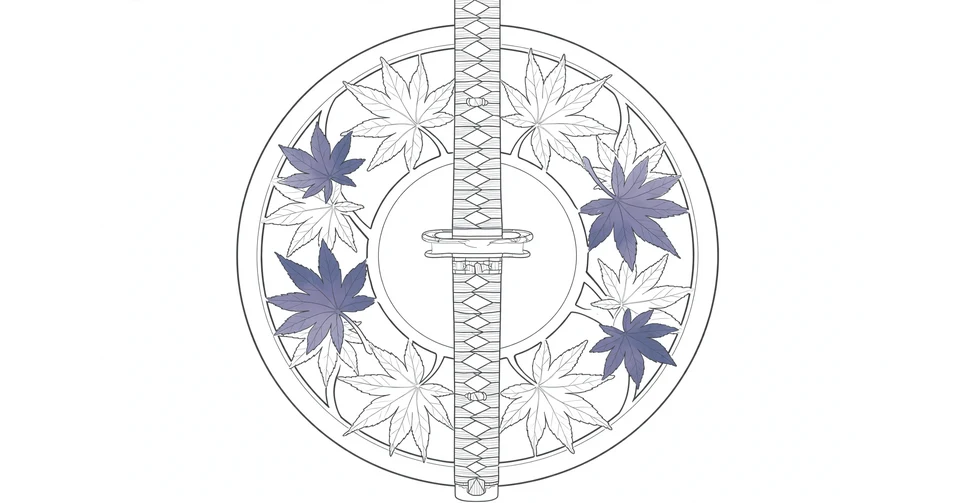
What makes a tsuba worth a whole article is the size of the achievement. A maker had a disc about eight centimetres across, often only a few millimetres thick, and in that space he had to make something strong enough to take a blow, light enough not to unbalance the sword, and beautiful enough to please a man who carried it every day. The best makers solved all three at once, and their work is still collected and copied four hundred years later.
What a tsuba actually does
A tsuba sits at the end of the grip, between the handle and the blade, held in place by a wedge shaped collar called the habaki above it and by two thin washers called seppa on either side. Take the sword apart and the tsuba slides off the tang, with no glue and no screws, so the guard can be changed without touching the blade. That is why so many old blades survive in mountings younger than the blade itself. A samurai could keep his grandfather's blade and order a new tsuba to suit his own taste.
The practical job of a tsuba is narrower than most people imagine. A European sword guard is a basket or a cup that shields the whole hand, but a Japanese tsuba does not do that. It is mostly there to stop the hand from sliding forward onto the edge during a thrust, and to give the thumb something to press against when drawing the sword. The tsuba also sets the balance of the weapon, since a heavier guard pulls the balance point toward the hand. In kendo today, two fighters sometimes lock their swords together at the guards and push, a moment called tsubazeriai, and the word has passed into everyday Japanese as a way of describing fierce competition.
The size of a tsuba depends on the sword it guards. According to the Wikipedia overview of Japanese sword mountings, a tsuba for a katana measures about 7.5 to 8 centimetres across, a tsuba for a wakizashi about 6.2 to 6.6 centimetres, and a tsuba for a tanto about 4.5 to 6 centimetres. Everything a maker wanted to say had to fit inside that circle.
How a tsuba was made
A tsuba began as a plate of iron, forged, hammered flat, and shaped, often with a slightly raised rim and a gently domed or flat face. The best iron guards have a surface full of tiny hammer marks called tsuchime, the record of thousands of blows from a small hammer. The surface is not smooth by accident. It is smooth by long labour rather than by polishing alone.
Once the plate was shaped, the maker cut the openings. The central slot had to fit the tang of the blade exactly, so the guard would not rattle or slip. Then came the decoration, and here the craft split into several techniques worth knowing by name. Sukashi is openwork, where the maker cut shapes clean through the plate so that a design appears as a silhouette with light showing through the gaps. Takabori is high relief carving, where the design is raised above the surface. Zogan is inlay, where gold, silver, copper, or brass is set into grooves cut in the iron. Shakudo is an alloy of copper and gold that turns a deep, almost black blue when treated, and shibuichi is an alloy of copper and silver with a soft grey tone. A single tsuba might combine several of these techniques, and the skill lay in making them look like one idea rather than a display of tricks.
The materials changed over time. Early guards were iron, because iron was strong and suited to war. Later, as peace lasted and the guard became more of an ornament, makers worked in softer metals and alloys that took finer detail, including brass, copper, shakudo, and shibuichi, often with gold and silver inlay. The shift from iron to soft metal is one of the clearest signs of how Japan itself changed, from a country at war to a country at peace.
I find the hammer marks the most honest part of a tsuba. A painting can hide its labour, but a forged plate cannot, and the tsuchime on a good iron guard records the rhythm of the maker's arm. The beauty I see is not decoration laid over a tool. It is the tool itself, finished with care.
The makers who turned a guard into art
For a long time tsuba makers did not sign their work. Swordsmiths had signed blades since the Heian period, but makers of fittings only began signing regularly in the late sixteenth century, and a signature turns a craftsman into an artist with a name and a market. Two names from that turning point still dominate the field, Kaneie and Nobuie, and a third family, the Goto school, shaped the craft for centuries after them.
Kaneie worked in Fushimi, in Yamashiro Province, in the late sixteenth century, and he is credited with being the first maker to bring pictorial landscape subjects onto a tsuba. Before him, guards carried simple openwork patterns or brass inlay. Kaneie painted with iron, carving Chinese landscapes and literary scenes onto a plate only a few millimetres thick, using gold sparingly, like a highlight in a painting. His work was thin, often only 1.5 to 2 millimetres at the centre, and the raised parts of his designs were inlaid rather than carved from the plate, because carving them from such thin iron would have pierced it.
A surviving Kaneie tsuba in the Varshavsky Collection, dated to around 1600, shows the method clearly. It is a thin iron plate in kobushi gata, or fist shape, with a ginkgo leaf on one side and plum blossom on the other, openwork filled with grey metal to suggest cracked ice, and a rim folded over in a few places. The theme is late winter turning to spring, told on a disc about 84 millimetres across. Kaneie was among the first tsuba makers to sign his work regularly, and his signature became so famous that copies and forgeries of his name were made for centuries.
Scholars still argue about his life, and very little is known with certainty. One careful study notes that the link between Kaneie and the warlord Toyotomi Hideyoshi, who built a castle at Fushimi, is plausible but speculative, a good guess rather than a fact. What can be shown is that Kaneie changed what a tsuba could be.
Nobuie worked in the same generation, and his approach was different. Where Kaneie painted pictures, Nobuie thought like a sculptor and like a tea master. His tsuba are iron, strongly shaped, with a rough and living surface texture that recalls the simple ceramics made for the tea ceremony. His guards are meant to be held as much as looked at, small sculptures whose weight and texture matter as much as their pattern. He came from the same world of taste that prized a rough tea bowl over a polished one, and his work carries that belief, that a plain material honestly worked can be more beautiful than gold.
The Goto school was a different kind of institution. Where Kaneie and Nobuie were individual masters, the Goto were a family line that served the shogunate as official makers of sword fittings for generations. The early master Yujo founded the school in the fifteenth century, and his descendants held the position for centuries. Goto Mitsuakira, who lived from 1816 to 1856, was the sixteenth generation master of the main line, and the Metropolitan Museum of Art in New York holds one of his tsuba, a small shakudo plate showing Fukurokuju, the god of happiness, wealth, and longevity, with a stag, worked in gold, silver, and copper. The museum describes the fineness of the engraving as marking the piece as one of his masterpieces.
Kaneie showed that a tsuba could carry a painting. Nobuie showed that it could carry a philosophy of texture and restraint. The Goto showed that it could carry the authority of an office.
What the pictures mean
A tsuba is small, but its pictures are rarely random. The motifs on a guard were chosen from a shared language of nature, legend, and luck. A cherry blossom speaks of beauty that does not last. A pine tree speaks of endurance, because it stays green through winter. Bamboo bends without breaking, and the plum blossom opens while snow is still on the ground, so it speaks of courage in hard times. A crane stands for long life, and a carp swimming upstream stands for perseverance. These are the common poetry of Japan, written in metal instead of ink. Family crests were sometimes worked onto a guard as well, and guards were often kept as heirlooms and passed from one generation to the next.
Some motifs tell a story. The Met tsuba by Goto Mitsuakira shows Fukurokuju with a stag, a wish for a long and fortunate life. Other guards show heroes from legend or the Eight Views of the Xiao and Xiang rivers, a famous subject of Chinese painting and poetry. The guard was therefore a test of taste as well as a piece of equipment.
There is a temptation to read too much into every picture, and it should be resisted. Not every flower is a symbol, and some makers chose a motif because it looked good in the space available. A dragonfly fits a round plate well, and a wave fits the curve of a rim. A good way to look at a tsuba is to ask two questions. What does the picture show, and does it suit the shape it sits in? The best guards answer both at once.
When peace made the tsuba more beautiful
The history of the tsuba follows the history of Japan, and the turning point is peace. During the Muromachi period, from 1333 to 1573, and the Momoyama period, from 1573 to 1603, guards were made for use, from strong metals and with practical designs. Then the Tokugawa shogunate brought peace in the early seventeenth century, and the sword stopped being primarily a weapon and became a mark of status. The full story of that change is told in How the Katana Became the Soul of the Samurai.
In peacetime the tsuba became more ornamental, and makers turned to softer metals, finer engraving, and richer inlay. Gold, which would have been too soft and too showy for a battlefield guard, became common. The fittings of a sword became a place to display wealth and taste, and a samurai of rank dressed his sword as carefully as he dressed himself.
The helmet of a samurai went through a similar change, and the story of Kabuto Gave the Samurai a Helmet Worthy of His Sword shows the same pattern from the other end of the body. Armour and fittings both began as protection and ended as art.
The tsuba as a collectible today
Tsuba are collected all over the world today. When collecting Japanese swords and fittings became popular outside Japan around the turn of the twentieth century, many fine guards left Japan for Europe and America. The Metropolitan Museum of Art alone holds close to 150 Kaneie and Kaneie style guards, most of them gifts from donors, which gives a sense of how many of these small objects survive and how seriously they are taken.
Collecting a tsuba is different from collecting a sword. A sword is large, expensive, and governed in Japan by strict registration laws. A tsuba is small, easier to store and display, and it can be appreciated without the legal weight of a blade. A collector can hold the whole object in one hand, turn it over, and study the back as well as the front.
Prices vary enormously, and that is worth saying plainly. A modest Edo period guard by an unknown maker can cost as little as a good dinner. A signed work by a famous master can cost as much as a car. The gap is not only about beauty. It is about rarity, condition, signature, provenance, and paperwork. The safest way into the field is to look first and buy later, and to handle as many genuine pieces as possible in museums and in the shops of reputable dealers.
Where to see real ones
The best way to understand a tsuba is to stand in front of a real one. The Tokyo National Museum holds fine sword mountings from the Edo period. The Japanese Sword Museum in Tokyo displays blades and mountings together, so a visitor can see a tsuba in its proper place on a sword.
Outside Japan, the Metropolitan Museum of Art in New York holds one of the largest collections of Japanese arms and armour in the world, including the Goto Mitsuakira tsuba described above. The Museum of Fine Arts in Boston holds important mountings too, and the Wolverhampton Art Gallery in England holds a collection of tsuba that is well known to specialists.
How to tell a real tsuba from a copy
The question every beginner asks is how to tell a real tsuba from a copy, and the honest answer is that there is no single test. The field has fakes, and it has had them for centuries. Kaneie was so famous that copies of his work were made while the Edo period was still running. The right approach is a set of checks that build into judgement over time.
Start with the iron. A real early tsuba is forged, and forged iron has a life that cast metal does not. The surface shows hammer marks, the plate is dense and hard, and the weight feels right for the size. A cast copy often feels light, or dull, or too smooth, and the details look soft, as if they had been poured rather than cut. The Varshavsky study of a Kaneie guard makes the point well. A real Kaneie plate is extremely thin, only 1.5 to 2 millimetres at the centre, and any raised motif is inlaid into the plate, because carving it from such thin iron would pierce the metal. A copy that carves its raised design from the plate, or that makes the plate too thick, has already given itself away.
Look at the signature next, and look with suspicion. A genuine signature has the rhythm of a hand that wrote it many times. A fake signature often looks laboured, too deep, or too perfect, and the most commonly faked names are the most famous ones, Kaneie above all. A signature alone proves very little. There are genuine unsigned pieces and signed pieces that are false, and the signature should be treated as one piece of evidence among many.
Check the holes and the wear. The central slot should fit a real blade tang, with clean edges and honest wear, and the side holes should be well cut and properly placed. A guard made only as a decoration sometimes has holes that are the wrong size or in the wrong place. A guard carried for two hundred years shows wear where the hand touched it and where the scabbard rubbed it, while a new copy often imitates that wear evenly, all over, in a way that real use never does.
The strongest protection is paperwork and provenance. In Japan, the Society for the Preservation of Japanese Art Swords, the NBTHK, issues papers grading fittings, including the rank of Special Important Fitting for outstanding pieces. A guard with NBTHK papers has been examined by experts. Provenance matters as well. A piece that comes from a known collection is safer than a piece that appears from nowhere with a grand story attached. Buy from reputable dealers, ask for the papers, and be wary of any seller who will not answer questions.
Finally, accept that uncertainty is part of the field. A piece described as in the style of Kaneie may be a fine Edo period work by a follower rather than a fake, and a follower's work is not worthless. It is real Japanese metalwork from the period, and it can be beautiful in its own right. The danger is not in buying a follower's work. The danger is in paying a master's price for it.
A small disc that carries a whole culture
A tsuba is the smallest part of a Japanese sword that anyone bothers to name, and it may be the most revealing. The blade tells the story of steel and war. The scabbard tells the story of lacquer and craft. The guard tells the story of taste, of the pictures a man chose to carry at his hip, and of the makers who learned to paint in iron.
The lesson of the tsuba is not only about Japan. It is about what happens when a culture gives its craftsmen time and permission to care. The guard did not need to be beautiful. It needed to stop a hand from sliding onto a blade. But the makers of the Momoyama and Edo periods were not satisfied with enough, so a small disc of iron became a canvas for landscapes, legends, and wishes for long life. That is the difference between making a thing and making it well.
I think the tsuba deserves a larger place in the story of Japanese art than it usually gets. The blade gets the poetry and the helmet gets the drama, but the guard is the part that sat closest to the hand, touched every day, and chosen by the owner himself. A man could inherit a blade and a helmet, but he chose his tsuba, and the choice said something about who he was. That is why these small discs still matter. They are not only guards. They are portraits, in miniature, of the men who carried them.
More in Culture & Society
- Seppuku Was the Ritual a Samurai Chose Over Disgrace
- Saya Is the Lacquered Sheath That Guards the Katana
- Daisho Was the Pair of Swords That Marked a Samurai
- Hamon Is the Wavy Line That Proves a Katana Is Real
- Ikebana and the Quiet Discipline Behind Japan's Flower Art
- The Wakizashi Was the Short Sword a Samurai Never Left Behind
Latest posts
- Omiyage and the Japanese Art of Bringing Something Back
- How the Katana Became the Soul of the Samurai
- The Menpo Gave the Samurai a Face Worth Fearing
- Japan Goes Maple Hunting Every Autumn and Calls It Momijigari
- Kabuto Gave the Samurai a Helmet Worthy of His Sword
- Christmas in Japan and the Fried Chicken Dinner That Started It All
- Kiso Yoshinaka Rode Out of the Mountains and Nearly Took Japan
- Sakayaki Gave the Samurai His Signature Hairline
- The Archer on the Tower Was Hangaku Gozen
- Koyo Turns Japan Into a Country That Forecasts Leaves
- Inside Japan's 100 Yen Shops, Where Everything Costs a Coin
- Tomoe Gozen Rode Into Battle When Women Were Told to Stay Home
- A Chonmage Is the Knot Every Sumo Wrestler Wears Before the Fan
- Onna-Bugeisha Held the Castle While the Men Were Away
- Momiji-Gari Is Japan's Autumn Answer to Hanami