Hamon Is the Wavy Line That Proves a Katana Is Real
· 13 min read
The hamon is the wavy temper line on a katana, and it is the visible proof that the blade was hardened the traditional way, with clay, fire, and water.
Look closely at a katana and you will find a line that runs along the blade like a slow wave frozen in steel. That line is the hamon, and it is the most honest mark on the whole sword. It is not engraved, painted, or etched on the surface. It is the visible edge of a change that happened inside the steel itself, when the cutting edge was made hard and the spine was left tough. A blade without a real hamon can still cut, but it cannot tell you how it was made. A blade with one carries its birth certificate in plain sight.
The word itself gives the game away. Hamon means edge pattern in Japanese, and the pattern is exactly what it sounds like, a line drawn by heat. Japanese smiths learned long ago that a sword cannot be hard all the way through and survive. A fully hard blade holds an edge beautifully and then snaps. A fully soft blade survives every shock and goes dull. The answer was to give one blade two natures, a hard edge for cutting and a soft spine for shock, and the hamon is where those two natures meet.
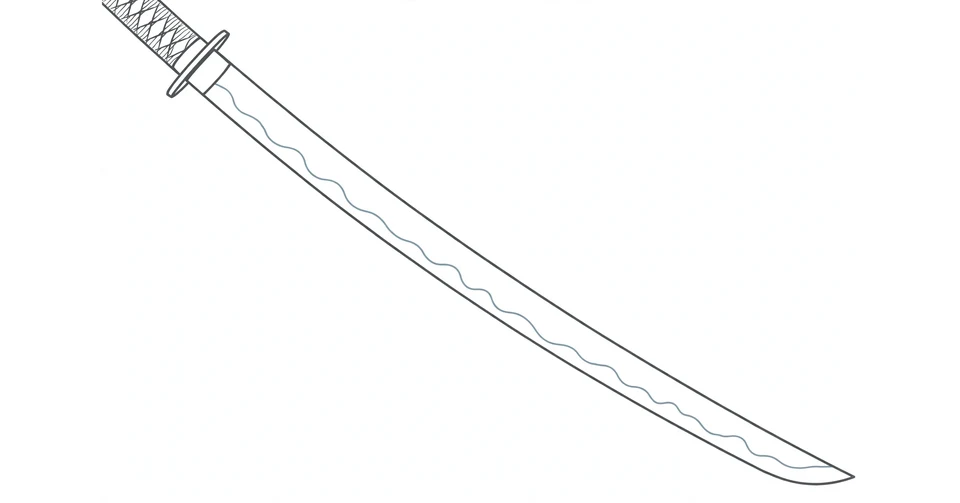
This article follows that line from the forge to the appraisal table: what it is, how a smith draws it with clay, how to read its five patterns, why no two match, how a polisher brings it out, and how experts use it to judge a katana. The line looks simple. The story behind it is a thousand years of metallurgy, patience, and taste.
What a hamon actually is
A hamon is the outline of the hardened zone of the blade, the strip of steel along the cutting edge that the quench made hard. That hardened zone has its own name, yakiba, and the line is its border. On one side sits the edge, called ha, steel that cooled fast and turned into martensite, the hard crystal structure that takes and holds a sharp cut. On the other side sits the body and the spine, called mune, steel that cooled slowly and settled into softer pearlite and ferrite, which bend instead of breaking. Tilt a polished blade under a lamp and the line appears and disappears with the angle. The fine mist of tiny crystals is called nioi, the larger sparkles are called nie, and together they make a real hamon glow rather than shine.
The numbers behind the hamon are striking. A differentially hardened katana typically measures around 50 to 62 on the Rockwell C scale at the edge and around 38 to 45 at the spine, while a blade hardened evenly through measures in the low 50s throughout. Those are averages, but the gap is the point. The edge is hard enough to cut and stay sharp, and the spine is soft enough to survive the blow. The hamon is the visible record of that compromise, and its beauty is a side effect of getting it right.
How clay and fire draw the hamon
The line is born in a step called yaki-ire, the quench, but the drawing happens before the blade ever touches water. First comes tsuchioki, the laying of the clay. The smith coats the blade with a fire resistant clay mixture, traditionally clay mixed with fine charcoal powder and fine grindstone powder, and every smith keeps a personal blend. The coat is thin along the cutting edge and thick over the body and the spine, and the smith scrapes the border into the pattern the blade will wear. The traditional mixture and the care the step demands are described in an in-depth look at the hamon.
Getting the clay right is a quiet skill with loud consequences. Too thick a layer near the edge lets residual heat spread into the steel that should harden, and the edge comes out soft. Too thin a layer over the spine lets the spine harden, and the whole blade turns brittle. The smith aims for a layer on the spine about equal to the thickness of the spine itself, kept at least a centimeter back from the edge, because the hamon will reach a little farther than the edge of the clay. Once laid, the clay must dry completely, which can take a few hours or a day or two.
Then comes the heat. The blade goes into the forge until the steel is hot enough to harden, a temperature the smith judges by the color of the glowing metal in a darkened forge rather than by a dial. Published accounts put the figure at about 800 degrees Celsius, while the Metropolitan Museum of Art places the change to austenite, the hot phase of steel, at around 750 degrees. The honest reading is that the blade is heated to roughly that range, judged by eye, and then plunged into water. Where the clay was thin, the fast cooling turns austenite into martensite, and where it was thick, the slow cooling forms softer ferrite and pearlite.
The quench is the most dangerous moment in the life of a blade, and the moment the hamon is truly made. The edge cools first and bends one way, then the body cools and bends the other, and that double bend is what gives the katana its famous curve. If the stress is too great, the blade cracks with a sharp pinging sound, and hours or days of work are lost in an instant. That high failure rate is one reason differentially hardened blades cost more. After the quench, a gentler reheating called aitori eases the internal stress and can adjust the curve slightly.
Five patterns to learn by sight
Every hamon falls into one of two broad families, suguha, the straight line, and midare, the irregular one. A detailed guide to reading them is laid out in why katanas have a wavy line, which draws on the Met, the NBTHK, and the Kantei tradition.
Suguha is the straight temper line, running parallel to the edge from base to tip. Its width is the main variable, and collectors name it by width, from ito-suguha, thread thin, through hoso-suguha, narrow, and chu-suguha, medium, to hiro-suguha, wide enough to cover a third of the blade or more. Suguha is one of the oldest patterns, strongly associated with the Yamato tradition and with the early blades of the Heian and Kamakura periods. A straight hamon looks easy, and it is the opposite. Any wobble in the clay shows at once, and the school of a suguha blade is read in the texture of its border.
Notare is the gentle wave, a line that rolls along the edge like a calm sea rather than a choppy one. The clay border was laid as a long, shallow curve, so the hardened zone wanders in broad, soft undulations, never sharp and never jagged. Large waves are called o-notare and small ones ko-notare, and the pattern is associated with the Soshu tradition and later Shinto smiths. Under magnification, a notare hamon often shows a soft, diffuse nioi cloud rather than sharp nie crystals.
A gunome hamon is a row of rounded peaks, a repeating series of semicircles or teeth marching along the edge at fairly regular intervals. The clay border was shaped into a row of similar rounded lobes, so each lobe hardened and the valleys between them stayed softer. Small teeth are ko-gunome, large arcs are o-gunome, and a tilted variant in which one side of each tooth is steeper than the other is called kataochi-gunome, compared by some to saw teeth. Gunome is closely associated with Bizen work from the mid-Koto period onward, and it spread from Osafune across the country.
A choji hamon is the clove pattern, and it is the most prized of the five for pure beauty. The clay border swelled into a round head on a narrow neck, like a clove bud, and the quench froze those buds in martensite, sometimes overlapping into clusters. The design began in the late Heian period and became the signature of the Ichimonji school of Bizen, where choji-midare became a celebrated style in the mid-Kamakura period. The neck is what separates choji from gunome. Gunome peaks are plain semicircles, while choji lobes sit on pinched stems, and once you have seen the difference you cannot unsee it.
Midare, in the narrow sense, is the irregular hamon that refuses to keep one repeated unit. Peaks change height, spacing changes, and the line wanders without a rhythm you can count. The clay edge was uneven on purpose, and the quench followed it, sometimes pushing the line a little past the clay itself. The oldest example is ko-midare, a small, low irregularity found on late Heian and Ko-Bizen blades, and the Soshu smiths, including the tradition associated with Masamune, carried the wild end of the family to its height. Mixed names are common: gunome-midare, notare-midare, and choji-midare.
Why no two hamon match
A hamon is a fingerprint because it records a hand, not a machine. The clay is mixed by one smith, laid by one hand, scraped into shape with tools the smith chose, and then answered by steel that never behaves exactly the same way twice. Two blades from the same workshop can carry the same pattern name and still differ in every wave and lobe. That is why specialists can look at the hamon and place a blade in a school or a period, and why they warn that a pattern name is not a certificate. Gunome spread far beyond Osafune, choji was copied for centuries, and a gentle notare wave does not mean a blade came from Masamune.
The same honesty runs through the rest of the sword. The story of how the katana itself became the soul of the samurai is told in how the katana became the soul of the samurai, and the guard that sits below the blade, the tsuba, is another place where a smith left a signature in metal, as described in the tsuba turned a sword guard into a small work of art. A sword is a set of small decisions, and the hamon is the largest of them, the one decision you can read without taking the sword apart. I find that quietly moving, because in a world where most objects hide how they were made, a katana wears its making on its face.
The polisher brings the hamon out
A fresh blade out of the quench does not show its line. The hamon is inside the steel, real but invisible, hidden under grey scale and rough grinding. Bringing it out is the work of a different master, the togishi, the sword polisher, whose craft is separate from forging and just as demanding. The smith begins with a rough polish called kaji-togi, which lets the smith check the blade for defects before handing it over. The togishi then takes over with a sequence of Japanese polishing stones, each finer than the last, until the steel is a mirror and the line can finally be read.
The finish is not sharpening, though the edge is sharpened along the way. It is revelation. The polisher works the stones by hand and by feel, and in the final stages uses stones shaved thinner than a fingernail, held on a fingertip, to coax the nie and nioi out of the border. A step called hadori frosts the hardened zone white, so the line stands out and is easier to see. The white area is not the hamon itself. The hamon is the fuzzy line inside that whitened zone, and a good polisher brings it forward without scrubbing away the texture that makes it real.
How a hamon helps judge a real katana
Appraisers, called kantei practitioners, treat the hamon as the single most informative feature of a blade, because its shape, texture, and activity carry more information than any other mark. They read it with the grain of the steel, called hada, the shape of the blade, the file marks and signature on the tang, and the condition of the polish. For formal authentication, the NBTHK, the Society for the Preservation of Japanese Art Swords, offers kantei appraisal, and its written papers are the most widely recognized authentication documents in the collecting world.
The line also helps expose fakes, and this is where a little knowledge saves real money. A genuine clay tempered hamon has depth. Under magnification it shows nie crystals or a nioi cloud, and the boundary is organic, with activity inside the hardened zone such as tobiyaki, isolated islands of temper above the main line, and kinsuji, hair thin bright lines running through the temper zone. A fake line made by acid etching, wire brushing, or sandblasting sits on the surface, flat and uniform, too crisp and too consistent, with no crystals that shift as the light moves.
The only certain test is the one most buyers will never perform. A real hamon means the edge is harder than the spine, so testing the hardness of the two zones settles the question. If the hardness is the same, the line is definitely fake. Short of that, the honest checks are ones any buyer can do: ask for close photographs under raking light, ask for an oshigata, the ink rubbing that records the exact shape of the line, ask who polished the blade and when, and ask for appraisal papers. A seller with a genuinely clay tempered blade can usually provide the photographs and the rubbing. Hesitation is itself an answer.
One caution matters as much as the rest. A real hamon can sit on a sword made last year, and a modern clay quench made outside Japan can carry a true line, because the process, not the age, makes it. A straight suguha was the most common choice in every era, while elaborate pictorial patterns appear on relatively ordinary steel. The pattern reflects the smith's intent, not a hierarchy of value, and the wisest buyers judge the whole blade.
The hamon rewards patience in a way few marks on any object do. At first it is only a pretty wave. The longer you study it, the more it becomes a record, of a clay recipe, a hand, a school, a quench that could have failed, and a polisher who spent days making the invisible visible. A katana is not a perfect weapon, and it was never meant to be. It is a compromise between hard and tough, drawn as a line you can see, and the line is honest about the compromise.
More in Culture & Society
- Seppuku Was the Ritual a Samurai Chose Over Disgrace
- Saya Is the Lacquered Sheath That Guards the Katana
- Daisho Was the Pair of Swords That Marked a Samurai
- Ikebana and the Quiet Discipline Behind Japan's Flower Art
- The Wakizashi Was the Short Sword a Samurai Never Left Behind
- The Tsuba Turned a Sword Guard Into a Small Work of Art
Latest posts
- Omiyage and the Japanese Art of Bringing Something Back
- How the Katana Became the Soul of the Samurai
- The Menpo Gave the Samurai a Face Worth Fearing
- Japan Goes Maple Hunting Every Autumn and Calls It Momijigari
- Kabuto Gave the Samurai a Helmet Worthy of His Sword
- Christmas in Japan and the Fried Chicken Dinner That Started It All
- Kiso Yoshinaka Rode Out of the Mountains and Nearly Took Japan
- Sakayaki Gave the Samurai His Signature Hairline
- The Archer on the Tower Was Hangaku Gozen
- Koyo Turns Japan Into a Country That Forecasts Leaves
- Inside Japan's 100 Yen Shops, Where Everything Costs a Coin
- Tomoe Gozen Rode Into Battle When Women Were Told to Stay Home
- A Chonmage Is the Knot Every Sumo Wrestler Wears Before the Fan
- Onna-Bugeisha Held the Castle While the Men Were Away
- Momiji-Gari Is Japan's Autumn Answer to Hanami