Fujin Carries the Wind That Arrives Before the Thunder
· 15 min read
Fujin is the Japanese god of wind who carries the weather in a great cloth bag, and his story runs from the Kojiki to the great gate of Asakusa and the gold screens of Kyoto.
On a summer afternoon in Japan, the first sign of a storm is rarely the thunder. It is the wind. The trees turn their leaves inside out, the laundry on the balcony starts to flap, and the air that was heavy and still a moment ago begins to move. The thunder comes later, loud and late, but the wind is the messenger that arrives first. In Japanese myth, that messenger has a name and a face. He is Fujin, the god of wind.
Fujin carries his winds in a great cloth bag slung over his shoulders, and when he loosens the knot, the weather changes. He is a fierce figure, a horned, muscular demon with wild hair and a tiger skin around his waist, yet he is also one of the oldest and most familiar gods in Japan. He guards temple gates beside his brother Raijin, he leaps across gold folding screens, and his bag of winds has traveled farther than most gods ever do, all the way from ancient Greece along the Silk Road to Japan.
This article follows Fujin from his strange birth in the oldest Japanese chronicle to the gates of Asakusa and the video games of today, and it ends with a simple observation about why the wind matters. The thunder gets the attention, but the wind does the early work, and the god who carries it has been reminding Japan of that for more than a thousand years.
What Fujin looks like and why the wind bag matters
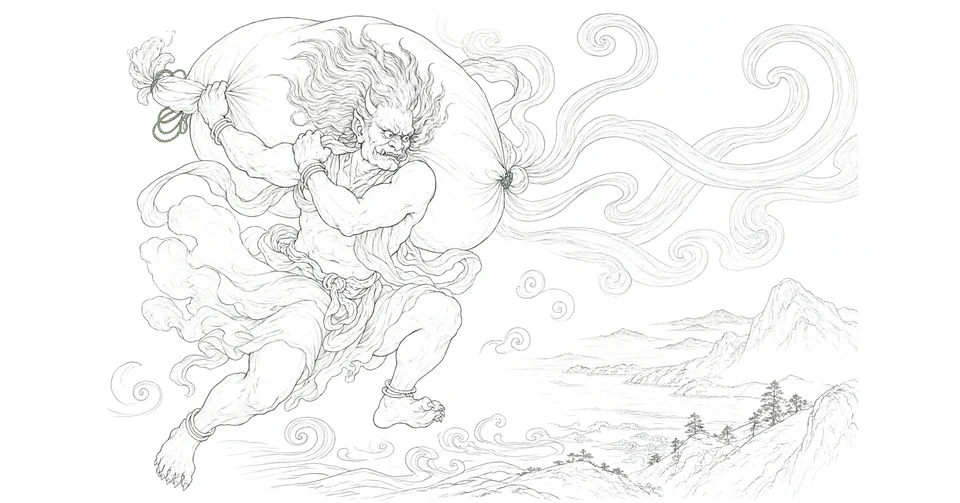
Every image of Fujin carries the same signs, so once you learn them you can spot him anywhere. He is a green skinned, red haired figure with horns, a fierce face, and a tiger or leopard skin worn as a loincloth. His hair flies in all directions, as if it were blown by the very wind he controls. Over his shoulders he carries a large, inflated bag, the kazebukuro, the bag of winds, and he grips it with both hands as if it might burst open at any moment.
The bag is the heart of the image. Wind is invisible, and an invisible god is hard to paint, so the bag gives the wind a shape you can see and a story you can follow. When Fujin opens it a little, a breeze slips out. When he opens it wide, a storm follows. The bag turns an abstract force into something a person can imagine holding, tying, and loosening, and that is why it has survived in art for centuries. A child who sees the bag understands the wind at once, even before learning a single word of mythology.
Fujin is also called Futen, which means Heavenly Wind, and in some older sources he appears under the name Ryobu. The name Fujin itself is simple and direct. Fu means wind, jin means god, and the two characters together say exactly what he is. There is no riddle in it, and that plainness suits him. He is not a god of secrets or of riddles. He is the god of the air moving past your face, and everyone has felt him, whether they know his name or not.
His appearance frightens at first sight, and that is deliberate. In Japanese art, the gods of storms are shown as demons because storms behave like demons, sudden, loud, and careless about what they break. Yet Fujin is not a villain. He is a force of nature given a body, and like every force of nature he can help and harm in the same breath. The wind that cools a summer evening is the same wind that tears the roof from a house.
Fujin in the Kojiki, born from a goddess who died
The oldest written account of Fujin comes from the Kojiki, the chronicle of ancient matters compiled in the early eighth century. His birth is one of the strangest in Japanese mythology, and it begins in grief. After the goddess Izanami died from the wounds of giving birth to the fire god, her husband Izanagi followed her down into Yomi, the land of darkness, hoping to bring her back.
Izanagi found Izanami as a decaying corpse in her palace, and on her body, thunder gods had arisen. When he fled in terror, Izanami sent demons after him to drag him back to the land of the dead. Izanagi blocked the entrance to Yomi with a great boulder, but a few demons escaped through a crack in the stone, and among them were Fujin and his brother Raijin, the god of thunder.
It is a dark beginning for a god who later became a guardian of temples and a figure on folding screens. Fujin was not born in a palace or a garden. He escaped from the land of the dead through a crack in a boulder, and he has carried that wildness with him ever since. The story explains something important about him. Fujin was never a god of order. He belongs to the raw, untamed side of nature, the part that humans cannot control, only respect.
Another old story gives Fujin a gentler role at the very beginning of the world. It says that he used his winds to clear away the dense mist, fog, and chaotic storms that covered the earth before there was life, and once the air was clear, the sun goddess Amaterasu could cast her light down and allow life to flourish. The two stories do not agree with each other, and that is normal for mythology. In one, Fujin is a demon who slipped out of the underworld. In the other, he is the one who cleared the sky so that the sun could shine.
Fujin is usually shown beside his twin brother Raijin, the god of thunder, and together with their brother Susanoo, the god of the sea and storms, they form the family of storm gods in Japanese myth. Thunder, wind, rain, and the sea all belong to the same family, which feels right to anyone who has watched a summer storm roll in from the coast. The wind arrives first, the thunder follows, and the rain comes down in sheets, and the three brothers arrive in that same order, one after the other.
The wind bag that traveled the Silk Road
The most surprising fact about Fujin is that his bag of winds is older than Japan itself, and it traveled farther than any storm. The iconography of the wind god seems to have its origin in the cultural exchanges along the Silk Road. In the Hellenistic period, when Greek culture spread across Central Asia and India, the Greek wind god Boreas became the god Wardo, also called Oado, in Greco-Buddhist art. From there the figure moved east into China, where he appeared in the frescoes of the Tarim Basin, often under the name Feng Bo, or Uncle Wind, among other names. Finally he reached Japan and became Fujin.
What is remarkable is how little changed along the way. The wind god kept his symbol, the wind bag, and his disheveled appearance through every stage of the journey. You can trace the line in surviving art, from a Greek wind god carved in Gandhara in the second century, to a wind god painted at Kizil in the Tarim Basin in the seventh century, to a Japanese wind god painted in the seventeenth century, and the same bag appears in each one. The bag may come from the shawl or mantle worn by Boreas, folded and gathered until it became a sack of winds in its own right.
This long journey matters because it corrects a common idea about Japanese culture, the idea that it grew in isolation. Fujin is one of the oldest gods in the Japanese tradition, and yet his image arrived on a road that carried silk, Buddhism, and Greek art across a continent. Japan took the figure, gave him a Japanese name, dressed him in a tiger skin, and set him beside Raijin at the temple gates, and in doing so made him entirely its own.
Fujin and Raijin at the Thunder Gate
The most famous place to meet Fujin today is the Kaminarimon, the great outer gate of Senso-ji temple in Asakusa, Tokyo. The gate is popularly known as the Thunder Gate, and its official name, Furaijinmon, means the Gate of the Wind and Thunder Gods, after the two statues that guard it. On the front of the gate, Fujin, the god of wind, stands on the east side, and his brother, the god of thunder, stands on the west side. You can read the full story of his brother in Raijin Is the Thunder God Behind Japan's Summer Storms, which tells how the thunder god went from a demon born in the land of the dead to a guardian of the temple.
The first gate was built in 941 by the military commander Taira no Kinmasa, and it was moved to its current location in 1635, when the statues of the two gods are believed to have been placed there. The gate burned down more than once, and the current structure dates from 1960. It stands 11.7 meters tall and 11.4 meters wide, and beneath its center hangs a giant red lantern about 3.9 meters tall and weighing around 700 kilograms. Only the heads of the original statues survived the fire of 1865, and the statues were restored for the rebuilding in 1960.
The pairing is worth noticing. The two storm gods face outward, guarding the temple from the world, while two dragon deities, the Buddhist god Tenryu and the goddess Kinryu, stand on the reverse of the gate and face inward. Visitors pass between them every day, often without looking up, yet the gate has watched over Asakusa for centuries. The Kaminarimon has stood in its present form since 1960, and the two gods have stood there with it, one with his drums and the other with his bag.
The gold screens that made Fujin famous
If the Kaminarimon is where most people meet Fujin in person, the folding screens are where they meet him in art. In the early seventeenth century, the painter Tawaraya Sotatsu, who lived from about 1570 to about 1640, painted Wind God and Thunder God, a pair of two-fold screens in ink and color on gold-foiled paper. The screens show Fujin on one side and the thunder god on the other, each placed at the far corner of his screen, with a wide field of gold between them. The composition is bold and simple, and it has become one of the most famous images in Japanese art.
The screens have no inscription or seal, yet their attribution to Sotatsu is not questioned. Each screen measures about 170 centimeters tall and about 155 centimeters wide. They belong to the Zen Buddhist temple Kennin-ji in Kyoto, and they are exhibited occasionally in the Kyoto National Museum. They are designated a National Treasure of Japan.
Sotatsu's design was so powerful that later painters copied it as an act of homage. Ogata Korin made his own version in about 1700, and Sakai Hoitsu made another, and all three versions were displayed together for the first time in seventy-five years in 2015 at the Kyoto National Museum. The wind god on gold paper has become a symbol of Japanese art itself, reproduced on posters, postcards, and folding fans around the world. It is strange to think that a demon who carries the weather in a sack could become a national treasure, but that is exactly what happened. Art took a frightening god and made him beautiful without making him tame.
Wind, rice, and typhoons
Wind has always meant two things to farming people, and Fujin carries both meanings at once. A gentle breeze dries the rice after rain, cools the workers in the fields, and carries pollen from plant to plant. A typhoon can flatten a whole crop in a single night, tear roofs from houses, and flood the low fields with seawater. The same god opens his bag for both, and the old stories never pretend otherwise.
Japan sits in the path of the typhoons that form over the warm Pacific in late summer and autumn, and every farming village has learned to live with them. The wind arrives first, bending the rice stalks, and then the rain follows in sheets. People tie down what they can, bring the laundry inside, and wait. There is little else to do. The wind does not negotiate, and it does not listen to complaints, and the only honest response is preparation and patience.
That double view is the farmers' version of the story, and it is wiser than it looks. Modern life trains us to sort things into good and bad, useful and useless, and to throw away whatever frightens us. The old view of Fujin refuses that sorting. The same wind that terrifies you also dries your rice and clears the sky after rain. The same god who escaped from the land of the dead also guards the gate of a temple in Asakusa. Holding both truths at once is harder than choosing one, and it is also more honest.
Why the wind arrives before the thunder
Anyone who has lived through a Japanese summer knows the order of a storm by heart. First the air goes still and heavy, and the cicadas grow louder. Then the wind picks up, sudden and cool, and the trees bend. Then the sky darkens, the first drops fall, and only then does the thunder roll. The wind is always early, and the thunder is always late, and the gap between them is the space where people run for shelter, bring in the washing, and close the shutters.
That order is not an accident of storytelling. It is how storms actually work. The wind is the leading edge of the weather, the first thing a storm pushes ahead of itself, and the thunder is the sound of the lightning that comes with the heavy cloud behind it. The old myths got the sequence right because people watched the sky for centuries, and the pairing of the two gods reflects what they saw. Fujin walks in front, carrying the bag, and Raijin follows behind, beating his drums.
There is a gentle lesson in being early. The thunder gets the attention because it is loud, but the wind does the useful work of warning. A person who notices the wind has time to act, and a person who waits for the thunder is already wet. Fujin rewards attention in a quiet way. He does not shout. He moves the leaves and cools the air, and anyone who is paying attention knows what comes next.
Fujin in games and on screens today
Fujin has not retired. In the fighting game Mortal Kombat 11, he appears as the God of Wind, a protector of Earthrealm who serves the Elder Gods alongside his brother Raiden, the thunder god, and fights with wind based powers and a staff. In Final Fantasy VIII, a character named Fujin serves on the disciplinary committee of Balamb Garden beside her friends Seifer and Raijin, speaks in short, clipped sentences, and uses wind based magic in battle. In both games, the old pairing survives. The wind god and the thunder god still appear side by side, just as they do at the Kaminarimon.
The games change the details freely. In Final Fantasy VIII, Fujin is a young woman with silver hair and an eyepatch, nothing like the horned demon of the old screens, and in Mortal Kombat he is a graceful warrior rather than a wild demon. That is fine. Mythology has always changed its gods to fit the age, and a god who cannot change is a god who will be forgotten. What matters is that the name still means wind, and the wind still comes first.
What the wind god still teaches us
The next time the wind picks up on a summer afternoon, it is worth listening to it the way the old stories do. The wind is not only weather. It is a reminder that nature is larger than our plans, that help and harm often arrive in the same gust, and that the wisest response is not to fight the wind or to fear it blindly, but to notice it early and prepare.
Fujin has lasted for more than a thousand years because he tells the truth about the air we live in and about life. Power is frightening and generous at the same time. A god can escape from the land of the dead and still guard a temple gate. A bag that crossed the Silk Road from Greece can still hold a Japanese storm. The wind arrives before the thunder, the thunder follows, and the rain falls on everyone alike, whether they are ready or not. The best we can do is what the farmers always did, watch the trees, bring in the washing, take shelter, and be grateful when the storm passes and the fields are green.
More in Culture & Society
- Miyadashi Is the Moment the God Leaves Home
- Otabisho Is Where the God Rests on the Way Through Town
- Mikoshi Are the Portable Shrines Japan Carries on Its Shoulders
- Sanja Matsuri Turns Asakusa Into Tokyo's Loudest Weekend
- Waraji Straw Sandals Walked Japan for a Thousand Years
- Raijin Is the Thunder God Behind Japan's Summer Storms
Latest posts
- An Engawa Is Neither Inside nor Outside, and That Is the Point
- Nikko and the Shrines Hidden in the Cedar Forest
- Minka Are the Folk Houses Japan Built Around the Hearth
- The Orangutan and the Vanishing Forests of Borneo
- Hozomon Guards the Treasure House Behind Senso-ji's Main Hall
- Nakamise Is the Shopping Street That Has Fed Pilgrims for Centuries
- Kaminarimon Is the Thunder Gate That Opens Asakusa to the World
- Sony, the Tokyo Workshop That Taught the World to Listen
- Tengu Is the Mountain Goblin Japan Still Meets on the Trail
- Kappa Is the River Imp Japan Still Warns Its Children About
- Calonarang Is the Night Rangda and Barong Finally Meet
- Yamata no Orochi Was Never Just a Monster to Slay
- Kit Kat Japan, the Flavours You Will Not Find Anywhere Else
- How Susanoo Slew the Eight-Headed Serpent and Won a Bride
- How Kusanagi Became Japan's Most Guarded Sword