Calonarang Is the Night Rangda and Barong Finally Meet
· 11 min read
Calonarang is the Balinese dance drama in which Rangda and Barong meet on a temple stage at night, retelling the old Javanese legend of the witch of Girah and the battle that restores the balance of the village.
There is a night in Bali when the whole village gathers in the temple courtyard and waits for a witch to arrive. The gamelan has been playing for a while, the torches are lit, and the air smells of incense and frangipani. Then the music changes, the crowd goes quiet, and a white mask with bulging eyes and long fangs appears at the edge of the light. That night is Calonarang, the performance in which Rangda and Barong meet, and it is the most serious dance drama on the island.
Calonarang is not a show that was invented for visitors. It is a ritual first and a performance second, an exorcism acted out in public so that the whole village can watch its own fears be faced and held back. The story it tells is nearly a thousand years old, and it comes from Java, not Bali, but Bali made it its own, and now no account of Balinese dance is complete without it.
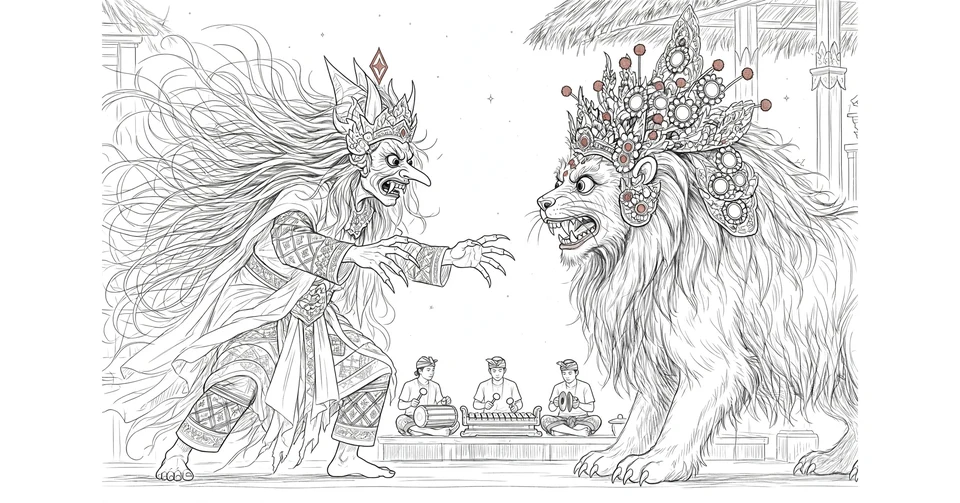
To watch Calonarang is to watch Bali think out loud about good and evil, and to see that the island does not believe evil can be destroyed, only balanced. The witch loses the battle every time, and she returns every time, and the village gathers again to watch it happen. That is the whole meaning of the night, and it is worth understanding before you ever take a seat in the courtyard.
The widow of Girah, and the curse that started it all
The story of Calonarang begins in the village of Girah, in the kingdom of Kediri, in what is now East Java. There lived a widow named Calonarang, a woman feared across the whole district for her mastery of black magic. She had a beautiful daughter named Ratna Manggali, but no man dared to ask for the girl's hand, because everyone was afraid of her mother. The Wikipedia entry on Calon Arang tells the tale plainly, and the plainness is part of its power, because the story needs no decoration to frighten.
Calonarang was furious at the humiliation. Her daughter was beautiful and good, and the whole village treated the girl as if she carried her mother's curse. So Calonarang decided to punish them all. She went to the cemetery at night and performed a dark ceremony, offering a young girl as a sacrifice to the goddess Durga. Durga came down and granted her request. A flood engulfed the village and took many lives, and a plague followed that no medicine could cure. The old texts place the tale in the reign of King Airlangga, though sources differ on the century.
Word of the disaster reached King Airlangga at his palace, and he sent his army to Girah to kill the witch. The soldiers failed. Calonarang was too powerful, and many of them were killed. The king then turned to his adviser, the holy man Mpu Bharada.
Mpu Bharada sent his disciple Mpu Bahula to Girah with a different plan. Bahula proposed to Ratna Manggali, and the proposal was accepted. The wedding feast lasted seven days and seven nights, and for the first time in years, Calonarang was pleased. Her daughter was married, her daughter was loved, and the witch let down her guard. But Ratna Manggali told her new husband a secret, that her mother kept a book of magic incantations in her room, and that she performed her ceremonies in the cemetery every night. While Calonarang slept deeply after the long feast, Bahula stole the book and carried it to his teacher.
When Mpu Bharada and Calonarang finally met in the cemetery of Girah, the holy man asked her to stop her magic, because it had caused so much misery. She refused, and they fought. Without her book, Calonarang could not win, and she was defeated and died. Ratna Manggali wept for her mother, and the village of Girah was safe again.
How a Javanese witch became a Balinese goddess of the dark
The story of Calonarang did not stay in Java. It travelled to Bali, and in Bali it changed. In Balinese tradition, Calonarang appears as Rangda, the demon queen, the queen of the leyak witches, the white masked figure with the lolling tongue and the long fangs. You can read the full story of that figure in our account of how Rangda is the witch queen Bali never lets win, and the two articles belong together, because the two figures are the same power wearing different names.
In Bali, Rangda is not only a character in a story. Her mask is a sacred object, kept in the temple and charged with spiritual power before a performance, and the dancer who wears it must become possessed by the power inside it. The mask is understood as a receptacle for the power of the goddess Durga, the same goddess to whom Calonarang offered her sacrifice in the cemetery of Girah. The circle closes neatly. The witch who called on Durga becomes the vessel through which Durga shows herself, and the goddess who granted the curse also grants the protection that holds it back.
Some interpretations say that Calonarang and Rangda were connected with a real person, the eleventh century queen Mahendradatta, a Javanese princess who married the Balinese king Udayana and became the mother of Airlangga himself. The story goes that her husband condemned and exiled her for allegedly practising witchcraft, and that as a widow she sought revenge on his court, summoning the leyak and the demons of the jungle to bring plague on the kingdom. The old Javanese word rangda means widow, and that meaning sits at the centre of both stories. Whether Mahendradatta was the model, or the two tales simply grew around the same fear, no one can now prove.
What happens on the night of Calonarang
The performance of Calonarang is the place where all of this comes together, and it is unlike any ordinary theatre. It is performed at night, usually in a temple courtyard, and it is meant to restore a disturbed cosmic balance, and afterwards to prevent and control epidemics. That is a precise description of its purpose, and it tells you what the dance is for. It is not entertainment first. It is medicine for the village, performed in public, with the whole community watching.
The evening begins with the masks being charged with power, and from that moment the event is dangerous in a way a stage show is not. The masks of both Rangda and Barong are understood to become magically unstable once they are charged, a state the Balinese call tenget, and only initiated people may handle them. The dancer who wears the Rangda mask becomes possessed by the power inside it, and the followers of Barong become possessed by the buta kala, the demons that bring illness and calamity, and attempt to attack Rangda. Overwhelmed by her power, they turn their keris daggers on themselves instead, in the act called ngurek, pressing the blades to their own chests. A priest must be present to keep the dancers safe, and the holy water he sprinkles is part of the ritual, not a decoration.
Then Barong answers, and the lion's protective magic makes the dancers' bodies resistant to the blades. The dance ends with the final battle between Barong and Rangda, and with the lion's victory, Rangda is driven off, and order is restored. Or rather, it is restored for now, because the story will be told again, and the balance will need keeping again. You can read the full story of the lion in our account of how Barong is the lion Bali calls out when the village needs protection, and the philosophy behind their endless battle is the same one that runs through the whole night.
The stage version, and where to see it
Most visitors will never see a village Calonarang. They will see a shorter version on a stage, often as part of a Barong and Kris dance, and that version is a real and beautiful thing, but it is not the same thing. The stage version usually lasts less than an hour, and the keris scene is performed within a schedule that has to end so the next audience can sit down. There is nothing wrong with that. A tradition that cannot be shortened cannot travel, and a tradition that cannot travel dies with its village.
The stage shows are usually performed in Batubulan, in Gianyar, which is known as the centre of Barong performance, and in Ubud, where the dance is staged at the palace and at Pura Dalem Ubud, and during temple festivals across the island. A guide to the legend of Calon Arang notes that the performances in Ubud often take place at night, with live gamelan orchestras, elaborate costumes, and intense storytelling, and that even if you do not follow every word, the energy, the music, and the atmosphere are unforgettable. That is a fair description, and it matches what most visitors report.
Why the witch never really loses
The question that stays with you after the dance is over is a simple one. If Rangda brings plague and death, why does Bali keep her? Why is her mask consecrated, why is her dance performed, why is her power honoured with offerings? The answer is the same answer that runs through everything in Balinese belief, and it is worth stating plainly. Bali does not believe that evil can be destroyed, only balanced.
In this view, good and evil are not two armies, one of which will eventually win. They are two forces that exist together, and the health of the world depends on keeping them in their proper tension. Barong does not destroy Rangda. He holds Rangda back, and that holding back has to be done again and again, in every generation, in every village. The dance ends with the lion's victory, but everyone watching knows the victory is temporary, and that knowledge is not a disappointment. It is the point.
That is not superstition. It is a practical system for living with forces no one can control. Disease will come back. Bad luck will come back. Grief and anger will come back, because people will keep being widowed, keep being exiled, keep being wronged. A culture that has a ritual for facing those things is a culture that has thought seriously about how to survive them. Calonarang is that ritual, and the witch at its centre is the reason it works, because you cannot face a fear that has no face.
Calonarang in the Bali of today
The legend has not stayed in the temple courtyard. It has travelled into films, into books, and into the way Bali presents itself to the world, and that travel has changed it without killing it. Two films carry her name, the 1985 film Ratu Sakti Calon Arang, about the powerful queen herself, and the 2024 horror film Kutukan Calon Arang, the curse of Calon Arang, which borrows her name and her fear and takes the story far from its origins. The newer film is worth watching if you like Indonesian horror, but it is not a history lesson, and it strays far from the original tale.
What has not changed is the figure at the centre of it. Calonarang is still the widow, still the witch, still the queen of the leyak, and still the power that the village must face together. Her name still stirs fear in children and adults across Bali, and her story is still told in temple courtyards and village gatherings, centuries after it was first whispered. A legend that no one told would have died long ago. This one is alive because the island keeps retelling it, and keeps finding new meaning in it.
What the night leaves you with
So what does Calonarang leave you with, once the dance is over and the masks are back in the temple? I think she leaves you with a better question than the one you arrived with. Most of us come to a story like this asking who wins, the lion or the witch, good or evil, and we expect an ending. Bali answers with a different question, which is how you live with both of them, and keep them in balance, for as long as you live.
The witch loses every time she dances, and she returns every time she loses. That is not a defeat. It is a promise, that the balance will be kept, that the village will gather again, that the lion will answer again, and that the story will go on. Calonarang is the night Rangda and Barong finally meet, and it is a night Bali will keep holding, for as long as there are villages that need to remember how to face what frightens them, together.
More in Culture & Society
- Miyadashi Is the Moment the God Leaves Home
- Otabisho Is Where the God Rests on the Way Through Town
- Mikoshi Are the Portable Shrines Japan Carries on Its Shoulders
- Sanja Matsuri Turns Asakusa Into Tokyo's Loudest Weekend
- Waraji Straw Sandals Walked Japan for a Thousand Years
- Fujin Carries the Wind That Arrives Before the Thunder
Latest posts
- An Engawa Is Neither Inside nor Outside, and That Is the Point
- Nikko and the Shrines Hidden in the Cedar Forest
- Minka Are the Folk Houses Japan Built Around the Hearth
- The Orangutan and the Vanishing Forests of Borneo
- Hozomon Guards the Treasure House Behind Senso-ji's Main Hall
- Nakamise Is the Shopping Street That Has Fed Pilgrims for Centuries
- Kaminarimon Is the Thunder Gate That Opens Asakusa to the World
- Sony, the Tokyo Workshop That Taught the World to Listen
- Raijin Is the Thunder God Behind Japan's Summer Storms
- Tengu Is the Mountain Goblin Japan Still Meets on the Trail
- Kappa Is the River Imp Japan Still Warns Its Children About
- Yamata no Orochi Was Never Just a Monster to Slay
- Kit Kat Japan, the Flavours You Will Not Find Anywhere Else
- How Susanoo Slew the Eight-Headed Serpent and Won a Bride
- How Kusanagi Became Japan's Most Guarded Sword