Raijin Is the Thunder God Behind Japan's Summer Storms
· 14 min read
Raijin is the Japanese god of thunder who beats his ring of drums to make the summer sky roar, and his story runs from the Kojiki to the great gate of Asakusa.
On a humid summer evening in Japan, the sky can turn black in minutes, the air goes still, and then a crack of thunder rolls across the rooftops. For centuries, Japanese people have given that sound a face, and the face belongs to Raijin. He is the god of thunder and lightning, a fierce, muscular figure who stands on a cloud and beats a ring of drums to make the sky roar.
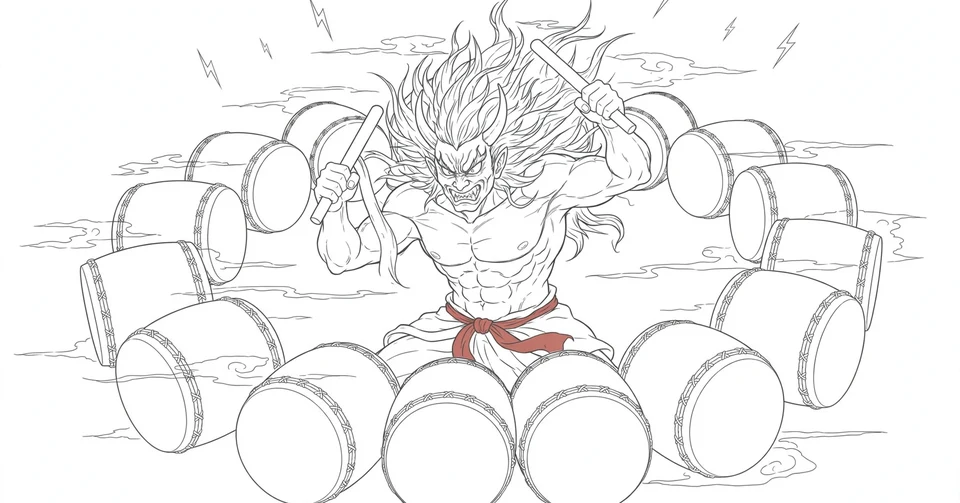
Raijin is not a gentle god. His hair flies upward as if blown by his own storm, his eyes bulge, and his grin is the grin of a demon who enjoys his work. Yet he is also one of the most familiar figures in Japanese culture, painted on folding screens, carved into temple gates, and warned about by parents who tell their children to hide their belly buttons when thunder rolls. He frightens, and he protects, and that contradiction is the heart of his story.
To understand Raijin, it helps to start with his name. The name comes from two Japanese words, kaminari, meaning thunder, and kami, meaning god. He is also called Kaminari-sama, Raiden-sama, Narukami, and Raiko, and in older texts he appears as Kamowakeikazuchi-no-kami. The many names tell their own story. Thunder was too big and too frightening to be left nameless, so people gave it a name they could speak to, scold, and pray to, all at once.
What Raijin looks like and why the drums matter
Every image of Raijin carries the same signs, so once you learn them you can spot him anywhere. He is surrounded by a ring of taiko drums, each marked with a tomoe symbol, and he strikes them with heavy mallets to create the sound of thunder. His body is muscular and his face is fierce, with wild hair that defies gravity. In some portrayals he has three fingers, said to represent the past, the present, and the future.
The drums are more than a prop. In the old stories, thunder is not a random noise but a sound someone makes on purpose, and the drums give that idea a shape you can picture. A child who hears thunder during a summer storm can imagine the drums rolling, and the fear becomes a little smaller because it has a cause. That is a kind way to meet a frightening force of nature, and it shows how mythology works at its best. It does not deny the danger. It gives people a story they can hold on to while the storm passes.
Raijin rarely appears alone. He is usually shown beside his twin brother Fujin, the god of wind, or with his son Raitaro, another thunder god, or with his animal companion, the Raiju, a thunder beast often shown as a dog or a wolf. His brother Susanoo, the god of the sea and storms, is another close relation. Thunder, wind, rain, and the sea all belong to the same family in Japanese myth, which feels right to anyone who has watched a summer storm roll in from the coast. The wind arrives first, the thunder follows, and the rain comes down in sheets.
Raijin in the Kojiki, born from a goddess who died
The oldest written account of Raijin comes from the Kojiki, the chronicle of ancient matters compiled in the early eighth century. The story begins in grief. After the goddess Izanami died from the wounds of giving birth to the fire god, her husband Izanagi followed her down into Yomi, the land of darkness, hoping to bring her back.
Izanagi found Izanami's corpse in her palace, and on her body, thunder gods had arisen. Great Raijin stood on her head, Fire Raijin on her chest, Black Raijin in her stomach, Blossoming Raijin elsewhere on her body, Young Raijin in her left hand, Soil Raijin in her right hand, Roaring Raijin on her left leg, and Bending Raijin on her right leg. Together they were called Ho-no-Ikadzuchi-no-Kami. The names are strange and unsettling, and they are meant to be. Thunder in this story is born from death and decay, from a body breaking apart, and it carries that wildness with it forever.
When Izanagi fled in terror, Izanami sent Raijin and several female demons after him to drag him back to the land of the dead. It is a dark beginning for a god who later became a familiar guardian of temples and a figure on folding screens. But the darkness explains something important about him. Raijin was never a god of order. He belongs to the raw, untamed side of nature, the part that humans cannot control, only respect.
The god catcher who tied Raijin in a sack
One of the best loved stories about Raijin shows what happens when humans try to tame him. In the tale, Raijin was causing so much destruction with his storms that the emperor ordered a man named Sugaru, known as the God Catcher, to imprison him and bring him to the capital.
Sugaru first asked the thunder god politely, in the name of the emperor, to give himself up and stop the storm. Raijin only laughed at him. Sugaru then prayed to Kannon, the bodhisattva of mercy, who ordered the thunder god to let Sugaru take him. Sugaru tied Raijin up in a sack and carried him to the emperor. Under the emperor's control, the thunder god was forced to stop his destruction and bring only rain and bounty to Japan.
The story is funny on purpose. The most frightening voice in the sky is stuffed into a sack like a sack of rice and carried to court. But the ending carries a serious idea. Thunder cannot be abolished, and nobody in the story tries to kill the god. Instead he is put to work. The rain that follows a thunderstorm waters the rice fields, and the same force that destroys houses also feeds the country. It is a wise bargain, and it reflects how farming people have always thought about the weather. You cannot command the storm, but you can hope it leaves something useful behind.
Raijin and Fujin, the pair who guard the Thunder Gate
The most famous place to meet Raijin today is the Kaminarimon, the great outer gate of Senso-ji temple in Asakusa, Tokyo. The gate is popularly known as the Thunder Gate, and its official name, Furaijinmon, means the Gate of the Wind and Thunder Gods, after the two statues that guard it. On the front of the gate, Fujin, the god of wind, stands on the east side, and the thunder god stands on the west side.
The first gate was built in 941 by the military commander Taira no Kinmasa, and it was moved to its current location in 1635, when the statues of the two gods are believed to have been placed there. The gate burned down more than once, and the current structure dates from 1960. It stands 11.7 meters tall and 11.4 meters wide, and beneath its center hangs a giant red lantern about 4 meters tall and weighing around 670 kilograms. Only the heads of the original statues survived the fire of 1865, and the statues were restored for the rebuilding in 1960.
Two more statues stand on the reverse of the gate, the Buddhist god Tenryu on the east side and the goddess Kinryu on the west. They were donated in 1978 and carved by the master sculptor Hirakushi Denchu, who was 106 years old at the time. The pairing is worth noticing. The two storm gods face outward, guarding the temple from the world, while the two dragon deities face inward. Visitors pass between them every day, often without looking up, yet the gate has watched over Asakusa for centuries. A god who once chased Izanagi through the land of the dead now stands quietly at a street corner, photographed by crowds, and that is a kind of taming too.
The same pairing appears in other temples. At Sanjusangen-do in Kyoto, sculptures of the thunder god and the wind god from the thirteenth century are considered National Treasures, carved from wood with lacquer, gold leaf, and paint, and crystal inlaid eyes. At the Taiyuin hall of Rinno-ji temple, the two gods stand in the Niten-mon gate, one with his drums and the other with his wind bag. Wherever you find one, the other is usually close by, because wind and thunder arrive together and leave together.
How Raijin merged with Tenjin, the patron of learning
Raijin also has a quieter connection to one of Japan's most beloved gods, Tenjin, the patron of learning. The story of Tenjin begins with the scholar Sugawara no Michizane, who died in exile in the early tenth century, after which storms and disasters were blamed on his angry spirit. But an older thunder and weather deity, called tenjin raijin, was already worshipped before Michizane died, and the two figures merged in the popular mind. The scholar became a god, and the thunder god gave him his weather.
You can read the full story of that transformation in Tenjin Is the Storm God Who Became Japan's Patron of Learning, which tells how Michizane's angry spirit was calmed and turned into a protector of students. The merging of the two figures is a reminder that gods in Japan are rarely fixed in one shape. They blend, borrow each other's powers, and change with the needs of the people who worship them. Thunder belonged to the old god first, and it stayed with the new one.
That blending also explains why thunder shrines and Tenjin shrines sometimes feel alike. Both deal with forces that strike suddenly and cannot be reasoned with, whether a lightning bolt or a failed examination. People pray at both for protection, and both shrines promise that a frightening power can be turned into a helpful one. It is the same bargain as the story of Sugaru and the sack, retold in a different key.
Raijin on gold, the screens that made him famous
If the Kaminarimon is where most people meet Raijin in person, the folding screens are where they meet him in art. In the early seventeenth century, the painter Tawaraya Sotatsu, who lived from about 1570 to about 1640, painted Wind God and Thunder God, a pair of two-fold screens in ink and color on gold-foiled paper. The screens show Fujin on one side and the thunder god on the other, each placed at the far corner of his screen, with a wide field of gold between them. The composition is bold and simple, and it has become one of the most famous images in Japanese art.
The screens have no inscription or seal, yet their attribution to Sotatsu is not questioned. Each screen measures about 170 centimeters tall and about 155 centimeters wide. They belong to the Zen Buddhist temple Kennin-ji in Kyoto, and they are exhibited occasionally in the Kyoto National Museum. They are designated a National Treasure of Japan.
Sotatsu's design was so powerful that later painters copied it as an act of homage. Ogata Korin made his own version in about 1700, and Sakai Hoitsu made another, and all three versions were displayed together for the first time in seventy-five years in 2015 at the Kyoto National Museum. The thunder god on gold paper has become a symbol of Japanese art itself, reproduced on posters, postcards, and folding fans around the world. It is strange to think that a demon who beats drums on a cloud could become a national treasure, but that is exactly what happened. Art took a frightening god and made him beautiful without making him tame.
The screens also show how the thunder god changed over time. In the Kojiki he is born from a corpse. On the screens he is a figure of pure energy, leaping across gold, his drums circling him like a halo. The fear is still there in his face, but it is balanced by grace. A god who was once only a warning has become something people want to look at, and that is a measure of how deeply he belongs to Japanese culture.
Why farmers feared and thanked Raijin
Thunder has always meant two things to farming people. A lightning strike can burn a house or kill a person, and a summer storm can flatten a rice field in an hour. Yet the rain that comes with the storm is the same rain that fills the paddies and brings the harvest. Raijin carries both meanings at once, and the old stories never pretend otherwise.
The tale of Sugaru ends with the thunder god bringing rain and bounty, and that ending is the farmers' version of the story. The god is not forgiven because he is harmless. He is forgiven because he is useful. In the same way, Japanese parents tell their children to hide their belly buttons during thunderstorms so that the thunder god does not take them away and eat them. The warning is playful, but it is also practical. It keeps children inside during a storm, and it teaches them to respect a force that can hurt them.
There is a lesson in this double view that goes beyond farming. Modern life trains us to sort things into good and bad, useful and useless, and to throw away whatever frightens us. The old view of the thunder god refuses that sorting. The same sky that terrifies you also waters your rice. The same god who chases a hero through the land of the dead also guards the gate of a temple in Asakusa. Holding both truths at once is harder than choosing one, and it is also more honest.
Raijin in everyday Japan today
Raijin has not retired. He appears in the kabuki play Narukami, in which he is imprisoned under a pool of water, causing a drought until he is released. He appears on the backs of nineteenth century firemen's coats, where his image was believed to protect the wearer from fire and lightning. He appears in manga, video games, and festival floats, still beating his drums, still grinning.
His brother Susanoo, the storm god who slew the eight-headed serpent, belongs to the same family of wild gods, and his story shows the same pattern of a violent god being put to use for human good. You can read it in How Susanoo Slew the Eight-Headed Serpent and Won a Bride. The two brothers remind us that Japanese mythology does not separate the storm from the hero. The hero is the one who faces the storm and finds a way to live with it.
Even the name Raijin has entered everyday language. Thunder itself is kaminari, and a sudden summer downpour is still described with words that carry the god's echo. When the sky darkens over Tokyo in July and the first roll of thunder shakes the windows, people do not need a textbook to know who is up there. They have known since childhood.
What the thunder god still teaches us
The next time a summer storm rolls in, it is worth listening to it the way the old stories do. The thunder is not only noise. It is a reminder that nature is larger than our plans, that rain and ruin arrive together, and that the wisest response is not to fight the storm or to fear it blindly, but to respect it and wait for what it leaves behind.
Raijin has lasted for more than a thousand years because he tells the truth about the weather and about life. Power is frightening and generous at the same time. A god can be born from death and still guard a temple gate. A storm can destroy a field and still fill it with water. The thunder god beats his drums, the sky answers, and the rain falls on everyone alike, whether they are ready or not. The best we can do is what the farmers always did, take shelter, keep the children close, and be grateful when the storm passes and the fields are green.
More in Culture & Society
- Miyadashi Is the Moment the God Leaves Home
- Otabisho Is Where the God Rests on the Way Through Town
- Mikoshi Are the Portable Shrines Japan Carries on Its Shoulders
- Sanja Matsuri Turns Asakusa Into Tokyo's Loudest Weekend
- Waraji Straw Sandals Walked Japan for a Thousand Years
- Fujin Carries the Wind That Arrives Before the Thunder
Latest posts
- An Engawa Is Neither Inside nor Outside, and That Is the Point
- Nikko and the Shrines Hidden in the Cedar Forest
- Minka Are the Folk Houses Japan Built Around the Hearth
- The Orangutan and the Vanishing Forests of Borneo
- Hozomon Guards the Treasure House Behind Senso-ji's Main Hall
- Nakamise Is the Shopping Street That Has Fed Pilgrims for Centuries
- Kaminarimon Is the Thunder Gate That Opens Asakusa to the World
- Sony, the Tokyo Workshop That Taught the World to Listen
- Tengu Is the Mountain Goblin Japan Still Meets on the Trail
- Kappa Is the River Imp Japan Still Warns Its Children About
- Calonarang Is the Night Rangda and Barong Finally Meet
- Yamata no Orochi Was Never Just a Monster to Slay
- Kit Kat Japan, the Flavours You Will Not Find Anywhere Else
- How Susanoo Slew the Eight-Headed Serpent and Won a Bride
- How Kusanagi Became Japan's Most Guarded Sword