Kit Kat Japan, the Flavours You Will Not Find Anywhere Else
· 11 min read
Kit Kat Japan turned a British chocolate bar into a national obsession, with more than 300 flavours from matcha to sake. This is how a pun, a gift culture, and a strawberry bar from Hokkaido did it.
Walk into any convenience store in Japan and you will find a wall of them. Small red boxes, stacked in rows, each one promising a flavour you have never seen before. Green tea. Roasted tea. Strawberry cheesecake. Sake. Wasabi. A single shelf can hold a dozen varieties, and the shelf in the next town will hold a dozen more. For a visitor, the first reaction is usually disbelief. It is only a chocolate bar. How many flavours can one chocolate bar have?
The answer, in Japan, is more than 300. Kit Kat Japan now counts over 300 flavours, and it is not a product. It is a hobby, a souvenir, a good luck charm, and a running joke that the whole country is in on. The bar itself is the same wafer and chocolate that Britain invented in 1935. Everything around it, the flavours, the packaging, the reason people buy it, is Japanese.
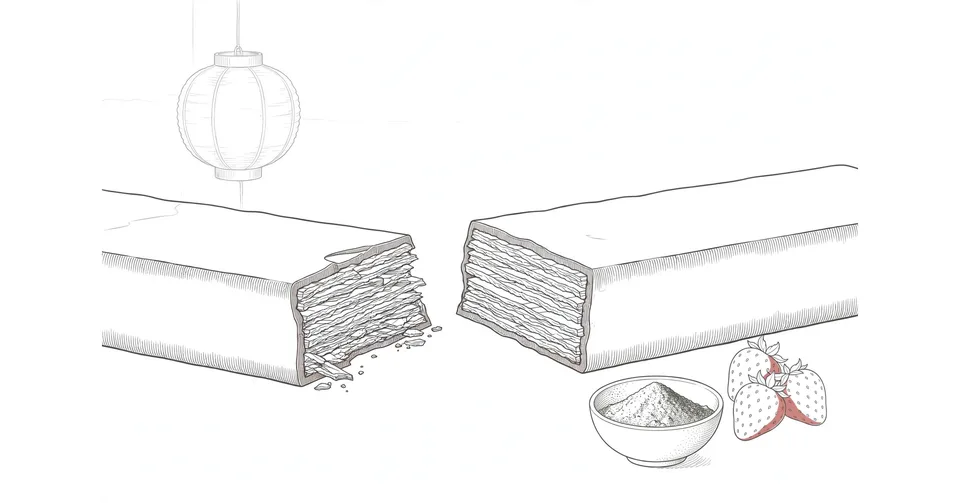
What makes Kit Kat Japan worth a closer look is not the chocolate. It is the story of how a foreign snack became so Japanese that most people outside Japan now think of Kit Kat as a Japanese thing. That transformation took fifty years, one lucky pun, and a strawberry bar that was only supposed to be a test.
A British bar with a Japanese second life
Kit Kat began in York, England, in 1935, when the confectioner Rowntree launched a four finger wafer bar called Chocolate Crisp. It was renamed Kit Kat in 1937, after the Kit-Cat Club of 18th century London, and it became a staple of British lunchboxes. The bar arrived in Japan in 1973, imported through the Japanese confectionery company Fujiya, and for years it was unremarkable. It was a foreign chocolate bar on a shelf full of Japanese sweets, pleasant but ordinary.
The change came in stages. Nestle acquired Rowntree in 1988 and began producing Kit Kat inside Japan the following year. In 2000, Nestle bought out Fujiya's share of the brand, which gave it full control of the bar in Japan, and the same year it tried something new. It released a strawberry flavour, first as a test in Hokkaido, and the bar sold far better than anyone expected. Strawberry became the first Japanese exclusive flavour, and the test became a strategy.
From that point on, Kit Kat Japan stopped being one product and became a platform. Nestle Japan began releasing new flavours every year, roughly 30 to 50 of them, tied to seasons, regions, and events. The total now stands at more than 300, with some counts putting it above 400 once every regional and seasonal variety is included. No other country in the world has anything like it. The bar is produced by Nestle in 16 countries, but only in Japan did it become a collector's item.
Part of the appeal is physical. Japanese Kit Kat bars are smaller than the ones sold in Britain or America. They come as two finger minis, individually wrapped, in boxes of nine or twelve. The small size fits the Japanese habit of buying snacks to share and to give away, and it fits the omiyage tradition, the custom of bringing a local speciality home for family and colleagues after a trip. A box of Kit Kat Japan from Hokkaido or Okinawa is the perfect omiyage. It is light, it is cheap, it is unmistakably from that place, and everyone knows what to do with it.
The pun that turned chocolate into luck
None of this would have happened without a pun. In Japanese, Kit Kat sounds like "kitto katsu", a phrase that means "you will surely win". Students noticed it first. In the early 2000s, a Kit Kat became a good luck gift for friends sitting university entrance exams, the Japanese equivalent of wishing someone luck with a chocolate bar. Parents bought them for their children. Classmates handed them out before test day. Nestle noticed, and instead of ignoring the coincidence, it leaned into it. The company began printing messages of encouragement on the packaging, and it even worked with Japan Post on a version students could write a message on and mail like a postcard.
The exam gift tradition explains why Kit Kat Japan never feels like an imported brand. It is woven into a moment that matters to almost every Japanese family, the entrance exam season, and it carries a meaning that has nothing to do with chocolate. The bar is a wish. That is a very Japanese way for a foreign product to succeed, not by being louder than the local competition, but by finding a small gap in daily life and filling it exactly.
The pun also explains the pace of new Kit Kat Japan flavours. A good luck gift works best when it feels fresh, so the company keeps inventing. Matcha arrived in 2004 and became the most famous Japanese flavour abroad, a deep green bar that tastes of real green tea rather than chocolate. It was followed by roasted green tea, or hojicha, and by a strong matcha version for people who wanted more bitterness. Every year brings a new set, and every year the old ones come back for a season and then disappear again.
More than 300 flavours and counting
The Kit Kat Japan flavour list reads like a map of Japanese taste. Some are permanent, and most are not. The regular range, the ones you can buy all year, is small, just the original milk chocolate, dark chocolate, matcha, strong matcha, roasted tea, and raspberry. Everything else is a limited run, and the limited runs are where Kit Kat Japan becomes a sport.
| Flavour | What it is | Where it comes from |
|---|---|---|
| Matcha | Green tea, the most famous Japanese flavour | Uji, Kyoto, launched 2004 |
| Strawberry | The first Japanese exclusive flavour | Hokkaido, launched 2000 |
| Sake | White chocolate with 0.8 percent sake powder | Niigata, launched 2016 |
| Wasabi | Mild heat, made for tourists | Shizuoka |
| Beni imo | Purple sweet potato, vivid and sweet | Okinawa |
| Zunda | Sweet edamame paste | Miyagi |
| Yubari melon | The luxury melon of Hokkaido | Hokkaido |
| Kinako | Roasted soybean flour, nutty and soft | Nationwide |
The table only scratches the surface. There have been flavours made with soy sauce, hot sauce, apple cider vinegar, cough drops, and baked potato. A sake flavour, launched in 2016, went viral overseas because it actually contains sake, and it became the flavour that introduced Kit Kat Japan to people who had never been to Japan. Some flavours are jokes that turned out to be delicious. Some are delicious and then gone forever. That impermanence is the point. In Japan, a flavour that is always available is less interesting than one you might miss.
What I find most telling about Kit Kat Japan is that the flavours are rarely random. They are tied to a place, a season, or a local speciality, so buying one is a small act of travel. A wasabi bar from Shizuoka tastes of the prefecture that grows most of Japan's wasabi. A beni imo bar from Okinawa tastes of the island's purple sweet potato. The chocolate is the delivery system. The flavour is the postcard.
A map of Japan in chocolate
The regional flavours are the heart of Kit Kat Japan, and they work because Japan already thinks in regions. Every prefecture has a food it is proud of, and Kit Kat Japan turned that pride into a chocolate bar. Yubari melon from Hokkaido, where a single melon can sell for thousands of yen. Beni imo from Okinawa, where the purple sweet potato colours everything from ice cream to tarts. Wasabi from Shizuoka, where the mountain streams grow the real thing. Zunda from Miyagi, where mashed edamame has been a local sweet for centuries.
For a traveller, Kit Kat Japan turns a simple purchase into a game. The flavours change from station to station, and a shelf in Kyoto will not match a shelf in Fukuoka. People collect them the way other travellers collect stamps, and a box from a faraway prefecture carries a small story with it. I have seen travellers in Tokyo station comparing boxes like trading cards, arguing about which prefecture has the best one. That is not how people usually talk about a chocolate bar, and it is the clearest sign that Kit Kat Japan has become something else entirely.
The regional system also explains why Kit Kat Japan has survived so long without going stale. A company that sells one flavour everywhere eventually bores people. A company that sells a different flavour in every prefecture gives people a reason to look at the shelf every time they travel. The shelf is never finished, and that is the trick.
Where to buy Kit Kat Japan
Buying Kit Kat Japan is easy, but buying the interesting ones takes a little planning. The regular flavours are everywhere. You will find them in every convenience store in the country, usually for a little over 100 yen a mini box, and in every supermarket. The regional flavours are a different hunt. They are sold at train stations, airport shops, highway service areas, and souvenir shops in the prefecture they belong to, and they rarely travel far. A beni imo box bought in Okinawa is easy to find in Naha and almost impossible to find in Tokyo.
For the widest choice in one place, the big discount stores are the best bet. Don Quijote, the chaotic discount chain with branches in every major city, usually stocks a whole wall of regional flavours, and its shelves are where most visitors do their serious collecting. Airport duty free shops carry a curated selection for departing travellers, and they are a good last chance if you missed a flavour on the road.
The most expensive way to buy Kit Kat Japan is also the most interesting. The Kit Kat Chocolatory, a boutique shop in Ginza that opened in 2014, sells premium bars designed by the pastry chef Yasumasa Takagi. These are not the minis from the convenience store. They are handmade, sold individually for several hundred yen each, and made with ingredients like Uji matcha, Hokkaido melon, and sake lees. A visit there is a reminder that the same brand can live at two prices at once, a 100 yen snack and a luxury gift, and both are real.
One practical note. The minis are small and individually wrapped, which makes them ideal for packing, but they melt. If you are buying boxes in summer, keep them out of a hot bag and out of direct sun, and pack them in the middle of your suitcase rather than the outside pocket. A melted regional flavour is still edible, but it is a sad end to a good hunt.
What the craze says about Japan
There is a temptation to treat the Kit Kat Japan craze as a novelty, a funny story about a chocolate bar with too many flavours. That misses the point. The craze is a neat summary of how Japan absorbs foreign things. It does not reject them and it does not copy them exactly. It takes the foreign object, finds a local meaning for it, and then rebuilds it around that meaning until the original is almost unrecognisable. The British bar became a Japanese exam charm, a regional souvenir, and a luxury gift, and it did all three without ever stopping being a chocolate bar.
The same pattern shows up everywhere in Japan, from the way a British curry became Japanese curry to the way a Portuguese cake became a Nagasaki castella. The country is very good at this, and Kit Kat Japan is one of the clearest examples because the starting point is so ordinary. It is a wafer bar. There is nothing special about it until Japan makes it special, and then it becomes the biggest Kit Kat market in the world, bigger even than Britain, where the bar was invented.
That is why I think the flavours matter less than the habit behind them. The habit is to pay attention to small differences, to seasons, to places, and to the people you are buying for. A box of Kit Kat Japan is a small thing, but it carries all of that. The chocolate is the excuse. The attention is the gift.
So if you visit Japan, buy a box of Kit Kat Japan. Buy the matcha one first, because it is the classic, and then buy whatever flavour belongs to the place you are standing in. Eat one yourself and give the rest away. That is what the bar is for. It was never really about chocolate. It was about a country that looked at a foreign snack and found, inside a pun and a strawberry, a way to make it its own.
More in Food & Travel
- Nikko and the Shrines Hidden in the Cedar Forest
- The Orangutan and the Vanishing Forests of Borneo
- Hozomon Guards the Treasure House Behind Senso-ji's Main Hall
- Nakamise Is the Shopping Street That Has Fed Pilgrims for Centuries
- Kaminarimon Is the Thunder Gate That Opens Asakusa to the World
- Yakiniku, Japan's Do-It-Yourself Barbecue
Latest posts
- An Engawa Is Neither Inside nor Outside, and That Is the Point
- Minka Are the Folk Houses Japan Built Around the Hearth
- Miyadashi Is the Moment the God Leaves Home
- Otabisho Is Where the God Rests on the Way Through Town
- Mikoshi Are the Portable Shrines Japan Carries on Its Shoulders
- Sanja Matsuri Turns Asakusa Into Tokyo's Loudest Weekend
- Waraji Straw Sandals Walked Japan for a Thousand Years
- Sony, the Tokyo Workshop That Taught the World to Listen
- Fujin Carries the Wind That Arrives Before the Thunder
- Raijin Is the Thunder God Behind Japan's Summer Storms
- Tengu Is the Mountain Goblin Japan Still Meets on the Trail
- Kappa Is the River Imp Japan Still Warns Its Children About
- Calonarang Is the Night Rangda and Barong Finally Meet
- Yamata no Orochi Was Never Just a Monster to Slay
- How Susanoo Slew the Eight-Headed Serpent and Won a Bride