Yamata no Orochi Was Never Just a Monster to Slay
· 17 min read
Yamata no Orochi was the eight-headed serpent of Izumo, a creature so vast that trees grew on its back, and its story still shapes the rivers, shrines, and stages of Shimane today.
Some monsters are only monsters. Yamata no Orochi was never only a monster. In the oldest chronicles of Japan, Yamata no Orochi arrives as a disaster with a schedule: eight heads, eight tails, and an appetite that returns once a year to take a daughter from the same family. It is the most frightening creature in Japanese myth, and yet the story that carries it is not really about fear. It is about a river that would not stay in its banks, a family that had run out of daughters to lose, and a god who beat the beast by understanding what it wanted.
Yamata no Orochi belongs to Izumo, the old province in what is now Shimane Prefecture, and its story is told in the Kojiki, completed in 712, and in the Nihon Shoki, completed in 720. The two chronicles disagree on small details, as old books do, but they agree on the shape of the thing: a creature so large that it crossed eight valleys and eight hills, with trees growing on its back. This article stays with the serpent itself rather than the hero who killed it, because Yamata no Orochi is the part of the story that still explains the land.
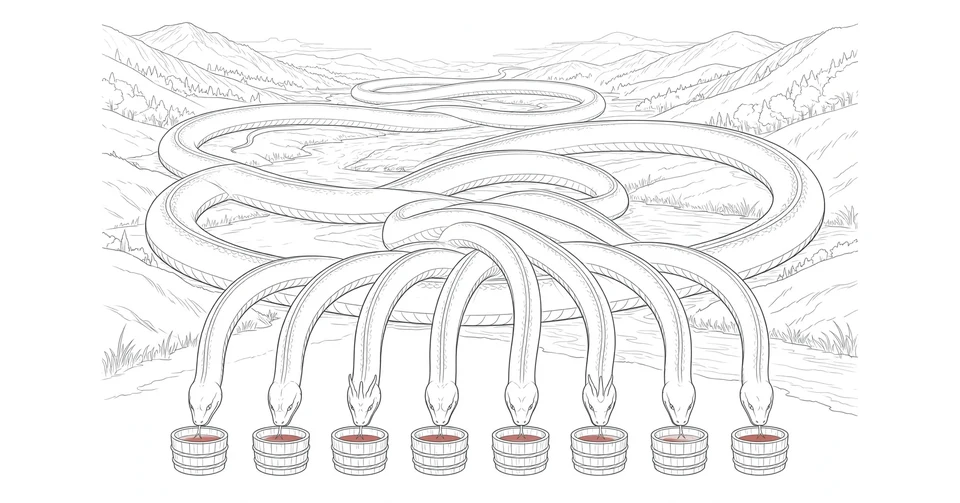
To look at Yamata no Orochi closely is to see how a myth works. The serpent has a body you can measure, a name you can translate, a home you can visit, and a meaning scholars still argue about. It is a monster, a river, and a memory of flood and iron all at once, and the story has lasted more than thirteen centuries because it holds all of those things without choosing between them.
the serpent the Kojiki describes
The Kojiki gives Yamata no Orochi a description that reads less like a beast and more like a piece of geography that learned to eat. Yamata no Orochi has eight heads and eight tails, eyes red like winter cherries, and a body so vast that it stretches across eight valleys and eight hills. Moss grows on its back, along with cypress and cedar trees, and its belly is always bloody and raw. Kokugakuin University, in its study of the eight-headed serpent, renders the eyes as Chinese lantern plants, which is the same plant under a different English name, and it keeps the rest of the description intact: a body large enough to span eight valleys, a surface so broad that trees grew upon it, and a belly covered in bloody red sores.
The name itself is a small puzzle. Yamata means eight forks, the kind of branching fork found in a tree or a road, and orochi means a great serpent, so the name is usually given in English as the eight-forked serpent. Kokugakuin points out a strange consequence of that reading. If the serpent's neck forks eight ways, the beast should have nine heads, not eight, and the same source wonders whether the creature was first imagined as something like a giant sea anemone, with many heads wriggling outward from a mass of body. Since the word for eight could also mean a large number, Yamata no Orochi may simply have been a serpent with many necks, and the precise count mattered less than the feeling of a thing too large to count.
What makes Yamata no Orochi different from other monsters is the calendar. Yamata no Orochi did not attack at random. It came to Izumo once a year to devour a young girl, and it kept coming, year after year, to the same family. A monster that strikes once is a tragedy. A monster that returns on schedule is a tax, and a tax is what breaks people slowly. I think that is why the description spends so much time on the body. A beast you can fight is frightening for an evening. A landscape that eats your children once a year is frightening for a lifetime, and it teaches a different kind of fear, the kind that settles into a household and rearranges everything around it.
eight daughters, one bargain
Yamata no Orochi's last visit was due to fall on a family that had almost nothing left to give. At the upper reaches of the river Hi, known today as the Hii River, the storm god Susanoo found an elderly couple weeping beside the water with a young girl standing between them. The old man was Ashinazuchi, the old woman Tenazuchi, and the girl was their daughter Kushinada-hime. They had once had eight daughters. Seven had been devoured, one each year, by Yamata no Orochi, and Yamata no Orochi would return for the last daughter. The parents were weeping because there was nothing they could do to stop it.
Susanoo made them a bargain. If they would give him Kushinada-hime as his wife, he would kill Yamata no Orochi. They agreed, and the story that follows is usually told as the tale of the hero, which is why the full account of his exile and redemption is told in how Susanoo slew the eight-headed serpent and won a bride. But the bargain itself deserves a pause, because it is not a pretty thing. A god in exile, with no home and no standing, asks grieving parents for their last child as payment for a rescue, and they accept because they have no better offer. The myth does not present this as a model of courtship. It presents it as a transaction struck in desperation, and the marriage that follows has to earn its meaning afterward, in the life the two of them build together.
The Nihon Shoki preserves a different version of the meeting, placing it by the river E in what is now Hiroshima Prefecture, and in one variant Kushinada-hime has not even been born when the serpent dies. The Kojiki version, set in Izumo with the marriage at its center, is the one that has shaped shrines, festivals, and folk plays ever since. When old sources disagree like this, the careful choice is to follow the version the living tradition has kept, and to say plainly that another version exists. Yamata no Orochi is the same in both. Only the address changes.
eight vats of sake and a patient trap
Susanoo did not meet Yamata no Orochi with a charge and a war cry. He met it with a fence, eight gates, eight platforms, and eight vats of sake brewed strong, one for each head. Yamata no Orochi had eight heads, so the plan gave each head its own drink, and the trap relied on appetite rather than strength. Yamata no Orochi came, put a head into every vat, drank itself senseless, and lay sprawled and helpless. Only then did Susanoo draw his sword, the ten-span blade at his side, and cut the serpent apart head by head and tail by tail until the river ran with blood.
There is a practical wisdom in the trick that the myth seems proud of. Susanoo was a storm god, and a storm god could have tried to overpower the beast with wind and fury. Instead he studied what Yamata no Orochi wanted and gave it exactly that, in a quantity it could not handle. The victory belongs to patience and observation, not to rage, and that matters because rage was the very thing that had gotten him exiled. The god who once smashed his sister's rice fields in a tantrum now builds a fence, waits quietly, and strikes only when the moment is right.
I find this the most human part of the whole story, and it is the part that stays with me. Yamata no Orochi is beaten not by a bigger monster but by someone who paid attention to it. Yamata no Orochi wanted sake, so it was given sake, and its own appetite did the work that no sword could have done alone. There is a lesson in that for anyone facing a problem that looks too large to fight. You do not always need more force. Sometimes you need to understand what the problem feeds on, and then decide, calmly, how much of it to serve.
the sword hidden in the tail
When Susanoo cut through Yamata no Orochi, one tail resisted his blade. His sword struck something hard inside the flesh, and when he split the tail open he found a great sword lodged within it. The sword was the Ame-no-Murakumo, the Heavenly Sword of Gathering Clouds, the blade later known as Kusanagi. He carried it up to heaven and presented it to Amaterasu as a gift, and the gift carried an apology that words could not. The full story of what that blade became is told in how Kusanagi became Japan's most guarded sword, and it is worth reading on its own, because the sword outlived the serpent by more than a thousand years and became one of the three sacred treasures of the imperial line.
What matters here is the strangeness of where the sword was found. A monster that devours daughters turns out to carry, hidden in its own body, the finest blade in the myth. Yamata no Orochi is not only a destroyer. It is also, without knowing it, a keeper of treasure, and the treasure can only be reached by going through the monster rather than around it. That is a pattern myths love, and it is one reason the serpent keeps its place in the story. Kill it and you get a bride and a home. Cut it open and you get a sword that changes the history of a nation.
Yamata no Orochi as a river in disguise
The most widely held reading of Yamata no Orochi is that the serpent was never only a serpent. Yamata no Orochi was the Hii River itself, given a body so that people could tell a story about it. The river that runs through Izumo flooded its banks with regularity before its course was engineered, and the damage it did to fields and homes was the kind of recurring disaster that a community would remember as a monster with a schedule. The eight heads are often read as the eight tributaries of the river upstream, each one a branch of the same violent water, and Yamata no Orochi's annual return is the flood season coming back whether anyone is ready or not.
The names in the story support that reading. Kushinada-hime is also called Inada-hime in some traditions, a name built from the characters for rice field, and Kokugakuin notes that her rescue can be read as the taming of the river for irrigation, the protection of rice fields from floods brought on by water deities. Yamata no Orochi's red eyes and bloody belly fit the same picture. A flooded river runs red with earth, and a river in flood looks wounded and dangerous at once. Shimane's tourism board makes the same point in its guide to the legend of Yamata no Orochi, saying plainly that the legend refers to the Hii River itself and to the attempts to control the recurrent flooding that did great damage to the surrounding areas.
There is a second reading, and it is just as interesting. The blood-red belly of Yamata no Orochi has been seen as recalling the flames of iron production, and the miraculous creation of a sword from the beast's tail as signifying the birth of iron weaponry. The upper Hii River basin was a center of tatara ironmaking, the traditional method of smelting iron in Japan, and Yamata no Orochi's body becomes, on this reading, a memory of fire and forge as much as of flood. Both readings are interpretations added by later readers. Neither is stated in the Kojiki, and scholars still disagree about which one carries more weight. The honest position is that the serpent can hold both meanings at once, because a myth that survives for thirteen centuries is rarely about one thing only. A river floods, iron burns, and a community tells one story that covers both.
walking the legend in Shimane today
One reason Yamata no Orochi refuses to fade is that the story is pinned to real ground, and the ground is still there to walk. Local tradition counts roughly fifty sites along the Hii River tied to the legend, and the Shimane tourism board lists the main ones as stops on a route a visitor can follow from the headwaters down to the sea. The place where Susanoo met Kushinada-hime is called Torikami, near the headwaters of the Hii River in Okuizumo Town in southern Shimane. Ama-ga-fuchi, a deep pool where the waters slow, is said to have been the place where Yamata no Orochi lived, in the Kisuki area of Unnan City. Orochi Shrine, a small shrine that is part of Iwatsubo Shrine in Okuizumo, enshrines a piece of the serpent's tail.
In Unnan City, the Happon-sugi, eight cedar trees on the grounds of Hii Shrine, mark the spot where Susanoo buried the eight heads of Yamata no Orochi. Nearby, the Tsubogami, a pit on the grounds of Yaguchi Shrine, is said to be where one of the eight vats for the sake is located, and local legend adds that whenever anyone touched the stone, lightning would flash across the sky and the earth would rumble, so people covered the pit with stones and placed a fence around it. Two shrines figure prominently as well. Yaegaki Shrine in Matsue is the place where Kushinada-hime hid from Yamata no Orochi, and its grounds hold the Mirror Pond, Kagami-no-ike, said to have served as both drinking water and a mirror. Suga Shrine, in the Daito area of Unnan, stands on the site of the palace at Suga where Susanoo and Kushinada-hime lived after the serpent was slain, and its name comes from the word for refreshing, which is how Susanoo said he felt when he arrived there.
Susa Shrine in Izumo City belongs to the same landscape, traditionally associated with pacifying the spirit of Susanoo after the killing. The shrines do not agree with each other in the way a guidebook would, and that is part of their charm. Each one keeps a different piece of the serpent: a tail here, eight heads there, a vat pit, a hiding place, a palace. Walk the route and the myth stops being a text. It becomes a set of places that remember different parts of the same story, and the story feels larger for being spread across a whole river valley rather than kept in one book.
the serpent on stage at night
If the shrines keep Yamata no Orochi in the landscape, the stage keeps Yamata no Orochi in the body. The Iwami Kagura, a ritual dance theater of western Shimane, performs the story of Yamata no Orochi as one of its most famous pieces, and Shimane's tourism board calls the Yamata-no-Orochi performance one of the most famous Kagura performances in the present day. The dance runs through the night, with drums driving the action and a great eight-headed serpent puppet writhing across the stage while the hero waits for his moment with the sake.
The puppet is the point. A story told in words can describe eight heads, but a puppet with eight heads moving in the dark, lit by firelight and driven by drums, makes the audience feel the size of the thing. People gather to watch a monster die, and they gather again the next year, because the performance is not a history lesson. It is a ritual, a communal act of facing a danger together and watching it be overcome, and the repetition is the meaning. Yamata no Orochi returns every year in the story, and the dance returns every year on the stage, and each return is a reminder that the danger is managed, not gone.
I think there is something quietly wise about keeping a monster on stage instead of in a museum. A museum puts the past behind glass, where it can be admired and forgotten. A stage puts it in front of a living audience, where it has to be faced again. The people of Shimane did not retire Yamata no Orochi. They gave it a puppet, a drumbeat, and a night of the year, and in doing so they kept the warning alive in the form people remember best, which is a story told out loud, together, in the dark.
why we still tell the story of Yamata no Orochi
The tale of Yamata no Orochi carries themes that travel far beyond Izumo. Kokugakuin notes that it mirrors in part the Greek myth of Perseus and Andromeda, in which a hero fights a great beast to save a maiden given up as sacrifice, and later marries her. The same source points to an older parallel in a Hittite myth, where a hero tricks a serpent called Illuyanka with a great feast, then attacks it once it has grown too fat to escape. The shape is universal: a monster, a maiden, a bargain, and a trick that turns appetite into a weakness. The Japanese version keeps that shape and adds its own details, a storm god in exile, a river that floods, a sword in a tail, and those details are what make it last.
But universality is only part of the answer. The story also lasts because it names a fear that people actually live with, which is the fear of a danger that returns on schedule. Most disasters in a life are not single events. They are patterns: a debt that comes due every month, an illness that flares every winter, a river that floods every rainy season. The myth of Yamata no Orochi gives that kind of danger a face, eight of them, and then it gives the face a weakness. Yamata no Orochi wants sake. It wants what every appetite wants, more than it can handle, and the hero's victory is to see that clearly and prepare for it.
There is also a gentler reason the story survives, and it is the one I keep coming back to. Yamata no Orochi's victims are not forgotten. The seven daughters who were devoured are counted, named as a family, and mourned by parents who weep openly at a riverbank. The myth does not rush past their grief to get to the fight. It sits with the parents first, and it lets their loss set the stakes. A story that remembers the dead is a story that respects the people telling it, and people keep telling stories that respect them.
Yamata no Orochi began as a monster in a chronicle written more than thirteen centuries ago, and it is still a river, a row of shrines, a puppet on a night stage, and a warning about appetite and flood. The serpent lost the fight, and that was never the interesting part. The interesting part is that it never really left. It stayed in the valley, in the names of places, in the drums of the Kagura, and in the story parents still tell when they want a child to understand that some dangers come back every year, and that the way to face them is not with more noise but with a fence, eight vats, and the patience to wait for the right moment.
More in Culture & Society
- Miyadashi Is the Moment the God Leaves Home
- Otabisho Is Where the God Rests on the Way Through Town
- Mikoshi Are the Portable Shrines Japan Carries on Its Shoulders
- Sanja Matsuri Turns Asakusa Into Tokyo's Loudest Weekend
- Waraji Straw Sandals Walked Japan for a Thousand Years
- Fujin Carries the Wind That Arrives Before the Thunder
Latest posts
- An Engawa Is Neither Inside nor Outside, and That Is the Point
- Nikko and the Shrines Hidden in the Cedar Forest
- Minka Are the Folk Houses Japan Built Around the Hearth
- The Orangutan and the Vanishing Forests of Borneo
- Hozomon Guards the Treasure House Behind Senso-ji's Main Hall
- Nakamise Is the Shopping Street That Has Fed Pilgrims for Centuries
- Kaminarimon Is the Thunder Gate That Opens Asakusa to the World
- Sony, the Tokyo Workshop That Taught the World to Listen
- Raijin Is the Thunder God Behind Japan's Summer Storms
- Tengu Is the Mountain Goblin Japan Still Meets on the Trail
- Kappa Is the River Imp Japan Still Warns Its Children About
- Calonarang Is the Night Rangda and Barong Finally Meet
- Kit Kat Japan, the Flavours You Will Not Find Anywhere Else
- How Susanoo Slew the Eight-Headed Serpent and Won a Bride
- How Kusanagi Became Japan's Most Guarded Sword