Tengu Is the Mountain Goblin Japan Still Meets on the Trail
· 18 min read
Tengu are the long-nosed mountain spirits of Japanese folklore, feared first as demons and honored later as guardians of the peaks. Here is how they changed, and where travelers can still meet them today.
If you hike a cedar trail in the mountains of Japan and hear laughter with no one in sight, old stories have a name for what you just met. A Tengu is a mountain spirit of Japanese folklore, part bird and part man, with feathered wings, a long nose, and the robes of a mountain ascetic. Travelers have blamed these creatures for sudden winds, falling stones, and getting lost on familiar paths for more than a thousand years, and they still watch over the same peaks today.
It began as something frightening. Early chronicles tie the creature to falling stars and war, and medieval tales made it the ghost of a proud priest who could not rest. Over the centuries the image softened. The demon became a guardian, a teacher of swordsmen, and a neighbor the mountain villages learned to respect rather than fear. That long change is what makes the creature worth knowing. It is not only a monster story. It is a record of how Japan learned to live with its mountains.
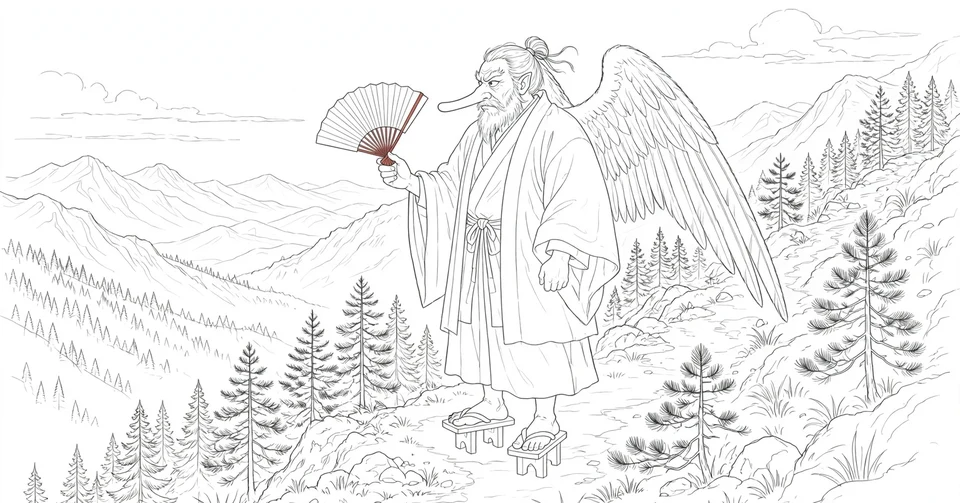
This article follows the creature from its first mention in an eighth-century chronicle to the festivals and video games of today. It looks at the two kinds of mountain spirit, the famous teacher of Mount Kurama, the fan and the tall sandals, and the shrines where hikers still leave offerings. The creature changed many times, but it never left the mountains.
The first Tengu fell from the sky
The creature did not start in Japan. Its name and its characters come from a fierce demon of Chinese folklore called the tiangou, a dog-like monster often described as a shooting star or comet. Chinese accounts say it made a noise like thunder and brought war wherever it fell. The Japanese creature kept that link to the sky for centuries, and it explains why the first of these spirits in Japanese records arrives as a light in the heavens rather than as a man in the woods.
The first recorded mention of one in Japan sits in the 23rd chapter of the Nihon Shoki, written in 720. A great star floated from east to west, with a noise like thunder, and a Buddhist priest named Bin told the court it was not a falling star but a celestial dog, whose barking sounded like thunder. Famine followed its appearance. The text uses the characters for Tengu, but the phonetic reading beside them gives amatsukitsune, or heavenly fox, which shows how unsettled the creature still was. The scholar M. W. de Visser suggested that the early Japanese creature may have been a blend of the Chinese tiangou and the fox spirits of Chinese lore, before local gods and mountain spirits were folded into the same shape.
Other roots have been proposed as well. Some Japanese scholars have linked the creature to Garuda, the Hindu eagle deity who entered Buddhism as a guardian, because both are shown in human form with wings and a beak. The god Sarutahiko is often named as the model for the long-nosed form, since the Nihon Shoki describes his nose as measuring seven hand-spans in length. The earliest of them, though, looked like a bird of prey. Early depictions show a kite-like being, the Japanese black kite called tobi, that could take a human-like form while keeping its wings, head, or beak. The long nose that defines the creature today seems to have been conceived in the 14th century, likely as a humanization of the original bird's bill. A full account of these origins is kept in the Tengu entry on Wikipedia, which traces the creature from the Chinese tiangou to the mountain goblin of later centuries.
Two kinds of mountain spirit live in the peaks
Most depictions of the creature fall into two broad types, and the difference between them is a matter of rank. The greater ones, called daitengu, are mostly human in appearance, with red skin, a long nose, and an expression twisted into a menacing leer. The lesser ones, called kotengu, are more bird-like, and they are often called karasu-tengu, with beak-like mouths and blue or green skin, sometimes with a red or orange crest like a cockerel's. The old text Genpei Josuiki explains the split in moral terms: knowledgeable men become daitengu, while ignorant ones become kotengu. The philosopher Hayashi Razan listed the greatest of the daitengu as Sojobo of Mount Kurama, Tarobo of Mount Atago, and Jirobo of the Hira Mountains.
The daitengu are also called hanatakatengu, or tall-nosed spirits, for the feature that gives them away. The smaller bird-like kind are sometimes called konoha-tengu, or foliage spirits. A book from 1746 called the Shokoku Rijin Dan describes bird-like ones with wings two meters across that were seen catching fish in the Oi River, a reminder that the small ones were once imagined as real animals of the rivers and forests rather than as robed priests.
By the 13th century the creature had taken on the dress of the yamabushi, the mountain ascetics who practice Shugendo. The costume is unmistakable: a small black cap called a tokin, a sash with pompoms called a yuigesa, and a ringed monk's staff called a shakujo. The association makes sense, because both the spirits and the yamabushi lived in the mountains, and folk belief soon treated them as near kin. The mountain ascetic En no Gyoja, the founder of Shugendo, is tied to the same lore, and legend says he appeared as the great spirit Hokibo of Mount Daisen. The old lists of named daitengu give each great spirit a mountain of its own: Sojobo of Mount Kurama, Tarobo of Mount Atago, Jirobo of the Hira Mountains, Sanjakubo of Mount Akiha, Buzenbo of Mount Hiko, Hokibo of Mount Daisen, and Naigubu of Mount Takao. To know one, in other words, you first had to know its mountain.
When they were demons to fear
For the first few centuries of their life in Japanese stories, the creatures were not guardians at all. They were the troublesome opponents of Buddhism. The Konjaku Monogatarishu, a collection of stories from the late Heian period, shows them misleading the pious with false images of the Buddha, carrying off monks and dropping them in remote places, possessing women to seduce holy men, and robbing temples. They often disguised themselves as priests or nuns, but their true form seems to have been that of a kite.
Through the 12th and 13th centuries, the spirits settled into a grimmer role: they were the ghosts of angry, vain, or heretical priests who had fallen onto the demon road, or tengudo. As Buddhists they could not go to hell, yet as people with bad principles they also could not go to heaven, so they haunted the world instead. They possessed people, especially women and girls, and spoke through their mouths. The Kojidan tells of an empress who was possessed, and the Okagami reports that Emperor Sanjo was made blind by one, the ghost of a priest who resented the throne. One notorious spirit of the 12th century was himself the ghost of an emperor. The Hogen Monogatari tells how Emperor Sutoku was forced to abandon the throne, raised the Hogen Rebellion to take it back, was defeated, and was exiled to Sanuki Province in Shikoku. Legend says he died in torment, having sworn to haunt the nation of Japan as a great demon, and so became a fearsome demon with long nails and eyes like a kite's.
The satire of the age used the creature to mock the clergy. The Tenguzoshi Emaki, a picture scroll painted around 1296, parodies high-ranking priests by giving them the hawk-like beaks of demons. In the 13th century the spirits also began to abduct young boys as well as priests, returning them in a state near death or madness. The creature's link to pride was so strong that it entered the language. The Japanese expression tengu ni naru, or becoming one, is still used today to describe a conceited person. I find that detail telling. A monster that began as a falling star became, in the end, a warning about the oldest human fault: thinking too much of yourself.
The Tengu who taught a boy to use a sword
The most enduring legend of the creature is not about a haunting. It is about a lesson. During the 14th century the spirits began to trouble the world outside the Buddhist clergy, and like their ominous ancestors they became creatures associated with war. Legends eventually gave them great knowledge in the art of skilled combat, and that reputation rests on one boy and one mountain.
The boy was Minamoto no Yoshitsune, then known by his childhood name Ushiwaka-maru. After his father Yoshitomo was killed by the Taira clan, the child was allowed to survive on the condition that he be exiled to the temple on Mount Kurama and become a monk. One day in the Sojo-ga-dani Valley he encountered the mountain's great spirit, Sojobo, the white-haired king of the mountain spirits who lived on Mount Kurama. Sojobo taught the boy swordsmanship, tactics, and magic so that he might one day bring vengeance on the Taira. In the Noh play Kurama Tengu, Ushiwaka is the only person from his temple who does not give up an outing in disgust at the sight of a strange yamabushi, and Sojobo befriends the boy and teaches him out of sympathy for his plight. Images of the two sparring secretly in the moonlight became a common theme in woodblock prints of the Edo period.
The story set a pattern. The spirits began to appear in the origin stories of famous swordsmen and in martial scrolls called densho. Two stories from the 19th century carry the theme further. In one, a boy is carried off by one and spends three years with the creature, coming home with a magic gun that never misses a shot. In another, from Inaba Province, a girl with poor manual dexterity is possessed by one who wishes to rekindle the declining art of swordsmanship, and the spirit instructs a young samurai through her as an expert swordsman. What strikes me about these tales is how completely the teacher redeems the demon. The same creature that once carried monks off to drop them on mountaintops now spends its nights making sure a lonely boy learns to defend himself. Fear did not vanish from the creature. It was put to work.
The long nose, the fan, and the tall sandals
You can recognize one by three things, and each of them carries its own story. The first is the nose. Long and red, sometimes nearly phallic in the masks of village festivals, it is the feature the 14th century gave the creature when the bird's bill became a human face. In village festivals the creature and the god Sarutahiko are often portrayed with identical red-nosed mask designs, a sign of how closely the two figures merged in folk belief. The second is the feather fan, or hauchiwa. The spirits are commonly shown holding it, and folk tales credit it with the power to stir up great winds and to grow or shrink a person's nose. The tale called The Tengu's Fan tells of a scoundrel who steals one and secretly lengthens the nose of a rich man's daughter, then shrinks it again in exchange for her hand in marriage, until he fans himself in his sleep and his own nose grows so long it reaches heaven.
The third is the footwear. They are often shown wearing a type of tall, one-toothed geta sandal called tengu-geta, and the same high wooden sandals turn up in festival costumes and shrine statues across Japan. The geta that still clatter through Japanese summer are the everyday cousins of this footwear, worn for rain and mud rather than for flying between mountain peaks, but the shape is the same, and the sound is the same too. The fierce tengu-men mask worn by samurai also takes the form of the mountain spirit of Japanese folk religion, and its long nose and glaring eyes were meant to frighten enemies before a battle began.
Folk tales loved to make the creature ridiculous as well as fearsome. In The Tengu's Magic Cloak, a boy looks through an ordinary piece of bamboo and pretends he can see distant places, and a curious spirit trades him a magic straw cloak that renders the wearer invisible. In The Tengu's Gourd, a gambler lies to one about what frightens him most, and the creature answers by making money and rice cakes rain down on him. In the best known of these tales, The Old Man's Lump Removed, an old man joins a band of dancing spirits in the mountains and pleases them so much that they take the lump off his face as a gift. His unpleasant neighbor tries to copy him, dances badly, and tries to steal the gift, so the spirits give him the first lump in addition to his own. The humor matters. A creature people can laugh at is a creature people can live beside.
From feared demon to mountain guardian
That image did not change overnight, but by the 17th century the change was unmistakable. The Shasekishu, a book of Buddhist parables from the Kamakura period, already distinguished between good and bad ones, explaining that the good ones are in command of the lesser ones and are protectors, not opponents, of Buddhism. Though pride had caused them to fall onto the demon road, they remained the same good, dharma-abiding persons they had been in life. Some stories now presented them as much less malicious, protecting and blessing Buddhist institutions rather than menacing them.
An 18th-century tale in the Kaidan Toshiotoko tells of one who took the form of a yamabushi and faithfully served the abbot of a Zen monastery until the man guessed his attendant's true form. The wings and huge nose reappeared, and the spirit asked for a piece of wisdom, then left, but continued unseen to provide the monastery with miraculous aid. In the 18th and 19th centuries the creatures came to be feared as the vigilant protectors of certain forests. A tale in the 1764 collection Sanshu Kidan tells of a man who wanders into a deep valley while gathering leaves and is met with a sudden, ferocious hailstorm. Peasants later tell him he was in the valley where the guhin live, and anyone who takes a single leaf from that place will surely die.
Mountain workers learned to bargain with the guardian rather than fight it. The woodcutters of Mino Province offered a kind of rice cake called kuhin-mochi to placate the mountain spirit, who would otherwise cause mischief, and in other provinces woodsmen and hunters offered a special fish called okoze in exchange for a successful day's work. The people of Ishikawa Prefecture long believed that the mountain spirits loathe mackerel and used the fish as a charm against kidnappings and hauntings. The great folklorist Miyamoto Tsuneichi recorded that loggers of Mount Ishizuchi in Ehime Prefecture felt the constant presence of the mountain spirits around them and asked their permission before cutting down any tall trees with wide, high branches that the spirits might choose to sit on. As late as 1860, the Edo government was said to have posted polite notices to the mountain spirits asking them to vacate a rural area ahead of a state visit. Like the kappa, the river imp Japan still warns its children about, the mountain spirit softened over time from a feared creature into a neighbor to be respected and appeased.
That respect eventually became worship. They are honored as beneficial kami in various regions. The Tengu Saburo of Mount Izuna is worshipped as Izuna Gongen, a beaked, winged figure with snakes wrapped around his limbs, surrounded by a halo of flame, riding on a fox and brandishing a sword. Worshippers on other sacred mountains adopted similar images for their deities, such as Sanjakubo of Mount Akiha, honored as Akiba Gongen, and Doryo Gongen of Saijo-ji Temple in Odawara. The demon had become a god, and the god still lived on the same mountain.
Mountains where they still live
The simplest way to meet one today is to go to its mountain. Mount Kurama in the north of Kyoto remains the most famous, with Kurama-dera Temple, a huge Tengu head at its entrance, and statues of Sojobo watching over the trail where Yoshitsune is said to have trained. Mount Takao on the edge of Tokyo is another stronghold, where Yakuoin Temple honors the karasu-tengu and the war deity Izuna Gongen, and where its image is carved into statues along the climbing path. Mount Hiko in Kyushu is the home of Buzenbo, and Mount Atago, the Hira Mountains, Mount Daisen, and Mount Omine each keep their own great mountain spirit in local legend.
Smaller shrines keep the creature close as well. Kasuga Shrine in Nara and Hansobo Shrine in Kamakura both hold karasu-tengu figures, and at Kobi no Tenguyama Shrine in Minokamo City the walls are lined with long-nosed masks. On Mount Mitake, the Tenguiwa rock marks a place where the creature is said to sit. The landscape itself is named after the mountain spirit in many places: tenguda, or Tengu field, tengudani, or Tengu valley, and tengu no yama, or Tengu mountain. Mountain villages gave names to the strange sounds of the peaks too. In Kanagawa the night sound of a tree being cut and falling was called tengu-daoshi, or Tengu fall. In Gunma, laughter heard from nowhere on the trail was tengu-warai, or Tengu laugh. On Mount Ogasa in Shizuoka, the sound of festival music drifting from the mountains in summer was called tengubayashi, or Tengu music. I like to think of these names as a map. Long before anyone wrote a guidebook, the people who lived under these peaks had already marked the places where the mountain felt alive, and they gave that feeling a name and a nose.
Festivals and modern Japan
The mountain spirit never left the calendar either. The Mino Tengu Festival is held on October 16 at Saikoji Temple in Osaka, and the Tenkaichi Parade takes place on February 2 in the Shimokitazawa neighborhood of Tokyo. In Kamakura, the Menkake Gyoretsu festival features a man wearing a long-nosed mask representing the deity Sarutahiko. These festivals keep the creature in public view, not as a horror but as a neighbor worth celebrating, and they are among the best ways for a visitor to see the mountain-spirit tradition alive. A good place to start planning such a visit is the japan-guide introduction to the mountain spirit, which gathers the shrines, festivals, and legends in one place.
Modern fiction has adopted the mountain spirit just as warmly. The Unicode emoji character U+1F47A shows a red-faced goblin under the name Japanese Goblin, so the mountain spirit now sits on millions of phones. The Pokemon Nuzleaf and Shiftry are based on the mountain spirit, with long noses and leaf fans in place of feather fans. The Dead or Alive fighting games feature a long-nosed fighter named Bankotsubo, and the Touhou Project series includes no fewer than five named mountain-spirit characters. They even appear in the 2013 film 47 Ronin. What surprises me is not that the creature survived into games and films. It is that it survived without losing its shape. A thousand years after the first chronicle, it still has the long nose, the wings, and the mountain, and children still recognize it at a glance.
Why the Tengu still matters
It endures because it holds two truths that still fit the mountains. The first is about pride. The creature began as the ghost of people who thought too much of themselves, and the phrase tengu ni naru still warns anyone who starts to swagger. The second is about respect. Loggers who asked permission before cutting a tall tree, villagers who left rice cakes for the guardian of the valley, and officials who posted a polite notice before a state visit were all practicing the same habit: treating the mountain as a place that belongs to something older than us.
I think that habit is worth keeping. A hiker who treats a trail as a gym will miss what the mountain is offering, while a hiker who walks quietly, leaves nothing behind, and turns back when the weather changes is doing exactly what the old stories asked for. It never needed to be real to do its work. It only needed to remind people that the forest has rules, that pride is punished, and that a mountain rewards those who approach it with care. Walk the trails of Kurama or Takao on a misty morning, and you may not see a long nose among the cedars. You will, however, feel watched in the best sense of the word, as if the mountain itself is paying attention. That feeling is the mountain spirit, and it has lasted for more than a thousand years because it is true in the way that matters most.
More in Culture & Society
- Miyadashi Is the Moment the God Leaves Home
- Otabisho Is Where the God Rests on the Way Through Town
- Mikoshi Are the Portable Shrines Japan Carries on Its Shoulders
- Sanja Matsuri Turns Asakusa Into Tokyo's Loudest Weekend
- Waraji Straw Sandals Walked Japan for a Thousand Years
- Fujin Carries the Wind That Arrives Before the Thunder
Latest posts
- An Engawa Is Neither Inside nor Outside, and That Is the Point
- Nikko and the Shrines Hidden in the Cedar Forest
- Minka Are the Folk Houses Japan Built Around the Hearth
- The Orangutan and the Vanishing Forests of Borneo
- Hozomon Guards the Treasure House Behind Senso-ji's Main Hall
- Nakamise Is the Shopping Street That Has Fed Pilgrims for Centuries
- Kaminarimon Is the Thunder Gate That Opens Asakusa to the World
- Sony, the Tokyo Workshop That Taught the World to Listen
- Raijin Is the Thunder God Behind Japan's Summer Storms
- Kappa Is the River Imp Japan Still Warns Its Children About
- Calonarang Is the Night Rangda and Barong Finally Meet
- Yamata no Orochi Was Never Just a Monster to Slay
- Kit Kat Japan, the Flavours You Will Not Find Anywhere Else
- How Susanoo Slew the Eight-Headed Serpent and Won a Bride
- How Kusanagi Became Japan's Most Guarded Sword