How Kusanagi Became Japan's Most Guarded Sword
· 12 min read
Kusanagi is the sacred sword of Japanese myth, found inside the serpent Yamata no Orochi and now kept unseen at Atsuta Jingu in Nagoya. This is the story of how a blade from a monster's tail became the most guarded object in Japan.
There is a sword in Japan that almost no one alive has ever seen. It has no verified photograph, no public exhibition, and no confirmed description of its length, its curve, or even its condition. Yet it sits at the center of the oldest story the Japanese imperial family tells about itself. That sword is Kusanagi, and its power comes precisely from the fact that it stays hidden.
Kusanagi began as a weapon pulled from the tail of a monster. The Kojiki, the chronicle completed in 712, and the Nihon Shoki, completed in 720, both tell how the storm god Susanoo found the sword inside the body of the eight-headed serpent Yamata no Orochi after he slew it. He carried it up to heaven and gave it to his sister Amaterasu, the sun goddess, as a gift of reconciliation after his exile from the heavenly realm. The full story of that quarrel, and of the darkness that followed when Amaterasu hid herself away, is told in the cave where Amaterasu hid the sun, where the sword appears at the turning point of the myth.
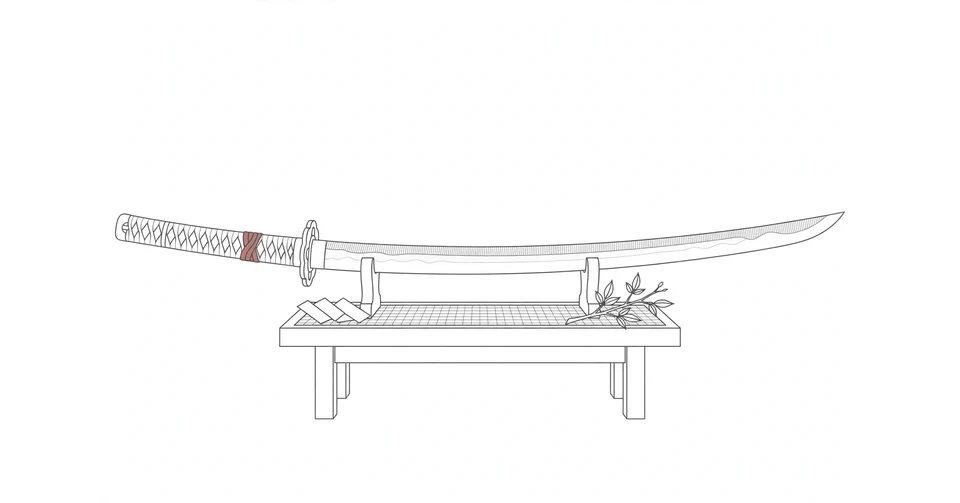
From that gift, Kusanagi traveled down through the generations until it became one of the three sacred treasures of the imperial line, beside the mirror Yata no Kagami and the jewel Yasakani no Magatama. Today it is said to rest at Atsuta Jingu in Nagoya, behind doors that never open for visitors. This is the story of how a blade from a serpent's tail became the most guarded object in Japan, and why its invisibility is the whole point.
the sword inside the serpent
Susanoo was not a hero when he found Kusanagi. He was a god in disgrace, driven out of heaven for a rampage that had terrified his sister Amaterasu so badly that she sealed herself inside a cave and took the light of the world with her. The other gods lured her out again, famously with a dance by the goddess Ame-no-Uzume, whose wild performance is remembered in how Ame-no-Uzume danced the sun back into the sky. But Susanoo himself was sent down to earth, and it was in exile that he found the thing that would define him.
In the land of Izumo he met an old couple weeping for their daughters. A serpent with eight heads and eight tails, Yamata no Orochi, had devoured seven of their eight girls, and the last one was next. Susanoo promised to kill the creature if the parents would give him their remaining daughter as his wife. They agreed, and he set a trap that relied on the serpent's appetite rather than on brute strength. He had eight vats of strong sake prepared, one for each head, and waited for the beast to drink itself senseless.
When the serpent lay drunk and sprawled, Susanoo cut it apart head by head and tail by tail. One tail resisted his blade. Inside it, his sword struck something hard, and when he split the tail open he found a great sword lodged within the flesh. He took Kusanagi to heaven and offered it to Amaterasu. The gift carried an apology that words could not, and the two were reconciled.
Kusanagi first had another name, Ame-no-Murakumo-no-Tsurugi, the Heavenly Sword of Gathering Clouds. The name Kusanagi came later, and it came from an escape, not from a victory parade. What strikes me about this beginning is how little it resembles the origin of a crown jewel. Sacred objects in most traditions are made for ceremony, forged by royal smiths and blessed at birth. Kusanagi was salvage, found inside something dead and offered by a disgraced brother who had nothing else to give. Perhaps that is why the story has lasted. A gift that costs the giver his pride is remembered longer than a gift that costs him money.
how Kusanagi got its name
After the reconciliation, Kusanagi passed from Amaterasu to her grandson Ninigi when he descended to rule the earth, and from him down the imperial line. Generations later it reached the warrior prince Yamato Takeru, and it saved his life in a way that gave the blade its lasting name.
Yamato Takeru was campaigning in the east when his enemies set the grassland around him on fire. Trapped in a ring of flame with no road out, he drew Kusanagi and cut the burning grass down around himself, clearing a space where the fire could not reach him. The sword that cut the grass became known as Kusanagi, the grass cutter. The two chronicles differ on small details of the campaigns, as old texts do, but they agree on the core of the episode, and the name has stuck for more than a thousand years.
There is a quiet lesson in the renaming. The sword was not named for what it was made to do. It was named for what it did when it mattered, in a field, in a fire, with no audience. Most of us are named by our parents before we have done anything at all. Kusanagi earned its name the way a person earns a reputation, one act at a time, and the act that defined it was not killing a monster but making room to survive. A blade that cuts a path out of a fire is a different kind of weapon from one that only cuts enemies down, and Japan seems to have understood that difference from the start.
one of three treasures, and the only one with a temper
Kusanagi does not stand alone. It is one of the Sanshu no Shinki, the three sacred treasures that Amaterasu is said to have handed to Ninigi as proof of the legitimacy of the imperial throne. The mirror, Yata no Kagami, is kept at Ise Jingu as the manifestation of Amaterasu herself. The jewels, Yasakani no Magatama, have always been kept in the imperial palace. The sword, Kusanagi no Tsurugi, is enshrined as the deity of Atsuta Jingu. A replica of the sword is also kept in the Kashiko-dokoro, the sacred storehouse of the imperial palace, which shows how seriously the court treats even the idea of the blade.
Tradition assigns each treasure a virtue. The mirror stands for wisdom, the sword for courage, and the jewels for benevolence. The set is described in detail in the Encyclopedia of Shinto's Basic Terms of Shinto, compiled by Kokugakuin University, which records the homes and meanings of all three treasures in one place.
Of the three, Kusanagi is the only one with a temper in the old stories. The chronology of Shinto records that in 686 the Emperor Tenmu fell gravely ill, and a divination blamed the curse of the sword Kusanagi. The emperor sent the blade back to Atsuta Shrine, and it has remained there ever since. Whether one reads that episode as history or as legend, it tells us how the sword was understood. A mirror reflects and a jewel adorns, but a sword acts, and an object that acts can also harm. Sending it away to a shrine was a way of honoring it while keeping it at a safe distance.
I find something honest in that arrangement. Many cultures keep their most dangerous sacred things close and pretend they are tame. Japan did the opposite with Kusanagi. It acknowledged that the blade was trouble, gave it a grand home of its own, and left it there. Respect, in this story, looks a lot like distance.
the sword that went to sea and came back as a question
The hardest episode in the history of Kusanagi comes five centuries later, at the Battle of Dan-no-ura in 1185. The Genpei War was ending, the Taira clan was losing, and the child emperor Antoku was aboard a Taira ship with the imperial regalia when the fleet was destroyed. According to the tradition, Kusanagi went down with the emperor into the sea, and the original blade was lost.
What happened next is where history turns into a careful silence. A sword was later recovered or remade, and the shrine at Atsuta continued to guard what it holds as Kusanagi. The official position of the Imperial Household is that the regalia have never been lost. Scholars, meanwhile, generally treat the blade at Atsuta as a replacement or as a recovered sword, and they say so openly. The two accounts cannot both be literally true, and no one alive can settle the matter, because the sword is never shown.
It would be easy to treat this as a problem, but I think it is the point. The sword at Atsuta is guarded as Kusanagi, and it has been guarded that way for centuries, whatever happened in the straits of Dan-no-ura. A sacred object does not survive by being proven genuine in a laboratory. It survives because a community agrees, generation after generation, to treat it as genuine and to behave accordingly. The doubt around Dan-no-ura does not weaken the sword. It explains why the sword must never be displayed. The moment it is put on a table under bright lights, the argument becomes about metal and age. Kept unseen, the argument stays where it belongs, about meaning and continuity.
why Atsuta Jingu never shows it
Atsuta Jingu, in the south of Nagoya, was reportedly founded about 1,900 years ago to enshrine the sword, and it has long ranked second only to Ise Jingu among the shrines of Japan. Its grounds cover about 60,000 square meters of wooded land, and they hold a camphor tree said to be 1,000 years old, a treasure hall, and a museum of swords. Millions of people visit every year. The shrine is easy to reach, three minutes on foot from Jingu-mae Station on the Meitetsu Line, or eight minutes from JR Atsuta Station, and its grounds are open for worship around the clock.
None of those visitors will see Kusanagi. The Japan National Tourism Organization states the fact plainly in its guide to Atsuta-jingu Shrine: the sword itself is not displayed to the public, so you cannot see it. The shrine does have a sword museum, the Kusanagi-kan, where visitors can look at historic Japanese blades and learn the craft behind them. Kusanagi is not among them. It stays in the inner sanctuary, behind fences and doors that the public never passes.
The warlord Oda Nobunaga once donated a wall to the shrine, and its remains still stand on the grounds, a reminder that the powerful have always paid court here. But even the powerful never got a viewing. No emperor, no shogun, and no modern prime minister has produced a photograph of the blade, and no such photograph is known to exist. That is not an accident of history. It is a policy that has held for centuries, and it has held because everyone involved understands what would be lost if it broke.
We live in a time when everything worth seeing is expected to be photographed, posted, and zoomed into. A museum that hides its greatest treasure looks, at first, like it is failing at its job. But Atsuta Jingu is not a museum. It is a shrine, and a shrine has a different duty. A museum proves, a shrine trusts. The refusal to display Kusanagi is not secrecy for its own sake. It is the shrine saying that some things are protected precisely by not being turned into images, and that the sword belongs to the imperial line and to the gods, not to the public eye. In an age that treats visibility as the only form of honesty, that refusal feels almost radical.
what Kusanagi means today
The regalia still play a part in the enthronement ceremonies of the emperor, where their presentation has long been a central rite. Kusanagi is present in those ceremonies as an idea and as a presence, not as an object on display, and that is consistent with everything that came before. A sword that no one sees can still legitimize a throne, because legitimacy was never about the metal. It was about the chain of hands that carried the story, from Susanoo to Amaterasu to Ninigi, down to the present day.
Walk through Atsuta Jingu today and you will see what that chain looks like from the outside. People bow, clap, and walk the shaded paths between old trees. Children run ahead of their parents. The treasure hall and the sword museum fill with visitors who came to be near something they cannot see. Kusanagi itself stays where it has always stayed, out of sight, and the shrine goes on doing what it has done for some 1,900 years.
That is the real answer to how Kusanagi became Japan's most guarded sword. It was not guarded by walls or by armies, though it has had both. It was guarded by an agreement, renewed by every generation, that the most important things do not need to be seen to be believed. The sword began inside a monster, earned its name inside a fire, survived a drowning that may or may not have happened, and ended up as a presence that fills a whole shrine without ever appearing. There is a calm in that arrangement, and a kind of wisdom too. Some treasures are safest not when they are locked away, but when everyone agrees to leave them exactly where they are.
More in Culture & Society
- Miyadashi Is the Moment the God Leaves Home
- Otabisho Is Where the God Rests on the Way Through Town
- Mikoshi Are the Portable Shrines Japan Carries on Its Shoulders
- Sanja Matsuri Turns Asakusa Into Tokyo's Loudest Weekend
- Waraji Straw Sandals Walked Japan for a Thousand Years
- Fujin Carries the Wind That Arrives Before the Thunder
Latest posts
- An Engawa Is Neither Inside nor Outside, and That Is the Point
- Nikko and the Shrines Hidden in the Cedar Forest
- Minka Are the Folk Houses Japan Built Around the Hearth
- The Orangutan and the Vanishing Forests of Borneo
- Hozomon Guards the Treasure House Behind Senso-ji's Main Hall
- Nakamise Is the Shopping Street That Has Fed Pilgrims for Centuries
- Kaminarimon Is the Thunder Gate That Opens Asakusa to the World
- Sony, the Tokyo Workshop That Taught the World to Listen
- Raijin Is the Thunder God Behind Japan's Summer Storms
- Tengu Is the Mountain Goblin Japan Still Meets on the Trail
- Kappa Is the River Imp Japan Still Warns Its Children About
- Calonarang Is the Night Rangda and Barong Finally Meet
- Yamata no Orochi Was Never Just a Monster to Slay
- Kit Kat Japan, the Flavours You Will Not Find Anywhere Else
- How Susanoo Slew the Eight-Headed Serpent and Won a Bride