Kappa Is the River Imp Japan Still Warns Its Children About
· 15 min read
Kappa is the river imp of Japanese folklore, a small green creature with a dish of water on its head, a love of cucumbers, and a warning that still stands beside rivers across Japan.
Every Japanese child who grows up near a river hears the same warning, and the warning has a name. Do not swim alone, do not play near the deep water, because the Kappa lives there. The Kappa is a river imp the size of a small child, green and slimy, with a turtle shell on its back and a shallow dish of water balanced on its head, and for centuries parents have used it to keep their children out of dangerous water.
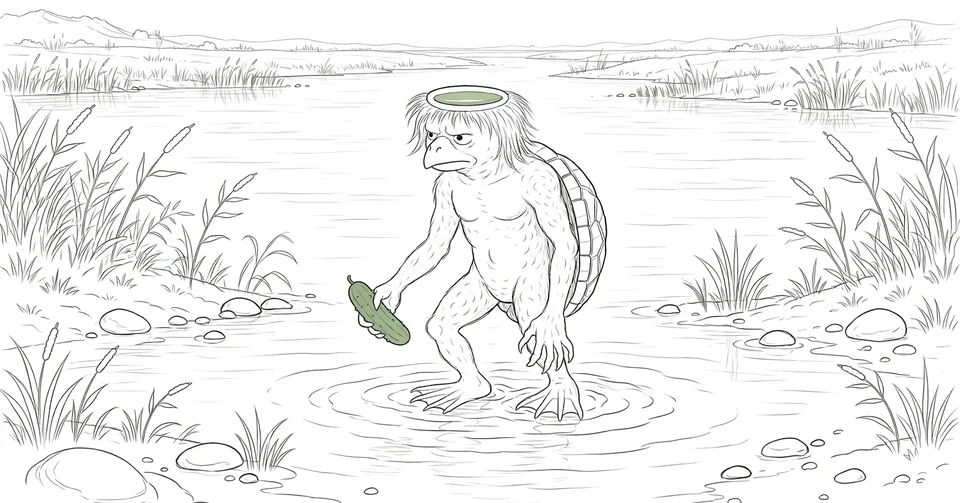
The warning works because the creature behind it is so specific. It is not a vague ghost or a faceless spirit. It has a beaked mouth, webbed hands and feet, and a bald patch on its head that holds water like a saucer. That dish is the whole secret of the creature. While the water stays in it, the creature is strong enough to drag a horse toward the river. Once the water spills, the creature weakens, and that weakness is the one fair trick a human has against it.
So the creature is two things at once, and that is why it has lasted so long in Japanese stories. It is a genuine danger, a drowner blamed for deaths in rivers and ponds, and it is also a polite, cucumber loving fool who can be beaten by a bow. Japan never chose one version over the other. It kept both, and the creature is richer for it.
I find this imp more interesting than the grander monsters of Japanese folklore precisely because it is small and local. It does not guard a mountain or haunt a castle. It lives in one river, one pond, one stretch of water behind a temple, and it worries about cucumbers. There is something honest about a monster with such a small territory and such a clear appetite, and I think that is why people kept telling stories about it long after they stopped believing in it literally.
Kappa and the dish on its head
The standard picture of the creature is settled enough that a child could draw it from memory. It stands about as tall as a human child, with greenish skin that is sometimes described as yellow green or even red in some regions. Its hands and feet are webbed for swimming, its back carries a turtle like shell, and its mouth comes to a small beak. Long strands of hair hang down around a bald patch on the top of its head, and in that patch sits the dish, called a sara, which holds water even when the creature walks on land.
The dish is not decoration. Folklore says it draws its strength from the water it carries, and a full dish makes it mighty at sumo wrestling and strong enough to pull people and animals into the water. If the dish is damaged, or if the water spills or dries out, the creature becomes severely weakened and may even die. An early account from 1742, a collection called Rōō sawa, already describes the trick of upsetting the water in the dish in order to weaken the creature and capture it, which shows how old this detail is.
The creature also has stranger features in some local tales. In certain accounts its arms are joined through its torso and can slide from one side to the other, so that tugging one arm makes the other shrink and even fall out. In other regions the imp is said to be slimy enough that a sword cut slides off it, and to smell of fish. These details vary from village to village, which is normal for a creature that was never written down in one official version. The dish, the shell and the webbed hands are the parts that stay constant.
The name itself tells the story in one word. Kappa is a contraction of words meaning river and child, so the creature is literally a river child, and it is often translated into English as a water sprite. That translation makes it sound cute, which is misleading. The older stories are clear that the Kappa was a dangerous mankiller before it became a comic figure, and the cuteness came later.
Why the kappa wants your cucumber
No detail of the creature is more famous than its love of cucumbers. Folk belief names the cucumber as the creature's traditional favorite food, and at festivals offerings of cucumber are frequently made to it. Some regions also name eggplant, buckwheat noodles, adzuki beans and Japanese pumpkin among its favorites, but the cucumber is the one that stuck. A cucumber filled sushi roll is called a kappamaki, which means the creature's name sits on sushi menus all over the world, usually without anyone at the table knowing why.
The connection may run deeper than a joke about appetite. One explanation holds that the creature is a fallen form of a water god, and the first harvest of cucumber was always an offering to the water god. The tradition continued into modern times in some regions, where the first cucumbers of the season were offered at altars and pools for the Kappa before people were allowed to eat them. In old Edo, people bought cucumbers and floated them down the river to appease the creature and prevent drownings, and some families wrote the names of their children on the cucumbers to protect them. That is a strange image, a river full of floating cucumbers with children's names on them, but it shows how seriously the offering was taken.
There is even a disagreement in the folklore about whether eating a cucumber before swimming protects you or puts you in danger. In some regions it was customary to eat cucumbers before swimming as protection, while in others it was believed that doing so would guarantee an attack. The safest reading is the one the sources themselves suggest. Local rules varied, and a visitor was wise to ask the locals before getting into the water. The imp is a local creature, and its rules were local too.
The shirikodama and the danger in the water
The frightening side of the Kappa is not only that it drowns people. It is accused of reaching into its victim to remove a mythical organ called the shirikodama, a small ball said to contain the soul and located inside the anus. The creature is said to eat the shirikodama, which some accounts call its favorite food alongside cucumbers, or to be after the liver behind it. The idea is grotesque, and it probably grew from the condition of drowning victims found in rivers, but the story did its job. It made the water frightening in a way a simple warning never could.
That is the practical purpose the creature has always served. It is the monster blamed for drownings, the creature said to lure people into the water and pull them under with great skill at wrestling. Children were warned about it to keep them from swimming in dangerous places, and warning signs featuring the creature still stand beside rivers in Japan today. In that sense the Kappa is a piece of public safety equipment dressed up as a monster, and it worked for centuries because the story was more memorable than a lecture.
The older literature is harsher than the modern picture. Writers from the early 1700s describe the Kappa as a mankiller that drowned people, dragged horses and cattle into the water, and left survivors in a stupor. Over the Edo period the image softened into something more comic, a mischievous creature that bungles its mischief and gets punished. Both versions survived side by side, and the modern imp carries the shadow of the older one. A cute mascot with a dark history is still a creature with a dark history.
How to beat a kappa with a bow
The creature has two weaknesses, and both are wonderfully Japanese. The first is the dish on its head. The second is politeness. The creature is obsessed with good manners, so if a person makes a deep bow, it will return the gesture, and the water in its dish spills out as it bends. One caught in that position cannot leave it until someone refills the dish with water from the river where it lives. Refill it, and folklore says the creature will serve that person for the rest of its life.
The trick fits neatly into the creature's favorite sport. The creature loves sumo wrestling and challenges people to matches, and it is very strong on land as long as its dish is full. A human who accepts the challenge is likely to lose the bout, but a sumo match begins with a bow, and the bow is the opening the human needs. Bow first, let the creature bow back, and watch its strength pour out onto the ground with the water. It is a fight won by etiquette, which may be the most Japanese victory in all of folklore.
There are other defenses in the old accounts. The creature is said to dislike gourds, sesame, ginger and iron, and catching one often meant using its desires against it, luring it with the very thing it wanted most. None of these tricks require strength or weapons. They require knowing the creature's habits, and that is the real lesson of the stories. The imp is beaten by attention and manners, not by force, and a child who knows the trick is safer than an adult who does not.
The grateful kappa and the arm that buys medicine
The strangest part of the Kappa stories is what happens after the creature is caught. A captured Kappa rarely stays an enemy. In tale after tale it begs for forgiveness, and in exchange it offers something useful. The most common payment is a secret medicine. A Kappa that has lost an arm, often sliced off by a samurai when it reached up out of a toilet to grab someone, will trade the recipe for a wonder drug that heals sword wounds in return for getting its arm back. Tales of medicine won from the creature are found all over Japan, and the drug is sometimes said to treat other ailments as well.
Other captured Kappa make different bargains. Some submit written apologies and vow to behave. Some bring gifts of fish. Some help with work in the fields. There are stories of a Kappa that is befriended and then performs tasks for humans for years, a river worker with webbed hands and a strong back. The pattern is consistent. The creature starts as a threat, loses a contest, and ends as a neighbor with useful skills.
This is why I think the Kappa survived when other monsters faded. It is not only a warning or a joke. It is a small story about how enemies become neighbors, and about how a debt paid honestly can turn a dangerous creature into a helpful one. The creature that once drowned people ends up setting broken bones and teaching medicine, and the village that once feared it ends up building it a shrine. That arc, from fear to familiarity, is the whole history of the Kappa in one shape.
Where kappa live on the map
The Kappa is not one creature but a family of local creatures with at least eighty regional names. In the east it was usually called kappa, while in the west, in Kyushu and the Kansai region, it was often called kawatarō, a hairier and more monkey like version. Other names point to the animals the creature may have been based on, including monkeys, turtles and the now extinct Japanese river otter. In some regions it is called by the same name as the soft shelled turtle, which tells you how turtle like the local version was thought to be. The yokai article that inspired this one places the Kappa among the great spirits of Japanese folklore, and the list of its local names shows how widely it was known.
The best known home of the creature is the Kappabuchi, a river pool in Tōno in Iwate Prefecture, on the Ashiarai River behind the Jōkenji temple. Tōno is the town of the Legends of Tono, the early twentieth century collection of folk tales that preserved many stories about the creature, including the unsettling tale of a child born looking something like the creature. The pool is still a place people visit, and the town has kept the creature as part of its identity rather than letting it fade into a book.
Tokyo has its own Kappa geography. At Sogenji Temple in Asakusa, also known as Kappa-dera, the story says the area suffered repeated floods until a group of the creatures helped build flood control structures, and the creatures are now venerated there. The temple is even said to hold a mummified hand of a Kappa as a relic. Nearby stands the Kappabashi district, whose first bridge was reportedly built by a raincoat merchant who hired Kappa to labor on it. The raincoat connection is a pun that runs through the folklore. The Japanese word for raincoat, amagappa, contains the creature's name, and one story says the creature must take off its skin to sleep, leaving it defenseless without it.
From river monster to mascot
By the twentieth century the Kappa had become more cute than scary, and the change was deliberate. In the 1960s the manga artist Mizuki Shigeru drew a Kappa named Sanpei as perfectly adorable, with basically the same face as his human friend, and wrote stories in which the two are mistaken for each other. From the 1970s onward, rural revitalization projects and festivals used the friendly version of the creature as a symbol, playing on its association with nature and a disappearing country lifestyle. Today the Kappa appears on warning signs, on posters asking people not to litter, and in campaigns to protect clean water. It also appears as a mascot on local specialties and character goods.
The shift is ironic and also fitting. A creature that once personified the violence of water has become a poster child for protecting it, and the folklore scholar Michael Dylan Foster has described exactly that turn, calling the creature a symbol of the natural world that needs protection. The creature is still used to warn children away from deep water, but some of the signs now look more like friendly advice than a threat. The monster did not disappear. It changed jobs.
The language kept the creature too. The saying kappa no kawanagare means even a Kappa can drown, a warning that anyone can fail at the thing they know best. Another saying, he no kappa, compares doing something easily to a Kappa passing gas, and the creature is famously good at farting in the old prints. These are not grand proverbs. They are the kind of everyday phrases that show a monster has moved into the language itself, and that may be the most lasting home the Kappa ever found.
The kitsune belongs to the same old company of famous yokai, a fox messenger that guards shrines while the Kappa guards rivers, and the two creatures show the two poles of Japanese folklore. One is elegant and sacred, the other is slimy and rude, and both are loved. That range is worth noticing. Japanese folklore makes room for a shrine fox and a river imp with equal seriousness, and the imp may be the more honest of the two about what nature actually is.
For a fuller picture of the creature's appearance, its many names and the old accounts behind the stories, the Wikipedia article on the Kappa) collects the sources in one place. For a livelier tour through the legends, including the bowing trick, the sumo challenges and the modern mascot turn, Tofugu's guide to the Kappa tells the story with the humor the creature deserves.
The warning that still works
The Kappa endures because it was never only a monster. It was a lesson about water, told in a shape a child could remember. A river is beautiful and dangerous in the same moment, and a creature with a dish on its head and a cucumber in its hand makes that truth easy to carry. The stories gave children a reason to stay out of deep water, gave villages a way to talk about drownings, and gave everyone a small comedy about manners beating strength.
I still think the bow is the best part of the whole legend. The creature is stronger than you, faster in the water than you, and armed with a grip that can pull a horse. None of that matters if you bow first. Politeness is not weakness in these stories. It is the one weapon that always works, and the Kappa, for all its teeth and claws, cannot resist returning it. That is a good rule for rivers, and it is not a bad rule for the rest of life either.
So the warning stands, and it should. Do not swim alone. Do not trust a calm river. And if you meet a small green creature with a dish on its head, bow low, keep your cucumbers close, and remember that the oldest safety advice in Japan comes with a joke attached. The Kappa is still there, in the stories and on the signs, doing the job it has done for centuries. It keeps children out of the water, and it keeps the rest of us honest about how much we still do not know about the rivers we live beside.
More in Culture & Society
- Miyadashi Is the Moment the God Leaves Home
- Otabisho Is Where the God Rests on the Way Through Town
- Mikoshi Are the Portable Shrines Japan Carries on Its Shoulders
- Sanja Matsuri Turns Asakusa Into Tokyo's Loudest Weekend
- Waraji Straw Sandals Walked Japan for a Thousand Years
- Fujin Carries the Wind That Arrives Before the Thunder
Latest posts
- An Engawa Is Neither Inside nor Outside, and That Is the Point
- Nikko and the Shrines Hidden in the Cedar Forest
- Minka Are the Folk Houses Japan Built Around the Hearth
- The Orangutan and the Vanishing Forests of Borneo
- Hozomon Guards the Treasure House Behind Senso-ji's Main Hall
- Nakamise Is the Shopping Street That Has Fed Pilgrims for Centuries
- Kaminarimon Is the Thunder Gate That Opens Asakusa to the World
- Sony, the Tokyo Workshop That Taught the World to Listen
- Raijin Is the Thunder God Behind Japan's Summer Storms
- Tengu Is the Mountain Goblin Japan Still Meets on the Trail
- Calonarang Is the Night Rangda and Barong Finally Meet
- Yamata no Orochi Was Never Just a Monster to Slay
- Kit Kat Japan, the Flavours You Will Not Find Anywhere Else
- How Susanoo Slew the Eight-Headed Serpent and Won a Bride
- How Kusanagi Became Japan's Most Guarded Sword