How Susanoo Slew the Eight-Headed Serpent and Won a Bride
· 14 min read
Susanoo, the storm god of Japanese myth, slew the eight-headed serpent Yamata no Orochi in Izumo, found the sword Kusanagi in its tail, and won the hand of Kushinada-hime. This is the story of how a disgraced god earned his redemption.
The storm god Susanoo killed an eight-headed serpent, found a sacred sword inside its tail, and married the last daughter of the couple he had saved. That single sentence holds the whole myth, and it is worth pausing over, because the god who did all of it was not a hero when the story began. He was a troublemaker freshly thrown out of heaven, with nowhere to go and no one left to impress.
Susanoo had quarreled with his sister Amaterasu, the sun goddess, so badly that she hid herself in a cave and took the light of the world with her. The other gods coaxed her out again, but Susanoo himself was banished from the heavenly plain. He came down to earth in disgrace, and it was there, in the land of Izumo, that he met an old couple weeping beside a river for daughters they had already lost. What happened next turned an exile into a husband, a killer of monsters, and the founder of a home.
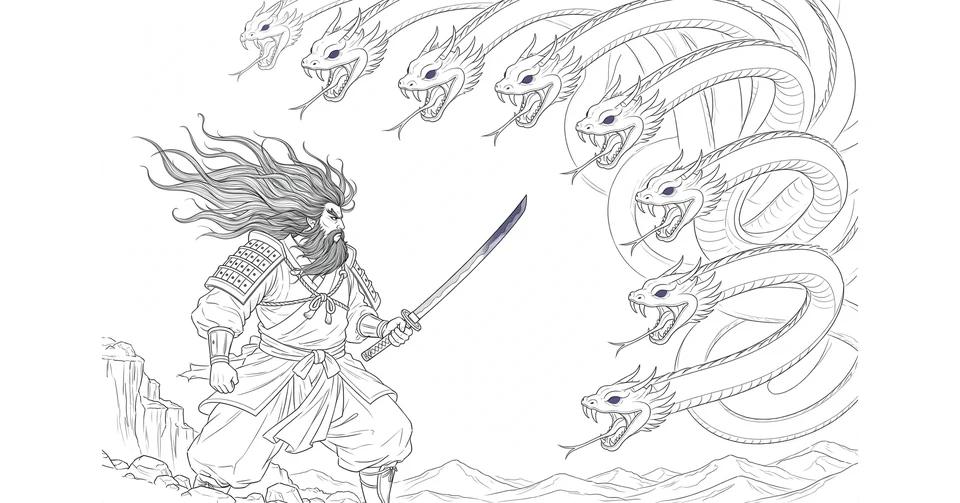
The story survives in the two oldest chronicles of Japan, the Kojiki, completed in 712, and the Nihon Shoki, completed in 720. The two books do not agree on every detail, and the honest way to read them is to hold the core steady and let the small differences stand. In both versions, Susanoo faces the serpent, outwits it rather than overpowering it, and walks away with a bride and a sword. The full story of the sword is told in how Kusanagi became Japan's most guarded sword, but the sword was only the second prize. The first was a life rebuilt from nothing.
the storm god who could not stay in heaven
Susanoo was born from the nose of the creator god Izanagi, during the ritual washing Izanagi performed after returning from the underworld. His sister Amaterasu was born from the left eye and his brother Tsukuyomi from the right eye, and the three together were called the three noble children. Where Amaterasu was given the sun and Tsukuyomi the moon, Susanoo was associated with wind and rain, and with the sea plain he was ordered to rule. The Encyclopedia of Shinto, compiled by Kokugakuin University, puts the contrast plainly in its entry on Susanoo. In heaven his deeds were without exception disruptive of order, while in Izumo he appears as a god bringing orderly rule to the area.
The trouble began because Susanoo did not want the domain he was given. According to the chronicles, he longed instead to visit his dead mother in the underworld, and he wept and howled until the mountains withered and the seas dried. His father Izanagi banished him for it. Before leaving heaven, Susanoo went to say farewell to Amaterasu, and she, suspecting him of coming to seize her realm, made him undergo a trial by pledge. He declared himself the winner of the trial, and then, drunk on his own victory, he ran wild. He broke down the divisions of her rice fields, defiled her sacred hall, and in the worst of the rampage a heavenly horse was thrown through the roof of her weaving hall, killing one of her attendants. Amaterasu fled into the rock cave and sealed the entrance, and darkness fell over heaven and earth.
The gods eventually lured Amaterasu out with music, dancing, and a mirror, an episode told in the cave where Amaterasu hid the sun. Susanoo was punished with a heavy fine and expelled from heaven for good. Yet the same chronicles refuse to leave him as a villain, and that refusal is what makes the story worth telling. Exile is not the end of his story. It is the place where his story finally begins.
I think there is something quietly honest about a mythology that lets its gods be this flawed. Many traditions give their heroes a clean past and a single mistake. Susanoo gets a whole career of bad behavior, and then he gets a second act anyway. The myth does not excuse what he did in heaven. It simply insists that a person, or a god, is more than the worst thing he has done, and that the proof of change is not an apology but a different kind of deed.
the weeping couple at the river Hi
Susanoo descended to the land of Izumo, in what is now Shimane Prefecture, and came to the upper reaches of the river Hi, known today as the Hii River. There he found an elderly couple weeping, with a young girl standing between them. The old man introduced himself as Ashinazuchi, the old woman as Tenazuchi, and the girl as their daughter Kushinada-hime. They told Susanoo that they had once had eight daughters, and that seven of them had been devoured, one each year, by a monstrous serpent called Yamata no Orochi. The eight-headed serpent would return for the last daughter, and the parents were weeping because there was nothing they could do to stop it.
The serpent of the Kojiki is a creature built to frighten. It has eight heads and eight tails, eyes red like winter cherries, and a body so vast that it stretches across eight valleys and eight hills, with moss and trees growing on its back and a belly that is always bloody and raw. It is less a beast than a landscape that eats people, and the parents' grief is the grief of people who have watched a disaster return on schedule, year after year, and learned that pleading does not help.
Susanoo made the couple a bargain. If they would give him Kushinada-hime as his wife, he would kill the serpent. They agreed, and he set to work. The bargain is easy to judge harshly from a modern distance, and it is worth pausing on rather than rushing past. A god in exile, with no home and no standing, asks grieving parents for their last child as payment for a rescue, and they accept because they have no better offer. The myth does not present this as a model of courtship. It presents it as a transaction struck in desperation, and the marriage that follows has to earn its meaning afterward, in the life the two of them build together.
The Nihon Shoki preserves a different version of the fight, placing it by the river E in what is now Hiroshima Prefecture, and in one variant Kushinada-hime has not even been born when the serpent dies. The Kojiki version, set in Izumo with the marriage at its center, is the one that has shaped shrines, festivals, and folk plays ever since. When old sources disagree like this, the careful choice is to follow the version the living tradition has kept, and to say plainly that another version exists.
eight vats of sake and one patient trap
Susanoo did not meet the serpent with a charge and a war cry. He met it with a fence, eight gates, eight platforms, and eight vats of sake brewed strong, one for each head. The serpent had eight heads, so the plan gave each head its own drink, and the trap relied on appetite rather than strength. The creature came, put a head into every vat, drank itself senseless, and lay sprawled and helpless. Only then did Susanoo draw his sword, the ten-span blade at his side, and cut the serpent apart head by head and tail by tail until the river ran with blood.
There is a practical wisdom in the trick that the myth seems proud of. Susanoo was a storm god, and a storm god could have tried to overpower the beast with wind and fury. Instead he studied what the serpent wanted and gave it exactly that, in a quantity it could not handle. The victory belongs to patience and observation, not to rage, and that matters because rage was the very thing that had gotten him exiled. The god who once smashed his sister's rice fields in a tantrum now builds a fence, waits quietly, and strikes only when the moment is right.
the sword inside the tail
When Susanoo cut through the serpent, one tail resisted his blade. His sword struck something hard inside the flesh, and when he split the tail open he found a great sword lodged within it. The sword was the Ame-no-Murakumo, the Heavenly Sword of Gathering Clouds, the blade later known as Kusanagi. He carried it up to heaven and presented it to Amaterasu as a gift, and the gift carried an apology that words could not. The two were reconciled.
The reconciliation is the quiet heart of the whole myth. Susanoo did not return to heaven to demand his place back, and he did not send the sword as a boast. He offered the finest thing he had found, something he had pulled from the body of a monster with his own hands, to the sister he had wronged. A gift that costs the giver his pride is remembered longer than a gift that costs him money, and this one changed the course of Japanese myth. The sword passed from Amaterasu to her grandson Ninigi when he descended to rule the earth, and from him down the imperial line, becoming one of the three sacred treasures beside the mirror and the jewel.
a wedding, a home, and a new beginning
After the serpent was dead, Susanoo married Kushinada-hime, as promised, and the two of them settled in the land of Izumo. He built a palace at Suga, in what is now the city of Unnan in Shimane Prefecture, and tradition credits him there with composing the first waka poem, a verse about eightfold clouds rising over Izumo, a line that poets have quoted ever since. The marriage that began as a bargain became a household, and the household became a home, and the home became the center of a new life.
The couple had children, and their descendants fill the later books of the chronicles, including Okuninushi, the god who would one day hand the land over to the descendants of Amaterasu. That handover, the transfer of the land, is one of the great turning points of Japanese myth, and it runs through the family Susanoo founded in Izumo. The exile who arrived with nothing became the ancestor of the god who governed the land itself, which is the kind of long arc the chronicles love. A life is not judged by its worst year, and a family is not defined by how it begins.
Suga Shrine in Unnan stands today on the site tradition associates with the palace, and the area around the Hii River still keeps about fifty sites tied to the serpent legend. The Iwami Kagura, a ritual dance theater of western Shimane, still performs the serpent story through the night, with a great eight-headed serpent puppet writhing across the stage while the drums drive the action on. The myth is not a text on a shelf. It is a performance people still gather to watch, and a landscape people still walk through with the story in mind.
| Susanoo in heaven | Susanoo in Izumo |
|---|---|
| Broke the divisions of Amaterasu's rice fields | Built a fence with eight gates to trap the serpent |
| Defiled the sacred hall and caused a death | Protected Kushinada-hime by hiding her in his hair |
| Declared himself the winner and ran wild | Waited patiently for the serpent to drink itself senseless |
| Banished from the heavenly plain | Settled at Suga and founded a household |
The table above is a simplification, and old myths resist neat summaries, but the contrast is one the chronicles themselves invite. The same god, the same temper, the same strength, turned toward two different ends. In heaven his power broke things. In Izumo it fixed them. The difference was not a new power but a new purpose, and that is a distinction worth carrying out of the story and into ordinary life.
where Susanoo is still worshipped today
Susanoo did not fade into a storybook after the serpent died. He is still enshrined across Japan, and the two shrines most closely tied to him show the two sides of his character. In Izumo, Susa Shrine in what is now Izumo City is traditionally associated with pacifying his spirit, a quiet shrine in the land where he settled and married. In Kyoto, Yasaka Shrine in the Gion district enshrines Susanoo as its chief deity, alongside his wife Kushinada-hime and their eight children, and it is the home of one of Japan's most famous festivals.
The Gion Matsuri, held every July at Yasaka Shrine, began as a prayer against plague. According to Kyoto's official tourism site, the festival traces its origin to the year 869, when an epidemic struck the capital and the emperor sent a messenger to Yasaka Shrine to pray for the disease to end. Sixty-six halberds, one for each province of the country at the time, were raised in offering, and from the year 970 the rite became an annual event. The connection to Susanoo is the point of it all. He was believed to have unusual power against plague, and his spirit was said to ride in the portable shrines carried through the streets of Kyoto, as described in the Kyoto tourism board's guide to the Gion Matsuri Festival. A god once banished for bringing disorder became the god people called on to restore order when disease threatened the city.
There is a long history behind that transformation. From the medieval period onward, Susanoo was frequently identified with Gozu Tenno, a deity of the Gion faith associated with protection against epidemics, and the two figures blurred together in popular worship until the separation of Shinto and Buddhism in the nineteenth century restored Susanoo as the named deity of Yasaka Shrine. The details are tangled, and scholars still debate them, but the shape of the story is clear. A storm god became a plague god, and a plague god became the patron of a festival that now fills Kyoto with music, floats, and crowds for a whole month each summer.
what the serpent story still teaches
The story of Susanoo and the serpent has lasted for more than thirteen centuries, and it has lasted because it is not really about a monster. Monsters are easy to invent and easy to forget. What lasts is the shape of a life that goes wrong and then, slowly and without fanfare, goes right. Susanoo does not become good by deciding to be good. He becomes good by doing one useful thing, then another, and letting the useful things add up until they outweigh the harm.
That is a useful measure for the rest of us. Most people do not get a single dramatic moment of redemption, and waiting for one is a way of wasting years. What we get instead are small chances to be helpful to someone who is grieving, to plan carefully instead of charging in, and to finish a hard job instead of leaving it half done. Susanoo took those chances in Izumo, and the myth remembers him for them rather than for the rampage in heaven. It does not forget the rampage. It simply refuses to let the rampage be the whole story.
Susanoo arrived in Izumo as an exile with a ruined reputation, and he left the serpent's riverbank as a husband with a home and a sword that would outlast him by more than a thousand years. He did not get his old life back, and he did not need to. He built a new one out of a fence, eight vats of sake, a careful plan, and a promise kept, and the new life turned out to be the one worth remembering. That is the calm at the center of the story, and it is why people still tell it. A monster can be slain, a debt can be repaid, and a person who has done real harm can still, with patience and useful work, become someone his neighbors are glad to have living beside the river.
More in Culture & Society
- Miyadashi Is the Moment the God Leaves Home
- Otabisho Is Where the God Rests on the Way Through Town
- Mikoshi Are the Portable Shrines Japan Carries on Its Shoulders
- Sanja Matsuri Turns Asakusa Into Tokyo's Loudest Weekend
- Waraji Straw Sandals Walked Japan for a Thousand Years
- Fujin Carries the Wind That Arrives Before the Thunder
Latest posts
- An Engawa Is Neither Inside nor Outside, and That Is the Point
- Nikko and the Shrines Hidden in the Cedar Forest
- Minka Are the Folk Houses Japan Built Around the Hearth
- The Orangutan and the Vanishing Forests of Borneo
- Hozomon Guards the Treasure House Behind Senso-ji's Main Hall
- Nakamise Is the Shopping Street That Has Fed Pilgrims for Centuries
- Kaminarimon Is the Thunder Gate That Opens Asakusa to the World
- Sony, the Tokyo Workshop That Taught the World to Listen
- Raijin Is the Thunder God Behind Japan's Summer Storms
- Tengu Is the Mountain Goblin Japan Still Meets on the Trail
- Kappa Is the River Imp Japan Still Warns Its Children About
- Calonarang Is the Night Rangda and Barong Finally Meet
- Yamata no Orochi Was Never Just a Monster to Slay
- Kit Kat Japan, the Flavours You Will Not Find Anywhere Else
- How Kusanagi Became Japan's Most Guarded Sword