Jikan-Yu Gives You Exactly Three Minutes
· 9 min read
In Kusatsu, jikan-yu turns bathing into a timed ritual: stir the scalding water, pour it over yourself, then soak to the neck for exactly three minutes, no more.
Most bathing advice in Japan tells you to slow down. Sink in, empty your mind, stay until your fingers wrinkle. The hot spring town of Kusatsu, high in the mountains of Gunma, mostly agrees, except for one stubborn ritual that runs the other way. It is called jikan-yu, the timed bath, and it gives you exactly three minutes.
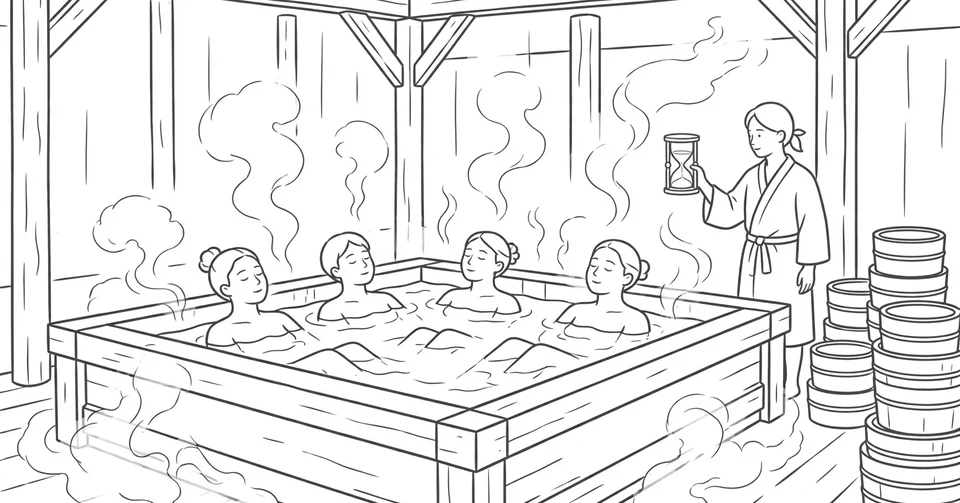
Three minutes is not a suggestion. In jikan-yu the whole group prepares together, enters together, and climbs out together when the time is called. The water is far too hot and far too strong for drifting, so the town long ago turned the bath into a drill: stir the water, pour it over yourself, soak to the neck, get out. Done properly, jikan-yu is over before an ordinary bath has even begun.
I find something honest in that. Plenty of famous springs quietly dilute their water until it suits everyone. Kusatsu refuses, and jikan-yu is what bathing looks like when the water wins: short, strict, and shared, a small ceremony of respect for a spring that could scald you if you treated it casually.
What jikan-yu actually involves
A session of jikan-yu begins before anyone touches the water. The bath is scalding, so the first job is cooling it without weakening it, and that is done by yumomi, the paddle stirring that cools the bath without diluting it. Bathers stand around the wooden tub with long planks, around 180 centimetres each, and churn the surface in unison. The stirring is rhythmic work, and the rhythm is kept by song: the Kusatsu-bushi, the town's old bathing song, sets the pace so that a dozen strangers stir as one.
Only when the water has dropped to something a body can survive does the second act begin. Each bather ladles the hot water over themselves, bucket after bucket, a practice called kaburiyu when it is poured over the head. This is not washing. It is acclimatisation, a way of telling the skin and the circulation what is coming, so that the shock of the full bath lands as a jolt rather than a blow. In the old medical literature on Kusatsu, researchers described patients pouring twenty pails of water over their heads before entering, and treated the custom as a serious part of the method. When later researchers tested the head pouring on its own, they found it did not directly stir up the body's stress hormones. Its value seemed to be preparation: opening the blood vessels of the head in advance, so the rush of heated blood that follows a very hot bath meets a system that is ready for it.
Then comes the bath itself. Everyone lowers in up to the neck and stays there for exactly three minutes, timed in the traditional way by the attendant's calls and the singing rather than by a clock on the wall. At the signal, everyone climbs out. One soak is a round, and rounds repeat: in the classic therapeutic routine, bathers repeated jikan-yu up to four times a day, and kept that schedule up for weeks at a time.
Water too strong for lingering
To understand why anyone would ration a bath to three minutes, you have to understand Kusatsu's water. It emerges from the ground at over 50 degrees Celsius, loaded with sulfur, with a pH down around 2, acidic enough that the town's own legend claims it can cure anything except lovesickness. I have written before about the town that refuses to water down its springs, and that refusal is the whole point. Adding cold water would make the bath gentler and, in the local view, pointless. The minerals are the medicine, so the minerals stay.
What changes is everything around the water. Channels of wooden sluices at the Yubatake spring field bleed off heat on the way into town. Yumomi stirring sheds a few more degrees and raises the pale mineral flakes called yunohana, which coat the skin and are said to soften the bite of the bath. Even after all that, the water in a jikan-yu tub sits in the high forties, around 47 or 48 degrees depending on the account. At that temperature, in water that acidic, lingering is not relaxation. It is a mistake. The three minutes of jikan-yu are not miserly. They are calibrated.
There is a discipline hidden in that calibration that I admire. A long soak asks nothing of you except patience. Jikan-yu asks for attention: stir properly, pour properly, breathe through the first fierce minute, and get out when you are told. The bath has rules because the spring has teeth, and everybody in the tub knows it.
Everyone moves on the same clock
Jikan-yu was never a solitary practice. It belonged to the communal bathhouses, the small wooden soto-yu scattered around the town, where neighbours and cure guests bathed side by side under the eye of a bath attendant. These are intimate rooms even now: the town's free public bathhouses, Shirahatanoyu, Chiyonoyu and Jizonoyu, each fed by a different spring, hold only two to four bathers at a time, with little more than a changing space, a shelf for your clothes and the tub. In a bath that small, a shared method is not a quaint custom. It is the only way the room works, because one person soaking at leisure would be taking up a quarter of the town's hospitality. In the Meiji period that attendant, the leader of the session, directed the stirring and the soaking like a conductor, and the role survives today under the name yucho. When the leader calls, the group moves. Nobody negotiates with the clock, because the clock is the same for the first timer and the veteran on his hundredth cure.
That shared timing is easiest to see today at Netsu-no-yu, the hall facing the Yubatake, where the yumomi performance reproduces jikan-yu for an audience six times a day. Women in matching dress stir the great tub to the Kusatsu-bushi, pour the water, and demonstrate the soak, and the show is genuinely a demonstration rather than a dance: this is how it was done, measured out in song. Watching it, you realise the song was never decoration. The song was the stopwatch, and singing together was how a room full of people kept the same three minutes.
A discipline first, a cure second
Kusatsu built its name on toji, the old practice of staying at a spring for weeks to treat illness, and jikan-yu was one of its core prescriptions. The German physician Erwin von Balz, who introduced Kusatsu to the West, researched the method in the late nineteenth century and believed the timed hot baths, together with the mountain air, did his patients good. Doctors at the university clinic in Kusatsu were still publishing studies of the time limit bath in the 1950s, measuring what a three minute bath at 47 degrees did to the blood of the patients who repeated it four times a day.
The traditional claims around jikan-yu are confident: better circulation, relief for chronic aches and skin conditions, a general resetting of the body. I would file those claims where they belong, as the working beliefs of a cure tradition rather than as settled medicine, and the tradition itself was honest about the costs. The old studies noted that weeks of bathing in that acid water could raise a raw dermatitis in the folds of the skin, which the bathers accepted as part of the cure. Jikan-yu was never sold as gentle. It was sold as effective, which is a different promise, and one I am content to leave to the judgement of the people who swore by it.
What I do believe, from the logic of the thing, is that the strictness itself did some of the work. A cure you perform exactly, four times a day, in company, under instruction, for weeks, organises a life around recovery. Whether the healing came from the sulfur or from the schedule, the schedule was real, and jikan-yu supplied it.
Where jikan-yu survives now
The everyday version of jikan-yu has shrunk. Kusatsu still runs hot and undiluted, but most visitors now soak at their own pace in the town's baths and inns, and the timed ritual survives in narrower channels: scheduled sessions at a few communal bathhouses, including the public Jizonoyu, and at Chiyo-no-yu, where a dedicated jikan-yu bath runs at set times of day and everyone still moves together on command. The rest of its public life is the Netsu-no-yu performance, six shows a day, preserving the choreography for people who will mostly never be timed themselves.
That is a familiar pattern in Japan, where a working practice retires into a demonstration and is kept alive by being watched. I do not think jikan-yu has been diminished by it. The water is still there, still too strong to argue with, and anyone who books a session at a communal bath can still learn in three minutes what the performance can only describe.
Because that is the real souvenir of jikan-yu, and it fits in a sentence: some waters are not for lingering in. In a country that has perfected the art of the endless soak, Kusatsu keeps one bath that measures you instead, three honest minutes, counted out loud, and it has kept faith with that small strict idea for well over a century. I hope it keeps the clock running.
More in Life & Style
Latest posts
- Shimekasu Was Herring You Never Ate
- A Hana Donko Wears Its Cracks Like Flowers
- Hashigo-Nori Is Riding a Ladder Someone Else Holds
- At a Goma, Prayers Are Written to Be Burned
- The Sekaa Teruna Builds the Monsters
- A Lembaga Perkreditan Desa Is a Bank the Village Owns
- Every Melasti Goes to Fetch Tirta Amerta
- Kuki Is the Spring the Sea Turned White
- When the Kulkul Stops Sounding for You
- A Caru Is an Offering for the Ones You Fear
- Tatsuko Wished for Beauty and Became a Statue
- Warangan Is the Wash That Reveals the Pattern
- Every Village Writes Its Own Awig-Awig
- Umaji Refused to Disappear
- Rwa Bhineda Keeps Opposites From Going to War