Yu No Hana Are Flowers You Bathe In
· 9 min read
Yu no hana, the pale sulfur crust skimmed from the wooden cooling troughs of Kusatsu, has been harvested since around 1790 and ground into bath powder, so travellers can take Japan's most famous hot spring water home with them.
Stand in the middle of Kusatsu on a cold morning and you will see steam rising off a wide field of wooden troughs, and along the edges of those troughs a pale crust forming, soft and white, like frost that grows in hot water instead of cold. That crust is yu no hana, which translates literally as hot spring flowers. It is not a flower at all. It is a sulfur rich mineral deposit that crystallises out of Kusatsu's fiercely acidic water as the water cools, and the town has been gathering it for more than two centuries.
A few times a year, workers skim the yu no hana off the troughs, dry it and grind it into a fine powder that is sold in small jars and packets in the souvenir shops around the square. Dissolve a spoonful in a bathtub at home and the water turns cloudy and smells faintly of sulfur, a modest home copy of the real bath. It is one of the oldest souvenirs in Japanese travel, and one of the most literal. Most souvenirs are pictures of a place. Yu no hana is a piece of the place itself.
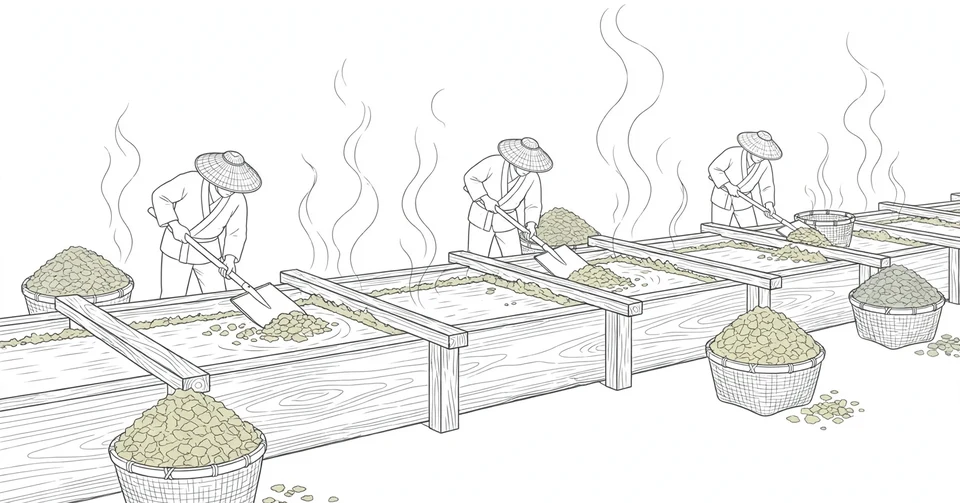
The part I enjoy most is that the harvest is not really a harvest. The same deposit that becomes yu no hana in a jar is also the deposit that clouds Kusatsu's baths their milky colour, and the same one that slowly builds up inside troughs and pipes and has to be cleared away. Skimming it off is plumbing maintenance that the town learned, a very long time ago, to sell. The flowers are what the water leaves behind, and Kusatsu simply found a use for the leaving.
What yu no hana actually is
Hot spring water is never just water. On its way up through volcanic rock it dissolves minerals, and at Kusatsu it picks up a heavy load of sulfur along with a strong dose of acid. While the water is still underground and hot, all of that stays dissolved and invisible. Once the water reaches the surface and starts to cool, and its mineral content grows more concentrated as it travels, some of those minerals can no longer stay in solution. They come out as fine crystals and settle as a soft white crust wherever the water slows down. That crust is yu no hana.
Seen up close, the name stops sounding like poetry and starts sounding like plain description. The deposits form in pale blooms along the edges of the wooden channels, spreading the way frost spreads across a window. Sulfur gives Kusatsu's water its yellow tinge at the source, and the finest particles of yu no hana, still suspended in the flow rather than settled, are a large part of why the baths themselves look milky instead of clear. A bather in Kusatsu is, in a sense, soaking in flowers that have not yet landed.
Not every spring grows them. A mild, clear spring has little to deposit. Yu no hana belongs to the strong springs, the acidic and sulfur heavy ones, the kind of water that blackens silver jewellery and eats through metal pipes. The flowers are a byproduct of intensity. Weak water leaves nothing behind.
Why Kusatsu grows them so well
Kusatsu, on a plateau some 1,200 metres up in the mountains of Gunma, has the raw material in unusual abundance. It is counted among Japan's three great hot spring resorts, alongside Arima and Gero, and its flow of natural spring water is the most prolific in the country. The water at the Yubatake, the great open field of troughs at the centre of town, emerges at anywhere from about 50 to more than 90 degrees Celsius, and the Yubatake spring is strongly acidic, with a pH of around 2.1. That is water closer to lemon juice than to anything you would normally bathe in.
The town's whole system exists to cool this water without weakening it. Kusatsu has always refused to simply add cold water, because dilution spoils what makes the spring itself. Instead the water runs in the open air through long wooden channels, losing heat to the sky as it goes, which is the arrangement I described in my piece on the yubatake and how Kusatsu cools its spring with nothing but wood and gravity. Wood is not a quaint choice here. Acid water destroys metal, so the plumbing of the entire town is carpentry.
And it is exactly that long, slow, cooling journey that grows yu no hana. Every metre of trough is a place where the water sheds a little heat and a little of its mineral load, so the yu no hana gathers steadily along the channels. No cooling field, no yu no hana. The deposit is the visible receipt for the town's stubbornness about dilution, the subject of my earlier piece on Kusatsu and its undiluted onsen. A town willing to water its spring down would have clearer troughs and nothing to harvest.
A harvest older than the souvenir shop
The collection of yu no hana is believed to have begun around 1790, in the late Edo period, which makes it older than the railway, older than the postcard, older than almost every habit we now associate with tourism. Even today the deposits are gathered only a few times a year, and because the amount that can be collected is limited, the genuine article is treated as a valuable local specialty rather than a bulk product. What is skimmed from the troughs is all there is until the water lays down more.
The name of the field itself keeps the memory of the harvest. Yubatake means hot water field, and one explanation, noted in a nippon.com guide to the resort, is that the main spring earned that name because yu no hana, the flowers of the water, are plucked from it. Field and flowers and harvest: the vocabulary of farming, applied to steam. Travellers in the Edo period wanted to carry the famous water home just as travellers do now, and the dried crust was the only portable form the spring allowed. Local tradition even holds that Kusatsu water was transported all the way to Edo Castle for the eighth Tokugawa shogun, Yoshimune. Whether or not every barrel of that story is true, the impulse behind it is easy to understand. Strong water was precious, and yu no hana was how it travelled.
I find something honest in that. A great deal of the modern souvenir trade is scented, dyed and flavoured imitation, an onsen bath salt manufactured far from any spring and perfumed to suggest one. Yu no hana makes no such pretence. The jar does not contain an impression of Kusatsu. It contains Kusatsu, or at least the part of Kusatsu that can be dried, ground and carried down the mountain.
Taking the water home
Using it is simple, and the simplicity is the point. A small amount of the yu no hana powder goes into a full bathtub of hot water, where it dissolves, clouds the water and gives off the spring's unmistakable sulfur smell. Visitors who buy it are usually chasing the reputation of the source. Kusatsu's waters have been praised as healing waters for centuries, a fame the German physician Erwin Bälz carried to the West in the Meiji era, and generations of travellers have soaked there believing the strong acid water does their skin and joints good. That reputation is best described as exactly that, a reputation and a belief held by the people who make the journey, and the home bath version inherits it in miniature. What a jar of yu no hana can honestly promise is the feel and the smell of the place, not a cure.
A little respect for the source is still wise. This is the deposit of water with a pH close to 2, so the powder is used sparingly, according to the directions on the packet, and it is not something to tip generously into the tub the way you might with ordinary bath salts. The same sulfur that perfumes the bath will blacken silver, which is why bathers in Kusatsu are told to leave jewellery in the locker, and why your best ring should stay out of the home version too.
Kusatsu did not keep the idea to itself. Any spring strong enough to lay down a crust can gather it, and packets of yu no hana now sit on souvenir shelves in onsen towns far from Gunma, each one claiming the character of its own water. The Kusatsu original remains the famous one, partly because the spring is famous, and partly because the harvest is genuinely limited. The troughs produce what they produce. There is no factory setting that makes the water deposit faster.
There is a quiet satisfaction in the whole arrangement, I think. A town is given water so hot and so sour that it cannot be used as it comes out of the ground. It must be cooled in wooden fields, stirred with boards, handled with carpentry instead of plumbing. And the residue of all that difficulty, the crust that clogs the channels and clouds the baths, turns out to be the thing travellers most want to take home. Yu no hana is Kusatsu's problem, dried and ground and sold by the jar, and after more than two hundred years the flowers are still blooming in the troughs, right on schedule.
More in Life & Style
Latest posts
- Shimekasu Was Herring You Never Ate
- A Hana Donko Wears Its Cracks Like Flowers
- Hashigo-Nori Is Riding a Ladder Someone Else Holds
- At a Goma, Prayers Are Written to Be Burned
- The Sekaa Teruna Builds the Monsters
- A Lembaga Perkreditan Desa Is a Bank the Village Owns
- Every Melasti Goes to Fetch Tirta Amerta
- Kuki Is the Spring the Sea Turned White
- When the Kulkul Stops Sounding for You
- A Caru Is an Offering for the Ones You Fear
- Tatsuko Wished for Beauty and Became a Statue
- Warangan Is the Wash That Reveals the Pattern
- Every Village Writes Its Own Awig-Awig
- Umaji Refused to Disappear
- Rwa Bhineda Keeps Opposites From Going to War