Tamagawa Onsen Bathes You in Water at pH 1.2
· 9 min read
Tamagawa Onsen in the Akita mountains runs the most acidic spring water in Japan, about pH 1.2 from a single vent flowing 9,000 litres a minute. For over 140 years it has drawn long-stay guests who come to take the cure slowly.
Most hot springs in Japan compete on charm. Tamagawa Onsen competes on chemistry. High on the flank of the Hachimantai plateau in Semboku, Akita, its single source delivers water at about pH 1.2, the most acidic of any hot spring in the country, and since 1885 people have made the long climb up here not for a holiday but for a cure, taken slowly, a few minutes of bathing at a time.
The scale takes a moment to absorb. The source is one vent, the Obuki, and it throws out around 9,000 litres of water a minute at 98 degrees, the largest output of any single hot spring source in Japan. It does not gush politely. It roars, in a permanent cloud of steam, and the overflow escapes downhill as a stream three metres wide.
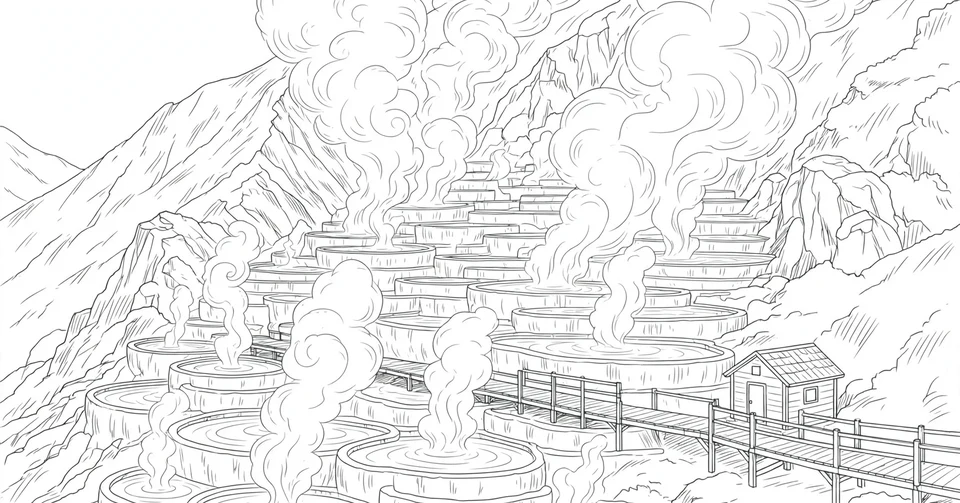
There is no lantern lit onsen town at Tamagawa Onsen, and no row of souvenir shops. This is a working therapeutic resort in a landscape that steams and hisses and smells faintly of sulphur, and people come to it with a purpose other than sightseeing. Many of the guests are older. Many are unwell. The seriousness is not a flaw in the atmosphere. It is the atmosphere.
One vent, nine thousand litres a minute
The Obuki, a name that translates roughly as great gusher, hands Tamagawa Onsen both of its national records at once. By the Japan Tourism Agency's account, the spring has the highest output of hot spring water in Japan, 9,000 litres a minute from one opening in the rock, and the highest acidity in the country, at pH 1.2. The water is based on hydrochloric acid, with sulphuric acid, iron and aluminium drawn up through the volcanic plateau, and it carries trace radium, a combination described as extremely rare anywhere in the world.
Most onsen towns are fed by a field of wells and pumps. Tamagawa Onsen is fed by a single hole in a mountainside, and everything about the place follows from that fact. The water arrives hotter and stronger than any bath could use, so it has to be cooled, calmed and portioned out before a single guest gets in. The resort is less a town built around a spring than a set of instruments built around a vent.
The grounds make the geology unavoidable. A nature research path, a stroll of about thirty minutes, loops past fumaroles and earth streaked yellow with sulphur, and ends at the Obuki itself. Steam rises out of cracks along the way, and the air carries the sharp, eggy bite of hydrogen sulphide. After an hour or so, strangely, you stop noticing it.
The state noticed the spring early. In 1932 the first steps were taken to develop Tamagawa Onsen as a formal health resort, and its fierce water has been drawing cure seekers from across Japan ever since.
The pools at Tamagawa Onsen are graded by strength
The headline number deserves a pause. At about pH 1.2 the water sits close to the acidity of stomach acid, and it is, by a clear margin, the most acidic natural spring water anyone bathes in in Japan. At full strength it is simply too aggressive for a long soak, so the bathhouse at Tamagawa Onsen grades its pools the way a pharmacist grades a dose. There are baths of 100 percent source water, baths at 50 percent, and mildly acidic baths, and guests choose according to their condition.
The progression is the treatment. At Tamagawa Onsen nobody is expected to start at full strength, and nobody sensible tries. Tolerance is built across the days of a stay rather than the minutes of a single visit, which is one reason the place makes most sense to guests who stay a while. Short visits get the spectacle. Long ones get the system.
The etiquette follows from the chemistry. Newcomers start in the milder water and build up their tolerance over days. The full strength pool is a matter of minutes, not a soak. Open cuts are found by the acid at once and sting fiercely, and jewellery comes off before bathing because the water can tarnish it. Even the dilution is done with respect. When the active ingredient is this strong, halving it is a precise operation, not a casual splash of cold water. I find that grading system quietly honest. A resort that labels its baths in percentages is telling you exactly what it thinks its water is, a substance to be dosed rather than a backdrop for photographs.
Heat without acid, on the bedrock
Not all of the treatment at Tamagawa Onsen is taken in water. Behind the baths the ground itself is warm, and the second signature practice here is ganbanyoku, bedrock bathing. Visitors spread mats over the geothermally heated stone and lie down on it, often for an hour or more, warming through from toes to head while steam drifts past. There are roofed bedrock halls as well, their floors heated and the air kept warm and humid, so the practice continues when the outdoor ground is buried under snow.
There is little ceremony to any of it. People arrive with blankets and books, choose a patch of stone, and settle in, wrapped against the cooling air while the ground does the work. The bedrock field has the same unhurried quiet as the bathhouse, a row of people lying still in the steam, each of them there for their own reasons.
The stone is not just any stone. The bedrock at Tamagawa Onsen contains hokutolite, a rare mineral found in only a handful of places on earth, which takes trace radium into its structure and gives off low levels of radon. That faint radioactivity underpins the area's reputation for radon therapy, and generations of guests have clearly believed in it, whatever the limits of the evidence. The tourism agency describes the heated rocks along the path as natural stone saunas, and on a cold Akita morning the appeal needs no theory at all. Lying flat on warm rock, doing nothing at all, is rest in its simplest form.
A cure measured in weeks, not nights
Tamagawa Onsen opened as a toji ground in 1885, and it still runs on toji time. The old custom of moving to a hot spring until you got better treated a spring as a course of treatment measured in weeks, and the inn keeps a distinct wing for long-stay guests, plainer rooms with cooking facilities, where regulars settle in for a fortnight or a month. Days there fall into a simple order. Bathe, rest on the bedrock, eat modestly, sleep, begin again.
The company explains the place as much as the water does. Many guests at Tamagawa Onsen are managing chronic illness or recovering from treatment, and some arrive carrying hopes that go far beyond stiff shoulders, including hopes attached to serious disease. The resort receives those hopes without embarrassment, but also, to its credit, without promises. As a careful English guide to Japan's surviving toji inns puts it, Japanese rules list indications for each spring water, the conditions it is traditionally associated with, and an indication is not a cure. Hot springs are not medicine, and anyone seriously ill should start with a doctor. What Tamagawa Onsen can honestly offer is heat, rest, routine and time, plus the company of other people doing the same slow work.
That company cuts both ways for a first time visitor. Anyone arriving at Tamagawa Onsen in search of a resort holiday, fine dinners and a lively evening, will find the place austere to the point of confusion. Anyone who arrives understanding what it is tends to be moved by it. There is a dignity to a place organised entirely around the slow business of getting better, and it asks its guests to meet it on those terms.
Winter closes the mountain
Reaching Tamagawa Onsen is part of the commitment. The gateway is Tazawako Station, roughly three hours from Tokyo on the Akita Shinkansen, and from there a seasonal bus climbs for about ninety minutes into the mountains, some services by way of Lake Tazawa. Then winter edits the map. The access road closes under deep snow, the main building shuts for the season, and guests in the cold months use the sister inn, Shin-Tamagawa Onsen, which stays open all year. The dependable window for the main resort runs from late spring to late autumn, and anyone planning a long stay in the colder half of the year should confirm the road and the opening dates well in advance.
For a gentler counterpoint, the seven thatched inns of Nyuto Onsen sit in the same uplands, all milky water and beech forest, everything Tamagawa Onsen chooses not to be. Travellers often pair the two, the beautiful one and the fierce one. The regulars on their mats above the warm stone would probably say the fierce one is beautiful too, just on different terms.
What stays with me is the refusal to soften. The water at Tamagawa Onsen is graded because it has to be, the stays are long because the place assumes recovery is slow, and nothing is sweetened or diluted beyond what safety requires. It treats its guests as adults with a job to do, and then gives them the heat, the rock and the time to do it. In a country full of hot springs selling an evening of escape, that plain seriousness feels less like austerity and more like respect.
More in Life & Style
Latest posts
- Shimekasu Was Herring You Never Ate
- A Hana Donko Wears Its Cracks Like Flowers
- Hashigo-Nori Is Riding a Ladder Someone Else Holds
- At a Goma, Prayers Are Written to Be Burned
- The Sekaa Teruna Builds the Monsters
- A Lembaga Perkreditan Desa Is a Bank the Village Owns
- Every Melasti Goes to Fetch Tirta Amerta
- Kuki Is the Spring the Sea Turned White
- When the Kulkul Stops Sounding for You
- A Caru Is an Offering for the Ones You Fear
- Tatsuko Wished for Beauty and Became a Statue
- Warangan Is the Wash That Reveals the Pattern
- Every Village Writes Its Own Awig-Awig
- Umaji Refused to Disappear
- Rwa Bhineda Keeps Opposites From Going to War