A Handful of Places on Earth Have Hokutolite
· 9 min read
Hokutolite is a radium bearing barite that crystallizes in only two hot spring valleys on Earth, one in Taiwan and one in Akita, and people cross Japan to lie down on it.
Most hot springs leave something behind. Pipes fur up with scale, rocks stain yellow with sulfur, and attendants chip the deposits away because they clog the works. Hokutolite is a deposit nobody chips away. It is a radioactive stone that grows in exactly two valleys on Earth, and at one of them, Tamagawa Onsen in the mountains of Akita, guests spread straw mats over the warm ground and lie on it for hours.
The stone is a variety of barite, the heavy mineral barium sulfate, except that hot spring water has folded lead and a trace of radium into its crystal lattice as it grew. That trace is enough to make hokutolite measurably radioactive, and for more than a century that faint radioactivity has been the whole point. People do not come to Tamagawa despite the radiation in the ground. They come because of it.
Almost everywhere else, a spring deposit is a maintenance problem. Here the hokutolite deposit became the destination, protected by law, stolen by thieves, studied by physicists, and trusted by the seriously ill. Few minerals carry that much human weight per gram.
What hokutolite is
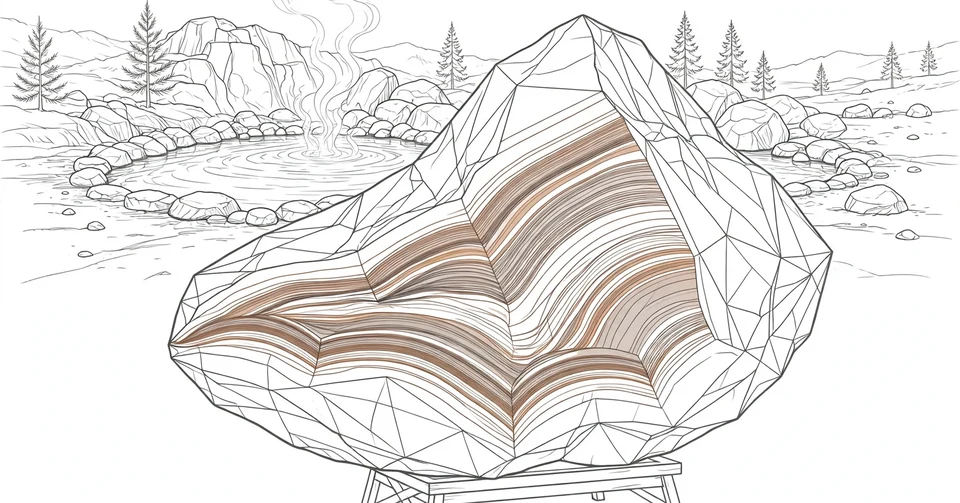
Chemically, hokutolite is a lead bearing barite, written as (Ba,Pb)SO4, a sulfate mineral in which lead takes the place of some of the barium. The proportions are not fixed. They shift as the crystal grows, which is why a sliced specimen shows alternating light and dark bands, ring after ring of slightly different stone. The radium arrives the same way, dissolved in the spring water and locked into the lattice layer by layer as each band forms.
The result is a pale stone, white to yellowish brown, softer than a steel file at about 3 to 3.5 on the Mohs scale, but strikingly heavy in the hand, because barite is dense and lead makes it denser still. Hokutolite only forms where fiercely acidic, mineral loaded spring water runs in the open air, and conditions that exact are rare. As far as anyone has documented, nature runs the experiment in two places: the Beitou hot spring district of Taipei, in Taiwan, and Tamagawa Onsen in Semboku, Akita Prefecture, in northern Japan. Every other hot spring on the planet makes do with ordinary scale.
Named for Beitou, proven by a photograph that nobody took
Hokutolite takes its name from Hokuto, the Japanese reading of Beitou, and it remains the only mineral variety named after a Taiwanese place. A mining technician named Okamoto Yohachiro, working for the Government-General of Taiwan, first noticed the hokutolite sediment in the Beitou River in 1905, during Japan's colonial rule of the island. By 1907 he had crystals, dense and full of lead, which he took to be anglesite, a common lead sulfate.
What changed his mind was an accident of the darkroom. Okamoto left the crystals resting on an unexposed photographic glass plate, and when the plate was developed ten days later it had fogged completely. The stone was exposing film by itself. Radioactivity had only recently become a tool a technician could test for, and the crystals were full of it. Professor Kotora Jimbo of Tokyo Imperial University then matched Okamoto's mineral to a specimen already sitting in the university's collection, gathered at Tamagawa in 1898. The two valleys, separated by sea, were growing the same impossible stone.
In 1912 Jimbo carried the specimens to an international mineral conference in St. Petersburg and, together with the Russian geochemist Vladimir Vernadsky, who chaired his country's Committee for Radium Mining Investigation, had the mineral formally named hokutolite. The timing matters. Radium was the prestige element of the age, new, luminous and widely believed to be a tonic, and a radium stone of one's own was a scientific prize. Taiwan's government banned mining along the Beitou River almost immediately, an early sign that this hokutolite deposit would be treated as a treasure rather than a resource.
Rings like a tree, growing slower than one
Cut a piece of hokutolite and the banding is the biography. Each ring records a period of growth in water whose chemistry wandered slightly, more lead here, more barium there, and researchers can read elapsed time in the stone because the radium sealed inside it decays at a known rate. When a team modeled the growth of the Taiwanese hokutolite using that decay, the best fit came out at about 0.17 millimeters a year. A centimeter of crystal, laid down ring by ring in running water, represents roughly six decades.
That slowness explains both the reverence and the rules. Japan's education ministry designated hokutolite a Special Natural Monument in 1952, and Taiwan had already listed it as a natural monument in 1933. Beitou later ringed its stretch of river with protected status, culminating in a dedicated Hokutolite Natural Reserve in 2013, the first reserve in Taiwan created by a local government to protect a mineral. You may look at the Beitou stone. You may not take it home.
Science kept a share of the stone too. Polonium drawn from hokutolite served as a reference source in early nuclear physics in colonial Taiwan, and Bunsaku Arakatsu's team at Taipei Imperial University used it in 1934 when they achieved the first artificial disintegration of an atomic nucleus in Asia. A young Yuan-Tseh Lee, decades before he came to lead Academia Sinica, wrote his master's thesis on the radioactivity of Beitou stone. The same lattice that bathers trust with their health once helped calibrate the instruments of people splitting atoms.
Lying down on it at Tamagawa
The Japanese half of the story is the more physical one. Tamagawa's source is a single vent that throws out about 9,000 liters of water a minute at 98 degrees Celsius, among the largest single source discharges of any hot spring in Japan, and the water is essentially dilute hydrochloric acid at about pH 1.2. The springs were found by a matagi hunter in 1680 and mined for sulfur before the first inn opened in 1885. The place only took the name Tamagawa Onsen after a newspaper reporter praised what the water was said to do, and in 1959 it was designated a National Health Resort. I have written separately about Tamagawa Onsen and its ferocious water, but the water is only half the ritual there.
The other half happens on the ground. Geothermal heat warms the hokutolite bearing rock around the source, and Tamagawa is said to be the birthplace of ganbanyoku, bedrock bathing, the practice of lying on heated stone that later spread across Japan as spa floors and heated slabs. At Tamagawa there is no slab and no floor. Guests lay a straw mat or towel directly on the warm earth and stay there, sometimes for hours, while snow melts around them in winter. Travel guides note the scene almost in passing, remarking that along the walking paths you will see people lying on the radioactive rocks for hours, as if it were the most natural thing in the world.
For most visitors the day alternates: short, careful dips in the acid baths, then long still hours on the stone. Many are not tourists in any ordinary sense. Tamagawa draws a large share of guests who have come primarily for their health, staying in simple rooms with shared kitchens for weeks at a time. It is toji, the old discipline of moving to a hot spring until you got better, in its most concentrated surviving form. The main inn closes when the snow road shuts, from early November to mid April, and the ritual simply pauses until spring, the way the hokutolite itself pauses for nothing at all.
A reputation that has to be carried carefully
Here the writing has to slow down, because the honest words are "believed" and "touted". Tamagawa's waters have traditionally been touted as a remedy for a long list of ailments, and above all for cancer. Hokutolite is widely believed to help prevent and treat it, and that belief, not the scenery, is what fills the inn with patients from across Japan. No study I have read establishes that lying on hokutolite cures anything, and this article will not pretend otherwise. What the stone demonstrably emits is low level radiation, roughly ten times the ordinary background in the ground around the source. What it demonstrably gives people is harder to weigh.
The people who run the place have, at their best, refused to oversell it. A manager of Tamagawa Onsen, quoted by The Japan Times in 2004, said of guests who had outlived grim prognoses: we do not know whether it was the effect of the hot spring. I find that sentence more trustworthy than any brochure. It holds the door open without promising what is behind it. Guests who arrive with a terminal diagnosis are not buying a cure so much as a place where the days are structured around doing something, in company with others doing the same, in a valley that smells of sulfur and steam. That has real value. It is just not the value printed on the label.
Belief that strong also draws a market, and the market has not always been honest. Akita police have dealt with repeated thefts of the protected crystals, including men who hammered 7.7 kilograms off the deposit to sell, while crystals legally collected before the ban changed hands at hundreds to over a thousand yen per gram. At least one visitor was sold an ordinary stone for 30,000 yen as the real thing. Protecting hokutolite, it turns out, also means protecting desperate people from the trade their hope creates.
The two homes of the stone acknowledge each other. In 2011, Beitou and Tamagawa formally became sister hot springs, an agreement between the only two valleys on Earth where this mineral grows. In Beitou the hokutolite rests behind the guardrails of its reserve, a specimen. In Akita it works for a living, warming the backs of strangers. Same crystal, same faint radiation, two entirely different relationships with it.
I keep coming back to the growth rate. A stone that needs most of a century to thicken by a centimeter is not impressed by urgency, and yet the urgent are exactly who gather on it. Perhaps that is the real service Tamagawa performs. It gives people whose time has suddenly become precious a place governed by a much slower clock, where lying still is the entire prescription and the ground itself is warm. The geology makes no promises at all. It simply continues, ring by ring, at 0.17 millimeters a year, long after every one of us has checked out.
More in Life & Style
Latest posts
- Shimekasu Was Herring You Never Ate
- A Hana Donko Wears Its Cracks Like Flowers
- Hashigo-Nori Is Riding a Ladder Someone Else Holds
- At a Goma, Prayers Are Written to Be Burned
- The Sekaa Teruna Builds the Monsters
- A Lembaga Perkreditan Desa Is a Bank the Village Owns
- Every Melasti Goes to Fetch Tirta Amerta
- Kuki Is the Spring the Sea Turned White
- When the Kulkul Stops Sounding for You
- A Caru Is an Offering for the Ones You Fear
- Tatsuko Wished for Beauty and Became a Statue
- Warangan Is the Wash That Reveals the Pattern
- Every Village Writes Its Own Awig-Awig
- Umaji Refused to Disappear
- Rwa Bhineda Keeps Opposites From Going to War