Kachi-Koshi Is the Eight Win Line That Moves a Sumo Wrestler Up
· 13 min read
A kachi-koshi is a winning record of eight or more wins in a fifteen bout tournament, and it is the line that decides whether a sumo wrestler rises or falls on the next banzuke.
Eight wins. That is the whole secret. In the top two divisions of professional sumo, a wrestler who wins eight of his fifteen bouts has a kachi-koshi, a winning record, and the next ranking sheet will almost certainly move him up. A wrestler who stops at seven has a make-koshi, a losing record, and the same sheet will move him down. One bout, one win, decides which side of the line he stands on.
The line is so simple that it can hide how much it carries. A kachi-koshi does not win a tournament, and it does not make a wrestler a champion. It does something quieter and, over a career, more important. It keeps a wrestler moving in the right direction, tournament after tournament, and it is the basic unit of progress in a sport where rank is everything.
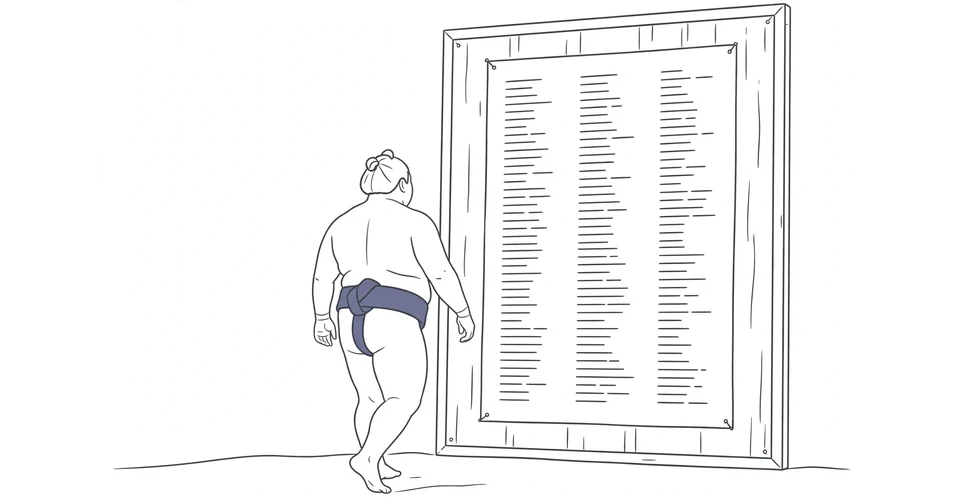
Watch a wrestler sitting at seven wins and seven losses on the final day, and you will see what the line means in human terms. His whole tournament comes down to a single bout that lasts a few seconds. Win it and he has a kachi-koshi, and his name climbs the ranking sheet. Lose it and he has a make-koshi, and his name slides down. The crowd knows this, the commentators know it, and the wrestler knows it best of all. Few moments in sport pack so much consequence into so little time.
What kachi-koshi means in plain numbers
The word itself tells the story. Kachi-koshi joins kachi, winning, with koshi, crossing over. A wrestler with a kachi-koshi has crossed over to the winning side of his record, with more wins than losses when the tournament ends. The opposite, make-koshi, joins make, losing, with the same crossing over, and it means the losses outnumber the wins.
In the top two divisions, makuuchi and juryo, wrestlers fight fifteen bouts in a tournament, one on each of the fifteen days. Eight wins is the smallest majority, so eight wins is a kachi-koshi and seven wins is a make-koshi. The narrowest winning record is 8-7, and the narrowest losing record is 7-8. There is no middle ground, and there are no draws in sumo, so every wrestler finishes on one side of the line or the other.
The four lower divisions, makushita, sandanme, jonidan and jonokuchi, work on a shorter programme. Wrestlers there normally fight seven bouts across the fifteen days rather than appearing every day. More wins than losses on a seven bout card is four wins, so 4-3 is a kachi-koshi down there and 3-4 is a make-koshi. The number changes, but the idea stays exactly the same. Win more than you lose, and you move up. Lose more than you win, and you move down.
| Programme | Winning record | Losing record |
|---|---|---|
| 15 bouts, makuuchi and juryo | 8 wins or more | 7 wins or fewer |
| 7 bouts, makushita and below | 4 wins or more | 3 wins or fewer |
That table looks almost too plain to matter, and that plainness is part of the point. Sumo is a sport of elaborate ceremony, silk aprons, salt throwing and centuries of custom, yet its ranking system turns on a piece of arithmetic a child could follow. The simplicity is what makes the system fair in the eyes of the fans. Nobody needs a committee to explain why eight beats seven.
Why eight wins is the line that matters
Professional sumo holds six grand tournaments a year, each lasting fifteen days. After every tournament the banzuke, the official ranking sheet, is redrawn, and the results of the tournament just finished are the evidence the ranking committee uses. A winning record generally means a rise, and a losing record generally means a fall, so a kachi-koshi is the single most valuable result most wrestlers can aim for in any tournament. The banzuke article on this site puts it plainly, saying that a basho is the only evidence the banzuke committee uses, and the committee reads it strictly. That strictness is what gives the eighth win its weight. There is no appeal, no style mark and no reputation bonus. The record is the record.
This is why a kachi-koshi matters even when the championship is far out of reach. Most wrestlers in a tournament are not chasing the title by the second week. They are chasing a kachi-koshi, and they are chasing the line. A maegashira sitting at 7-5 with two days left has already secured the outline of a good tournament, but he still needs one more win to make it count as a kachi-koshi. The difference between 8-7 and 7-8 may look small on paper, but on the next banzuke it can be the difference between climbing several places and sliding the same distance in the other direction. The maegashira article on this site follows one such climber through the numbered ranks, and it shows how each bout can shift a wrestler's position, which you can read in a maegashira climbs the numbered ladder one bout at a time.
There is a lesson in this that reaches beyond sumo, and it is one I keep coming back to. Most careers are not decided by a single brilliant triumph. They are decided by whether you can finish slightly above the line, again and again, until the small margins add up to a real change of position. A kachi-koshi is the sporting form of that idea. It rewards consistency over spectacle, and it treats a narrow winning record as a genuine achievement rather than a near miss.
How far up does a kachi-koshi take you
A kachi-koshi guarantees the direction of travel, but it does not fix the distance, and that gap between direction and distance is where the ranking committee does its real work. How far a wrestler rises depends on where he started, how big his winning margin was, and how the wrestlers ranked around him performed. A 12-3 record from a low maegashira position can carry a wrestler deep into the upper ranks, while an 8-7 record from the same spot may move him only a few places. The system is strict about the line, but it is flexible about everything past it. The full picture of divisions, ranks and promotion is laid out clearly in this guide to sumo ranks, divisions and the banzuke, which explains how tournament results shape the next ranking sheet.
That flexibility has a name in Japanese, banzuke-un, which means banzuke fortune. Two wrestlers with identical records can move by different amounts because the traffic around them was different. One may find a gap above him because several wrestlers ahead of him lost, while the other finds the places above him blocked by wrestlers who also won. Fans accept this because the rule itself is transparent. Everyone can see the records, everyone can see the new sheet when it appears, and the reasoning behind each move is open to argument for the two weeks before the next tournament begins.
The top ranks play by their own versions of the same rule. A wrestler in sanyaku, the upper ranks of sekiwake and komusubi, who wants promotion to ozeki needs sustained success rather than one good tournament. The Japan Sumo Association describes 33 wins over three tournaments in sanyaku as a benchmark for ozeki promotion. It is a guide to performance, not an automatic qualification, and a single kachi-koshi is only one step on that longer road. Even so, each kachi-koshi in that sequence is indispensable, because a losing record in the middle of the run breaks the count and forces the wrestler to start building again.
Ozeki is where the line turns into a test of survival. An ozeki who finishes with a losing record enters the next tournament in kadoban, on probation, and must secure a winning record to keep his rank. A second consecutive losing record brings demotion to sekiwake. A kachi-koshi in a kadoban tournament protects his position, which makes the eighth win significant even when the championship is nowhere in sight. The pressure on an ozeki chasing his eighth win is therefore different in kind from the pressure on a maegashira doing the same thing. One is fighting for a better position, and the other is fighting to keep the position he already has.
Yokozuna, the highest rank, stands outside this system altogether. A yokozuna cannot be demoted, and sustained poor results bring an expectation of retirement instead. His kachi-koshi still matters, because fans expect a yokozuna to win ten or more bouts, but it no longer decides his place on the sheet. The line that governs everyone else stops at the very top, which is fitting for a rank that is as much a position of honour as a competitive standing.
Kachi-koshi is not a championship
It is easy to confuse a winning record with a title, but sumo keeps the two carefully apart. A kachi-koshi compares a wrestler with his own losses. A championship, the yusho, compares a wrestler with every other wrestler in his division. The wrestler with the best record at the end of fifteen days takes the title, and if two or more wrestlers are tied, a playoff decides it on the final day. An 8-7 record is a kachi-koshi, but it is not a championship, and no wrestler has ever lifted a trophy for finishing 8-7.
The makuuchi champion receives the Emperor's Cup, and three special prizes are awarded in the top division for outstanding performances across the tournament. These honours sit above the ordinary business of winning records. A wrestler can have a kachi-koshi and still finish far behind the champion, and a wrestler can win the championship while another wrestler with a better story takes a special prize. The fifteen days of a basho decide who sumo remembers, and the way each tournament builds its own drama is described in fifteen days of basho decide who sumo remembers.
This distinction matters for how fans watch the second week of a tournament. The title race usually involves a handful of wrestlers, but the kachi-koshi race involves almost everyone. On day thirteen or fourteen, dozens of wrestlers are sitting on six or seven wins, and each of their bouts decides whether they finish above the line or below it. That is why a tournament stays worth watching long after the championship has been settled. The main prize may be decided, but the small prizes, a rise here and a fall there, are still being handed out in every bout.
There is also a quiet mercy in the way the line works. A wrestler who starts a tournament badly can still save it. A 2-5 start leaves eight bouts to find six wins, which is difficult but not impossible. A wrestler who loses his first three bouts has not lost his tournament. He has only made the arithmetic harder. The system gives a slow starter a route back, and it gives a fast starter no room to relax, because an 8-2 wrestler who loses his last five bouts still finishes 8-7, while a 7-3 wrestler who wins only once more finishes below the line. The record counts all fifteen days equally, and no win counts double because it came early.
The eighth win changes the room
Something visible happens when a wrestler secures his eighth win. The tension leaves his shoulders, his attendants relax, and his stablemaster can start thinking about the next tournament rather than this one. The wrestler has done the minimum that his profession asks of him, and everything after that is extra. A ninth or tenth win is a bonus that pushes him further up the sheet, but the eighth, the win that secures the kachi-koshi, is the one that changes his status from a wrestler in trouble to a wrestler on the rise.
The other side of the line is just as visible. A wrestler at 7-7 on the final day carries the whole tournament into a single bout, and the arena feels it. The bout is rarely the most skilful of the day, because both men are usually fighting with everything they have and very little margin for error. One of them will leave the ring with a kachi-koshi and the other with a make-koshi, and the difference between them after fifteen days of effort is a single push, a single slip, a single moment of balance lost. That is a harsh way to run a sport, and it is also an honest one. It refuses to pretend that close is the same as enough.
I find that honesty appealing, and I think it explains why the word kachi-koshi has travelled beyond sumo into ordinary Japanese conversation. People use it to describe any situation where the wins just outnumber the losses, a business quarter, a season, a year. It is a modest word for a modest achievement, and its modesty is the point. It does not promise greatness. It promises that you did slightly better than even, and that slightly better is enough to move forward.
Absences count in this arithmetic too, which is worth knowing if you follow a tournament closely. A missed bout counts as a loss, and a wrestler who withdraws after his next opponent has been announced gives that opponent a win by forfeit. A kachi-koshi earned through fifteen days of fighting is therefore different from one that was never tested, and the record keeps that distinction visible. The official record is published by the Japan Sumo Association, and its official English home page carries the current banzuke, the tournament schedule and the results as they are announced.
The line also explains why sumo fans learn to read a tournament in two ways at once. They follow the leaders at the top of the standings, and they follow the wrestlers sitting at seven wins, because the second group is usually larger and its bouts are often more desperate. A fan who understands kachi-koshi never runs out of things to care about before the final day. Every bout on the card has a wrestler in it who needs one more win, and that need is the same whether the wrestler is fighting for the title or fighting to stay in the division.
A line worth watching
A kachi-koshi is eight wins out of fifteen, or four out of seven, and that is all it is. It will not make a wrestler famous, and it will not fill a trophy cabinet. What it will do is move his name a little higher on a sheet of paper that decides who he fights, how much he earns and how the sport treats him. Do that often enough, and the small moves become a career. Miss the line often enough, and the small slides become a retirement.
The next time you watch a basho, keep one eye on the wrestlers at seven wins. Their bouts are the ones where the whole system is visible in a single contest. One more win, and the record tips to the good side. One loss, and it tips the other way. Sumo has many beautiful and complicated traditions, but its simplest rule may be its wisest. Win more than you lose, and you go up. Everything else is commentary.
More in Culture & Society
- A Shimekazari Hangs the New Year Over the Front Door
- Make-Koshi Is the Eight Loss Line That Sends a Sumo Wrestler Down
- Japanese Arcades and the Game Centers That Refuse to Die
- Danpatsu-Shiki Is the Haircut That Ends a Sumo Career
- Tachiai Is the One Second That Decides a Sumo Bout
- A Gunbai Points at the Winner and Nobody Argues
Latest posts
- Izakaya, the After-Work Pubs Where Japan Unwinds
- Dondo-Yaki Is the Fire That Closes the Japanese New Year
- Hakkeyoi Is the Word That Starts a Sumo Bout
- A Yobidashi Calls the Wrestlers and Sweeps the Ring
- A Dohyo Is Sacred Ground Long Before the First Bout
- A Kadomatsu Guards the Door Until the New Year Fire
- A Shikona Gives a Wrestler His Second Name
- Japanese Street Food, From Takoyaki Stalls to Festival Yatai
- Komusubi Is the Smallest Chair at Sumo's Top Table
- A Sekiwake Waits One Win From Sumo's Highest Door
- Tanabata Festival and the Star-Crossed Lovers Behind the Bamboo Wishes
- A Maegashira Climbs the Numbered Ladder One Bout at a Time
- An Ozeki Stands One Step From the Top and Cannot Afford to Slip
- An Oyakata Is the Father a Sumo Stable Cannot Replace
- A Tokoyama Spends Ten Years Learning to Dress a Topknot