A Gunbai Points at the Winner and Nobody Argues
· 16 min read
A gunbai is the lacquered wooden war fan a sumo referee points at the winner, and the whole sport trusts that one quiet gesture.
A gunbai is a solid wooden fan, lacquered and shaped like a paddle, and it is the tool a sumo referee uses to say who won. The referee, called a gyoji, holds it through the whole bout, and at the end he points it at one side of the ring. That single gesture is the decision. The crowd accepts it, the wrestlers bow to it, and the tournament moves on.
The moment is easy to miss if you do not know what to watch. The two wrestlers have thrown salt, stamped the clay, and stared at each other for minutes. Then the gyoji holds his gunbai flat against his body, the signal that the fight must begin. A few seconds of violence follow, one man falls or steps out, and the referee lifts the same fan and points it at the winner. No whistle blows. No scoreboard flashes. A wooden fan does the talking.
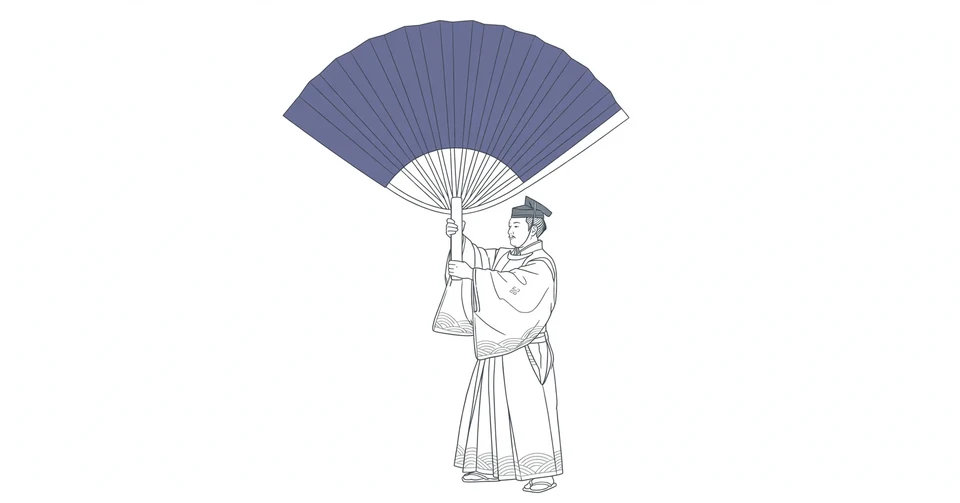
That is why the gunbai matters far beyond its size. It is small enough to hold in one hand and light enough to carry all day, yet it carries the authority of the whole sport. Sumo is full of large men, loud crowds, and heavy tradition, and the decision at the end of each bout rests on the lightest object in the ring. I find that contrast worth sitting with, because it says something about how authority works when it is trusted rather than enforced.
From the battlefield to the ring
The gunbai began its life far from any wrestling ring. Long before sumo referees carried one, military commanders in Japan used solid fans to signal their troops. A commander on a hill or a horse could raise his fan, lower it, or point it in a direction, and soldiers who could not hear his voice could still read his orders. The fan was a tool of command because it was visible at a distance and unmistakable in its meaning.
These war fans came in several forms, and the gunbai was the version carried by high ranking officers. Unlike the folding fans ordinary people carried for cooling themselves, a gunbai was solid, not folding, and it was usually made of wood, wood covered with metal, or solid metal. Some were made to ward off arrows, some served as a sunshade on a hot day, and all of them signalled rank as clearly as a uniform does today. The page on Japanese war fans sets out the family of these fans, from the folding gunsen of ordinary warriors to the iron tessen that doubled as a weapon, and it places it at the top of that family, in the hands of the men giving the orders.
There is a famous story that shows how seriously these fans were taken. At the fourth battle of Kawanakajima, so the legend goes, the warlord Uesugi Kenshin rode into the command tent of Takeda Shingen and swung his sword at him, and Shingen deflected the blow with his war fan. Historians are not sure which kind of fan it was, and it may not have been a gunbai at all, but the story survives because it captures the idea that a fan could stand between a commander and a sword. It was never only decoration.
Sumo borrowed the object along with its air of command. The sport grew out of ritual and ceremony long before it became the professional competition we watch today, and when it needed a way for one man to declare a winner without raising his voice, it reached for the tool generals had used for the same purpose. The gunbai kept its shape, its lacquer, and its meaning, and it simply changed its battlefield from a field of soldiers to a circle of clay.
What a gunbai is made of
A gunbai looks simple, and that simplicity is part of its power. It is a flat paddle of wood, usually lacquered in dark red or black, with a short handle and a cord and tassel hanging from the end. It is rigid, so it cannot be folded away or waved about like a paper fan, and it is light enough that a referee can hold it through a long day of bouts without tiring. There are no fixed rules about the material or the shape, and each gyoji has his own.
The fans carried by the most senior referees are the most beautiful. They are lacquered and decorated with gold or silver, and the color of the tassel hanging from the fan tells the crowd the rank of the man holding it. Purple belongs to the two most senior referees alone, the men at the very top of the profession. Below them the tassels run vermilion for the sanyaku grade and red and white for the top division, while the lower grades wear green, blue, or black. A spectator who knows the code can read the referee's rank from the fan before the bout even begins, without ever seeing his face.
Some gunbai are heirlooms, and the most famous of them belongs to the name Kimura Shonosuke, the most senior referee in sumo. His gunbai has been passed from one holder of the name to the next for more than 160 years, which means the same fan has pointed at winners across generations of wrestlers, through wars, earthquakes, and the whole modern history of the sport. A young gyoji receives his first gunbai from a senior referee or from his stablemaster, and the fan he is given becomes part of his working life in a way no other piece of equipment does. A wrestler's belt is replaced, a referee's robe is remade, but a gunbai can outlive the man who carries it.
That continuity is rare in modern sport. A football referee's whistle is a piece of plastic bought in a shop and replaced without a thought. A gunbai is chosen, given, kept, and sometimes inherited, and the object itself gathers meaning with every bout it decides. When a senior referee points a fan that has been in use for more than a century and a half, he is not only making a call about the two men in front of him. He is borrowing the authority of every referee who held that fan before him.
The gunbai in a bout
The work of a gunbai begins long before the winner is announced. During the shikiri, the preparation ritual in which the two wrestlers throw salt, stamp their feet, and stare at each other across two white starting lines, the gyoji stands at the north side of the ring, facing south, with the fan in his hand. The preparation can last several minutes, and the crowd watches the two men rather than the referee, but the referee is watching the clock. When the time runs out, he holds his gunbai flat against his body, and that is the signal that the fight must begin. Our guide to the gyoji, sumo's referee in silk describes that moment in detail, and it is worth reading if you want to understand how much of the bout is choreographed before anyone moves.
The fan then does quiet work during the charge. The referee coordinates the tachi-ai, the initial collision, and he can stop it before it starts if the two men are not ready together or if one of them jumps early. A false start sends both wrestlers back to their lines to try again, and the fan is part of how the referee controls the space between them. He is not shouting. He is standing in the ring with two men who each weigh as much as a small piano, and he is managing them with posture, timing, and a piece of lacquered wood.
The decisive moment comes at the end. The instant one wrestler loses, by touching the ground with anything other than the soles of his feet or by stepping outside the ring, the gyoji points his gunbai at the winner's side, east or west, and announces the winner's ring name. Each wrestler is assigned to start from either the east or the west side on each tournament day, so the point of the fan has a fixed meaning. Everyone in the arena can read it. The point is the verdict.
That verdict is not quite final, and the gunbai has a vocabulary for what happens next. Five judges seated around the ring, the shimpan, can object to the call, and if they do they meet in the centre of the ring in a conference called a mono-ii. They can confirm the call, overturn it, or order a rematch. The gunbai entry records both terms. If the judges confirm the referee's judgement, the announcement is gunbai-dori, which means according to the gunbai. If they overturn it, the announcement is gunbai-sashichigae, which means the gunbai was mispointed. The decision itself is so closely tied to the object that sumo named the outcome after the fan. The referee's call is called a gunbai, the confirmation is named after it, and even the mistake is named after it. The fan is not a prop for the decision. In the language of the sport, the fan is the decision.
When the verdict is settled, the gyoji points the fan again and calls the winner's name, and if the bout carried sponsor prizes he hands the envelopes of prize money to the winner on the face of his fan. That is the detail I like best. The money is not handed over in a handshake or placed on a tray. It is carried on the flat face of the gunbai, as if the fan itself were paying the winner. The object that decided the bout also delivers the reward, and the ceremony closes in a single gesture.
The fan also appears away from the bout itself. During the ring-entering ceremony of a yokozuna, the grand champion, a senior referee stands behind him and waves the cord of his gunbai as the champion performs his entrance. The fan is present at the most formal moments of the sport, not only at its most violent ones, and that tells you it belongs to the ceremony as much as to the contest.
Two families, two ways to hold a gunbai
Every gyoji in modern sumo takes one of two family names as his professional name, Kimura or Shikimori, depending on the tradition of the stable he joins. There are exceptions, but they are rare, and the two families are one of the oldest divisions in the sport. The division shows up in the smallest details, including how a referee holds his gunbai.
According to the account most often cited, the Kimura family hold their gunbai with their palm and fingers facing up, while the Shikimori hold theirs with their palm and fingers facing down. Other descriptions of the same detail seem to say the opposite, and I have not found a source that settles the question cleanly, so I will not pretend to be certain about which way is which. What is certain is that the difference exists, that it marks the two families apart, and that it is invisible to most of the crowd. It is a tiny distinction, kept alive by men who care about such things, and it is exactly the kind of detail sumo preserves long after its practical purpose has faded.
The doubt itself is worth noting. Sumo is a world of oral tradition and close observation, and two honest descriptions of the same gesture can disagree. When that happens, the honest thing to do is to say so rather than pick the version that sounds more confident. The fan deserves that honesty, because the whole point of the object is that it is supposed to be read clearly. If the record of how it is held is unclear, then the record should say that.
Why a fan still decides in a sport of giants
There is an obvious question to ask about the gunbai, and it is why sumo still uses one at all. A modern sport could decide a winner with a buzzer, a light, or a video review, and sumo does in fact use video review when the judges need it. The mono-ii exists precisely because human eyes can be wrong. But the announcement is still made by pointing a fan, and the overturn is still described as a mispointing. The sport has added new tools without giving up the old gesture, and that choice is deliberate.
Part of the reason is practical. A pointed fan is visible from every seat in the arena. A point to the east or the west can be read by a spectator in the highest row, by a wrestler with his back turned, and by a television camera in a single frame. It needs no electricity, no translation, and no explanation. It works in a hall full of thousands of people because it is large, simple, and unambiguous. A fan held flat against the body says wait, and a fan pointed at one side says this man won. There is nothing to misread.
The deeper reason is that the gunbai carries the history of the decision with it. When a referee points it at a winner, he is not only saying that the man on the east side touched the ground first. He is performing a gesture that commanders once used to order armies and that referees have used for generations to order bouts. The authority of the call comes partly from the correctness of the call and partly from the weight of the tradition behind it. A light or a buzzer would be correct and weightless. The gunbai is correct and heavy with meaning.
I think there is also a lesson in the way the fan restrains the person holding it. A referee who decided a bout by shouting could be argued with in the same register. A referee who decides by pointing a fan has said almost nothing, and there is almost nothing to argue with. The gesture is final in its form even when the judges can overturn its content, and that form protects the referee from becoming part of the contest. The fan does the pointing, and the man holding it can step back from the argument. Sumo understood long ago that the person who decides should be separated from the decision, and it built that separation into an object.
The gunbai also appears as a family crest, a mon, alongside the tochiwa fan, which shows that the object has travelled beyond the ring into the visual language of Japanese households. A crest is a mark of identity, worn on clothing and carved on gates, and the gunbai earned a place there because it had become a symbol of command itself. It no longer only means the fan a referee holds. It means the act of deciding, cleanly and in public, and standing behind the decision.
A gunbai outside the ring
That symbolic life is what makes the fan interesting beyond sumo. Most sporting equipment stays inside its sport. A cricket bat means nothing outside cricket, and a fencing foil means nothing outside fencing. The gunbai began as a military signal, became a referee's tool, and then became a crest, and each of those lives added a layer to what the object means. It is a fan, a signal, a verdict, and a symbol, and it carries all four meanings at once.
It is worth remembering that the ring where all of this happens is itself treated as sacred ground. The clay is purified with salt before every bout, and the referee's role includes religious duties that date back centuries. Our guide to the dohyo as sacred ground explains how the ring is blessed and prepared long before the first bout, and the gunbai belongs to that same world of ritual. The fan is not a piece of sporting equipment that happens to look old. It is a ritual object that happens to be used in a sporting contest, and the contest is shaped around it rather than the other way around.
That is why the gunbai has survived every modernization sumo has gone through. The sport now sells tickets online, broadcasts in high definition, and reviews close calls on video, and none of that has replaced the fan. The video review informs the judges, the judges inform the referee, and the referee informs the arena by pointing the gunbai. The chain ends where it has always ended, with a wooden fan and a pointed arm, and the arena accepts it because the chain is honest. The fan does not pretend to be a machine. It is a human decision, made visible, and the sport is better for admitting that.
The quietest verdict in sport
A gunbai is a small thing, and the whole sport of sumo could be described as a machine for giving that small thing a meaning large enough to matter. The wrestlers train for years, the ring is built and purified, the crowd fills the arena, and all of it leads to a few seconds of contact and a single point of a lacquered fan. The scale of the preparation and the simplicity of the verdict are not a contradiction. They are the point.
The next time you watch a bout, ignore the wrestlers for a moment at the end and watch the referee's hand instead. The fight will be over, the crowd will be rising, and a man in silk will lift a wooden fan and point it at one side of the ring. Nobody will argue with the fan itself, even when the judges overturn what it said. They will argue about the call, and then they will accept the new call, and the fan will point again. That is the job of a gunbai, and it has been doing it, in one form or another, for longer than the modern sport has existed.
What stays with me is how little the gunbai asks for. It does not need power, it does not need an audience, and it does not need to be loud. It needs a steady hand, a clear eye, and the trust of everyone watching. That is a modest list of requirements for an object that decides the fate of two men in front of thousands of people, and it is a reminder that authority does not have to shout. Sometimes it only has to point, once, in the right direction, and let the silence do the rest.
More in Culture & Society
- Tachiai Is the One Second That Decides a Sumo Bout
- Dondo-Yaki Is the Fire That Closes the Japanese New Year
- Hakkeyoi Is the Word That Starts a Sumo Bout
- A Yobidashi Calls the Wrestlers and Sweeps the Ring
- A Dohyo Is Sacred Ground Long Before the First Bout
- A Kadomatsu Guards the Door Until the New Year Fire
Latest posts
- Izakaya, the After-Work Pubs Where Japan Unwinds
- A Shikona Gives a Wrestler His Second Name
- Japanese Street Food, From Takoyaki Stalls to Festival Yatai
- Komusubi Is the Smallest Chair at Sumo's Top Table
- A Sekiwake Waits One Win From Sumo's Highest Door
- Tanabata Festival and the Star-Crossed Lovers Behind the Bamboo Wishes
- A Maegashira Climbs the Numbered Ladder One Bout at a Time
- An Ozeki Stands One Step From the Top and Cannot Afford to Slip
- An Oyakata Is the Father a Sumo Stable Cannot Replace
- A Tokoyama Spends Ten Years Learning to Dress a Topknot
- Japanese Calligraphy and the Brush That Turns Writing Into Art
- A Tegata Is Sumo's Inked Handprint Autograph
- A Rikishi Is a Man of the Sumo World Before He Wins a Single Bout
- Mawashi Carries a Wrestler's Rank Around His Waist
- Namasu Turns Daikon and Carrot Into a Red and White Wish