Dondo-Yaki Is the Fire That Closes the Japanese New Year
· 21 min read
Dondo-yaki is the bonfire that closes the Japanese New Year, when kadomatsu, straw ropes, and first calligraphy are burned together around 15 January, and this guide explains what is burned, what the fire is called across Japan, and where to see it.
Dondo-yaki is the fire that closes the Japanese New Year. Around 15 January, in the days called koshogatsu, the Little New Year, neighbourhoods across Japan gather the pine kadomatsu from their gates, the straw ropes from their doors, and the first calligraphy of the year, and burn them all on one bonfire. The dondo-yaki fire is built from bamboo, wood, and rice straw, it is lit at a shrine, beside a roadside dosojin shrine, or on a riverbank, and it marks the end of the holiday the way a door closing marks the end of a visit.
The custom is older than the bright bamboo suggests, and it is also simpler than it looks. Nothing is thrown away. Everything that served the New Year is returned by fire, and the fire itself becomes the last shared meal of the season, because mochi is grilled over the embers and eaten while the flames are still high. A dondo-yaki fire is a bonfire, a farewell, and a small piece of fortune telling all at once, and it is one of the few New Year customs that still belongs to the whole neighbourhood rather than to a single household.
Most visitors to Japan never see this dondo-yaki fire. They see the New Year itself, the shrine visits and the stacked boxes of osechi, and then they leave before the season has finished. The fire is the part that comes after, quieter and smokier and easier to miss, and it is worth staying for. To understand the Japanese New Year properly, you have to see how it ends, and it ends in a dondo-yaki fire.
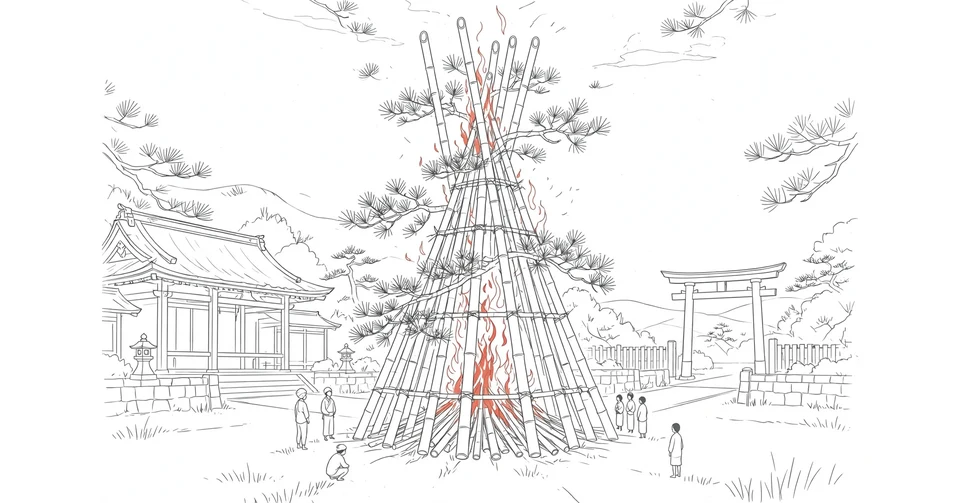
A dondo-yaki fire is easy to describe and hard to forget once you have stood beside one. The bamboo is stacked into a tall cone or cylinder, the pine decorations are piled around the base, and when the flame catches, the whole structure burns fast and bright, throwing sparks high into the cold January air. People stand in a ring around it, close enough to feel the heat on their faces, and nobody is in a hurry to leave. The New Year does not end with a countdown here. It ends with a fire that everyone watches together, and the watching is the point.
What dondo-yaki is
A dondo-yaki fire is the bonfire of koshogatsu, the Little New Year, and koshogatsu is the observance centred on the 15th day of the first month of the old lunar calendar, the first full moon of the year. The dictionaries give its dates as 14 to 16 January, and the 14th is treated as the eve of the Little New Year, the period when the New Year events of the season come to a general close. It is distinguished from oshogatsu, the Big New Year of 1 January, which belongs to the household and the shrine visit. Koshogatsu belongs to the village, and the dondo-yaki fire is its centre.
Most koshogatsu rites concern the harvest, and many are carried out by children and young people. Branches are hung with mochi shaped as rice blossoms, called mochibana, or as silkworm cocoons, called mayudama. Porridge in bamboo tubes, one for each of the early, middle, and late rice crops, is used to forecast the harvest. The dondo-yaki fire belongs to this group of rites, and like the rest of them it looks forward rather than backward. It closes the New Year by asking for a good year to come, and the asking is done with fire, rice, and the whole neighbourhood present.
A dondo-yaki fire is usually held on the night of the 14th or the morning of the 15th, although some districts hold it on the 7th, the date of the onibi fires of Kyushu. The variation is not confusion. It is the custom adapting to local calendars, local shrines, and local weather, and the result is a New Year that ends on slightly different days in different parts of the country, like a wave breaking on a long shore. A dondo-yaki fire in one town may be a quiet bonfire on a riverbank, while in another it is a festival with thousands of spectators, and both are the same rite.
I think the timing matters more than it first seems. The Big New Year is loud and crowded, and the Little New Year is the moment when the noise dies down and the community is left with itself. A dondo-yaki fire happens after the guests have gone home and the decorations have done their work, and that is exactly when a shared fire means the most. It is not a spectacle staged for visitors. It is a neighbourhood finishing something together, and the finish is what makes the beginning of the year feel real.
What gets burned on the fire
The main fuel of a dondo-yaki fire is the kadomatsu. The pine and bamboo decoration that guarded the gate is described in the encyclopaedias as a yorishiro, an object into which the toshigami, the deity of the New Year, descends, and the burning sends the deity off with thanks. Pine is the usual New Year tree, with bamboo added from the medieval period onward, though oak, camellia, chestnut, and sakaki are also recorded in some places. The trees were traditionally cut on the 13th day of the twelfth month, and removal dates vary between the 4th, the 7th, and the 14th of the first month. In Kyushu the pine is burned in the onibi fire of the 7th, and elsewhere it usually goes to the Little New Year dondo-yaki fire.
The dondo-yaki fire also takes the straw decorations. Shimenawa, ropes of straw twisted to the left that mark off sacred space, are hung at New Year on house entrances, gates, and kamidana shelves, and shimekazari, the New Year decorations made with shimenawa, are displayed with the kadomatsu. An older encyclopaedia entry describes setting up kadomatsu and shimekazari as marking the home as a sacred space for the New Year, and the fire unmarks it again. Children collect the pine decorations and the shimenawa from each house and carry them to a fixed place to be burned, and the collecting is part of the rite. A dondo-yaki fire is not fed by a truckload of fuel bought for the occasion. It is fed by the decorations of the houses around it, carried there by the people who lived with them.
The dondo-yaki fire takes more than the decorations. The previous year's talismans and old omamori charms go on it, and so does the paper used in the year-end soot cleaning, and in some places Daruma dolls as well. Kakizome, the first brush writing of the year, is displayed until koshogatsu and then burned on the dondo-yaki fire. Nothing that served the old year is kept past its time, and nothing is thrown in the rubbish. The rule is simple and it is applied without exception. What was sacred is returned by fire, and the dondo-yaki fire is the only proper way to let it go.
There is a wisdom in that rule that goes beyond religion. A modern household throws things away all year without thinking, and the New Year decorations are the one exception, the one set of objects that may not be discarded carelessly. The dondo-yaki fire forces a pause. It asks the household to carry what it used back to a shared place and to watch it burn, and the watching turns disposal into a small ceremony. I think every culture needs a moment like that, a moment when getting rid of something is done slowly and in company, instead of quickly and alone.
The names of the fire across Japan
A dondo-yaki fire is one rite under many names, and the names are a small map of Japan. Areas near Kyoto call it sagicho, most of Japan uses names of the tondo group, including dondo and dondo-yaki, eastern Japan uses saito, and Kyushu uses onibi and hokkengyo. The rite is the same under all its names, and the names survive because the rite is local before it is national. Each region kept its own word for the fire, the way each region kept its own date for it.
| Region | Name of the fire |
|---|---|
| Most of Japan | Dondo, dondo-yaki |
| Near Kyoto | Sagicho |
| Eastern Japan | Saito |
| Kyushu | Onibi, hokkengyo |
| Parts of Nagano | Sankuro-yaki |
The table above is only a rough guide, because the names overlap and drift from village to village, and a single district may use two names for the same fire. In parts of Nagano, a variant called sankuro-yaki burns a wooden doll named Sankuro. In parts of the Kanto and Chubu regions, the fire merged with festivals for dosojin, the road-guardian deities, and dosojin statues were sometimes thrown into the fire. The names are not a problem to be solved. They are evidence that the custom belongs to the places that keep it, and a dondo-yaki fire by any name still burns the same pine and straw.
The name sagicho has the longest history of all of them, and it comes from the imperial court. Heian period documents write it with characters meaning three gicho, and the name is explained as three gicho sticks set up together. On the 15th and 18th days of the first month, three mallet-like gicho poles were set up in the garden of the Seiryoden in the palace and burned while those present sang and chanted. The court rite involved onmyoji, the court's yin and yang diviners, and the custom spread from the palace to the shrines and villages until it belonged to the whole country. A dondo-yaki fire that began as a court ceremony became a neighbourhood bonfire, and the change is a measure of how deeply the New Year belongs to everyone in Japan.
The origin of the name is not settled, and the encyclopaedias are honest about the doubt. One dictionary calls the origin unclear, and cites a record from the 12th century describing a three-forked staff set up at the Shingon-in on the 15th day, and links it to a passage on sagicho in the Tsurezuregusa. Another suggests three poles tied together as a tripod for cooking over the fire, and notes that eating grilled mochi may be a survival of it. In the Muromachi period the court held the rite on the 15th with bundled bamboo decorated with calligraphy and fans, and on the 18th the wandering performers known as shomonji staged their own version. The uncertainty suits the subject. A dondo-yaki fire is old enough that its name has outlived the people who gave it, and the fire goes on without needing the etymology to be settled.
How a dondo-yaki bonfire is built
A dondo-yaki bonfire takes several forms, and the form depends on the district. One encyclopaedia describes bamboo shaped into a cylinder, a cone, or a square around a central core pole. Another describes a central pillar of wood or bamboo ringed with pine decorations, or a hut of wood or straw in which children eat before setting it alight. In some places the way the central pole of a dondo-yaki fire fell was read as a forecast of the year's harvest, so the building of the fire was also the reading of it. The structure is not a random pile. It is built the way a house is built, with a core and a shape, and the building is part of the ceremony.
Rice straw appears throughout the custom, and it is the material that ties the fire to the harvest it prays for. The shimenawa and shimekazari burned on the fire are twisted straw, the children's huts are built of straw, and the great festival floats are built on torches of wood and rice straw. The koshogatsu rites around the fire are concerned with rice. Mochibana take the form of rice blossoms, porridge divination forecasts the rice crop, and at Omihachiman each float carries a figure made of grains and beans in thanks for the previous harvest and in hope of a good one. The original purpose of the dondo-yaki fire, as one encyclopaedia puts it, is burning offerings and praying for the new year, and the offerings are the harvest itself, returned in the form of straw and grain.
A dondo-yaki bonfire burns fast. Bamboo is hollow, straw catches quickly, and a tall cone of dry pine and bamboo can go from a single flame to a tower of fire in minutes. That speed is part of the experience. The crowd gathers around an unlit structure that looks like a piece of architecture, and then the architecture becomes a flame, and then the flame becomes embers, and the whole transformation happens while people are still standing in the same place. There is something honest about a fire that does not linger. It says that endings are supposed to be decisive, and that a season should close the way a door closes, firmly and all at once.
The Sagicho Festival of Omihachiman
The grandest version of the dondo-yaki fire is held at Omihachiman in Shiga Prefecture, and it is also the strangest, because it does not happen in January at all. The Sagicho Festival of Omihachiman has more than 400 years of history and is designated a National Intangible Folk Cultural Property. The local account traces it to the late 16th century, when the warlord Oda Nobunaga is said to have held a festival in Azuchi to celebrate the completion of Azuchi Castle, dancing with the crowd in flamboyant dress. After Nobunaga's death the castle was abandoned and its residents moved to nearby Hachiman, now Omihachiman, where they revived the festival of their former town. It was originally held in the first lunar month and moved to March after Japan adopted the solar calendar in the late 19th century. It now takes place on the weekend closest to 15 March, and the move is a reminder that the dondo-yaki fire follows the calendar of the community, not the other way around.
Each float, itself called a sagicho, is built on a pyramid-shaped torch of wood and rice straw about 3 metres tall, topped with red paper streamers believed to ward off fire. The whole structure stands about 8 metres high and weighs roughly 500 kilograms, and on its front sits the dashi, a figure of the year's zodiac animal made from grains, beans, dried fish flakes, and kelp, or more recently corn flakes, pasta, and chewing gum. The figure is both an offering and a joke, a zodiac animal built from the contents of a kitchen cupboard, and the humour is part of the rite. A festival that takes itself too seriously would not survive four centuries.
Floats from 13 districts gather at Himure Hachimangu Shrine on the Saturday for judging and a parade through the old town. On the Sunday they meet in kenka, trials of strength in which two floats push against each other until one falls. At about 8 pm the carrying poles are removed and the floats are burned at the shrine as an offering to the deities and a prayer for protection from fire, and participants dance around the fires until about 11 pm. The burning of a float that took weeks to build is the heart of the festival, and it is the same logic as the village dondo-yaki fire, only larger. What was made with care is given back with fire, and the giving back is the celebration.
The full story of the dondo-yaki fire, from sagicho to Nozawa Onsen, is told in the account of dondo yaki and the fires that close the Japanese New Year, which records the Omihachiman festival in detail and traces the fire back to the Heian court. It is the best single introduction to the subject in English, and it is worth reading before going to see a fire in person, because it explains what the flames mean as well as what they look like.
The Nozawa Onsen Dosojin Fire Festival
The most famous dondo-yaki fire of all is the Dosojin Fire Festival of Nozawa Onsen, a hot spring village in Nagano Prefecture, and it is famous because it is also a battle. The village holds its festival from 13 to 15 January, with the fire on the night of the 15th, during koshogatsu. It is designated a national Important Intangible Folk Cultural Property, and it is described as one of Japan's three major fire festivals. The festival is led by men at the yakudoshi, the unlucky ages, of 25 and 42, and the whole village is organised around their year of service.
Five straight beech trees about 30 centimetres across and 18 metres tall are chosen from the village's jointly owned forest and felled in mid-October, led by the San'yanko group and the 25-year-olds. On 13 January two of the trees are dragged from the Hikage ski area to the festival site. The shaden, a wooden shrine pavilion about 7 metres tall, has the sacred trees rising more than 10 metres above its top and a roof covering nearly 40 tatami mats. The builders abstain from alcohol and work in silence, and a priest from a nearby shrine gives the structure the spirit of Dosojin. The silence is part of the building, and the building takes days.
On the night of the 15th, a flame kindled with flint and steel by the Kono family at Terayu lights the torches with which the village men attack the shaden. The 42-year-olds defend it from the roof, singing and chanting, while the 25-year-olds guard the base and put out the torches with pine branches. Afterwards the shaden is burned with the hatsu-toro, lantern pillars built by families when a first son is born, and villagers take charred pieces of the beams home to light their hearths. The dondo-yaki fire that destroys the shrine also lights the fires of the houses, and the circle is closed in a single night. A dondo-yaki fire at Nozawa Onsen is not a bonfire that happens to be large. It is a rite of passage, a harvest prayer, and a neighbourhood argument with flames, all in one evening.
The Japan National Tourism Organization describes the festival as one of the wildest traditional Shinto festivals in Japan, held yearly on 15 January, combining a rite of passage to protect village men in their unlucky years with ancient New Year fire rituals. Its guide to Nozawa Onsen also notes that the village is a ski resort with 13 free public baths, so a visitor can ski by day, soak in the evening, and then watch the dondo-yaki fire at night. In recent years entry to the night ceremony has been limited to village residents and guests staying in Nozawa Onsen village, so a bed in the village is the price of admission. The restriction is not a tourist trap. It is the village insisting that the festival is a religious rite before it is an event, and that the people who carry the fire should be the people who live with it.
Mochi, kakizome, and the small fortunes of the fire
Food is cooked on the same dondo-yaki fire that burns the decorations, and the cooking is part of the rite rather than an afterthought. Mochi or dango dumplings are grilled over the embers and eaten, and according to one encyclopaedia entry the ashes are rubbed on the body in some places. Children gather the night before in a hut built of logs and straw, sharing rice and mochi there, and burning the hut at the end. The fire feeds people as well as burning their decorations, and the meal is the simplest possible one, rice cake over embers, eaten standing in the cold. A dondo-yaki fire does not need a feast. The mochi is the feast.
Kakizome, the first brush writing of the year, is traditionally done on 2 January. Writers set down auspicious phrases, waka, or haiku, and the sheets are displayed until koshogatsu and then burned on the dondo-yaki fire. Children held their sheets over the flames, and the reading is a charming one. If the burning paper flies high, the writer's handwriting will improve, expressed in the phrase te ga agaru, the hand rises. The custom spread widely through the terakoya schools of the Edo period and through school calligraphy after the Meiji era, and mass kakizome events in schools remain popular. A child's first writing of the year is judged by fire, and the fire is kind. It does not grade the writing. It only asks whether the paper rises.
Red bean porridge, azuki-gayu, is eaten on the morning of the 15th, a custom traced to a diary from the 10th century. Porridge in bamboo tubes, one for each of the early, middle, and late rice crops, is used to forecast the harvest. The foods of the Little New Year are all foods of prediction and hope, porridge that forecasts the crop, mochi that feeds the crowd, and paper that rises or falls in the flame. A dondo-yaki fire is a meal and a fortune telling at once, and the two are not separate. To eat together at the fire is to hope together, and the hope is the point of the gathering.
I find the mochi the most moving part of the whole custom. The decorations that guarded the house are burned, the writing that began the year is burned, and then the same dondo-yaki fire that destroyed them cooks the food that everyone eats. Nothing is wasted, not even the ending. The dondo-yaki fire takes the old year and gives back a meal, and the meal is shared by the same people who carried the decorations to the fire. It is a small economy of gratitude, and it runs on the oldest fuel there is.
How to see a dondo-yaki fire
The best way to see a dondo-yaki fire is to be in Japan in mid January and to ask at a local shrine. Most dondo-yaki fires are neighbourhood events rather than tourist attractions, and they are held at shrines, beside roadside dosojin shrines, or on riverbanks, usually on the night of the 14th or the morning of the 15th. There is no ticket and no grandstand. You stand in a ring with the neighbours, you watch the bamboo catch, and you eat mochi if it is offered. The small dondo-yaki fires are the ones that show the custom most clearly, because at a small fire you can see the whole rite, the collecting, the building, the burning, and the eating, in a single evening.
The two great festivals are easier to plan for and harder to attend. The Sagicho Festival of Omihachiman now takes place on the weekend closest to 15 March, and it is a public festival with judging, a parade, and dancing around the fires until late at night. The Nozawa Onsen Dosojin Fire Festival runs from 13 to 15 January with the fire on the night of the 15th, and in recent years the night ceremony has been open only to village residents and guests staying in the village, so the practical step is to book a room in Nozawa Onsen well ahead and to check the tourism association for the current rules. Both festivals reward the effort, and both are worth the journey, but neither is a show put on for visitors. They are rites that visitors are allowed to watch, and the distinction matters.
Stand downwind of the smoke, dress warmly, and do not touch the structure or throw anything onto the dondo-yaki fire. The fire is a sacred object while it burns, and the people tending it know what they are doing. Photographs are welcome at most fires, and the flames against the winter dark make a fine picture, but the fire is better watched than photographed. Put the camera down after a few frames and stand in the ring. A dondo-yaki fire is a communal event, and the way to take part in it is to be present, not to record it.
A dondo-yaki fire is, in the end, a lesson in how to finish things well. The Japanese New Year does not simply run out of days. It is closed deliberately, by a community that gathers what served it, carries it to a shared place, and burns it together. The decorations had their time, the writing had its time, and the fire gives them a good ending instead of a slow fading. The year that follows begins with empty gates and clean shelves, and with the taste of mochi grilled over the embers still in the mouth, and that is a better way to begin than any resolution I know. A dondo-yaki fire that ends one year properly is also a fire that starts the next one, and the warmth it leaves behind lasts longer than the flames.
More in Culture & Society
Latest posts
- Izakaya, the After-Work Pubs Where Japan Unwinds
- A Shikona Gives a Wrestler His Second Name
- Japanese Street Food, From Takoyaki Stalls to Festival Yatai
- Komusubi Is the Smallest Chair at Sumo's Top Table
- A Sekiwake Waits One Win From Sumo's Highest Door
- Tanabata Festival and the Star-Crossed Lovers Behind the Bamboo Wishes
- A Maegashira Climbs the Numbered Ladder One Bout at a Time
- An Ozeki Stands One Step From the Top and Cannot Afford to Slip
- An Oyakata Is the Father a Sumo Stable Cannot Replace
- A Tokoyama Spends Ten Years Learning to Dress a Topknot
- Japanese Calligraphy and the Brush That Turns Writing Into Art
- A Tegata Is Sumo's Inked Handprint Autograph
- A Rikishi Is a Man of the Sumo World Before He Wins a Single Bout
- Mawashi Carries a Wrestler's Rank Around His Waist
- Namasu Turns Daikon and Carrot Into a Red and White Wish