Tachiai Is the One Second That Decides a Sumo Bout
· 21 min read
The tachiai is the initial charge that starts every sumo bout, and it often decides the winner in a single second. This guide explains how the charge works, the rules around it, and the techniques wrestlers use to win it.
The tachiai is the initial charge that starts every sumo bout, and it is over in about a second. Two wrestlers crouch behind their starting lines, set both fists on the clay, and then launch at each other with everything they have. In that one collision, a bout that took minutes of ritual to arrange is often decided before the crowd has finished drawing breath.
That is not an exaggeration for effect. NHK, in its sumo question and answer guide, reports that it is said that 80 to 90 percent of the time, the outcome of a match is decided by the initial charge. The tachiai is not the opening move of a long contest. In most bouts it is the contest, compressed into a single impact, and everything after it is the consequence of who won that impact.
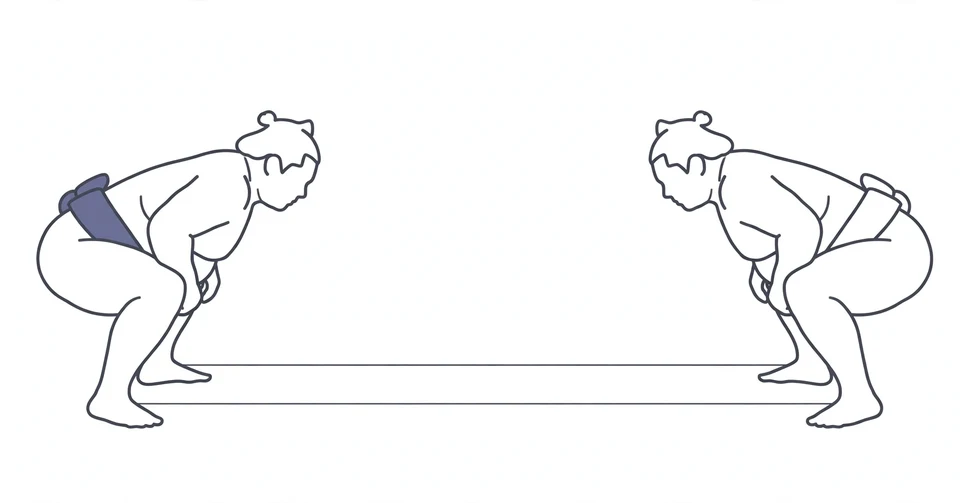
This guide explains what the tachiai is, how the long wait before it works, the techniques wrestlers use to win it, the rules that govern it, and why a single second carries so much weight. The tachiai looks like a simple collision from the seats. Up close, it is timing, courage, deception, and physics, all arriving at once.
What the tachiai actually is
The tachiai is the first physical contact of a sumo bout. The word comes from two Japanese words that mean stand and meet, and that is exactly what happens: two men who have been standing apart meet in the middle of the ring. The Tachi-ai entry on Wikipedia defines it plainly as the initial charge between two sumo wrestlers at the beginning of a bout, and the simplicity of that definition is part of its charm. There is no complicated scoring system to decode and no long rally to follow. Two wrestlers charge, they meet, and one of them is suddenly in trouble.
The charge takes place in the dohyo, the ring of packed clay and sand where every bout is fought. The dohyo is 4.55 metres across, which sounds generous until two men of well over 100 kilograms each are charging across it at each other. In the middle of the ring sit two short white starting lines, the shikiri-sen, and the wrestlers crouch behind them. The lines are 90 centimetres long and 6 centimetres wide, set 70 centimetres apart, and they have marked the start of bouts since the spring tournament of 1928. Before the lines existed, the two men simply charged from wherever they stood, and their heads sometimes met like fighting bulls. The lines gave the tachiai a fixed starting point, and with it, a fixed distance to cross.
That distance matters more than it looks. Seventy centimetres is barely a stride, and it means the wrestlers have almost no room to build speed before they collide. The tachiai is therefore not a sprint. It is an explosion from a crouch, driven by the legs, and the man who rises first or pushes hardest in the first half step usually owns the centre of the ring. The rest of the bout is often just the slow working out of that first advantage.
The tachiai also has a strict physical requirement. Both wrestlers must touch both fists down on the clay behind their lines before they charge. This is not a polite custom. It is the rule that makes the start fair, because a man who is still standing has an advantage over a man who is already crouched. The fist-down rule is what keeps the tachiai honest, and as this article will show, it has not always been obeyed.
Watch a tachiai once with this in mind and the bout changes shape. The long ceremony before it is not a delay. It is the preparation for a single second that both men know will probably decide everything, and the tension you feel in the arena is the tension of two athletes waiting to spend months of training in one collision.
The long wait before the tachiai
A tachiai does not happen quickly, even though it lasts a second. Before it, there is shikiri, the preparation routine in which the two wrestlers throw salt, stamp their feet, and stare at each other across the ring. In the top makuuchi division, four minutes of shikiri are allowed. In the second tier juryo division, three minutes are allowed. The wrestlers repeat the routine several times, crouching, rising, throwing more salt, and returning to their lines, and each repetition is a small test of nerve.
The salt is thrown to purify the ring, which is treated as sacred ground, and about 45 kilograms of it are used on each day of a grand tournament. The leg stamping is the shiko exercise, the same stamp that opens every training day, and our guide to shiko explains how that stomp prepares the legs and the mind for what is coming. The staring is the most honest part of shikiri. Two men look at each other across a short distance and try to read what the other one is planning, and the crowd watches them do it in silence.
When the shikiri time expires, the timekeeper, one of the five judges around the ring, raises a hand to let the gyoji, the referee, know. The gyoji nods to the wrestlers, and they settle behind their lines for the last time. The gyoji calls out to them, and when both men have their fists down together, he shouts the word that opens the bout. Our guide to hakkeyoi explains that call in full, and it is the sound that tells the arena the waiting is over.
There is a subtlety here that is easy to miss, and it matters. The gyoji signals readiness and calls the start, but the wrestlers themselves begin the bout by mutual consent. Nobody orders them to charge. NHK puts it plainly: the match starts by mutual consent, which makes things difficult for the wrestlers, because each of them has his own game plan and wants to gain an early advantage. The two men must move at the same instant, and they must agree, without speaking, on when that instant is. If one jumps early, the start is false, and they go back to their lines and try again.
I find that arrangement quietly remarkable. In most sports, the start is a mechanical thing, a whistle or a light or a buzzer, and the athletes react to a device. In sumo, the start is a shared decision between two opponents who are about to try to throw each other to the ground. It asks for a moment of cooperation at the exact instant the fighting begins, and it asks two men who want opposite outcomes to agree on the second when they will both go for them. The tachiai is a collision, but it begins with consent, and that tells you something about the sport that hosts it.
The waiting is also a weapon. A wrestler who is confident will settle quickly and hold his crouch, daring his opponent to move first. A wrestler who is unsure will rise, throw more salt, and take another slow walk back to his line, buying seconds to think. The crowd reads these delays like a language, and by the time the tachiai finally comes, the arena already has a sense of who wants it and who is afraid of it.
Seven ways to win the tachiai
There is no single correct tachiai. There are several, and each one is a different answer to the same question: how do you turn one second of contact into an advantage that lasts the whole bout? The techniques below are the standard answers, and every wrestler has a favourite among them, practised until it is automatic.
- Charge head first. The most direct tachiai of all. The wrestler drives forward low, using his weight and momentum to force his opponent backwards out of the ring. It is simple, honest, and dangerous, because a headlong charge in a low position can let a more agile opponent dodge out of the way and slap the charger on the back to push him to his knees.
- Raise the opponent upright. Instead of driving through, the wrestler lifts his opponent into a vertical position at the moment of contact. A man standing upright is easier to push backwards toward the ring edge, and he is also more open to throws and pull down moves.
- Thrust the chest. A hard double handed thrust to the opponent's chest, meant to drive him backwards or unbalance him enough to set up a beltless arm throw or a pull down. Powerful thrusts can on occasion be enough to force an opponent to fall over in the ring.
- Slap the face. An open handed slap to the cheek, meant to shock the opponent into lowering his guard. In certain cases the slap has been known to be enough to stun an opponent into falling to his knees, and even when it does not, it buys the space to take a better position.
- Grab the belt. The wrestler reaches straight for the mawashi, the belt, and uses it to gain leverage, force his opponent backwards, or set up a belt throw. This is the patient man's tachiai, because the grip is only the beginning of a longer fight.
- Dodge the charge. The henka, a sidestep at the tachiai, lets an incautious charger rush past into empty space, where a slap on the back can send him to his knees. The henka is often regarded as unsportsmanlike, but some say it is a legitimate outsmarting move, and it provides a necessary balance to direct force. A wrestler who never fears the henka charges without thinking, and a wrestler who charges without thinking is easy to beat.
- Surprise the opponent. The nekodamashi, a clap of the hands in front of the opponent's face, uses the momentary blink to duck underneath and take a strong belt or leg grip. It is a trick, and like all tricks it works best when it is used rarely.
There are rarer answers too. A few wrestlers have jumped clean over their opponent at the tachiai, hoping the charger would run himself out of the ring. It is spectacular when it works, and it is remembered for years, but it is a gamble, because a mistimed jump leaves the jumper with nowhere to land but the clay.
What all of these techniques share is that they are decided before the charge, not during it. A tachiai lasts about a second, and a second is not enough time to think. The wrestler who is still deciding when the fists go down has already lost, because his opponent has already decided and is already moving. The best tachiai is the one that was finished in the wrestler's head during the long minutes of shikiri, and the charge itself is only the delivery of a decision made in silence.
That is why watching the tachiai repays attention. The casual viewer sees two large men bumping into each other. The careful viewer sees a choice: a low drive, a lift, a thrust, a slap, a grip, a dodge, or a trick, each with its own risk and its own reward. The bout is often decided by which choice was better, and the better choice is usually the one that was made earliest and committed to hardest.
Matta, when the tachiai does not happen
Not every tachiai happens on the first attempt. Sometimes one wrestler charges while the other is still settling, or one man rises from his crouch a heartbeat too soon, and the gyoji calls matta, meaning wait, and raises his hand. The bout stops before it has started, and both men return to their lines.
A matta is a false start, and there is no limit to how many of them can happen in a bout. The wrestlers simply reset and try again, as many times as it takes to get a clean start. But there is a cost to repeating it. A wrestler who causes three matta in a row will be summoned to the judges' room to receive a warning or, sometimes, a reprimand. The rule exists because a false start can be used as a tactic, a way to break an opponent's rhythm or to test his nerves, and the judges do not want the start of a bout to become a game of its own.
Matta usually happens because the two wrestlers are not in sync. One man is ready and the other is not, or one man thinks the other is about to move and jumps the moment. That is the price of a start that runs on mutual consent. When two people must agree on a single instant without speaking, they will sometimes disagree, and the disagreement shows up as a false start.
There is a lesson in the matta that goes beyond the rulebook. A start that is forced is not a start at all. The gyoji does not let a bad start stand just because it happened. He stops it, sends both men back, and insists on a clean beginning. The bout that follows is fairer because the false one was not allowed to count, and both wrestlers know it. In a sport built on ritual, the willingness to stop and start again is part of what keeps the ritual honest.
For the crowd, a matta is a small drama of its own. The arena gasps, the wrestlers walk back to their lines, and the tension, which had peaked, has to build all over again. A wrestler who handles a matta well looks unbothered, as if the false start were nothing. A wrestler who handles it badly looks rattled, and his opponent notices. The tachiai is a test of timing, and the matta is the test of what happens when the timing fails.
Why the tachiai decides so much
The claim that 80 to 90 percent of bouts are decided by the initial charge sounds too strong until you think about what the tachiai actually does. It is not only a collision. It is the moment when position is decided, and in sumo, position is almost everything.
The wrestler who wins the tachiai usually wins the centre of the ring. The centre is the safest place in the dohyo, because it is the furthest from the edge in every direction, and the man who holds it can push in any direction he likes. The man who loses the tachiai is pushed back toward the straw bales at the edge, and from there his options shrink with every step. He can still win, and great wrestlers do, but he is fighting uphill for the rest of a bout that may last only a few seconds more.
The tachiai also decides the grip. A wrestler who charges well gets his hands where he wants them, on the belt or on the chest, and his opponent spends the rest of the bout trying to take those hands away. A wrestler who charges badly finds his opponent's hands where he does not want them, and the rest of the bout is a struggle to escape a grip that was set in the first second. The grip is the steering wheel of a sumo bout, and the tachiai is the moment it is seized.
There is a third reason, and it is the simplest. The tachiai is the moment of maximum surprise. Both wrestlers have a plan, and the charge is the first test of both plans at once. A plan that survives the first second is a plan that can be carried through. A plan that falls apart in the first second leaves its owner with nothing but reflexes, and reflexes are a poor substitute for a plan. The wrestler whose plan holds walks forward with purpose. The wrestler whose plan breaks walks backwards with worry, and the crowd can see the difference before either man has taken a second step.
That is why the long minutes of shikiri before the tachiai matter so much. They are not wasted time. They are the time in which each wrestler settles on a plan, reads his opponent's plan, and decides how much of his own plan to reveal. The tachiai is the moment the two plans collide, and the stronger plan usually survives. I think there is something honest about that. In most of life, we get time to recover from a bad start, and we tell ourselves the beginning does not matter. Sumo refuses that comfort. It says the beginning is the whole thing, and the rest is just the proof.
It would be a mistake to read this as fatalism, though. The remaining 10 to 20 percent is real, and it is where the great comebacks live. A wrestler who loses the tachiai can still pivot at the edge, can still find a throw, can still turn a bad start into a famous win. The tachiai decides most bouts, not all of them, and the gap between most and all is where hope lives. That gap is also what keeps the crowd watching after the first second, because they know that sometimes, just sometimes, the man who lost the charge finds a way to win anyway.
The rule that came back in 1984
The fist down rule sounds too obvious to need enforcing. Both fists on the clay before the charge, every time, no exceptions. Yet for a stretch of sumo history, it was widely ignored. By the 1970s and early 1980s, wrestlers were charging from a virtually standing position, fists barely touching the ground, and the tachiai had drifted into something faster and rougher than the rulebook described.
The Japan Sumo Association cracked down in 1984, and the fist down rule was enforced once again. The crackdown worked in the sense that wrestlers went back to touching down properly, and the start of a bout became fairer and more orderly. But it also raised a concern that has not gone away since. A proper crouch with both fists down means the wrestlers charge head first into each other from a low position, and that increases the likelihood of head to head contact and concussion. The rule that makes the start fair also makes the collision harder, and sumo has been living with that trade off ever since.
There is no tidy resolution to this, and it would be dishonest to pretend there is. The fist down rule exists because a fair start matters, and a start that lets one man stand while the other crouches is not a fair start. But the cost of fairness is real, and it is paid in the heads of the wrestlers. The association has kept the rule, and wrestlers have adapted to it, but the debate about it is a reminder that even the smallest rule in sumo carries weight. A rule about where two fists go is also a rule about how hard two heads will meet, and nobody in the sport pretends otherwise.
For a spectator, the 1984 crackdown is worth remembering because it explains what you are watching. The deep crouch, the two fists flat on the clay, the stillness before the charge, all of that is the enforced rule, not a natural habit. Before the crackdown, the start looked looser and quicker. After it, the start looked the way it looks today, formal and tense, with both men folded low over their own fists. The tachiai you see now is a product of that decision, and it is the reason the first second looks the way it does.
How wrestlers train the tachiai
A tachiai lasts a second, but it is trained for hours. The work happens in the stable, in the morning practice, and it is repetitive in the way that all serious training is repetitive. The goal is to make the charge automatic, so that when the moment comes, the body knows what to do before the mind has time to hesitate.
One of the oldest tools is the teppo, a wooden pole used for slapping and for tachiai training. The wrestler strikes the pole again and again, building the strength in his wrists, arms, and shoulders that the tachiai demands, and the rhythm of the slapping becomes a habit of its own. It looks simple from the outside, and it is simple. That is the point. The tachiai is a simple movement, and simple movements are perfected by repetition, not by complication.
Another drill is the butsukari, the collision exercise, in which a junior wrestler pushes a more senior wrestler across the ring, again and again, until exhaustion. The senior man stands his ground and presents his torso, and the junior man drives into him with force, learning hand placement and building the strength to keep pushing when his legs are tired. It is a demanding exercise, and it is repeated until the junior man can no longer stand, because the tachiai demands exactly that kind of strength: the ability to keep driving forward when the body wants to stop.
The legs get their own work too. The shiko leg stamp, which opens every training day, builds the hips and thighs that power the charge from the crouch, and the stamp is practised in the same spirit as the rest of the training, slowly, carefully, and many times. Strength in sumo is not built in a single dramatic effort. It is built in the hundredth repetition of a movement that looked easy the first time and feels heavy by the fiftieth.
What strikes me about this training is how much of it is about removing choice. The wrestler practises the same charge until he does not have to choose it anymore, and that is what makes him dangerous. In the ring, a second is not enough time to decide, so the decision has to be made in the stable, months earlier, and carried into the bout like a habit. The tachiai is won in the morning, in an empty training room, by a man hitting a wooden pole for the thousandth time. The crowd sees one second. The wrestler knows the thousand hours behind it.
What the tachiai teaches beyond the ring
The tachiai is a small thing, one second in a sport most of the world watches only in passing, but it carries a lesson that is larger than sumo. It says that beginnings matter more than we like to admit, and that the work done before the beginning matters most of all.
Most of us prefer to believe that a bad start can always be fixed. We tell ourselves that we will catch up later, that the first impression can be corrected, that the opening move is only a formality. Sometimes that is true. But often it is a comfort we offer ourselves because we do not want to prepare properly. The tachiai refuses that comfort. It says that the first second decides most bouts, and that the wrestler who prepares for the first second wins most of the time. Preparation is not a guarantee, but it is the best odds anyone gets.
There is also a quieter lesson in the way the bout starts. Two opponents must agree on the instant they begin, and they must do it without speaking. That is a strange and generous rule for a fighting sport, and it suggests that even a contest can begin with a moment of shared understanding. The fight is real, and it is hard, and someone will lose. But it begins with both men choosing the same second, together, and that shared choice is what makes the fight fair. A contest without a fair start is only a brawl, and sumo has never wanted to be a brawl.
So watch the next tachiai with the sound up and your eyes on the crouch, not on the collision. Watch the fists go down together, watch the stillness hold for one heartbeat, and watch the two men agree, silently, that now is the moment. Then watch what happens in the second that follows. You will see months of training, a plan made in silence, and a decision that was finished long before the charge. And you will understand why a sport that lasts fifteen days, six times a year, can turn on a single second that most people barely notice.
More in Culture & Society
- A Gunbai Points at the Winner and Nobody Argues
- Dondo-Yaki Is the Fire That Closes the Japanese New Year
- Hakkeyoi Is the Word That Starts a Sumo Bout
- A Yobidashi Calls the Wrestlers and Sweeps the Ring
- A Dohyo Is Sacred Ground Long Before the First Bout
- A Kadomatsu Guards the Door Until the New Year Fire
Latest posts
- Izakaya, the After-Work Pubs Where Japan Unwinds
- A Shikona Gives a Wrestler His Second Name
- Japanese Street Food, From Takoyaki Stalls to Festival Yatai
- Komusubi Is the Smallest Chair at Sumo's Top Table
- A Sekiwake Waits One Win From Sumo's Highest Door
- Tanabata Festival and the Star-Crossed Lovers Behind the Bamboo Wishes
- A Maegashira Climbs the Numbered Ladder One Bout at a Time
- An Ozeki Stands One Step From the Top and Cannot Afford to Slip
- An Oyakata Is the Father a Sumo Stable Cannot Replace
- A Tokoyama Spends Ten Years Learning to Dress a Topknot
- Japanese Calligraphy and the Brush That Turns Writing Into Art
- A Tegata Is Sumo's Inked Handprint Autograph
- A Rikishi Is a Man of the Sumo World Before He Wins a Single Bout
- Mawashi Carries a Wrestler's Rank Around His Waist
- Namasu Turns Daikon and Carrot Into a Red and White Wish