Izakaya, the After-Work Pubs Where Japan Unwinds
· 12 min read
An izakaya is where Japan goes after work to eat, drink, and talk too loudly. Here is how it started, what to order, and what the small dish you never ordered will cost you.
An izakaya is the fastest way to understand how Japan relaxes after work. Walk past one on a weeknight in Tokyo or Osaka and you will hear it before you see it: glasses clinking, someone shouting kanpai, the hiss of skewers on a grill. Step inside and the room is warm, crowded, and loud in a way that feels like permission to be loud yourself.
The word itself tells the story. Izakaya combines iru, to stay, with sakaya, a sake shop. It is a shop where you stay and drink, and that is exactly how it began, in the Edo period, when sake sellers started letting customers drink on the premises instead of carrying the bottle home. Barrels became stools, small plates of food appeared beside the cups, and a Japanese institution was born.
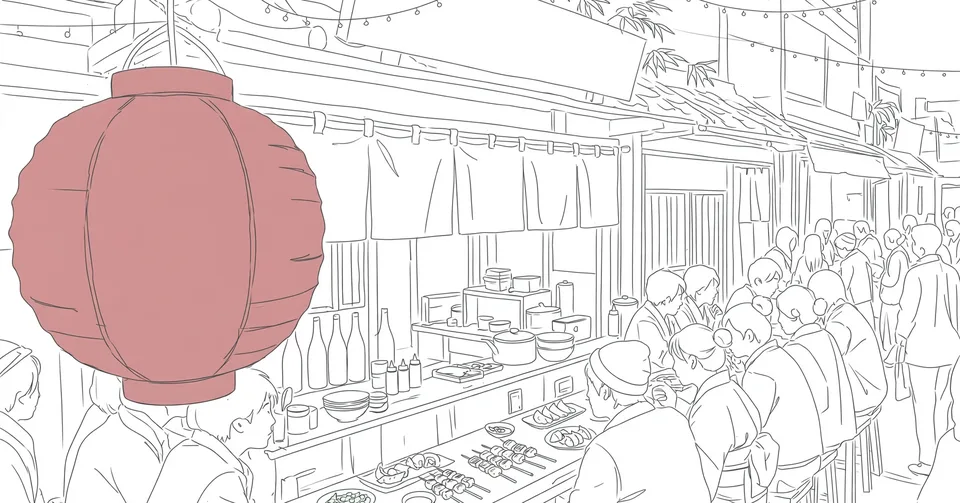
Today there are more than 150,000 of them across Japan, by one recent industry count, from six-seat counters in old yokocho alleys to huge chains with hundreds of branches. The format has changed less than you might expect. You still sit close to strangers, order a little at a time, and pay a small cover charge in the form of a dish you never ordered. If Japan has a living room outside the home, this is it. My own view, after many evenings in them, is that no other place in Japan teaches you as quickly how the country balances formality with release. The office rules stay at the door, and for two hours the hierarchy softens.
What an izakaya actually is
An izakaya is not a bar and not quite a restaurant. It sits between the two. The menu is built for sharing: small plates meant to arrive one or two at a time while the drinks keep coming. You do not order a main course for yourself. You order for the table, and the table orders again. The bill is usually modest, which is part of the point. An izakaya is a place you can visit on a Tuesday without planning for it.
The room tells you what kind of izakaya you have walked into. A traditional one has a wooden counter, low tables on tatami, and a red paper lantern, called akachochin, glowing outside the door. A chain izakaya has bright lights, touchscreen menus, and private booths. Both count. The chain version is where most office parties end up, and the counter version is where regulars keep the same seat for years.
Drinks run from draught beer and highballs to sake, shochu, and sour cocktails made with shochu and fruit. Non-drinkers are not an afterthought: oolong tea, green tea, soft drinks, and non-alcoholic beer sit on nearly every menu. The food leans salty, grilled, and fried, because it is designed to sit beside a drink. Yakitori skewers, fried chicken karaage, edamame, sashimi, grilled fish, tofu, pickles, and potato salad are the backbone of almost every izakaya menu in the country.
From sake shops to after-work institutions
It took its recognisable shape in the Edo period, from 1603 to 1868. Sake retailers had sold alcohol by measure for centuries, pouring it into whatever vessel the customer brought. At some point in the 1700s, customers started drinking it on the spot, standing at the shop front. The practice acquired a name of its own, izake, meaning staying-drinking, and shops that allowed it advertised the fact with a paper notice by the door.
By 1811, a census of food businesses in Edo counted 1,808 of them, the largest single category of eating establishment in the city. The numbers tell you how fast the idea had spread. Edo was a city of single men, workers and clerks living far from home, with nowhere to cook. The izakaya fed them and gave them somewhere to sit after the working day ended.
The modern version arrived with the economic boom of the 1960s and 1970s. As salaryman culture hardened into long hours and lifetime employment, the after-work drinking session became part of business life itself. Chains appeared in the 1980s and standardised the format: fixed-price all-you-can-drink plans, photographed menus, and rooms big enough for a whole department. The small counter izakaya survived alongside them, and the two kinds still serve different needs. One is for the office party, the other is for the regular who wants to be left alone with a beer and a newspaper.
The otoshi, the small dish you never ordered
Every first-time visitor meets the same small surprise. You sit down, you are handed a hot towel called oshibori, and a few minutes later a small dish arrives that nobody at the table ordered. It might be a spoonful of simmered vegetables, a few slices of pickled radish, or a little marinated fish. This is the otoshi, called tsukidashi in the Osaka and Kobe area.
The otoshi is effectively a seating charge, and in most places it is not optional. It appears on the bill as a per-person charge, typically a few hundred yen. Some visitors bristle at paying for food they did not choose, but the custom dates back to the Edo-period sake shops, where a small snack came with the first drink. Think of it as the price of the seat, the towel, and the table, and the surprise disappears. In my experience, the otoshi is often one of the better things on the table, because it is whatever the kitchen is proud of that day.
A tachinomi, a standing bar, usually skips the otoshi, which is one reason regulars love it. You pay for exactly what you order, you stay for one or two drinks, and you move on. The tachinomi is the closest surviving form to the original Edo-period sake shop, and it is the cheapest way to try an izakaya for the first time.
What to order at an izakaya
If the menu feels endless, start with the classics. Edamame and pickles arrive fast and cost little. Yakitori, chicken skewers grilled over charcoal, is the dish most people picture when they picture an izakaya. Order them by the piece or in sets, with salt or with tare, the sweet soy glaze. Karaage, Japanese fried chicken, is the other safe bet, and it travels well between drinks.
From there, follow the season. In summer, cold tofu and sashimi. In winter, oden, the simmered pot of fish cakes, eggs, and daikon that warms an izakaya from the inside. Grilled fish, especially sanma in autumn, is a quiet test of a kitchen. A good izakaya grills it whole and serves it with grated daikon and a wedge of lemon, nothing more.
The drink order matters less than the rhythm. Beer first is the convention, and the first round is almost always ordered together, with everyone raising a glass and shouting kanpai. After that, people drift to their own drinks: highballs, sake, shochu with hot water in winter, or a sour. Sake is usually ordered by the glass or in a small flask called a tokkuri, poured into tiny cups. If someone pours for you, hold your cup with both hands. If you pour for someone else, use both hands on the bottle. Nobody will correct you for getting this wrong, but people notice when you get it right.
Nomihodai, the all-you-can-drink deal
Many izakaya offer nomihodai, an all-you-can-drink plan for a fixed price and a fixed time, usually ninety minutes to two hours. The price is typically around 1,000 to 2,000 yen per person, and it is the standard choice for office parties. Order it when the group plans to stay a while and drink steadily. Skip it when you only want one beer, because a single drink costs less.
The rules are simple and worth knowing in advance. The clock starts when the first drink arrives, not when you sit down. The last order usually comes thirty minutes before the plan ends. Everyone at the table has to join the same plan, which is why the waiter asks the whole table rather than one person. And the plan covers a set list of drinks, not the premium bottles. None of this is a trap. It is a system built for groups that want to stop thinking about the bill and start talking.
The same logic applies to tabehodai, all-you-can-eat, which some chains offer as a combined course with nomihodai. A course with both, usually two hours and a fixed menu of dishes, is the default shape of a Japanese office party, and it is priced so that nobody has to calculate anything at the end.
Tachinomi and yokocho, the small rooms
The most memorable ones are rarely the biggest. A yokocho is a narrow alley of tiny bars and food stalls, often built around a station, where each shop holds six or eight seats. Omoide Yokocho in Shinjuku grew out of the black markets that followed the war, and it still feels like a different city from the towers above it. The smoke, the shouting, and the smell of grilling chicken are the same as they were decades ago.
In a yokocho, the rules are looser and the rooms are smaller. You may share a counter with strangers, you may be handed a menu in Japanese only, and you may be asked to leave after an hour if people are waiting. None of this is hostility. It is the economics of a room that seats eight. Order quickly, drink at the pace of the room, and do not camp at the counter.
A tachinomi works the same way, standing up. There are no chairs, no otoshi, and no reason to linger. It is the izakaya reduced to its oldest form: a counter, a drink, and a small plate. Some of the best food in Japan is served in places like this, to people who came in for one drink and stayed for three.
The nomikai, the office ritual
No guide to these pubs is complete without the nomikai, the after-work drinking party. It is the reason the izakaya exists in its modern form. A nomikai is not a casual drink with friends. It is a work event that happens to take place in an izakaya, and it has its own etiquette. The boss sits at the far end of the table, the newest employee pours for everyone, and nobody drinks before the first kanpai.
The custom has its critics, and the pressure to attend is real. I have written elsewhere about nomikai, the after-work drinks that are part of the job in Japan, and about the salaryman culture that built it. The izakaya is where that culture breathes. For a visitor, the nomikai is worth watching from the next table, because it shows you something a guidebook cannot: how a country that prizes restraint gives itself permission to relax.
That permission is the point. The izakaya is one of the few places in Japan where talking loudly, laughing hard, and disagreeing with your boss are all acceptable, as long as it happens inside the room. The next morning, the office pretends none of it happened. The Japanese have a word for that, too, but the izakaya does not need it. The room itself keeps the secret.
How to behave, and how not to
The etiquette is light. Wait for the kanpai before drinking. Pour for the people around you, and let them pour for you. Order a little at a time rather than everything at once. If you are done, say so clearly, because the kitchen will keep sending food as long as you keep ordering. And keep your voice down when you step outside, because the alley belongs to the neighbours.
A few practical points help. Most izakaya take cards now, but small counter shops may still be cash only. Smoking is still allowed in some small izakaya, though the law has pushed most chains to separate smoking rooms. Tipping does not exist in Japan, and the otoshi is the closest thing to it, so do not leave money on the table. If you want the bill, catch the waiter's eye and say okaikei onegaishimasu, or simply raise a hand and ask for the check.
Solo visitors are welcome. Sit at the counter, order a beer and one dish, and watch the room. The counter is the best seat in the house for a first visit, because the staff will talk to you, the regulars will talk to you, and the menu will stop looking like a wall of kanji and start looking like dinner.
Why the izakaya endures
The izakaya has survived the Edo period, the war, the bubble, and the pandemic, and it has done so by changing very little. The red lantern still hangs outside the door. The otoshi still arrives unasked. The first beer still comes with a kanpai. What has changed is everything around it: the city got taller, the working day got longer, and the drinks got cheaper. The izakaya stayed a room where people sit close together and order one more round.
That is the honest answer to what one is. It is not a theme restaurant and not a bar. It is a sake shop that learned, three hundred years ago, to let people stay. If you want to understand Japan beyond the temples and the trains, spend an evening in one. Order the yakitori, pay the otoshi without a second thought, and stay for one drink longer than you planned. The yakitori tastes better here than anywhere else, the beer is colder, and the street food you tried at the festival makes more sense once you see where it comes from. The izakaya is where Japan goes to be itself after work, and for a couple of hours, it lets you in too.
More in Food & Travel
- Japanese Street Food, From Takoyaki Stalls to Festival Yatai
- Namasu Turns Daikon and Carrot Into a Red and White Wish
- Ebi Bends Like an Old Back and Wishes You a Long Life
- Kobumaki Rolls Joy Into a Strip of Kelp
- Kurikinton Is the Golden Mash That Wishes You Wealth
- Japanese Beer and the Dry Wars That Changed How Japan Drinks
Latest posts
- Tachiai Is the One Second That Decides a Sumo Bout
- A Gunbai Points at the Winner and Nobody Argues
- Dondo-Yaki Is the Fire That Closes the Japanese New Year
- Hakkeyoi Is the Word That Starts a Sumo Bout
- A Yobidashi Calls the Wrestlers and Sweeps the Ring
- A Dohyo Is Sacred Ground Long Before the First Bout
- A Kadomatsu Guards the Door Until the New Year Fire
- A Shikona Gives a Wrestler His Second Name
- Komusubi Is the Smallest Chair at Sumo's Top Table
- A Sekiwake Waits One Win From Sumo's Highest Door
- Tanabata Festival and the Star-Crossed Lovers Behind the Bamboo Wishes
- A Maegashira Climbs the Numbered Ladder One Bout at a Time
- An Ozeki Stands One Step From the Top and Cannot Afford to Slip
- An Oyakata Is the Father a Sumo Stable Cannot Replace
- A Tokoyama Spends Ten Years Learning to Dress a Topknot