Iaido Is the Art of Drawing the Sword Before the Fight Begins
· 18 min read
Iaido is the Japanese martial art of drawing the sword in one smooth motion, and this article explains what it is, where it came from, and why it is still practised today.
Most martial arts begin when the fight begins. Iaido begins before it. The practitioner stands still in a quiet room, hands loose at the sides, sword resting in its scabbard at the hip, and the whole art turns on a single question: can you draw, cut, and return the blade before an attacker has finished moving? Nothing about the scene looks violent. That is the point. Iaido is the Japanese art of meeting a sudden attack with a sword that is still sheathed, and it treats readiness as a skill you can practise every day, not a gift you are born with.
At its simplest, iaido is a solo martial art built around four movements. The practitioner draws the sword from its scabbard, cuts, shakes the blade clean, and slides it back home. Every kata, every prearranged form in iaido, begins and ends with the sword sheathed, and there is no sparring at all. The opponent is imaginary, but the concentration is real, and that combination is why the art is sometimes called moving Zen.
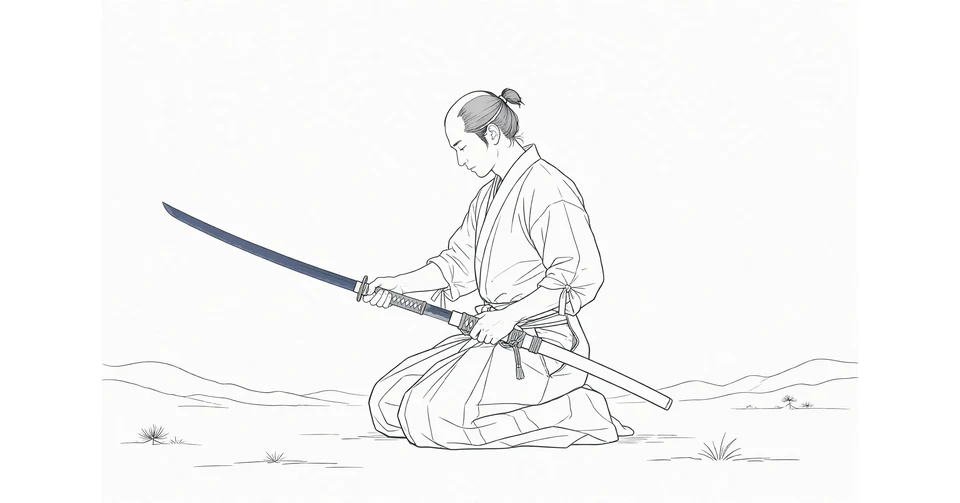
I first watched iaido at a small demonstration in Japan, expecting something loud. What I got was silence. A line of practitioners in dark hakama knelt on the wooden floor, and for a long minute nothing happened. Then, in one smooth motion, a sword was out, the cut was made, and the blade was back in its scabbard before I had quite registered the movement. The audience did not cheer. Nobody needed to. The beauty of iaido is that it makes violence look like calligraphy, and it leaves you wondering how much practice it takes to make a lethal skill look that calm.
What iaido actually is
Iaido is a Japanese martial art that emphasises being aware and capable of quickly drawing the sword and responding to sudden attacks. That short definition, given by Wikipedia, hides a surprising amount of philosophy. The art does not teach you how to win a duel. It teaches you how to be ready for one that may never come, and it treats that readiness as a form of self cultivation rather than a combat trick.
Practitioners of iaido are called iaidoka, and they practise alone. Each kata is performed against one or more imaginary opponents, which means imagination and concentration are not decorations in iaido, they are the training itself. Without a real opponent to react to, the practitioner must supply the danger in the mind, holding the image of an attack clearly enough that the body responds as if it were real. That demand is what makes iaido so different from its louder cousins. There is no armour, no bamboo sword, no scoreboard, only a person, a sword, and a room full of silence.
The purpose of iaido is openly non combative. It belongs to the modern budo, the martial ways of Japan, and it aims to cultivate a spiritually balanced individual, characterised by intellect, sensitivity, and resolute will. Its moral roots run deep, drawing on the ethics of Confucianism, the methods of Zen, philosophical Taoism, the purifying rites of Shinto, and aspects of bushido, the way of the warrior. A beginner can learn the footwork in an afternoon. The harder lesson, that a calm mind is itself a weapon, takes years, and many practitioners would say it never quite ends.
I think that is the honest appeal of iaido. It does not promise that you will ever need to draw a sword, and it does not pretend that the world is still a place of duels at dawn. Instead it offers a quieter bargain: practise being present, practise moving without hesitation, and carry that steadiness into the rest of your life. In a world that rewards speed and noise, an art that rewards stillness feels almost rebellious.
The meaning inside the name
The word iaido is younger than the art itself. It first appeared in 1932, and it is written with three kanji, 居合道, read i, ai, and do. The first two characters, iai, are believed to come from the saying "Tsune ni ite, kyu ni awasu", which can be roughly translated as being constantly prepared and meeting the opposition immediately. The primary emphasis in iai is on the psychological state of being present. The secondary emphasis is on drawing the sword and responding to a sudden attack as quickly as possible. The final character, do, means the way or path, so iaido approximately translates as the way of mental presence and immediate reaction.
The name was popularised by Nakayama Hakudo, one of the great swordsmen of the modern era, and its arrival marked a deliberate shift. The older word for the art was iaijutsu, the technique of the quick draw. In the late nineteenth and early twentieth centuries, many Japanese martial arts replaced the suffix jutsu, meaning art or technique, with do, meaning way, in order to emphasise the philosophical and spiritual side of practice. Judo, kendo, and aikido all made the same change, and iaido joined them. The sword stayed the same. What changed was the reason for holding it.
That change of a single syllable matters more than it looks. A jutsu is something you learn in order to use it. A do is something you practise in order to become someone. Iaido asks its students to do both at once: to master a draw that could once have saved a life, and to treat that mastery as a path toward a steadier self. The art keeps the old technique alive, but it refuses to let technique be the whole story.
Four movements in a single breath
Every kata in iaido, however long or complicated, is built from the same four movements. They flow into each other so smoothly that a casual watcher sees only one gesture, but a teacher will break them apart and drill each one separately for months.
| Stage | Japanese term | What happens |
|---|---|---|
| Draw | Nukitsuke | The sword leaves the saya in a single cutting motion, while the scabbard is pulled back in the opposite direction |
| Cut | Kirioroshi | The blade completes its arc, usually in a downward cut, with the full body behind it |
| Clean | Chiburi | The blade is shaken or flicked to clear it, in a controlled and symbolic motion |
| Sheathe | Noto | The sword slides slowly and precisely back into the saya, and the practitioner returns to stillness |
The draw, nukitsuke, is the heart of iaido and the hardest part to learn well. It is not a matter of pulling hard. The right hand draws the blade while the left hand pulls the saya back, a paired movement called saya-biki, and the cut begins before the sword has fully cleared the scabbard. Done well, there is no gap between drawing and cutting, no moment when the practitioner is holding a drawn sword and wondering what to do with it. Done badly, the movement is jerky, the blade catches, and the whole kata falls apart.
The sheathing, noto, is just as important, and it reveals the character of the art more clearly than the cut does. After the imaginary opponent has been dealt with, the practitioner does not relax or celebrate. The sword is guided back into the scabbard slowly, with the edge turned away from the hand, and the eyes stay on the space where the opponent stood. In iaido, the fight is not over when the cut lands. It is over when the blade is home and the mind is quiet again. That insistence on a careful ending is, to me, the most civilised thing about the art. Anyone can learn to strike. Learning to put the sword away properly is the real discipline.
From the battlefield to the dojo
Iaido started in the mid 1500s, and Hayashizaki Jinsuke Shigenobu, who lived from 1542 to 1621, is generally acknowledged as its organiser. He did not invent the sword, and he did not invent the quick draw from nothing. Older schools, such as the Tenshin Shoden Katori Shinto-ryu of the fifteenth century, already included drawing techniques in their curriculum. What Hayashizaki did was to systematise the quick draw into a coherent art of its own, and the schools that followed him carried his teaching forward for centuries.
Many different koryu, or old schools, grew out of that work, and only a few are still practised today. The best known are Muso Shinden-ryu, Hoki-ryu, Muso Jikiden Eishin-ryu, Shinto Munen-ryu, Tamiya-ryu, Yagyu Shinkage-ryu, Mugai-ryu, and Sekiguchi-ryu. Each one preserves its own kata, its own timing, and its own way of holding the sword, and each one claims a line of teachers stretching back to the sixteenth or seventeenth century. A student who joins one of these schools is not just learning movements. They are joining a conversation that has been going on for four hundred years.
The art changed with Japan itself. After the collapse of the feudal system in 1868, the samurai lost their status and their swords, and the old schools had to find a new reason to exist. Part of the answer came in 1895, when the Dai Nippon Butoku Kai, the Greater Japan Martial Virtue Society, was founded in Kyoto. In 1932 that body officially approved and recognised the discipline of iaido, the first time the term appeared in Japan, and the modern forms of swordsmanship began to take shape. The organisation was disbanded by the Allied occupation after the Second World War, but it was reestablished in 1950, and practice began again.
Two federations founded in the years just after the war still shape iaido today. The All Japan Iaido Federation, known as Zen Nippon Iaido Renmei, was founded in 1948, and the All Japan Kendo Federation, known as Zen Nippon Kendo Renmei, was founded in 1952. The International Martial Arts Federation followed in the same year. Because members of these organisations came from many different schools, each with its own kata, a problem of commonality appeared: teachers needed a shared set of forms that every member could learn and be graded on. The answer was a standardised curriculum, and it is the version of iaido that most people in the world practise today.
The twelve seitei kata and the old schools
In 1969, a committee formed by the All Japan Kendo Federation created a set of twelve standard forms, the seitei-gata, for the teaching, grading, and spread of iaido. These twelve kata are the common ground of the art. Every dojo that belongs to a regional kendo federation teaches them, and the member federations of the International Kendo Federation use them as the standard for examinations and competitions. That is why seitei iaido has become the most widely practised form of iaido in Japan and the rest of the world.
The twelve seitei kata, in order, are Mae, the front cut; Ushiro, the back cut; Ukenagashi, receive, parry, and cut; Tsuka Ate, striking with the hilt; Kesagiri, the diagonal cut; Morotezuki, the two handed thrust; Sanpogiri, three direction cutting; Ganmen Ate, the hit to the face; Soetezuki, the joined hand thrust; Shihogiri, four direction cutting; Sougiri, the complete cuts; and Nukiuchi, the sudden draw. A beginner starts with Mae, the simplest of the set, and works through the list over years of practice, with each form adding a new direction, a new posture, or a new problem to solve.
Alongside the standard set, the older schools keep their own kata alive. The All Japan Iaido Federation has its own set of five koryu forms, called Toho, contributed by five major schools: Mae-giri from Muso Jikiden Eishin-ryu, Zengo-giri from Mugai-ryu, Kiri-age from Shindo Munen-ryu, Shiho-giri from Suio-ryu, and Kissaki-gaeshi from Hoki-ryu. The two lines of the Eishin tradition are worth knowing by name. Muso Shinden-ryu was created by Nakayama Hakudo in 1932, and Muso Jikiden Eishin-ryu was formally named by Oe Masaji Shikei, who lived from 1852 to 1927, during the Taisho era. Mugai-ryu, founded by Tsuji Gettan Sukemochi on 23 June 1680, is another of the great surviving schools, and Toyama-ryu, established in 1925 and created by the Japanese army as a simplified form, was revived after the war and is still practised today.
The coexistence of the standard set and the old schools is one of the healthiest things about iaido. The seitei kata give every student the same foundation and every examiner the same measure. The koryu keep the art honest, preserving the older, stranger, and more particular ways of moving that a standard curriculum can never quite capture. A serious student will usually learn both, and the tension between them, standard against tradition, is part of what keeps the art alive.
The sword you train with
A beginner in iaido does not start with a sharp sword. Depending on the teaching style of the instructor, a new student may begin with a wooden sword, a bokuto, and move on from there only when the basic movements are safe and steady. Most practitioners train with a blunt edged sword called an iaito, also known as a mogito, which has the weight and balance of a real katana but an edge that will not cut. Only the more experienced practitioners use a sharp edged sword, a shinken, and even then the sharp blade is used with great care.
That progression is not a matter of snobbery. It is a matter of safety and sense. Iaido is practised almost entirely alone, with a metal weapon moving at speed close to the body, and a mistake with a live blade can be serious. The iaito lets a student practise the draw thousands of times, building the muscle memory that makes the movement smooth, without the risk that a moment of inattention turns into an injury. By the time a student is trusted with a shinken, the movements should be so familiar that the sharpness of the blade changes nothing except the attention it demands.
There is a quiet lesson in that order of things. In iaido, you earn the real sword by proving that you do not need it to be real. The wooden sword teaches the shape of the movement. The blunt sword teaches the weight and the timing. The sharp sword teaches only respect, and it teaches it to a student who is already ready to listen. I like that the art makes its students wait. It is a small reminder that the most dangerous tool in the room is never the blade, it is the person holding it, and the training is aimed at the person.
Iaido and kendo, two sides of the same coin
No art exists in isolation, and iaido is closely tied to its better known sibling, kendo. The All Japan Kendo Federation describes iaido as derived from methods of using the nihonto, the Japanese sword, that emerged in the Muromachi period, from 1333 to 1573, and says its object is to learn to draw the sword in an instant to overcome an aggressor. The federation adds that the connection to kendo is very close, and that iaido and kendo are two sides of the same coin. You can read the federation's own explanation on the All Japan Kendo Federation knowledge page.
The comparison is easy to see in practice. Kendo is the loud half of the pair: two armoured practitioners, bamboo swords, shouting, striking, and scoring points in a match. Iaido is the quiet half: one practitioner, a metal sword, no opponent, no points, only form. Where kendo tests your reactions against a living person, iaido tests your reactions against yourself. Iaidoka are often encouraged to practise kendo in order to maintain a combative spirit, and it is common for high ranking kendoka to also hold high rank in iaido, and vice versa. The two arts feed each other, and many dojos teach both under the same roof.
That pairing explains why so many people discover iaido through kendo, and why the two arts share a ranking system, a federation, and a large part of their student body. If you want the fuller story of the noisy half of the pair, read The Way of the Sword Lives On in Kendo. Kendo will show you what the sword looks like in a fight. Iaido will show you what the sword looks like in the second before the fight starts, and that second, the art insists, is where everything important happens.
The uniform that completes the picture
An iaidoka does not practise in ordinary clothes. The uniform is the keikogi and the hakama, the wide pleated trousers worn over a kimono, and the two garments together turn a person in a sports hall into a practitioner of a four hundred year old art. Practitioners of kendo, iaido, aikido, kyudo, jodo and naginata all wear it for training, and in iaido the dark, flowing lines of the hakama are part of the visual language of the kata, hiding the feet and making the movement look as if it glides across the floor. You can read the full story of that garment in Hakama Turn a Kimono Into Ceremony.
The hakama also carries a small story that belongs to iaido itself. Nakayama Hakudo, the founder of the Muso Shinden school of sword drawing, is said to have required his students to wear white hakama so that dirt would show on anyone who neglected to wash. The garment does not hide its wearer. It reports on them. That detail says a great deal about how the old teachers thought about training. The uniform was not a costume, it was a standard, and a student who could not keep it clean was a student who was not yet paying attention. The sword, the uniform, and the attention all belonged to the same discipline.
There is something fitting about that. Iaido asks for attention in everything, from the angle of the draw to the folding of the hakama after practice. In many schools the folding of the garment at the end of training is treated as part of the etiquette, and the most senior student may be given the honour of folding the teacher's hakama. It is a small, unglamorous act, and it is also the whole art in miniature: care, patience, and respect for the tools you use, repeated until they become habit.
Why people still practise iaido
Iaido has no sparring, no opponent, and no scoreboard, so it is fair to ask why anyone still practises it. Part of the answer is the competition that does exist, even without fighting. In an iaido competition, two or more iaidoka perform their kata next to each other at the same time, and a panel of judges scores them according to standardised regulations. The European Kendo Federation has arranged European iaido championships since 1993, and the competition continues to be held almost every year. The contest is not about beating another person. It is about performing the same forms, side by side, and letting the judges decide whose movement is cleaner, calmer, and more precise.
The other part of the answer is the grading system, which gives students a long road to walk. Iaido uses the kyu and dan system created in 1883, and the International Kendo Federation sets the tenth dan as the maximum attainable rank, although the All Japan Kendo Federation currently awards only up to the eighth dan. The ranks are not a ladder to climb quickly. A first dan, shodan, means beginning degree, not mastery, and the higher grades can take a decade or more each. That slowness is deliberate. The system is built to reward people who stay, not people who rush.
Iaido is also open in a way that surprises newcomers. It can be practised by both men and women, and in modern Japan it is seen as one of the traditional martial arts rather than a relic of the samurai class. Murayama City in Yamagata, described as the birthplace of iaido, runs training and experience programmes for visitors, including sessions with English speaking teachers. The art that began with warriors on a battlefield now welcomes office workers, students, and retirees, and it asks the same thing of all of them: stand still, breathe, and be ready.
I find that openness encouraging. A martial art that survives by excluding people would be a museum piece, and iaido is not that. It survives because ordinary people keep finding something in it that they cannot find elsewhere: a practice that is physically demanding without being violent, mentally absorbing without being competitive, and old without being closed. The sword is the excuse. The real subject is attention, and attention is something every life needs more of.
The art of iaido will not make you a swordsman in the old sense, and it does not pretend otherwise. What it offers is simpler and, I think, more useful: a few minutes of complete attention, repeated until attention becomes a habit, and a reminder that the most important moment in any confrontation is the quiet one before it starts. The sword stays in its saya until it is needed, and the practitioner stays still until the moment arrives. That is the whole lesson, and it is enough.
More in Culture & Society
- A Torii Gate Marks Where the Ordinary World Ends
- The Yumi Stands Taller Than Its Archer
- Kyudo Turns Archery Into a Moving Meditation
- Pancawara Gives Bali a Five Day Week That Never Stops Turning
- Hanami Turns Cherry Blossom Season Into Japan's Longest Picnic
- Bogu Is the Armour That Lets Kendo Strike at Full Speed
Latest posts
- Ekiben, the Train Station Bento That Turns a Journey into a Meal
- Natto, the Sticky Fermented Beans Japan Loves and Visitors Fear
- Ema Lets You Hang a Wish Where the Kami Can Read It
- Bonsai and the Thousand-Year Art of Tiny Trees
- The Shinai Is a Bamboo Sword That Teaches Before It Strikes
- Omikuji Tells Your Fortune on a Slip of Paper
- Japan Meets the New Year at Hatsumode
- The Way of the Sword Lives On in Kendo
- Hakama Turn a Kimono Into Ceremony
- A Haori Is the Jacket That Turns a Kimono Formal
- The Taiko Musubi Turned a Kimono Sash Into a Drum
- Hiroshige Walked the Tokaido and Japan Followed
- Hokusai Spent a Lifetime Chasing One Mountain
- Tabi Are the Split Toe Socks Japan Wears Under Everything
- Ukiyo-e Turned Everyday Edo Into Art Anyone Could Own