Yakiniku, Japan's Do-It-Yourself Barbecue
· 13 min read
Yakiniku is Japan's tabletop barbecue, where raw cuts arrive at your table and you grill them yourself. This is its Korean-born history, the cuts worth knowing, and how to order like a regular.
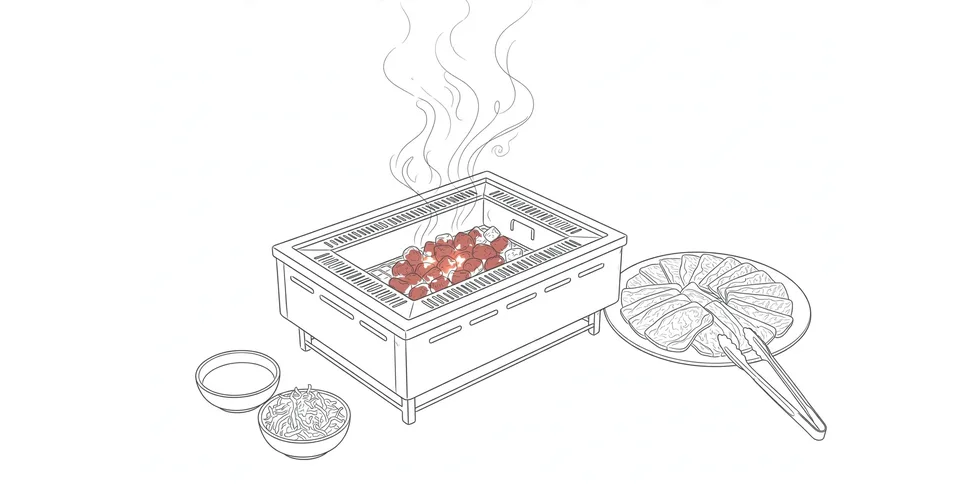
The grill arrives before the food does. A small charcoal brazier or a gas burner set into the table, already glowing, with a pair of tongs laid beside it like a challenge. Then come the plates: thin slices of beef, pink and marbled, arranged in neat rows, plus small bowls of dipping sauce, shredded cabbage, and rice. Nobody brings you a finished dish. In yakiniku, you are the cook, and the meal is over when you decide it is.
Yakiniku means grilled meat, and in Japan it means one specific ritual. Raw, bite-sized cuts are brought to your table, you grill them a few pieces at a time over a hot grill, and you eat them the moment they leave the heat.
That history is worth knowing before your first visit, because yakiniku is not an ancient Japanese tradition. It is a young dish, not much older than the postwar era, and it arrived in Japan through Korean kitchens. Knowing that changes how the meal tastes. The smoky room, the offal on the menu, the communal grill in the middle of the table, all of it makes more sense once you know where it came from.
From Korean grills to Japanese tables
The word yakiniku is older than the meal. The writer Kanagaki Robun used the characters for grilled meat in his 1872 Western cookery book, Seiyo Ryoritsu, written just after the Meiji government lifted a centuries-old ban on eating meat. But the dish you eat today was built by Koreans living in Japan, known as zainichi. In the 1930s, migrants from the south of the Korean peninsula settled in large numbers around Ikaino, a district in east Osaka, and brought galbi and bulgogi with them. The food historian Sasaki Michio argues in his 2004 book Yakiniku no Bunkashi that yakiniku was not so much born in Japan as made in Ikaino, by Korean cooks adapting their own grilled meat to Japanese kitchens and Japanese customers.
The postwar years turned that neighborhood cooking into a restaurant business. After 1945, in the black markets of a hungry country, zainichi cooks grilled beef and pork innards that Japanese butchers had little use for and sold them cheaply. The innards spoiled fast without refrigeration, so butchers were glad to be rid of them, and the cooks found that a cheap ingredient could fill a restaurant. That is why a yakiniku menu still lists stomachs and intestines alongside the prime beef, and why the grilled offal known as horumon has never left the menu.
Two restaurants are usually named as the first of the modern kind. Meigetsukan in Tokyo and Shokudoen in Osaka both opened around 1946, and both began as Korean restaurants and cold noodle shops that added grilled meat later. Shokudoen is still running in Osaka, and it still says it opened in Sennichimae in 1946 as a shop for Pyongyang cold noodles and grilled meat. From those beginnings, yakiniku spread through the 1950s and 1960s, and the neutral word yakiniku itself became the standard name for the cuisine in the late 1960s. In 1993, it was formally recognized as a distinct category of Japanese food culture. The beef import quotas were lifted in 1991, which brought cheaper imported cuts to ordinary restaurants, and by then the meal had already become a family treat, a payday celebration, and a standard night out.
What strikes me about this history is how honest it is. Yakiniku does not pretend to be ancient. It is a dish built by immigrants in a difficult decade, from ingredients other people threw away, and it became one of Japan's most loved meals without ever hiding that origin. That feels like the right way to think about Japanese food in general. The dishes that last are rarely the ones with the oldest pedigree. They are the ones that adapted, borrowed, and kept cooking.
The cuts worth knowing
A yakiniku menu can look long, but a handful of names appear everywhere, and learning them changes the whole meal. The cuts arrive raw and sliced thin, usually 3 to 5 millimeters thick, so they cook in seconds rather than minutes. Here are the ones to know first.
| Cut | What it is | How to cook it |
|---|---|---|
| Tan | Beef tongue, usually the first thing ordered | Grill briefly on high heat, eat with lemon and salt |
| Karubi | Short rib, the most popular cut, fatty and juicy | Watch for flare-ups, dip in sweet tare sauce |
| Harami | Skirt steak from the diaphragm, rich and beefy | Medium heat, turn once or twice, tare or salt |
| Rosu | Loin or chuck, leaner than karubi | Quick sear, good with tare |
| Misuji | Tender shoulder cut, soft and lightly marbled | Very brief grill, easy to overcook |
| Horumon | Offal, including intestines and stomach | Cook thoroughly, longer than the lean cuts |
Tan, or beef tongue, almost always comes first. It cooks fast, it cleans the palate with lemon and salt, and regulars treat it as the opening act. Karubi is the cut most people mean when they say they want yakiniku. The name comes from the Korean galbi, and in practice most shops cut it from the rib and belly area, so it carries enough fat to stay juicy over fierce heat. Harami looks like premium red meat but is technically offal, cut from the diaphragm muscle, and it is often the best value on the menu because it tastes expensive without costing as much as sirloin. Rosu is the safe, lean choice, misuji is the tender surprise from the shoulder, and horumon is the original heart of the meal, the offal that started it all in the postwar black markets.
The order matters more than most first-timers expect. Start with tan, move to the leaner cuts, then the fatty ones like karubi, and save horumon for later, since it takes the longest and leaves the strongest flavor on the grill. Put only a few pieces on at a time. A crowded grill steams the meat instead of searing it, and the whole point of yakiniku is the sear.
How a yakiniku meal actually works
The mechanics are simple, but there are rules, and they are mostly about respect for the grill and for the people sharing it. The tongs are for raw meat. Your chopsticks are for eating. Mixing them up is the one mistake that will earn you a quiet look from everyone at the table. Raw meat touches the tongs, cooked meat touches the chopsticks, and the two never cross.
Sauce comes in two styles. Tare is the sweet, soy-based dipping sauce that most first-timers reach for, and it is the default for karubi and rosu. Lemon juice with a pinch of salt is the lighter choice, and it belongs with tan and with harami. Some shops also offer a ponzu-style sauce or a spicy miso dip. There is no wrong choice, but regulars will tell you that a great cut of beef needs almost nothing, and they are right. If the meat is good, salt and lemon let you taste it. If the meat is ordinary, tare does the heavy lifting.
A typical meal builds itself in courses, even though nobody calls them that. The grill heats up, tan goes on first, then a round of karubi and harami, then whatever else the table ordered, pork belly, chicken, or seafood, with rice, kimchi, and namul on the side to reset your palate between rounds. Beer is the standard drink, and a cold glass of it next to a hot grill is one of the small pleasures of the meal. Many shops offer all-you-can-eat and all-you-can-drink courses, and a weekday lunch set often costs little more than 1,000 yen, which is why yakiniku works as an ordinary lunch as well as a celebration dinner.
The smoke is part of the experience, and you should plan for it. Good shops have strong ventilation above each table, but your clothes will still carry the smell home. That is not a flaw. It is a souvenir, and in Japan it is understood. Nobody judges a faint smell of grilled beef on the train home from a yakiniku dinner.
Wagyu and the price of marbling
No discussion of yakiniku is complete without wagyu, the beef that made the meal famous abroad. Wagyu is not a brand, it is a category covering four Japanese cattle breeds and their recognized crosses: Japanese Black, Japanese Brown, Japanese Polled, and Japanese Shorthorn. The famous names, Kobe, Matsusaka, and Omi, are regional brands within that category, and Omi beef from Shiga Prefecture is the oldest of the three great brands, with more than 400 years of history.
What makes wagyu different is marbling, the fine web of fat inside the muscle that melts at a low temperature and gives the meat its soft, almost buttery texture. Japanese grading runs from A1 to A5, with A5 at the top, and an A5 slice of karubi needs only a few seconds per side on the grill. Cook it like ordinary beef and you will ruin it. The fat renders, the slice shrinks, and the texture you paid for disappears into the fire.
That is also why a wagyu yakiniku dinner can cost so much. A full wagyu course at a good shop can pass 10,000 yen per person, and a single small steak can cost more than an ordinary dinner. I wrote about that price gap in my piece on wagyu beef and why one small steak costs more than dinner, and the short version is that you are paying for genetics, feed, time, and scarcity, not just for the meat on the plate. At a yakiniku grill, though, the math changes a little. You are not buying a whole steak. You are buying a few slices, and a few slices of A5 karubi, shared around a table, can be the most affordable way to taste the best beef Japan produces. That is a good deal, and it is one reason yakiniku is the smartest introduction to wagyu for a first-time visitor.
If the budget is tighter, the menu still has plenty to offer. Imported beef, domestic non-wagyu beef, and pork cuts all grill well, and harami in particular gives you a rich, beefy flavor at a gentler price. The grill does not care about the label. It only cares about heat and timing.
Beyond beef
Beef may be the star, but a good yakiniku menu is wider than that. Pork belly grills beautifully, chicken thighs take the smoke well, and many shops offer seafood like squid, shrimp, and scallops for a lighter round between the heavier cuts. Vegetables go on the grill too, usually onion, pumpkin, mushrooms, and peppers, and they are worth ordering, not just as a garnish but as a way to pace the meal.
Horumon deserves its own mention, because it is where yakiniku began. The word comes from the Kansai dialect phrase for things that are thrown away, and the menu still lists intestines, stomach, and other offal that Japanese butchers once discarded. Cooked properly, horumon is chewy, rich, and deeply savory, and it is the cut that most clearly connects the modern restaurant to the postwar stalls. First-timers sometimes skip it. Regulars rarely do.
There is also a cousin worth knowing. Jingisukan, named after Genghis Khan, is a Hokkaido style of grilling lamb on a dome-shaped grill, and it grew out of the same postwar culture of grilling meat at the table. It is not yakiniku, strictly speaking, but if you enjoy one, you will enjoy the other, and Hokkaido is the place to try it.
Yakiniku also sits comfortably next to Japan's other table-cooked meals. Where shabu-shabu swishes thin meat through hot broth, yakiniku sears it over fire, and the two meals attract the same kind of diner, someone who likes food that arrives unfinished and becomes a meal through their own hands. The same spirit runs through Japanese curry, another dish that arrived from abroad and became unmistakably Japanese, and through the festival stalls of Japanese street food, where the cooking happens in front of you.
Why the grill matters
I keep coming back to the grill itself, because it is what makes yakiniku different from every other way of eating beef. A steakhouse cooks for you. A barbecue at home is a performance by one person for everyone else. At a yakiniku table, everyone cooks, everyone watches the grill, and the meal becomes a shared task instead of a service. Someone tends the tongs, someone else orders the next round, and the conversation fills the gaps between flips. The food is good, but the format is what people remember.
That shared work is also why yakiniku is forgiving for visitors. You do not need perfect Japanese to order. Pointing at the menu works, the pictures are usually clear, and the grill does the same thing in every language. Solo diners are welcome too, and chains built around single-person counters have made it normal to grill alone, which was once unthinkable for such a communal meal. The ritual bends without breaking.
There is a small holiday for the dish, too. August 29 is celebrated as Yakiniku Day, a pun on the date, 8, 2, 9, which can be read as ya, ki, ni, ku. It is a lighthearted excuse, and restaurants often run specials for it, but it says something real about how deeply the meal has settled into Japanese life. A dish that began in black markets and immigrant neighborhoods now has its own day on the calendar.
So if you are planning a trip to Japan, or you already live here and have never tried it, put yakiniku on the list near the top. Start with tan, move to karubi and harami, dip lightly, grill a few pieces at a time, and let the meal take its own pace. The history is worth knowing, the cuts are worth learning, and the grill is worth sitting around. A meal you cook yourself, a few slices at a time, has a way of tasting better than the same meat served on a plate, and yakiniku proves that every single time.
More in Food & Travel
- Nikko and the Shrines Hidden in the Cedar Forest
- The Orangutan and the Vanishing Forests of Borneo
- Hozomon Guards the Treasure House Behind Senso-ji's Main Hall
- Nakamise Is the Shopping Street That Has Fed Pilgrims for Centuries
- Kaminarimon Is the Thunder Gate That Opens Asakusa to the World
- Kit Kat Japan, the Flavours You Will Not Find Anywhere Else
Latest posts
- An Engawa Is Neither Inside nor Outside, and That Is the Point
- Minka Are the Folk Houses Japan Built Around the Hearth
- Miyadashi Is the Moment the God Leaves Home
- Otabisho Is Where the God Rests on the Way Through Town
- Mikoshi Are the Portable Shrines Japan Carries on Its Shoulders
- Sanja Matsuri Turns Asakusa Into Tokyo's Loudest Weekend
- Waraji Straw Sandals Walked Japan for a Thousand Years
- Sony, the Tokyo Workshop That Taught the World to Listen
- Fujin Carries the Wind That Arrives Before the Thunder
- Raijin Is the Thunder God Behind Japan's Summer Storms
- Tengu Is the Mountain Goblin Japan Still Meets on the Trail
- Kappa Is the River Imp Japan Still Warns Its Children About
- Calonarang Is the Night Rangda and Barong Finally Meet
- Yamata no Orochi Was Never Just a Monster to Slay
- How Susanoo Slew the Eight-Headed Serpent and Won a Bride