Kusatsu Refuses to Water Down Its Onsen
· 9 min read
Kusatsu in Gunma has so much hot spring water that it never needs to dilute or recirculate it. This is how the town cools some of Japan's most acidic water with air, wood, and patience instead.
Most hot spring towns in Japan quietly cheat. When the source runs too hot, they add cold water. When it runs short, they pump the bath water around in a loop, filtered and reheated, so a little spring goes a long way. Kusatsu, a small town in the mountains of Gunma Prefecture, does neither. Its water reaches the bath the way it left the ground, cooled by air and wood and time, and used exactly once.
The refusal is possible because of a number that sounds made up. Kusatsu sits about 1,200 metres above sea level, and beneath and around it roughly a hundred separate sources pour hot water out of the volcanic ground. Counts of the combined flow differ a little by method, landing somewhere between about 32,300 and 34,000 litres every minute. Travel guides describe it plainly as the largest natural flow of hot spring water in Japan. When a town has that much water, dilution stops being a necessity and becomes a choice, and Kusatsu has chosen not to.
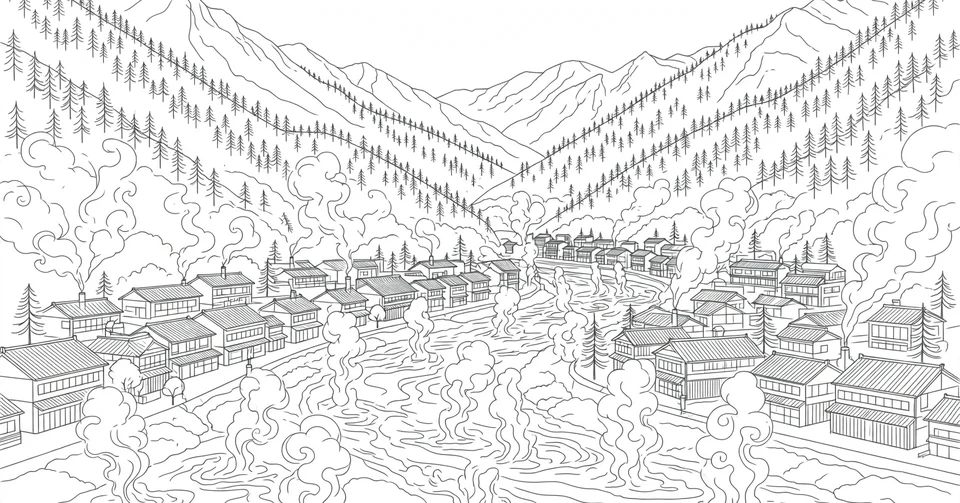
That choice shapes everything about bathing here. In most of the town's baths the water is gensen kakenagashi in spirit and in plumbing, source water flowing straight through and away, never recirculated, never stretched with tap water. What the mountain gives is what you sit in. I find something quietly admirable in that. Abundance can make a place careless, but in Kusatsu it seems to have done the opposite, turning into a standard the town holds itself to precisely because it can afford to.
Why Kusatsu can afford to refuse
Scarcity is what forces compromise at most onsen. A weak source has to serve every inn on the street, so the water gets shared, thinned, and recycled, and nobody says much about it. Kusatsu starts from the other end of the problem. Its springs produce far more water than its baths can hold, day and night, in every season. The overflow that other towns would kill for simply runs through the town in steaming channels and away down the valley.
So the engineering question in Kusatsu was never how to save water. It was how to cool it. The sources are recorded across a wide range, roughly 45 to 95 degrees Celsius depending on the vent, and the strongest of them emerge close to boiling. A bather needs about 42. Everything the town has built, from its famous wooden channels to its stirring dances, exists to close that gap without adding a single drop of cold water to the spring itself.
The water also has a character worth protecting. It comes from the slopes of Mount Kusatsu-Shirane, an active volcano west of town, and it is sulfurous and strongly acidic, around pH 2 by the usual published figures, closer to vinegar than to bath water in the abstract. Depending on which source feeds a bath, it can run cloudy white or almost clear. Locals have claimed for generations that it cures everything except lovesickness, and while that is a slogan rather than a medical finding, the chemistry at least explains why people believed the water was doing something.
Cooling the water without touching it
The heart of the system stands in the middle of town. The yubatake, literally a hot water field, is a raised square of stone and timber where the spring water runs through long, shallow wooden channels, shedding heat to the mountain air before it is divided up and piped to the baths. A separate article on this site walks through how those channels work in detail. What matters for Kusatsu as a whole is the principle it announces in public, in the town square, where everyone can watch it happen. The water is cooled by exposure, not by mixture.
The last stage of cooling is done by hand. Kusatsu is famous for yumomi, the practice of stirring the bath itself with long wooden boards, worked in unison and in rhythm to a traditional song, until the temperature drops to something a person can enter. Performances are held daily at the Netsunoyu hall beside the yubatake, and it is easy to file the show under folklore. But it began as labour, the final adjustment at the bathhouse level, done by people rather than plumbing.
Some baths solve the problem a third way, by offering the bather a staircase of temperatures. At Otakinoyu, one of the town's large public bathhouses, the Awaseyu section lines up wooden pools at graded heats, recorded between about 38 and 46 degrees, so you climb from bearable to fierce as your body allows. Nothing is diluted there either. The bather adapts to the water, not the other way around.
A town built on the cure
Kusatsu has been a bathing destination for a very long time. Local folklore says Minamoto no Yoritomo bathed at the yubatake in 1193 while hunting fugitives, and a stone seat and shrine still carry his name, though that story belongs to legend rather than record. By the Sengoku period the resort is on firmer ground, known among wounded samurai who came up the mountain to soak damaged bodies back together. In 1595, correspondence between Toyotomi Hideyoshi and Tokugawa Ieyasu has Hideyoshi recommending the Kusatsu springs, and Ieyasu, cautious as ever, sending servants to fetch the water rather than going himself.
During the Edo period the town boomed into one of Japan's best known hot springs, with a saying that it had a thousand storefronts just like Edo. Part of that fame was medical in the way of the time. Men came back from the pleasure districts of the capital with diseases that had no cure besides the baths, and Kusatsu's ferocious water was the strongest medicine going. The toji tradition, staying at a spring for weeks to take the cure, is woven through the town's whole history. People did not visit Kusatsu. They moved into it, temporarily, and let the water work.
The scientific chapter arrived with the Meiji era. Erwin von Baelz, a German doctor who taught medicine in Tokyo and served at the imperial court, came to Kusatsu in 1876 and became convinced of the water's healing power. He studied the springs and argued that Japanese doctors should be taught their proper use. Whatever modern medicine makes of the old cure claims, Baelz gave Kusatsu something valuable, a reputation documented rather than merely repeated, and the town has traded on it ever since.
Bathing in Kusatsu today
For a town of its size, Kusatsu offers an unusual amount of public bathing. There are grand public bathhouses like Sainokawara Rotenburo, a huge open air pool in Sainokawara Park wide enough for more than a hundred bathers, and Gozanoyu, a handsome wooden bathhouse opened in 2013 beside the yubatake, whose stone and wooden baths are fed by different waters. Scattered through the streets are more than a dozen small community bathhouses, most reserved for residents, though three of them, Shirohatanoyu, Jizonoyu, and Chiyonoyu, also open free to visitors. Their pools hold only a few people at a time and run seriously hot, straight from the spring.
Jizonoyu is among the local baths that still offer jikanyu, the timed bathing therapy sessions that belong to the old toji discipline, short immersions taken to a schedule rather than a long lazy soak. It is a reminder that Kusatsu bathing was once a regimen before it was a pleasure. Ryokan across town open their own baths to day visitors for a few hundred to fifteen hundred yen or so, and free foot baths stand beside the yubatake, outside the bus terminal, and in Sainokawara Park, for anyone who just wants to test the water with their feet first.
Getting there takes a little commitment, which probably protects the town from the worst of the crowds. No railway reaches Kusatsu at all. Visitors ride the train to Naganohara-Kusatsuguchi and finish the climb by bus, or drive up the Romantic Road, the themed route the town sits on. In winter the same altitude that cools the springs brings skiing above the town, and in the warmer months the volcano paths open for hiking, so the baths anchor a year round mountain town rather than a single season resort.
The abundance spills beyond bathing altogether. Hot spring water heats the town's primary and secondary schools, its municipal welfare centre, many households, and even the municipal swimming pool, and in winter it keeps the streets clear. Few towns anywhere are so literally warmed by their own ground. Across the same volcano, the smaller and quieter resort of Manza Onsen guards the same ethic at higher altitude, with milky sulphur water and a fraction of the crowds. Kusatsu is the famous sibling, the one that has held a top spot in Japanese onsen rankings for as long as such rankings have existed, but the two towns are really one argument at two volumes.
My own feeling, standing in the steam above the yubatake, is that Kusatsu's fame rests on something more durable than rankings. Plenty of resorts have good water. Fewer have built their whole identity around refusing to interfere with it. The town could dilute its springs tomorrow and almost nobody would notice, except that the promise would be broken, and Kusatsu seems to understand that the promise is the product.
In the end, that is what the wooden channels in the town square are really saying. A spring this generous does not need help, it needs restraint. Kusatsu lets its water cool in the open air, stirs it by hand when hands are needed, and pours the rest away unused rather than run it in circles. The bath you finally sink into is exactly what came out of the volcano, minus a little heat. Nothing added, nothing taken away, and in a country full of wonderful baths, that restraint still feels rare enough to travel for.
More in Life & Style
Latest posts
- Shimekasu Was Herring You Never Ate
- A Hana Donko Wears Its Cracks Like Flowers
- Hashigo-Nori Is Riding a Ladder Someone Else Holds
- At a Goma, Prayers Are Written to Be Burned
- The Sekaa Teruna Builds the Monsters
- A Lembaga Perkreditan Desa Is a Bank the Village Owns
- Every Melasti Goes to Fetch Tirta Amerta
- Kuki Is the Spring the Sea Turned White
- When the Kulkul Stops Sounding for You
- A Caru Is an Offering for the Ones You Fear
- Tatsuko Wished for Beauty and Became a Statue
- Warangan Is the Wash That Reveals the Pattern
- Every Village Writes Its Own Awig-Awig
- Umaji Refused to Disappear
- Rwa Bhineda Keeps Opposites From Going to War