Kayabuki Is the Roof Japan Rebuilds Every Generation
· 18 min read
A kayabuki roof is a thatched roof of kaya grass, rebuilt by the whole village every generation, and it is one of the most honest pieces of building Japan still has.
A kayabuki roof is a roof made of grass, and it is rebuilt every generation. The Japanese word kayabuki means thatching with kaya, the miscanthus grass that grows wild on the hillsides of Japan, and the roof it makes is thick, steep and warm, laid in layers over a timber frame until it can carry snow and shed rain for decades. It is the roof of the old farmhouses of Japan, and it is one of the oldest pieces of building knowledge the country still has.
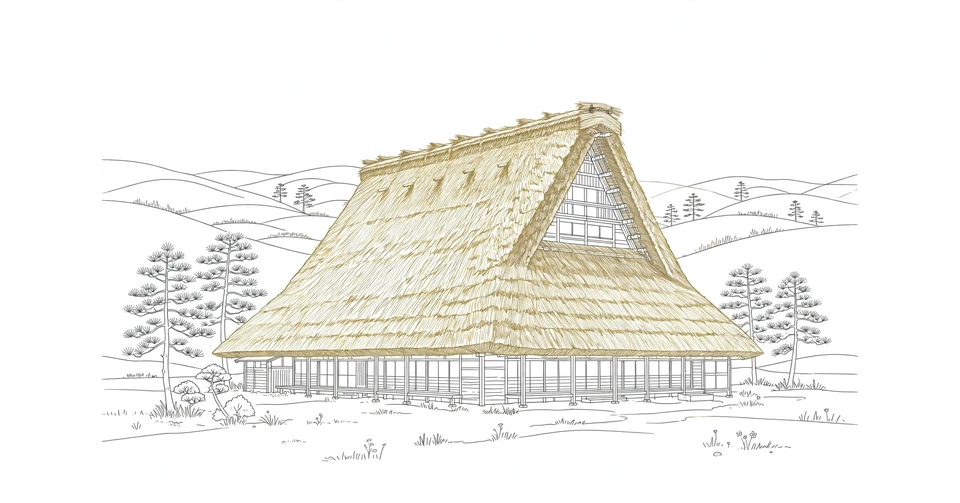
The honest truth is that a kayabuki roof does not last forever. At best it lasts about 30 years, and then the whole village climbs onto the roof and builds it again. That sounds like a flaw, and in a way it is, but it is also the point. A roof that has to be rebuilt forces a village to keep its skills alive, to keep working together, and to keep passing the knowledge from one generation to the next. A roof that lasted forever would need nobody.
This is the story of that roof: what the grass is, how it is laid, why it wears out, and why a handful of villages in Japan still choose to rebuild it, generation after generation, when a sheet of metal would be cheaper and easier.
What kayabuki actually is
The word kayabuki is often translated simply as thatched roof, but the Japanese word is more precise than that. According to the JAANUS dictionary of Japanese architectural terms, kayabuki means thatching with miscanthus, and the word kaya itself covers many kinds of grasses, reeds and straw. A kayabuki roof is therefore not one fixed material but a family of materials, chosen from whatever grass grows well near the village.
That matters because the roof is defined by its material, not by its shape. A steep roof in the snowy mountains and a gentle roof on the warm coast can both be kayabuki, as long as they are thatched with grass. The shape and pitch of the roof vary from region to region, and the steepest roofs use the gassho style, with two great planes meeting at the ridge like hands pressed together in prayer, so that heavy snow slides off before it can pile up. In milder areas the pitch is relatively gentle, because the roof only has to shed rain.
Kayabuki is also not limited to farmhouses. Thatch is usually associated with the vernacular dwellings called minka, but some shrine and temple buildings and gates still use this type of roofing as well. The grass roof is older than the farmhouse, and it belongs to the whole tradition of Japanese building, not only to one kind of house. The minka is simply where most people meet it, and the story of the minka, the folk house Japan built around the hearth is where the roof and the house come together.
There is something quietly radical about a roof made of grass. It is the cheapest material a village has, it grows back every year, and it asks for nothing from far away. A roof like that does not impress anyone with expense. It impresses with patience, because it works, and because it has worked for centuries.
The grass that becomes a roof
The grass of a kayabuki roof is mostly susuki, Japanese silver grass, the tall miscanthus that turns gold in the autumn fields. It is cut in late autumn, when the stalks are dry and strong, and bundled into sheaves that are stored until the thatching begins. The grass has to be the right length and the right dryness, and the people who know how to judge it are the same people who know how to lay it.
Not every part of the roof uses the same grass. In coastal regions where it is available, ditch reed called yoshi is used, and it is considered more durable than miscanthus or other grasses, so it is used for the eave ends, the part of the roof that takes the most weather. Rice straw is also used in some places. The choice is practical, not decorative, and it is made by people who have watched roofs fail and learned where they fail first. A kayabuki roof is only as good as the grass in it, and the people who thatch it know the difference between a bundle that will last 30 years and a bundle that will fail in ten.
The eaves are the thickest part of the whole roof. According to the JAANUS entry on kayabuki, the thatch at the eave ends is built up so that it may be 90 centimetres thick or more, while in ordinary thatching the thickness of the thatch, except at the eaves, is usually about 35 centimetres. That is a roof you could lose a child in, and the thickness is the whole secret. Rain runs down the surface of the grass and never reaches the layers underneath, and the deeper the thatch, the longer that trick keeps working.
The grass itself is a crop that needs a field. A village that keeps a kayabuki roof also has to keep a grass field, a kayaba, where the miscanthus is cut and tended. When the field is abandoned, the roof becomes impossible, and this is one of the quiet reasons thatched roofs disappear. The roof does not die on its own. It dies when the field is forgotten.
How a kayabuki roof is built
A kayabuki roof begins with a frame, and the frame is as clever as the thatch. First a simple, basic framework of short struts and beams is raised to support the ridge, the long horizontal beam at the peak. Long lengths of strong bamboo are then laid like purlins about 30 centimetres apart, and smaller bamboo rafters are set at close intervals between them. Split bamboo is positioned and tied horizontally about 15 centimetres apart, forming a lattice that the thatch can be fixed to.
Thatching begins at the eave ends and works upward, layer by layer. Tied bundles of thickly thatched miscanthus are laid onto the frame and held in place with small bamboo pegs about 30 centimetres long, called shinodake or hokodake, which are pounded into the inclined members of the underlying framework. The pegs stop the thatch from slipping, and the thatch may also be tied to them as each layer is applied. Sometimes short bamboo lengths that project forward a little are tied vertically to these pegs, a method called tenbin, and horizontal bamboos are tied across their upper tips to create another place for tying the thatch.
The work is slow and physical. Every bundle has to be placed, pressed and pegged by hand, and the thickness has to stay even across the whole slope. When the thatch is laid at the ridge, the last row of miscanthus is bent upward and more thatch is placed at right angles to the ridge, across its very top. The treatment of the ridge varies from region to region. Sometimes it is covered with the bark of cedar, tile, clay or boards held in place by inclined wooden strips that cross at the peak, and sometimes a long pole is held inside these crossed strips with thatch formed into a semi-circular roll covered by bark.
The roof is finished when it has been trimmed with very large scissors from top to eave, a final haircut that gives the thatch its clean, even surface. In some areas it is pounded with a battledore instead. Without the proper trimming of the round parts, the characteristic beauty of a thatched roof would vanish, and the trimming is not only cosmetic. A clean cut sheds water better than a ragged one, so the finish is part of the engineering.
What strikes me about this process is how little of it can be rushed or bought. The frame is bamboo and timber, the fastenings are pegs and rope, and the skill is in the hands of the people doing it. A kayabuki roof is built the way a basket is woven, one piece at a time, and the result is a roof that is also a piece of craft. That is what a kayabuki roof really is: not a covering but a piece of work, made by hand and meant to be remade by hand.
Why a kayabuki roof has to be rebuilt
Grass rots. That is the simple fact behind everything else in this story, and it is why a kayabuki roof has a lifespan at all. The thatch wears down from the weather, the surface layers decay, and after a few decades the roof stops shedding water the way it should. The JAANUS entry puts the maximum life of a thatched roof at about 30 years, before re-thatching becomes necessary, and adds that about half the thatch can be removed, dried out and reused. That reuse is part of what makes a kayabuki roof less wasteful than it looks: half of it comes back for a second life.
Other sources give a slightly longer range, with figures of 20 to 30 years common for ordinary farmhouses and 30 to 40 years given for a well kept roof, so the honest answer is that it depends on the grass, the climate and how well the house is lived in. A roof above a house where the hearth fire burns every day lasts longer, because the smoke rises through the roof space and dries the thatch, hardens the timbers and keeps insects away. A roof above a house where nobody lights a fire ages faster. The house and the roof take care of each other, and when one is neglected, the other suffers.
Fire is the other enemy, and it has always been one. A kayabuki roof of dry grass burns, and thatched roofs have always been a fire hazard. That risk, together with the scarcity of skilled thatchers, is why the use of thatched roofs has decreased exceedingly, in the words of the JAANUS entry. There are fewer and fewer people who know how to thatch, and a house whose roof cannot be repaired by anyone nearby is a house that will eventually lose its roof.
The sensible modern answer is a sheet of metal. Many farmhouses now wear corrugated steel over their kayabuki thatch, a practice that keeps the rain out and removes most of the fire risk, but the thatch underneath is no longer smoked or renewed, and some of it may be sound while some of it is rotten. It is a practical compromise, and it is easy to understand, but it is also a quiet admission that the village has stopped rebuilding its roof. A kayabuki roof that is never rebuilt is a kayabuki roof that is slowly becoming something else.
Yui, the village that climbs onto the roof
No single household can re-thatch a large roof alone, and that is why the rebuilding of a kayabuki roof is a village event. In Shirakawa-go, the thatched roofs of the gassho style houses must be replaced at regular intervals, usually once every 20 to 30 years, and the work has traditionally been a cooperative effort that can involve up to 200 villagers at a time. The spirit of such cooperation, in which strict reciprocity is assumed, is called yui.
The way it works is recorded in a guide published by the Ministry of Land, Infrastructure, Transport and Tourism, which describes the re-thatching of a roof as a gathering of the whole community. The owner of the house first calls upon his immediate neighbours, who are part of the same residents group, called a kumi. If the house is small, the thatching can be accomplished by a single kumi, while help from other parts of the village is required for larger buildings. Some accounts give a larger figure of 200 to 300 people working over two or three days, while the ministry guide describes a single day of work by up to 200 villagers, so the numbers vary by village and by the size of the roof, and the conservative figure is the one to trust.
Before the age of plastic sheets, a roof had to be thatched in a single day, and most re-thatching projects still follow this schedule. The family of the house gathers before dawn to remove the old thatch and prepare the roof for the arrival of the yui participants, who are given different roles depending on their skills and experience. The most senior usually supervises the work, while young villagers are tasked with handing bundles of grass to the thatchers on the roof or cleaning up after them. Members of the house owner family serve refreshments during the day, and together with other villagers they prepare a feast called naorai for all participants once the roof has been thatched.
The contributions of each yui participant, from work performed and thatching materials arranged to the number of sake bottles provided for the feast, are recorded in a booklet called a yui-cho. Such record keeping helps ensure fairness and reciprocity, which are two of the key values of the yui tradition, and the oldest yui-cho still in existence is from 1792, proving that the thatching of roofs has been a cooperative undertaking in Shirakawa-go for more than two centuries.
Re-thatching is nowadays usually carried out by professionals, but villagers still get together at least once a year, usually in spring or autumn, to thatch a roof in the spirit of yui, so that the techniques involved are passed on to the next generation. That annual gathering is, in a way, the most important part of the whole tradition. The roof can be rebuilt by professionals, but the knowledge cannot. It can only be passed from one pair of hands to another, on the roof itself.
I find this the most moving part of the story. A roof that needs 200 people to rebuild is a roof that forces a village to remain a village. It cannot be maintained by a single family, and it cannot be maintained by a company. It can only be maintained by neighbours who owe each other, and who keep a careful record of what they owe. The yui-cho, with its list of sake bottles and bundles of grass, is not bureaucracy. It is a village keeping its promises in writing.
Where kayabuki still survives today
Most thatched houses in Japan are scattered one by one across the countryside, but a few villages keep them in groups, protected as Important Preservation Districts for Groups of Traditional Buildings. The Agency for Cultural Affairs counted 129 such districts nationwide in April 2025, of every type, not only thatched ones, and the thatched villages are the most famous among them.
The best known are the villages of Shirakawa-go in Gifu Prefecture and Gokayama in Toyama Prefecture, where the farmhouses are built in the gassho style. Shirakawa-go and Gokayama were inscribed on the UNESCO World Heritage List in 1995, not only for the farmhouses themselves but for the whole living landscape around them, including the communal culture that keeps the houses standing. The village of Ogimachi in Shirakawa-go holds 59 gassho farmhouses among 117 designated buildings, and the account of Shirakawa-go, the village of praying hands describes the place and its people in more detail.
Another village worth knowing is Kayabuki no Sato in Miyama, Kyoto Prefecture, a hamlet of about 40 thatched houses, with more than 200 thatched buildings across the wider Miyama area. Its houses are mostly 150 to 200 years old, and it lies about an hour and a half by road north of Kyoto, which makes it the thatched village most foreign visitors actually meet. Ouchi-juku in Fukushima Prefecture is a former post town lined with hipped thatched houses, and it has been a preservation district since 1981.
Inside these districts, people still live in the houses. Families run guesthouses, cafes and shops, and they hand the houses down within the family. That is the point that matters most. A thatched village is not a museum, and the moment it becomes one, the roofs start to fail, because a roof that nobody lives under is a roof that nobody smokes, nobody watches and nobody rebuilds. The villages survive because people stay, and the people stay because the villages are still home. Every kayabuki roof in those villages is a small argument for staying, and for the work that staying requires.
The cost of keeping a thatch alive
A kayabuki roof is expensive, and honesty demands saying so plainly. There is no official price list for thatching, and figures vary with the roof size, the grass supply and the region, but published figures for Shirakawa-go put the replacement of one face of a large gassho roof at around 10 million yen, so roughly 20 million yen for both faces. A smaller hipped farmhouse roof costs less, but a kayabuki roof on a small house is still a serious expense for a family, which is why so many owners hesitate before they commit to one. These numbers should be treated as an order of magnitude, not as a quotation, and anyone with a real roof should ask a thatcher for a quote.
The cost is not only money. A kayabuki re-thatching needs grass, and the grass needs a field, and the field needs someone to cut it. It needs thatchers, and thatchers are few and booked in advance. It needs a village willing to gather, or professionals willing to travel. And it needs a house that can be insured, which is not always simple, because a thatched roof is a fire risk that insurers price carefully. Some decline it, and others ask for a higher premium or a site visit.
All of this explains why so many owners choose the metal cover. The arithmetic is simple, and the choice is rational. But the arithmetic misses something, and it is worth naming. A roof that costs 20 million yen every generation is a roof that asks a family to decide, once in a lifetime, whether the house is worth it. Many families decide that it is, and they pay, and the village gathers, and the roof goes on for another 30 years. That decision, repeated house by house and generation by generation, is the whole reason the thatched villages still exist.
What a roof teaches about building
A kayabuki roof is a strange thing to admire in an age of buildings that are meant to last forever and be maintained by nobody. It lasts 30 years at best, it needs a field of grass, a team of thatchers and a village of neighbours, and it burns. By every modern measure it is a bad roof, and yet it has sheltered Japanese farmhouses for centuries, and the villages that keep it are among the most loved places in the country.
A kayabuki roof is a promise a village makes to its own future, and the villages that keep it are the ones that still have a future to promise. The lesson, I think, is that a building is not only a shelter. It is also a schedule, a set of promises a community makes to itself. A kayabuki roof promises that the grass will be cut, that the thatchers will be trained, that the neighbours will gather, and that the house will be lived in. When those promises are kept, the roof lasts. When they are broken, the roof fails, and no amount of money can replace the promises. A roof you can buy once and forget is convenient, but it teaches a village nothing, and it binds nobody to anybody.
Japan still has a choice to make about its thatched roofs, and it is the same choice every country faces about its old buildings. The cheap choice is to let them go, one by one, until only photographs remain. The expensive choice is to keep rebuilding them, generation after generation, and to keep the fields, the skills and the villages that make the rebuilding possible. The kayabuki villages have made the expensive choice for more than two centuries, and their roofs are the proof. A roof made of grass should not last this long. It lasts because people keep deciding that it should.
More in Life & Style
- Amado Are the Storm Shutters That Close Japan for the Night
- An Engawa Is Neither Inside nor Outside, and That Is the Point
- Minka Are the Folk Houses Japan Built Around the Hearth
- The Washlet Made the Japanese Bathroom the Warmest Room in the House
- Onsen Etiquette and the Unwritten Rules of Japan's Hot Springs
- Forest Bathing in Japan, the Quiet Science of Shinrin-Yoku
Latest posts
- Takarabune Sails Under the Pillow to Bring Japan a Lucky Dream
- Seven Lucky Gods Sail Into the New Year on a Treasure Ship
- Ebisu the Rejected Child Who Became Japan's God of Good Fortune
- How Izanagi and Izanami Created Japan From a Drop of Salt Water
- Dohyo-Iri Is the Ring Entering Ceremony That Opens Every Sumo Day
- Omakase, the Japanese Meal Where the Chef Decides Everything
- The Andon Lantern Lit Edo Homes With Oil and Paper
- Akari Lamp Is the Paper Lantern a Sculptor Turned Into Light
- Chochin Is the Paper Lantern Japan Folds Away and Brings Back to Life
- Odalan Is the Birthday Bali Gives Every Temple
- Japanese Mythology and the Gods Who Shaped an Island Nation
- Mepeed Is the Slow Walk That Carries Bali to the Temple
- Gebogan Is the Tower of Fruit Bali Carries to the Temple
- Banten Are the Offerings Bali Makes Out of Almost Nothing
- Tama Nuki Is the Rite That Lets a Sacred Object Rest