Dohyo-Iri Is the Ring Entering Ceremony That Opens Every Sumo Day
· 18 min read
The dohyo-iri is the ring entering ceremony that opens every day of a grand sumo tournament, a slow and graceful parade of the top wrestlers in silk aprons before a single bout begins.
Every day of a grand sumo tournament begins the same way, not with a fight but with a slow parade. Long before the first bout, the top wrestlers walk into the arena in their finest silk, circle the clay ring in silence, and perform a short ritual that has barely changed in centuries. That parade is the dohyo-iri, the ring entering ceremony, and if you arrive late and miss it, you have missed one of the most beautiful parts of the whole day.
What makes the dohyo-iri so striking is how calm it is. Sumo is a sport of sudden violence, with bouts that often end in seconds, but the ring entering ceremony moves at the opposite speed. The wrestlers walk slowly, the crowd applauds each man by name, and for a few minutes the arena feels more like a temple than a stadium. It is the moment when sumo stops being a contest and shows itself as a tradition.
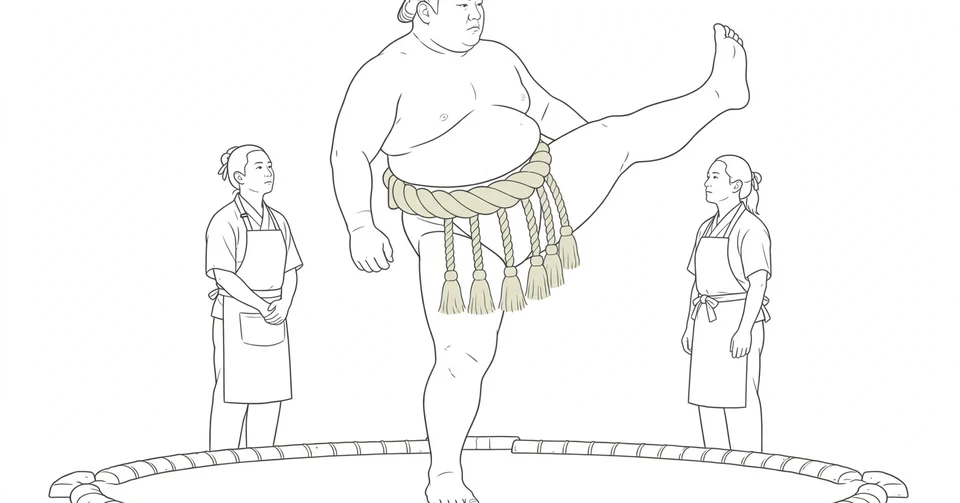
The first time I watched a dohyo-iri on television, I expected a quick introduction, something like the lineups before a football match. Instead I found myself watching a ceremony that asked for patience, and I realised that patience was the point. The dohyo-iri does not hurry because it is not entertainment filler. It is the ritual that makes the ring sacred before anyone is allowed to fight in it, and understanding it changes how you watch everything that follows.
What the dohyo-iri actually is
The dohyo-iri is the formal ring entering ceremony performed by the wrestlers of sumo's two top divisions, juryo and makuuchi. Nobody below those divisions takes part. Out of roughly six hundred professional wrestlers, only the seventy men in the top two divisions earn the right to circle the ring in this way, which is why the ceremony also works as a public announcement of who has arrived at the top of the sport.
The word itself is simple. Dohyo means the ring, and iri means entering, so the dohyo-iri is literally the entering of the ring. Yet the name undersells what happens, because the wrestlers do not simply walk in. They enter in order, form a circle, face the crowd, and perform a set of gestures that carry meanings older than the sport itself. The whole thing takes only a few minutes, but every movement in it is deliberate.
There is a useful way to think about the dohyo-iri. It is part introduction, part purification, and part promise. It introduces each wrestler to the crowd by name, it cleanses the ring through ritual movement, and it promises the audience that the men in the circle are ready to fight fairly. A first time spectator who knows this will see a completely different ceremony from one who only sees large men in aprons walking in a circle.
The dohyo itself deserves a mention, because the ceremony only makes sense once you know what the wrestlers are walking around. It is a ring of special clay, about two feet high, with straw bales buried in it so that a small part of each bale sticks up through the surface to mark the circle. A thin layer of sand is raked smooth over the clay between bouts, and above the ring hangs a roof shaped like a Shinto shrine, with tassels at each corner marking the four seasons. The ring is treated as sacred ground, and the dohyo-iri is one of the rituals that keeps it that way.
Who performs the dohyo-iri, and when it happens
Only juryo and makuuchi wrestlers perform the dohyo-iri, and the two divisions hold separate ceremonies at different points in the day. The juryo dohyo-iri takes place before the last few makushita matches, while the makuuchi dohyo-iri comes later, between the juryo bouts and the makuuchi bouts. If you only arrive in time for the top division, you will see the makuuchi ceremony and miss the juryo one entirely, which is a shame, because the juryo parade has its own quiet charm, with younger men who have only just earned their place among the salaried ranks.
The wrestlers are divided into east and west sides, and the two sides perform their dohyo-iri together in succession, one after the other. The division is not about teams, and it has no effect on who fights whom. It is simply the traditional way of organising the parade, and it means the ceremony happens twice, once for the east and once for the west, with the crowd applauding each side in turn.
One group is always missing from the shared dohyo-iri, and the absence is deliberate. The yokozuna, the grand champions at the very top of the ranking, do not join the circle with everyone else. Each yokozuna performs his own individual dohyo-iri separately, after the rest of the makuuchi wrestlers have finished theirs. The yokozuna is the rank sumo never takes back, the only rank from which a wrestler cannot be demoted, and the separate ceremony is a visible reminder of that status. When the yokozuna finally appears, the arena knows it is witnessing something apart from the rest of the day.
The order of the parade is fixed by rank, and it runs in reverse. The lowest ranked wrestler enters first and the highest ranked enters last, so in the makuuchi ceremony the ozeki closes the circle. The crowd understands this order instinctively, and the applause grows as the more senior men appear. By the time the last wrestler has taken his place, the audience has been given a ranking lesson without a single word of explanation, simply by watching who walks in last.
Step by step around the ring
The dohyo-iri begins before the wrestlers even reach the ring. A gyoji, the referee, leads the parade, dressed in a patterned kimono in the style worn by samurai in the Kamakura period, with a black gauze court hat like those worn by Shinto priests. As each wrestler enters, the gyoji announces his shikona, his ring name, along with his birthplace and his stable, in a specially trained high pitched voice. It is one of the most recognisable sounds in sumo, and regular spectators can often tell which referee is calling simply by listening.
The wrestlers walk down the aisle in reverse order of rank, wearing their kesho-mawashi, the heavily embroidered ceremonial aprons that are the visual signature of the ceremony. They walk around the perimeter of the ring and form a circle, turning to face outward toward the crowd. Then, together, they perform the ritual movements. They clap their hands, raise the right hand, lift the kesho-mawashi with both hands, and stretch both arms vertically upward. The movements are slow and synchronised, and from the upper seats the raised arms look like a ring of columns around the clay.
Then the wrestlers leave, one by one, in the same order they entered, from the lowest ranked to the highest. There is no rush and no flourish at the exit. Each man simply steps out of the circle and walks away, and the ring is left empty for a moment before the bouts begin. That quiet empty moment matters, because the dohyo-iri has done its work. The ring has been entered, honoured, and handed over to the fighting that follows.
The same gestures appear again later in the day, in miniature. Before each bout, the two wrestlers repeat parts of the dohyo-iri as pre match ritual, raising their arms and stamping their feet in a sequence called chiri-chozu, showing open hands to prove they carry no weapons. The ring entering ceremony is therefore not an isolated showpiece. It is the full version of a language of gestures that runs through the entire day, and once you have seen the dohyo-iri you will recognise its echoes in every bout that follows.
The kesho-mawashi aprons
No part of the dohyo-iri draws the eye quite like the kesho-mawashi. These are the ceremonial aprons worn over the wrestlers' mawashi, made of heavy silk and richly embroidered with designs that often tell a story about the wrestler, his hometown, or his supporters. The aprons are finished with gold fringe, and the effect under the arena lights is startling, a circle of colour and glitter around a ring of plain clay.
The aprons are also astonishingly valuable. According to the sumo guide at Notes of Nomads, each kesho-mawashi is worth a minimum of US$20,000. Many are gifts from a wrestler's supporters club, and some are embroidered with scenes that took months of work. When you watch the dohyo-iri, you are therefore looking at a parade of garments worth more than many cars, worn for a few minutes and then carefully folded away.
The connection between the apron and the wrestler's status runs deep. White silk means you made it as a sekitori, and the same logic applies here. Only the seventy salaried wrestlers of the top two divisions wear the kesho-mawashi in the ring entering ceremony, so the apron is not just clothing. It is proof of rank, worn in public, in front of thousands of people, every single day of the tournament. A young wrestler who has just been promoted to juryo will wear his first kesho-mawashi in his first dohyo-iri, and for his family and supporters that moment can matter as much as any bout he fights.
There is something touching about how carefully the wrestlers handle these aprons during the ceremony. The lifting of the kesho-mawashi with both hands is one of the most graceful movements in the whole dohyo-iri, and it is also a practical one, showing the embroidery to the crowd. It is hard not to think of the supporters who paid for the silk and the embroiderers who stitched it, and to see the gesture as a small act of thanks to both. Sumo is often described as a lonely sport, but the apron is a reminder that no wrestler reaches the ring alone.
The yokozuna dohyo-iri, a ceremony of its own
If the shared dohyo-iri is a parade, the yokozuna dohyo-iri is a solo performance, and it is the most solemn moment of the tournament day. After the makuuchi wrestlers have completed their circle and left the ring, a single yokozuna enters, flanked by two attendants. One is the tachimochi, the sword carrier, and the other is the tsuyuharai, the dew sweeper. The yokozuna wears a large braided hemp rope called a tsuna over his apron, a sacred object adorned with zigzag paper strips of the kind seen at Shinto shrines. The rope is heavy, and the sight of it marks the grand champion out from every other man in the arena.
The yokozuna dohyo-iri comes in two styles, Unryu and Shiranui, named after the nineteenth century grand champions Unryu Kyukichi and Shiranui Koemon. The story carries a gentle irony that sumo fans love to repeat, and it is recorded in the Wikipedia entry on the dohyo-iri. It is now believed that each man actually performed the style named for the other, so the names have been attached to the wrong wrestlers for more than a century, and nobody has bothered to correct them. The two styles differ mainly in how the tsuna is tied and in the shape of the arm movements, and knowing which style a yokozuna performs is one of those small details that marks a serious fan.
The movements of the yokozuna dohyo-iri are slow, powerful, and easy to read even without any explanation. The yokozuna claps his hands to attract the attention of the gods. He extends his arms to the sides and turns his palms upward to show that he is unarmed, a gesture of fair play that echoes the pre match rituals of every wrestler. Then he raises his legs high and stamps them down on the clay, driving evil from the dohyo with each stomp. The stamping is the most dramatic part of the ceremony, and the sound of a great champion's foot hitting the clay carries through a silent arena in a way that no commentary can match.
Every newly promoted yokozuna performs his first ring entering ceremony at the Meiji Shrine in Tokyo, outside the tournament altogether, in a tradition that underlines how deeply the ceremony is tied to Shinto. There is also a special form of the ceremony for a former grand champion's sixtieth birthday, the kanreki dohyo-iri, in which a retired yokozuna puts on the tsuna once more at the age of sixty. That a man would mark his birthday by returning to the ring, decades after his last bout, says everything about what the dohyo-iri means to the men who perform it. It is not a job requirement. It is an identity.
The Shinto roots behind the clapping and stamping
The dohyo-iri looks like pageantry, but its roots are religious. Sumo began as a ritual performed at Shinto shrines, and the ring entering ceremony still carries that origin in every gesture. The clapping of the wrestlers mirrors the clapping of worshippers at a shrine, a sharp sound meant to catch the attention of the kami, the spirits. The open palms show that no weapon is hidden. The stamping drives out evil and purifies the ground. None of this is explained to the crowd during the ceremony, and none of it needs to be, because the movements explain themselves to anyone willing to watch slowly.
The yokozuna dohyo-iri is regarded as a purification ritual in its own right, and it is occasionally performed at Shinto shrines away from the tournament. The dohyo matsuri, the ring festival held before each tournament, makes the connection even clearer. In that ceremony a head gyoji takes the role of a priest, reads a prayer, pours sake on the four corners of the ring, and buries six lucky items in the centre of the clay. The dohyo-iri that follows each day is the daily echo of that larger blessing, a smaller purification repeated before every round of bouts.
This is what I find most admirable about the dohyo-iri, and what I think modern sport could learn from it. Most sporting ceremonies exist to excite the crowd, with music, lights, and noise. The ring entering ceremony does the opposite. It slows everyone down, asks for silence, and reminds the audience that the contest about to happen takes place on ground that is considered sacred. There is a humility in that which feels rare, a willingness to say that the fight matters less than the respect shown before it. In a sporting world that grows louder every year, sumo's quiet opening feels like a deliberate choice, and a wise one.
It is worth remembering, too, that the ceremony survives because the people inside sumo protect it. The Japan Sumo Association has modernised much of the sport's business, from ticket sales to television rights, but the dohyo-iri has not been shortened, sped up, or dressed in modern staging. That restraint is a form of respect, not only for the past but for the audience, who are trusted to find meaning in a slow ritual without being entertained into attention.
How to watch the dohyo-iri as a first timer
If you ever attend a grand sumo tournament, plan your day around the dohyo-iri rather than treating it as a warm up act. The top division usually starts in the mid afternoon, and the makuuchi ceremony takes place between the juryo and makuuchi bouts, so arriving an hour before the top division begins will put you in your seat in time. The juryo dohyo-iri happens earlier, before the last few makushita matches, so a morning arrival will let you see both ceremonies and the lower division bouts in between.
Watch the gyoji first. The referee's announcements are the soundtrack of the dohyo-iri, and even if you do not understand Japanese you can hear the rhythm of it, the long drawn out syllables of each name, the pause, and the swell of applause that follows. The crowd applauds each wrestler by name as he is announced, and the volume tells you who the favourites are. A popular wrestler's entrance is easy to spot without knowing a single name.
Then watch the order. The wrestlers enter from the lowest rank to the highest, so the ceremony builds slowly toward the senior men. If you keep a ranking sheet open on your phone, you can follow along and see the hierarchy assemble itself in a circle before your eyes. The ozeki enters last in the makuuchi dohyo-iri, and the moment he takes his place the circle is complete, which is the visual cue that the yokozuna ceremony is about to begin.
Stay for the yokozuna dohyo-iri even if you think you have seen enough ceremony for one day. It lasts only a few minutes, but it is the emotional peak of the afternoon, and the arena falls quiet in a way it never does during the bouts. If there are two yokozuna in the tournament, each performs the ceremony in turn, so you will see it twice, and the second performance is no less moving than the first.
A small piece of etiquette matters here. The dohyo is sacred, and spectators must never attempt to enter it, even after the day's play has ended. Photography is welcome from your seat, but the ceremony deserves your attention more than your camera. The men in the circle have spent years earning the right to stand there, and the least a visitor can do is watch them properly, with the same patience they are showing the ring.
Special occasions around the ring entering ceremony
Most days the dohyo-iri follows the pattern described above, but a few occasions break the routine, and they are worth knowing about. When the emperor attends a tournament, a special form of the ceremony called gozengakari is performed. In this version the makuuchi wrestlers face the emperor's rostrum in ranks, dressed in their kesho-mawashi, with the lower ranked men standing closest to the emperor. They perform the leg raising exercise, squat, and are then called by their shikona one by one, rising to bow before departing. It is a rare ceremony that only takes place when the emperor arrives in time for the ring entering ceremony itself, and its most recent occurrence was in January 2007, when Emperor Akihito came to the Ryogoku Kokugikan.
The day itself ends with a ceremony that mirrors the opening. After the last bout, a specially selected makushita wrestler performs the yumitori-shiki, the bow dance, twirling a bow at great speed in the centre of the ring. The tradition dates to the Edo period, when the winning wrestler was awarded a bow as a prize and danced with it to express his satisfaction. Today the dance is understood as an expression of satisfaction on behalf of all the victorious wrestlers of the day, and it closes the tournament day the way the dohyo-iri opened it, with ritual rather than noise.
These bookends give the sumo day its shape. It opens with the ring entering ceremony and closes with the bow dance, and between them sits the fighting. A spectator who only watches the bouts sees the middle of the story without its beginning or its end, and the day feels thinner for it. The ceremonies are not decorations around the sport. They are the frame that holds it together, and the dohyo-iri is the most important part of that frame.
Why the dohyo-iri still matters
The dohyo-iri endures because it does something no highlight reel can do. It gives the audience a moment to arrive, to settle, and to understand that what they are about to watch is not only a contest of strength. In a few slow minutes it introduces the wrestlers, honours the ring, displays the silk and the rank, and reminds everyone present that sumo is a living tradition rather than a show. The ceremony asks nothing of the crowd except attention, and it repays that attention generously.
For the wrestlers, the dohyo-iri is a daily reminder of how far they have climbed. Most of them spent years in the lower divisions, cooking and cleaning for their seniors, fighting in the morning before the crowds arrive, and wearing no silk at all. To walk into a full arena in an embroidered kesho-mawashi, to hear your name called out and applauded, is the visible reward for all of that. The ceremony is brief, but for a man who has just been promoted it can be the proudest few minutes of his career.
If you ever find yourself in Tokyo during a tournament, go and see the dohyo-iri for yourself, and go early enough to see it properly. Sit still, listen to the gyoji, watch the circle form, and stay for the yokozuna. You will leave understanding sumo in a way that no description of the rules can give you, because you will have seen, before a single bout was fought, what the sport believes about itself. It believes that how you enter the ring matters as much as what you do once you are inside it, and that is a belief worth keeping.
More in Culture & Society
- Takarabune Sails Under the Pillow to Bring Japan a Lucky Dream
- Seven Lucky Gods Sail Into the New Year on a Treasure Ship
- Ebisu the Rejected Child Who Became Japan's God of Good Fortune
- How Izanagi and Izanami Created Japan From a Drop of Salt Water
- The Andon Lantern Lit Edo Homes With Oil and Paper
- Akari Lamp Is the Paper Lantern a Sculptor Turned Into Light
Latest posts
- Omakase, the Japanese Meal Where the Chef Decides Everything
- Kayabuki Is the Roof Japan Rebuilds Every Generation
- Chochin Is the Paper Lantern Japan Folds Away and Brings Back to Life
- Odalan Is the Birthday Bali Gives Every Temple
- Japanese Mythology and the Gods Who Shaped an Island Nation
- Mepeed Is the Slow Walk That Carries Bali to the Temple
- Gebogan Is the Tower of Fruit Bali Carries to the Temple
- Banten Are the Offerings Bali Makes Out of Almost Nothing
- Amado Are the Storm Shutters That Close Japan for the Night
- Tama Nuki Is the Rite That Lets a Sacred Object Rest
- Japanese Noh Theatre and the Slowest Drama on Earth
- Tamashii Ire Invites a Soul Into a Sacred Object
- Kaigen Kuyo Is the Ceremony That Wakes a Sacred Object
- Ihai Are the Lacquered Tablets That Keep a Name Alive
- A Butsudan Keeps the Dead Close in a Japanese Home