Seven Lucky Gods Sail Into the New Year on a Treasure Ship
· 15 min read
The Seven Lucky Gods are seven very different deities who sail together on a treasure ship at New Year, and their story says more about Japan than any single god could alone.
On the night of the second day of the New Year, many families in Japan slip a small picture under their pillow before they sleep. The picture shows a ship crowded with seven gods, sailing across a calm sea under a round moon. The hope is simple. Whoever dreams of the ship will have a lucky year, and whoever dreams of the Seven Lucky Gods will wake up with their blessings already on board.
The ship has a name, the takarabune, the treasure ship, and the gods have a name too, the shichifukujin. They are Ebisu, Daikokuten, Bishamonten, Benzaiten, Fukurokuju, Jurojin and Hotei, seven figures who could hardly be more different from one another. One carries a fishing rod, one carries a hammer, one carries a lute, and one carries nothing but a large bag and a smile. The Seven Lucky Gods do not look like a team, and that is exactly the point.
They were never a family, and the Seven Lucky Gods were never worshipped together from the beginning. They come from three different traditions, they arrived in Japan centuries apart, and they were only gathered into one group about six hundred years ago, when a priest and a shogun decided that Japan needed a set of gods who could cover every kind of luck at once. I find that history more interesting than any single miracle attached to them, because it shows a country choosing its gods the way a household chooses its tools, one for each job that matters.
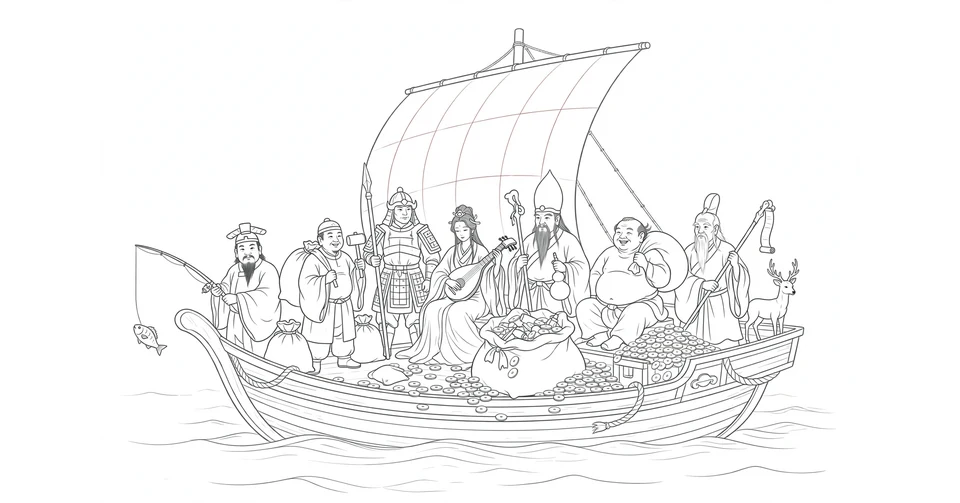
The story of the Seven Lucky Gods is therefore a story about Japan itself, about a fishing god from Japanese villages, a goddess from Hindu India, a warrior from the Buddhist scriptures and two old sages from Chinese Taoism, all sharing one small boat. What follows is who they are, how they came to sail together, and why, after six centuries, people still put their picture under a pillow and walk from shrine to shrine to meet them all.
The Seven Lucky Gods were first a merchant's idea
The Seven Lucky Gods were first worshipped by merchants, and that beginning explains a great deal about them. The two best loved members of the group, Ebisu and Daikokuten, were gods of business and trade, so the shopkeepers and traders of Japan claimed them first. Only later did other classes of society look at the group and find gods to match their own professions, the artists finding Benzaiten, the scholars finding Fukurokuju, and the warriors finding Bishamonten. The group grew the way a good market grows, by giving every visitor something to take home.
They began to be mentioned as a collective in the year 1420 in Fushimi, in order to imitate the processions of the daimyo, the feudal lords of premodern Japan. It is said that the Buddhist priest Tenkai selected the seven after speaking with the shogun he served, Iemitsu Tokugawa, seeking whoever possessed the perfect virtues of longevity, fortune, popularity, sincerity, kindness, dignity and magnanimity. Shortly after, the artist Kano Yasunobu was ordered to portray them for the first time, and the image of the seven together, often sailing on a treasure ship, became a fixed part of Japanese New Year celebrations. The fullest account of that history is the Seven Lucky Gods page on Wikipedia, which traces each of the seven to its source and sets out the 1420 beginning.
There is something honest about a group of gods chosen this way. The Seven Lucky Gods were not handed down from a single mountain or a single scripture. They were assembled, deliberately, by people who wanted their luck to be complete, and the assembly was open about it. A god of fishing and a god of war do not naturally belong together, but a merchant who needs both a good catch and a safe road does not care about theology. He cares about coverage, and the Seven Lucky Gods cover nearly everything a person in old Japan could hope for.
Meet the Seven Lucky Gods one by one
Each of the Seven Lucky Gods can be recognised at a glance, because each one carries the tools of his or her trade. Learn the objects and you can read a whole shrine display the way you would read a shop sign, knowing at once who stands for what.
Ebisu is the fisherman, and he is the only one of the seven who is purely Japanese. He wears a tall folded hat, holds a fishing rod in one hand and a fat red sea bream in the other, and he laughs, a round bellied laugh that has made him the favorite of fishermen and shopkeepers alike. In later tradition he is identified with Hiruko, the first child of Izanagi and Izanami, the divine couple who created the islands of Japan, a child born without bones and set adrift in a boat of reeds before his third birthday. The full story of that rejected child who became a god of good fortune is told in the tale of Ebisu, the rejected child who became Japan's god of good fortune, and it is the strangest beginning any of the seven can claim.
Daikokuten is the god of commerce and prosperity, and he is usually shown standing on rice bales with a large bag slung over his shoulder and a mallet in his hand. The mallet is the kozuchi, the mallet of good fortune, said to grant wishes with a single shake, and the bag is full of valuable things. He is also considered the patron of cooks, farmers and bankers, and a protector of crops. His imagery grew from a meeting of two older figures, the Buddhist death deity Mahakala and the Shinto deity Okuninushi, which is why his name means Great Blackness, a direct translation of the Sanskrit Mahakala. He is the god a shopkeeper keeps by the till, because he stands for the simple hope that goods will come in and money will follow.
Bishamonten is the warrior of the group, the god of fortune in war and authority, and the protector of those who follow the rules and behave appropriately. He wears armour and a helmet, carries a spear to fight evil spirits, and holds a small multi-storey pagoda in his hand, a treasury in miniature. His origins reach back to the Hindu god Kubera, also known as Vaisravana, and he acts as the protector of holy sites and important places. Where Ebisu promises a good catch, Bishamonten promises that the road home will be safe, and that dignity, one of the seven virtues Tenkai sought, will be defended.
Benzaiten is the only goddess among the Seven Lucky Gods, and she came from the Hindu goddess Saraswati. She plays the biwa, a Japanese lute, and she is the patron of the arts, of writers, dancers, musicians and geisha. She is usually shown as a beautiful woman, sometimes with a white snake beside her, and sometimes with a torii gate behind her. Some traditions say she married a sea dragon and ended his attacks on the island of Enoshima, where many of her shrines still stand by the sea. Among the Seven Lucky Gods, she is the one who reminds us that luck is not only money and long life. It is also a song played well, and a story told beautifully.
Fukurokuju is the god of wisdom and longevity, and he is the easiest of the seven to recognise, because his head is almost as large as his whole body. He carries a staff in one hand and a scroll in the other, and he is often shown with a crane, a turtle or a deer, animals that stand for long life in Japan. He came from Chinese Taoism, and tradition says he was once a hermit during the Chinese Song dynasty, a reincarnation of the Taoist god Hsuan-wu, and that he was the only one of the Seven Lucky Gods said to have the power to resurrect the dead. He is also the patron of chess players, which suits a god whose wisdom is measured by the size of his head and the patience of his game.
Jurojin is the second of the Taoist sages among the Seven Lucky Gods, and he too is a god of longevity and wisdom, which is why his story overlaps with Fukurokuju's. Both trace back to the same Chinese Taoist figure, and both are said to have lived on earth as sages before they were worshipped as gods. Jurojin is shown as an old man with a long white beard and a scholar's headdress, carrying a staff with a scroll attached to it, a scroll said to contain all the wisdom of the world. A stag stands at his side, and he is often accompanied by a crane said to be fifteen hundred years old and a tortoise, two more creatures of very long life. He is also said to be based on a real person who lived in ancient times, which gives his long life a curiously human root.
Hotei is the last of the Seven Lucky Gods, and he is the one children love most. He is stout and smiling, bald, half naked because his clothes are not wide enough to cover his enormous belly, and he carries a large bag on his shoulders loaded with fortunes for those who believe in his virtues. He was a Zen priest, and he is often called the Laughing Buddha, because he is almost always chuckling and often surrounded by children. His traits are contentment, magnanimity and happiness, and his gift is the simplest of the seven. He does not promise wealth or victory. He promises that a person can be happy with what he already carries, and that is a kind of luck no mallet can grant.
The membership of the group was not fixed at first, and that looseness is worth remembering. Benzaiten joined the Seven Lucky Gods later than the others, and some old lists replace Fukurokuju with Kichijoten, a goddess adapted from the Hindu goddess Lakshmi. The Seven Lucky Gods we know today are the settled version of a group that took time to settle, and the fact that the list could change tells us that the group was shaped by the people who prayed to it, not only by the priests who named it.
The treasure ship under the pillow
During the first three days of the New Year the Seven Lucky Gods are said to pilot the takarabune, the treasure ship, through the heavens. A picture of the ship forms an essential part of traditional Japanese New Year celebrations, and on the night of the second day it is placed under the pillow so that the sleeper will dream of the gods and receive their luck. The custom is still alive today, and it is easy to understand why it survived. A new year is a fragile thing, and a picture of seven gods sailing toward you with gifts is a gentler way to begin it than any resolution.
The gifts the ship carries are the stuff of daydreams. The old lists promise a key to the gods' own storehouse, a hat that makes the wearer invisible, a purse that never runs out of coins, the hammer of Daikoku that brings forth a shower of gold coins, a straw raincoat that protects the wearer from evil spirits, precious jewels, sacks and boxes of gold coins, rolls of brocade cloth and copper coins. Nobody expects to wake up with a purse that never empties, and that is not the point. The point is that the ship carries something for every kind of hope, just as the Seven Lucky Gods carry something for every kind of life. The World History Encyclopedia tells the story of the ship and its cargo in its article on the Shichifukujin, and it describes the vessel itself as well, a ship with a single mast and sail marked with a gold coin or the character for good luck, a dragon's head at the prow, a crane above and a turtle below, three auspicious creatures sailing together.
I like the picture under the pillow more than the grand shrine ceremonies, because it is private and small. A person does not need a priest or a procession to take part. They need a printed picture, a pillow, and a night of sleep, and the Seven Lucky Gods do the rest of the work in a dream. There is a democratic kindness in that, a piece of luck that costs nothing and asks for no rank, only a willingness to hope while asleep.
Walking to seven shrines in one morning
At New Year many people in Japan go further than a picture under the pillow. They set out on a pilgrimage called the shichifukujin meguri, a walk that visits seven shrines, one for each of the Seven Lucky Gods, in a single morning. Well known routes run through Yanaka, Meguro, Mukojima and Asakusa in Tokyo, and similar circuits exist in cities across the country. The walk is brisk and social, families and friends moving from gate to gate with a stamp book or a small wooden plaque, collecting a seal at each shrine until all seven are gathered.
The promise attached to the walk is a neat piece of arithmetic. Visiting all seven shrines at the start of the year is said to remove seven calamities and bring seven blessings, one for each god met along the way. It is a modest bargain, and a sociable one, because the pilgrimage is as much a walk through a neighbourhood as it is a religious act. People greet each other at the gates, buy a sweet from a stall, and arrive home by lunch with their seven seals and their seven blessings, having spent the first morning of the year in the company of their neighbours.
I think the pilgrimage is the best proof that the Seven Lucky Gods belong to ordinary life. A god who can only be met in a distant temple stays distant, but a god who can be met on a morning walk through Yanaka or Asakusa, between a coffee shop and a school gate, becomes part of the year itself. The seven shrines are not far away. They are in the streets where people live, and the luck they offer is measured in footsteps, not in gold.
The month when Ebisu stays behind
There is one more story about the Seven Lucky Gods that shows their character, and it belongs to Ebisu alone. In Kannazuki, the month without gods, the gods of Japan gather at the Grand Shrine of Izumo, leaving their shrines empty for the month. Ebisu, however, does not hear the summons, and so he stays behind, still available for worship while all the other gods are away.
I love that detail more than any other in the story of the Seven Lucky Gods, because it turns a flaw into a gift. Ebisu is said to be slightly deaf, a mark of his imperfect birth, and that deafness is the reason he never leaves his post. The god who cannot hear the call is the god who is still there when everyone else has gone, and the shops and fishing boats that depend on him are never left without a god to pray to. It is a small story, but it holds the whole spirit of the group. Luck, in this telling, is not only about grand ships and golden hammers. It is about someone staying behind when the rest have gone away.
Why the ship still sails
The Seven Lucky Gods have been sailing together for more than six hundred years, and they show no sign of stopping. Their pictures still hang in shops and restaurants, their statues still stand by the till, their ship still slides under pillows on the second night of the year, and their seven shrines still fill with walkers on cold January mornings. The Seven Lucky Gods survived because they were never only one thing. A fisherman could pray to Ebisu, a musician to Benzaiten, a scholar to Fukurokuju, a shopkeeper to Daikokuten, and each of them could feel that the group had been made with them in mind.
There is a lesson in that, and it is a plain one. A community that gathers its gods from three traditions and seven professions is a community that believes luck should be shared, not hoarded, and that no single god, and no single person, can cover everything that matters. The treasure ship works because it is crowded. Seven very different gods, one small boat, and room enough for everyone who dreams of it. That is why the ship of the Seven Lucky Gods still sails, and why, on the night of the second day of the New Year, it is still worth putting the picture under the pillow and going to sleep hoping for a good dream.
More in Culture & Society
- Takarabune Sails Under the Pillow to Bring Japan a Lucky Dream
- Ebisu the Rejected Child Who Became Japan's God of Good Fortune
- How Izanagi and Izanami Created Japan From a Drop of Salt Water
- Dohyo-Iri Is the Ring Entering Ceremony That Opens Every Sumo Day
- The Andon Lantern Lit Edo Homes With Oil and Paper
- Akari Lamp Is the Paper Lantern a Sculptor Turned Into Light
Latest posts
- Omakase, the Japanese Meal Where the Chef Decides Everything
- Kayabuki Is the Roof Japan Rebuilds Every Generation
- Chochin Is the Paper Lantern Japan Folds Away and Brings Back to Life
- Odalan Is the Birthday Bali Gives Every Temple
- Japanese Mythology and the Gods Who Shaped an Island Nation
- Mepeed Is the Slow Walk That Carries Bali to the Temple
- Gebogan Is the Tower of Fruit Bali Carries to the Temple
- Banten Are the Offerings Bali Makes Out of Almost Nothing
- Amado Are the Storm Shutters That Close Japan for the Night
- Tama Nuki Is the Rite That Lets a Sacred Object Rest
- Japanese Noh Theatre and the Slowest Drama on Earth
- Tamashii Ire Invites a Soul Into a Sacred Object
- Kaigen Kuyo Is the Ceremony That Wakes a Sacred Object
- Ihai Are the Lacquered Tablets That Keep a Name Alive
- A Butsudan Keeps the Dead Close in a Japanese Home