How Izanagi and Izanami Created Japan From a Drop of Salt Water
· 17 min read
Izanagi and Izanami stirred the primeval ocean with a jeweled spear and created the islands of Japan, then a journey to the land of the dead tore them apart forever.
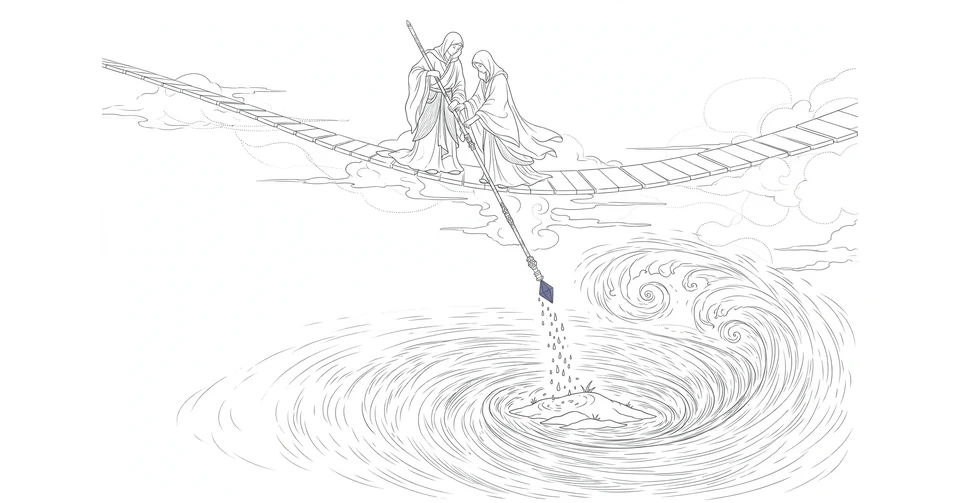
Before Japan had a name, before it had mountains or rice fields or a single shrine, it had a drop of salt water. Izanagi and Izanami stood on a bridge in the sky, dipped a jeweled spear into the primeval ocean, and watched that drop fall and harden into the first island. That is how the oldest Japanese chronicles explain the beginning of the country, and it is also the beginning of one of the saddest love stories in world mythology.
Izanagi and Izanami were not the first gods. They were the seventh and final generation of the primordial kami who appeared after heaven and earth separated, and the elder gods gave them a task no one else had been given. The land was still soft and drifting, like oil floating on water, and Izanagi and Izanami were told to firm it up and shape it into a country. What follows is their story, from a single drop of brine to a boulder that sealed the land of the dead.
Their names already tell us who they are. Izanagi and Izanami take their names from the verb izanau, to invite, so Izanagi means he who invites and Izanami means she who invites. The story that follows is, in a sense, one long invitation answered badly, then answered well, then answered too late. Izanagi and Izanami are remembered today as the creators of the Japanese archipelago and the parents of many of its gods, including the sun goddess Amaterasu, the moon god Tsukuyomi, and the storm god Susanoo. The Kojiki, compiled around 712, tells their story in full, and the Nihon Shoki of 720 tells it again with different details. Both books agree on the shape of the tale, and where they differ, the difference itself is worth knowing.
The seventh generation and a task from the elder gods
In the beginning, heaven and earth split apart, and the first kami appeared. The first group, the kotoamatsukami, were formless and had no partners. After them came pairs of partner kami, generation after generation, until the seventh and final generation. That generation was Izanagi and Izanami, a brother and sister, a husband and wife, the last of the primordial gods.
The world they inherited was unfinished. The land floated aimlessly, like oil on water, and it needed someone to give it shape. So the older deities charged Izanagi and Izanami with bringing order to the world, and they handed the pair a sacred spear to do it with. The spear was the Ame-no-Nuboko, the jeweled spear of heaven. With it, Izanagi and Izanami were to stir the chaos below and draw a country out of it.
There is something quietly moving about this beginning. Izanagi and Izanami did not create the world out of nothing, and they did not command it into being with a word. They stirred it, the way a cook stirs a pot, and waited to see what would settle. Creation here is patient work, not a sudden miracle. The Japan Tourism Agency, in its telling of the Shinto creation story, puts it in a way that has stayed with me. The world and its inhabitants are not made but born, and Izanagi and Izanami are at the center of that birth. You can read that account in the agency's overview of creation according to Shinto mythology, which follows the same sequence of events as the Kojiki.
A drop of salt water becomes an island
Izanagi and Izanami climbed to the Floating Bridge of Heaven, the Ame-no-Ukihashi, and looked down at the watery chaos below. Izanagi and Izanami lowered the jeweled spear into the ocean and stirred. When they lifted it again, brine dripped from its tip, and as the drops fell they congealed and hardened into land. The first island was Onogoro, also written Onogoroshima, a small island born from a single drop of salt water.
It is worth pausing on the scale of that image, and on what it says about Izanagi and Izanami as creators. An entire country begins as one drop. The myth does not start with a continent or a mountain range. It starts with something so small you could hold it on your fingertip, and then it grows. I think that is part of why the story has lasted for thirteen centuries. It tells its listeners that great things do not need great beginnings, only a beginning that is real.
Izanagi and Izanami descended to Onogoro and made it their home. Izanagi and Izanami built a dwelling there and raised the heavenly pillar, the Ame-no-Mihashira, at its center. The pillar would become the axis of everything that followed, the place around which their marriage, their children, and their country would turn.
The marriage around the heavenly pillar
Once they were settled on Onogoro, Izanagi and Izanami realized they were meant to have children together, and they devised a marriage ceremony. They would walk in opposite directions around the heavenly pillar, meet, and greet each other, and then they would be wed.
The ceremony of Izanagi and Izanami went wrong the first time. Izanami spoke first, greeting Izanagi before he could greet her, and Izanagi objected that the man should have been the first to speak. The union of Izanagi and Izanami that followed produced a child who was considered imperfect. The firstborn was Hiruko, the leech child, a child without proper limbs, and Izanagi and Izanami set him adrift in a boat of reeds. They also begot Awashima, the island of foam, but that child too was not counted among their rightful children.
It is easy to read this part of the story as a harsh old rule about who speaks first, and in a way it is. But I think there is a gentler reading too, and it is the one I prefer. Izanagi and Izanami were doing something no one had ever done before. They had no example to follow, no older couple to copy, and their first attempt failed. The story does not punish them for that failure. It lets them ask the elder gods what went wrong, learn the answer, and try again. There is a quiet kindness in a creation myth that allows its creators to fail and to start over.
After consulting the gods, Izanagi and Izanami repeated the ceremony, this time with Izanagi greeting Izanami first. This time it worked. The order was right, the union was blessed, and the children who followed were whole.
Hiruko, the child set adrift, was not forgotten by the tradition. In later belief he came to be identified with Ebisu, the smiling god of fishermen and good fortune, one of the Seven Lucky Gods. The child who was cast away became a god people prayed to for a good catch and a safe return home. That turn in the story feels like the myth quietly correcting itself, giving the rejected child a better ending than the one his parents gave him.
How Izanagi and Izanami gave birth to the eight great islands
With the ceremony done properly, Izanagi and Izanami could begin in earnest, and Izanami gave birth to the islands of Japan, one after another, and then to the kami who would give those islands their shape. The Kojiki lists the children as the Eight Great Islands, the Oyashima, in this order: Awaji, Shikoku, Oki, Tsukushi, Iki, Tsushima, Sado, and Yamato, which is Honshu. The Nihon Shoki gives a slightly different list and a different order, and it counts some islands as twins, but the heart of the list is the same. These are the large islands of the archipelago, born one by one from a single mother.
- Awaji, the firstborn island, in the Inland Sea
- Shikoku, the double named island of Iyo
- Oki, the triple islands off the western coast
- Tsukushi, the old name for Kyushu
- Iki and Tsushima, the islands between Japan and Korea
- Sado, the island in the Sea of Japan
- Yamato, the great island of Honshu
After the islands came the gods of the land itself. Izanagi and Izanami gave birth to kami of the sea, the mountains, the trees, the wind, and the rivers, a whole host of deities to fill the country they had made. The pattern of Izanagi and Izanami is the same throughout. First the land, then the life that fills it. The islands were not an empty stage. They arrived already crowded with gods, the way a real landscape arrives crowded with weather and water and green things.
This is the part of the story that still shapes how many Japanese people think about their country. If the islands were born, rather than built, then the land itself is family, not property. You do not own a mother, and you do not use up a sibling. You live with them, and you owe them care. I am not claiming every person in Japan thinks this way, but the idea is woven deep into the culture, and it begins here, with Izanagi and Izanami giving birth to islands instead of conquering them.
Fire, death, and the birth of grief
The story of Izanagi and Izanami turns dark with the birth of the last child. Izanami gave birth to Kagutsuchi, the god of fire, also called Homusubi, and the fire burned her so badly that she died. The mother of the islands died giving birth to the one child who could not be held safely, and her husband was left alone with a country that was still unfinished.
Izanagi grieved, and then he raged. He took his sword and killed Kagutsuchi, cutting the fire god apart, and from the pieces of the body new gods were born. More gods were born from Izanami's tears and from her body as well. Even in death, even in grief, the world of Izanagi and Izanami kept being born. That is the strange logic of this mythology. Nothing ends cleanly. Everything that breaks becomes something else.
The death of Izanami is the hinge of the whole tale. Until this moment, Izanagi and Izanami had been a pair, and everything they made, they made together. From this moment on, Izanagi works alone, and everything he makes alone carries the mark of loss. The story understands something true about grief. It does not stop life, but it changes the shape of everything that comes after it.
The journey to Yomi, the land of the dead
Izanagi could not accept that Izanami was gone, so he followed her to Yomi, the land of the dead, also called Ne-no-kuni, the land of roots. He wanted to bring her back, to finish the country Izanagi and Izanami had started together, and Izanami, who still loved him, agreed to ask the gods of the underworld whether she might leave. She made only one request. Izanagi must not look at her, and he must wait outside until she returned.
He waited a long time. The waiting became unbearable, and at last he broke his promise and went to look for her. What he found was terrible. Izanami was a rotting corpse, with the gods of thunder crawling over her body, and Izanagi ran away in terror. Izanami, shamed at being seen in that state, sent the Eight Thunder Gods and the ugly women of Yomi, the shikome, to chase him.
The chase is one of the most vivid passages in the Kojiki. Izanagi threw down the vine that tied his hair and the comb from his hair knot, and they turned into grapes and bamboo shoots that the pursuing hags stopped to eat. At the pass of Yomotsu Hirasaka, the flat slope of Yomi, he threw three peaches at his pursuers and drove them back, and he declared the peach a divine fruit, telling it to grow in the land of the living to help people in need, just as it had helped him.
When Izanami herself came after him, Izanagi sealed the entrance to Yomi with a huge boulder. The boulder became a god in its own right, the guardian of roads and borders, and Izanami was trapped inside. She pronounced a curse, vowing to kill a thousand people each day, and Izanagi answered that he would then bring a thousand and five hundred people into the world each day, to outnumber her curse. That exchange, cold and final, is the end of their marriage. Izanagi and Izanami would never meet again.
I find this ending harder to accept than the beginning, and I think that is the point. The story does not give Izanagi a noble reason for leaving. He was frightened, he broke a promise, and he ran. It does not give Izanami a gentle reason for her curse either. She was ashamed, and she answered shame with anger. Izanagi and Izanami made a world together, and they could not forgive each other one broken promise and one terrible sight. If the myth has a warning in it, it is this. The same carelessness that ruins a marriage can ruin a world, and the boulder that seals the dead away also seals the living out of any chance to make things right.
Misogi and the three noble children
Izanagi came back from Yomi feeling polluted by the land of the dead, and he went to the plain of Awagihara, by the mouth of the Tachibana river in Himuka, on the island of Tsukushi, to wash himself clean. As he stripped off his clothes and bathed in the river, gods were born from each thing he cast aside, and as he washed his face, the three most important kami of all were born. Amaterasu, the sun goddess, was born from his left eye. Tsukuyomi, the moon god, was born from his right eye. Susanoo, the storm god, was born from his nose. Together they are called the three noble children.
This washing, the misogi, is treated as the origin of the purification rituals of Shinto. Even today, washing with water before approaching a shrine, the ritual called harai, traces its meaning back to this moment. Izanagi washed away death, and from the washing came light, the moon, and the storm. The story suggests that purification is not only about getting clean. It is about making room for something new to be born.
Izanagi divided the world among the three children. Amaterasu was given the plain of high heaven, Takamagahara. Tsukuyomi was given the night. Susanoo was given the seas. But Susanoo would not settle to his task. He cried and howled until his beard grew eight hands long and hung over his chest, and he said he wanted to go to the land of his mother, the land of roots where Izanami now lay. A furious Izanagi expelled him with a divine expulsion, and Susanoo left the story of his father behind. His own adventures, including the slaying of the eight headed serpent and the bride he won by it, are told in the tale of Susanoo and the eight headed serpent.
Amaterasu, meanwhile, became the ancestor of the imperial line of Japan, through her descendants. That is why the story of Izanagi and Izanami is not only a myth about the past. It is also, in the traditional telling, the beginning of the family that still sits at the center of Japanese public life. Her own famous withdrawal into a cave, when the world went dark, is told in the story of the cave where Amaterasu hid the sun.
Two books, two versions, one story
Anyone who reads both of the old chronicles will notice that they do not agree on every detail, and it is worth saying so honestly. The Kojiki, compiled around 712 by O no Yasumaro at the request of Empress Genmei, presents Izanagi and Izanami as the seventh and final generation of primordial kami, born without parents. The Nihon Shoki, compiled in 720 under Prince Toneri, gives a similar main narrative but records variants in which the pair have parents among the earlier generations, and it lists the islands they bore in a different order, with some islands born as twins and others, like Tsushima and Iki, said to come from the foam of the sea.
Even the birth of the three noble children differs between the two books. In the Kojiki, Amaterasu, Tsukuyomi, and Susanoo are born from Izanagi's face during his purification bath after Yomi. In one Nihon Shoki variant, they are born differently. Neither book is wrong in the way a modern history book can be wrong. They are two tellings of a story that was already old when it was written down, and each telling keeps the details its audience cared about.
This matters for how we should read the myth. The important parts are the ones both books agree on. Izanagi and Izanami were the last of the primordial generations. They were given the jeweled spear. A drop from that spear became the first island. They married, failed, tried again, and gave birth to the islands and their gods. Fire killed Izanami. Izanagi went to Yomi, looked, ran, and sealed the entrance with a boulder. He washed himself clean, and the sun, the moon, and the storm were born. Everything else is a matter of which telling you hold in your hands.
For readers who want the fuller scholarly account of Izanagi and Izanami, with the genealogy, the variant traditions, and the sources behind each episode, the Wikipedia article on Izanagi gathers the Kojiki and Nihon Shoki material in one place, including the passages on the birth of the land, the descent into Yomi, and the purification.
Why the story of Izanagi and Izanami still matters
Izanagi and Izanami are still honored in Japan today. Izanagi is worshipped at Izanagi Shrine on Awaji Island, the first island his wife bore, and also at Taga Taisha and Kumano Hayatama Taisha, among other shrines. People still visit these places, still wash their hands at the basin before they pray, still perform in miniature the purification that Izanagi performed at the river mouth. The myth is not kept in a museum. It is kept in daily gestures.
That continuity is, I think, the real reason to read this story now. Izanagi and Izanami are not remote figures from a dead religion. They are the explanation a culture gave itself for why the land is holy, why marriage is a ceremony worth doing properly, why death pollutes and water cleanses, and why the sun returns every morning after the night. The story answers questions that people still ask, and it answers them with images a child can remember. A drop of water. A pillar. A peach thrown at the dark. A boulder rolled across a door.
There is also a warning in it that feels modern. Izanagi and Izanami made a world together, and they lost each other over a single broken promise and a single moment of fear. The myth does not say they were bad people. It says they were people, and people fail each other, and the failure has consequences that outlast the moment. If there is a lesson worth carrying out of the story, it may be that the most important work is not the making of islands. It is the keeping of promises, and the patience to wait outside the door until the one you love comes back to you.
Izanagi and Izanami began with a drop of salt water and ended with a boulder. Between the drop and the boulder lies the whole of Japan, its islands, its gods, its sun and its moon, and a marriage that the whole country was born from and that could not survive a single look into the dark. That is why the story is still told. It is a creation myth, yes, but it is also a story about how the things we love most can be lost in a moment, and how the world goes on being made anyway, one washing, one sunrise, one child at a time.
More in Culture & Society
- Takarabune Sails Under the Pillow to Bring Japan a Lucky Dream
- Seven Lucky Gods Sail Into the New Year on a Treasure Ship
- Ebisu the Rejected Child Who Became Japan's God of Good Fortune
- Dohyo-Iri Is the Ring Entering Ceremony That Opens Every Sumo Day
- The Andon Lantern Lit Edo Homes With Oil and Paper
- Akari Lamp Is the Paper Lantern a Sculptor Turned Into Light
Latest posts
- Omakase, the Japanese Meal Where the Chef Decides Everything
- Kayabuki Is the Roof Japan Rebuilds Every Generation
- Chochin Is the Paper Lantern Japan Folds Away and Brings Back to Life
- Odalan Is the Birthday Bali Gives Every Temple
- Japanese Mythology and the Gods Who Shaped an Island Nation
- Mepeed Is the Slow Walk That Carries Bali to the Temple
- Gebogan Is the Tower of Fruit Bali Carries to the Temple
- Banten Are the Offerings Bali Makes Out of Almost Nothing
- Amado Are the Storm Shutters That Close Japan for the Night
- Tama Nuki Is the Rite That Lets a Sacred Object Rest
- Japanese Noh Theatre and the Slowest Drama on Earth
- Tamashii Ire Invites a Soul Into a Sacred Object
- Kaigen Kuyo Is the Ceremony That Wakes a Sacred Object
- Ihai Are the Lacquered Tablets That Keep a Name Alive
- A Butsudan Keeps the Dead Close in a Japanese Home