Ebisu the Rejected Child Who Became Japan's God of Good Fortune
· 14 min read
Ebisu began as Hiruko, a child without bones set adrift in a boat of reeds, and rose to become the smiling god of fishermen, luck and prosperity, the only one of the Seven Lucky Gods born purely in Japan.
Of all the gods in Japanese mythology, Ebisu is the one who smiles the widest. He wears a tall folded hat, holds a fishing rod in one hand and a fat red sea bream in the other, and he laughs, a round bellied laugh that has made him the favorite of fishermen, shopkeepers and everyone who has ever hoped for a little more luck. He is the god of fishermen and luck, of wealth and prosperity, and he is the only one of the Seven Lucky Gods who was born in Japan, without a trace of Buddhist or Taoist influence.
His beginning, though, was anything but lucky. Ebisu began life as Hiruko, the first child of Izanagi and Izanami, born without bones and set adrift in a boat of reeds before his third birthday. His parents, the creators of Japan itself, cast him into the sea because they believed his birth had gone wrong. The child they threw away did not drown. He washed ashore, grew legs at the age of three, and became a god so beloved that small shops across Japan still keep his smiling face by the till.
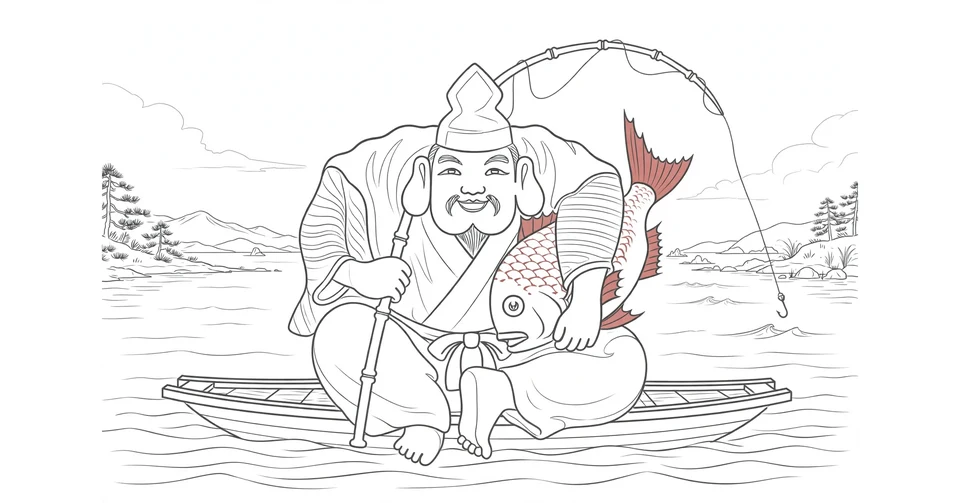
I find that arc hard to read without feeling something. Most gods arrive in myth fully formed and powerful, but Ebisu arrives as a discarded child, and the story never pretends otherwise. It does not tidy up the rejection or blame the sea for it. It simply follows the child who was thrown away and shows him, years later, laughing on a boat with a fish in his hands. That is a rare kind of hope, the kind that does not deny the wound but refuses to let the wound be the whole story.
The child who was set adrift
The story starts with a wedding that went wrong. Izanagi and Izanami, the divine couple who created the islands of Japan, walked around a heavenly pillar to marry, but Izanami spoke first, greeting her husband before he could greet her. Izanagi objected that the man should have spoken first, and the union that followed produced a child the old chronicles describe as imperfect. That child was Hiruko, the leech child, born without bones, or in some versions of the tale without arms and legs, because of his mother's mistake in the marriage ritual. The full story of the creation and the failed wedding is told in the tale of how Izanagi and Izanami created Japan, and it ends, for Hiruko, with a boat of reeds and an open sea.
Before his third birthday, Hiruko was placed in that boat and set adrift. His parents did not keep him, and the chronicles do not soften the act. They also begot Awashima, the island of foam, another child who was not counted among their rightful children, and then they asked the elder gods what had gone wrong and tried the wedding again. The second attempt produced the islands of Japan and a long line of gods, including the sun goddess Amaterasu, who was born when Izanagi washed himself after his return from the land of the dead, a story told in the cave where Amaterasu hid the sun. Amaterasu is, in the myth, the half sister of the child who was cast away, and the contrast between them is hard to miss. One child was born from a god washing himself clean and became the sun. The other was born from a mistake and was thrown into the sea.
Here is where honesty matters, because the old books do not tell the story as simply as later tradition does. The identification of Hiruko with Ebisu is a later tradition, and it is debated. Scholars believe Ebisu first arose as a god among fishermen, and that his origin as Hiruko was a much later idea, formed only after his worship had spread to merchants and farmers. It is also theorized that he was originally Kotoshironushi no Mikoto, the son of Okuninushi. The Hiruko story may not be how Ebisu began at all. It may be how a much older sea god was given a family, a past and a wound, centuries after fishermen had already begun praying to him. The fullest account of the debate is the Wikipedia entry on Ebisu, which lays out both the legend and the doubt side by side.
I think the doubt makes the story better, not weaker. If Ebisu was always a god, his smile is just a decoration. If he was a child who was thrown away and then remembered, his smile is a choice, and a god who chooses to laugh after that beginning is a god worth keeping near.
How Ebisu became a god of fishermen
The legend says the weak child overcame many hardships, grew legs at the age of three, and became the god Ebisu. The story tells that Hiruko eventually washed ashore, possibly in Ezo, the ancient name for Hokkaido, and was cared for by Ebisu Saburo. Whether the child washed up in the far north or the tale simply needed a distant shore, the shape of it stays the same. The sea that was supposed to swallow him gave him back.
That is why fishermen across Japan still pray to Ebisu before they head out for the day. He is their god first, before he is anyone else's. Fishermen tell stories of how he keeps the ocean safe and clean, pushing debris to the shore, and they say that because he has no arms or legs he carries things in his mouth and crawls his way along the ocean floor. A screw or a bolt or an umeboshi seed lost at sea, they say, takes seven years to turn up on shore, because Ebisu is carrying it there himself. It is a strange and lovely image, a god crawling along the seabed with a plum seed in his mouth, and it explains why fishermen also believe he grows enraged whenever people pollute the ocean. The sea is his home and his body, and what is thrown into it carelessly is thrown at him.
Ebisu is also associated with the things the sea gives back on its own, objects that drift ashore such as logs and even corpses, and with the great creatures of the deep. Whales and whale sharks were seen as his incarnations, the whale shark even being called the Ebisu shark, because the great fish bring masses of smaller fish with them and protect the fishermen who follow. In areas of northeast Japan, fishermen opposed whaling because they believed the whales were Ebisu himself, swimming just below the surface. A god who arrives as driftwood and departs as a whale is a god who cannot be owned, only met, and I think that is why fishermen trusted him. He did not promise them a catch. He promised them that the sea was alive and watching, and that it noticed how they treated it.
The laughing god and his sea bream
Look at any statue of Ebisu and the picture is the same. He wears the tall folded hat called the kazaori eboshi, he holds a fishing rod, and in his other hand he carries a large red sea bream, the tai, or sometimes a sea bass. He remains slightly crippled and deaf, the legend says, but mirthful and auspicious all the same, and that is why he is called the laughing god. The lameness is not hidden. It is part of the portrait, sitting beside the smile as if the two belonged together all along.
The sea bream matters. In Japan the red sea bream is a fish of celebration, served at weddings and New Year feasts, so the god of fishermen carries in his hand a picture of abundance itself. He is not holding a net or a spear or a weapon. He is holding dinner, and he is delighted with it. Jellyfish are also associated with him, and the fugu restaurants of Japan often work his image into their decoration, as if even the cooks of the most dangerous fish in the sea wanted his luck in the room.
There is a lesson in the way he is drawn, and it is a plain one. Ebisu does not look like power. He looks like contentment. Other gods carry swords and jewels and mirrors, but the laughing god carries a fish, and the fish is enough. I have always liked gods who are easy to picture in a kitchen, and Ebisu is the easiest of them all. You can imagine him at a small harbor at dawn, checking the nets, laughing at his own catch, and wishing the boats well.
Ebisu and Daikokuten, the shopkeepers' pair
Ebisu is one of the Seven Lucky Gods, the shichifukujin, and he is the only one of the seven who is purely Japanese. The other six came from elsewhere. Benzaiten, Bishamonten, Daikokuten and Hotei came from Mahayana Buddhism, which reached Japan from China but began in India, and Fukurokuju and Jurojin came from Chinese Taoism. Ebisu alone has a native Japanese ancestry, a god who grew out of Japanese fishing villages rather than arriving with a scripture. The group is described in detail on the Seven Lucky Gods page, which traces each of the seven to its source.
The seven were first worshiped by merchants, because Ebisu and Daikokuten were gods of business and trade, and only later did other classes of Japanese society find gods among them to match their own professions. They began to be mentioned as a collective in the year 1420 in Fushimi, in order to imitate the processions of the daimyo, the feudal lords of premodern Japan. It is said that the Buddhist priest Tenkai selected the seven after speaking with the shogun he served, Iemitsu Tokugawa, seeking whoever possessed the perfect virtues of longevity, fortune, popularity, sincerity, kindness, dignity and magnanimity. Shortly after, the artist Kano Yasunobu was ordered to portray them for the first time, and the image of the seven together, often sailing on a treasure ship, became a fixed part of Japanese New Year celebrations. During the first three days of the New Year the seven are said to pilot the takarabune, the treasure ship, through the heavens, and a picture of the ship is still an essential part of the holiday.
Of all the pairings among the seven, the closest is the one between Ebisu and Daikokuten. The two are frequently shown together in displays by small shopkeepers, the twin patrons of the small business, and in some versions of the myth they are father and son, or master and apprentice. Sometimes they are joined by Fukurokuju as the Three Gods of Good Fortune. It is easy to see why shopkeepers chose them. Daikokuten carries a bag of valuable things and a hammer of plenty, and Ebisu carries a fish, and between the two of them they cover the whole of a small shop's hopes, that goods will come in and that money will follow. Ebisu, together with Daikokuten, was considered the most popular of the seven and was venerated in almost every Japanese home.
The month when Ebisu stays behind
Ebisu has his own day, and it is a day that tells you everything about his character. His festival is celebrated on the twentieth day of the tenth month, Kannazuki, the month without gods. While the other myriad members of the Japanese pantheon gather at the Grand Shrine of Izumo, Ebisu does not hear the summons, and so he is still available for worship. The other gods leave. He stays. I love that detail more than any other in his story, because it turns his deafness, the mark of his imperfect birth, into the reason he is still there when everyone else has gone. The flaw becomes the gift. The god who cannot hear the call is the god who never leaves his post.
His shrines are scattered across the country, and three sets of them stand in Tokyo alone, the Mukojima, Yamate and Meguro sets. Among the best known are Nishinomiya Shrine in Hyogo, Imamiya Ebisu Shrine in Osaka, and Toka Ebisu Shrine in Fukuoka, and the festivals in his honor draw the shopkeepers and fishermen who depend on his luck. They come to ask for a good catch and a good year, and to stand for a while in front of a god who knows what it is to be left out and who stayed anyway.
Ebisu in the streets of modern Japan
Ebisu never retired. He is still everywhere in Japan, in statues and shop windows and brand names, and he has lent his name to things his fishermen worshipers could never have imagined. The most widely recognized is Yebisu beer, first brewed in 1890 and later acquired by the Sapporo Brewery, whose label carries his face. He is also the basis of the name of the clothing brand Evisu, and the professional basketball team Osaka Evessa takes its name from the local pronunciation of Ebisu sama, Ebessan, with a mascot named Maido kun who is a stylized, childlike version of the god in a basketball uniform. A statue of him stands in front of Ebisu Station in Tokyo, and another at Ebisu jinja in Kyoto, so commuters pass him every day without always knowing who he is.
I think there is something quietly honest about a god who ends up on a beer label. Ebisu was never a god of temples and high ceremony. He was a god of work, of boats and shops and kitchens, and so it makes sense that he survives in the places where work happens, on a bottle, on a jacket, on the front of a train station. He belongs to ordinary days, and ordinary days have kept him alive for centuries after grander gods faded into textbooks.
Why a rejected child still matters
The tradition says Hiruko, the child set adrift, was not forgotten. In later belief he came to be identified with Ebisu, the smiling god of fishermen and good fortune, one of the Seven Lucky Gods. Whether that identification is history or a story told long after the fact, the meaning is the same. A community looked at a god of fishermen and decided that he had once been a child nobody wanted, and that his happiness was not an accident but a victory. They gave their god a past that hurt, because a god who had never been hurt could not understand the people praying to him.
That is why Ebisu still matters, and why his story still finds listeners. Most of us have felt, at least once, like something about us arrived wrong, like a first attempt that did not work out. Ebisu answers that feeling without arguing against it. He does not say the rejection never happened. He says it happened, and the child grew legs anyway, and the sea gave him back, and now he laughs, and now he fishes, and now the shops keep his face by the till because his luck is the kind that lasts. A god who began as a mistake and became good fortune is a god for anyone who has ever needed a second beginning, and that is nearly everyone.
More in Culture & Society
- Takarabune Sails Under the Pillow to Bring Japan a Lucky Dream
- Seven Lucky Gods Sail Into the New Year on a Treasure Ship
- How Izanagi and Izanami Created Japan From a Drop of Salt Water
- Dohyo-Iri Is the Ring Entering Ceremony That Opens Every Sumo Day
- The Andon Lantern Lit Edo Homes With Oil and Paper
- Akari Lamp Is the Paper Lantern a Sculptor Turned Into Light
Latest posts
- Omakase, the Japanese Meal Where the Chef Decides Everything
- Kayabuki Is the Roof Japan Rebuilds Every Generation
- Chochin Is the Paper Lantern Japan Folds Away and Brings Back to Life
- Odalan Is the Birthday Bali Gives Every Temple
- Japanese Mythology and the Gods Who Shaped an Island Nation
- Mepeed Is the Slow Walk That Carries Bali to the Temple
- Gebogan Is the Tower of Fruit Bali Carries to the Temple
- Banten Are the Offerings Bali Makes Out of Almost Nothing
- Amado Are the Storm Shutters That Close Japan for the Night
- Tama Nuki Is the Rite That Lets a Sacred Object Rest
- Japanese Noh Theatre and the Slowest Drama on Earth
- Tamashii Ire Invites a Soul Into a Sacred Object
- Kaigen Kuyo Is the Ceremony That Wakes a Sacred Object
- Ihai Are the Lacquered Tablets That Keep a Name Alive
- A Butsudan Keeps the Dead Close in a Japanese Home