Onsen Etiquette and the Unwritten Rules of Japan's Hot Springs
· 10 min read
Onsen etiquette is simple once you know it. Wash before you soak, bathe naked, keep your towel out of the water, and the hottest bath in Japan becomes the most relaxing one.
The first time I stood in front of an onsen changing room, I did everything wrong in my head before I did anything right with my body. I worried about the nudity, the washing, the towel, the tattoos I do not have, and the unspoken rules I was sure everyone else already knew. Then I watched what the locals did, copied them, and onsen etiquette took about three minutes to learn.
Onsen etiquette is not a test. It is a short list of habits that keep shared water clean and shared space comfortable, and once you know the order of things, a hot spring visit becomes one of the most relaxing hours in Japan. This guide to onsen etiquette walks through those habits in the order you will actually meet them, from the front door to the last rinse.
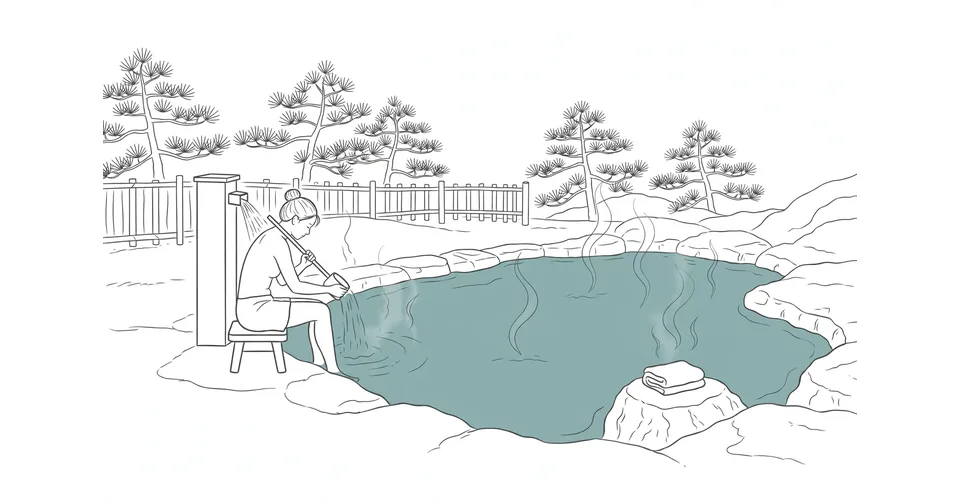
The short version is this: take your shoes off at the entrance, pay at the front desk, undress completely in the changing room, wash your whole body at the shower stations, and only then lower yourself into the bath. Keep your small towel and your hair out of the water, keep your voice down, and never bring a phone or camera into the bathing area. That is most of onsen etiquette in one paragraph. The rest of this article is the detail that makes onsen etiquette feel natural instead of stressful.
What counts as an onsen
Under Japan's Onsen Law of 1948, an onsen is water from underground that emerges at 25 degrees Celsius or above, or that contains at least one of 19 listed minerals in a set amount. A sento, by contrast, is a public bathhouse that heats ordinary tap water. The distinction matters because an onsen is fed by geothermal water, often rich in minerals, and the water in the bath is shared by everyone who soaks in it. That shared water is the reason the washing rule exists, and it is the reason onsen etiquette feels strict to a first timer.
Japan has thousands of onsen, from mountain inns with a single wooden tub to whole towns built around hot spring streets. Onsen etiquette is the same in all of them, which is good news. Learn it once and it works everywhere, from a small family bath in the countryside to a famous resort town.
Onsen etiquette step by step
Onsen etiquette follows a fixed order, and each step prepares the next one.
First, shoes off at the entrance. Swap into the slippers provided, or go in socks, and put your shoes in the shelf or locker by the door. Pay at the front desk or at a ticket machine, and collect a small towel if the facility provides one. Many places lend or sell a small towel for 100 to 300 yen, and a large towel for drying off afterward. Bring your own large towel if you have one, since the small towel is not meant for drying your whole body.
Second, find the right curtain. Baths are almost always separated by gender. The entrance curtain, called a noren, is usually blue for men and red for women, with the kanji for man (男) and woman (女) on it. When in doubt, look at the kanji or follow the pictograms. Changing rooms are always gender specific, as are the vast majority of baths.
Third, undress completely in the changing room, called the datsuijo. Leave your clothes, watch, and jewellery in a basket or coin locker, and carry only your small towel into the bathing area. Yes, you bathe naked. No swimsuit, no underwear, nothing. It feels strange for about thirty seconds, and then it feels normal, because everyone else is doing exactly the same thing and nobody is looking at anyone.
The washing rule matters most
Before you touch any bath, sit on a low stool at a shower station and wash your whole body. Soap, shampoo, rinse, and rinse again until there is no trace of suds left. This is mandatory, not optional, and it is the single most important rule of onsen etiquette. The shared water stays clean only because everyone washes first, and skipping this step is the breach locals notice and remember.
After washing, pour a basin of hot water over yourself before entering the bath. This is called kakeyu, and it helps your body adjust to the heat. Onsen water commonly runs at 40 to 42 degrees Celsius, sometimes hotter, so lower yourself in slowly rather than plunging in. Sit still, breathe, and let the heat do its work. Most people soak for about 10 to 15 minutes, then step out to cool down before going back in. Japan's Consumer Affairs Agency advises water of 41 degrees or lower for up to 10 minutes at a time, which is a sensible pace for a first visit.
With most mineral springs, you do not rinse off at the end. The minerals continuing to work on your skin is part of the benefit, and a quick rinse with plain water is enough if you prefer it. Dry off with your large towel before stepping back into the changing room, so you do not drip water across the floor.
The small towel has one job
The small towel, sometimes called a modesty towel, is the most misunderstood object in onsen etiquette. It is not for washing, and it is not for drying. It is for covering yourself modestly while you walk between the changing room and the bath, and for wiping sweat from your face while you soak.
Under onsen etiquette, the small towel must never touch the bath water. Fold it and rest it on your head, set it on the rim of the tub, or place it on a nearby rock. A towel floating in the water is the visual equivalent of shouting in a library, and it is the mistake first timers make most often. Long hair must be tied up so it never touches the water either, for the same reason. If you forget a hair tie, most facilities keep spares at the front desk.
Tattoos are changing, slowly
Tattoos have long carried a stigma in Japan because of their association with organised crime, so many traditional onsen historically banned visible ink. The rule was about keeping the baths neutral, not about art, but for a tattooed visitor it felt like a closed door. Things are shifting. Today roughly 30 percent of hot springs allow entry if you cover ink with a seal, and about 20 percent welcome tattoos regardless, according to recent surveys.
Whole towns now welcome ink. All seven public baths in Kinosaki and all three at Dogo Onsen in Matsuyama are tattoo friendly, and Beppu has the most options anywhere in Japan. Big resort chains are moving too. Hoshino Resorts has welcomed tattooed guests since April 2026. If you have tattoos, the practical approach is simple: check the facility's policy before you go, carry a cover seal for small tattoos, or book a private bath, called a kashikiri, where the rules are yours alone. I wrote about the tattoo question in more detail in my guide to onsen tattoo rules in Japan, including which towns are friendliest and how cover seals work.
Children, mixed bathing, and quiet
Children aged about seven and over must use the bath for their own sex in most prefectures, so a parent travelling with a young child should check the local rule. Mixed bathing, called konyoku, still exists at a small number of rural onsen, usually with towels allowed or with separate hours, but it is rare enough that you will almost certainly never meet it by accident. If a bath is mixed, the facility will say so clearly.
Noise is the other part of onsen etiquette nobody writes down. An onsen is a quiet place. People talk in low voices, if they talk at all. No splashing, no swimming, no diving, and no loud laughter. Phones and cameras in the bathing area are absolutely forbidden, to protect other bathers' privacy. Leave your phone in the locker with everything else. The hour without a screen is part of the point, and I say that as someone who reaches for his phone out of habit.
Health, safety, and what to bring
The Ministry of the Environment's bathing guidance advises not bathing right before or after a meal, avoiding bathing after drinking alcohol, resting about 30 minutes after exercise, and drinking a glass of water first. Hot water lowers blood pressure and dehydrates you, so onsen etiquette includes drinking water between soaks and stopping if you feel dizzy. People with heart conditions, high blood pressure, or who are pregnant should ask a doctor first, and should keep soaks short and water cooler.
What to bring is a short list: a large towel, a small towel, a hair tie if you need one, and a change of clothes for after. Most facilities provide soap, shampoo, and a hairdryer, so you can travel light. A plastic bag for wet towels is a small kindness to your future self. Entry to a public onsen typically costs about 300 to 1,500 yen, while a ryokan stay with dinner and private baths costs far more. If you want the full experience without the public bath, a day-use visit to a ryokan onsen is a good middle step.
Where to try onsen etiquette first
If you have never been to an onsen, start somewhere forgiving, and let onsen etiquette come to you one step at a time. A large resort town like Beppu or Kusatsu has clear signage, English guidance, and staff used to first timers. A ryokan stay is the gentlest introduction of all, because you can use the bath late at night when it is quiet, and many ryokan have private family baths you can book by the hour, which takes the pressure off learning onsen etiquette in public. My earlier piece on why Japan's hot springs are a way of life explains how onsen towns work and why the bath is woven into daily life here, not just a tourist activity.
Kinosaki is the town I recommend most often to nervous first timers, because all seven of its public baths welcome tattoos and the whole town is built around walking from bath to bath in a yukata. Dogo Onsen in Matsuyama is the other classic first visit, with a wooden bathhouse from 1894 and a history of about 3,000 years. Both towns are patient with beginners, and patience is what a first visit needs most.
The quiet rule underneath all the rules
Onsen etiquette looks like a list of prohibitions, but it is really one idea repeated in different forms: the bath belongs to everyone in it, so you leave it as clean and calm as you found it. Wash first, keep your towel out, keep your voice down, and the rest takes care of itself. I think that is a fair trade for an hour in water that has been rising out of the ground for centuries, and it is a small piece of Japan that stays with you long after you dry off.
If you are still nervous, go in the evening on a weekday, when the bath is quietest. Watch the person next to you for thirty seconds, copy them, and you will know onsen etiquette by heart before the water reaches your shoulders. The bath does the rest.
For a second opinion on onsen etiquette with prices and tattoo advice, see the practical guide at Self-Guided Japan and the detailed overview at Japan Guide.
More in Life & Style
- Forest Bathing in Japan, the Quiet Science of Shinrin-Yoku
- A Kamado Turned the Japanese Kitchen Into a Slow Oven
- Japanese Futon and the Art of Sleeping on the Floor
- A Tanzen Is the Full Length Robe Japan Wears Indoors in Deep Winter
- A Hanten Is the Winter Jacket Japan Wears to Work
- A Hibachi Carries the Hearth Anywhere in the House
Latest posts
- Barong Is the Lion Bali Calls Out When the Village Needs Protection
- Tumpeng Is the Rice Cone Java Serves When It Wants to Say Thanks
- Japan's Winter Illuminations Turn Dark Nights Into Light
- Setsubun, the Bean Throwing Festival That Chases Winter Away
- Karate, the Empty Hand That Became Japan's Most Exported Martial Art
- Kemari Is the Ball Game Japan Played Without Trying to Win
- Chagama Is the Kettle That Never Leaves the Tea Room
- Judo, the Gentle Way Japan Gave the World
- Lake Toba and the Supervolcano That Made the World's Largest Volcanic Lake
- Raja Ampat and the Coral Kingdom at the Edge of Indonesia
- Tokyo Skytree and How Japan Built the World's Tallest Tower
- Matsumoto Temari Turns Mountain Cocoons Into Wishes You Can Hold
- Nambu Tekki Is the Iron That Outlasted the Lords Who Ordered It
- Tokyo Tower and the Orange Giant That Refused to Be Replaced
- Emoji, the Tiny Pictures Japan Gave the World