Takarabune Sails Under the Pillow to Bring Japan a Lucky Dream
· 16 min read
The Takarabune is the treasure ship of the Seven Lucky Gods, and a picture of it under the pillow on a January night is Japan's oldest way of asking for a lucky first dream.
On a cold night in early January, in houses across Japan, a small printed picture slides under a pillow. It shows a ship with a single sail, crowded with seven laughing gods and piled high with treasure. The ship is the Takarabune, the treasure ship, and the sleeper who dreams of it is promised a lucky year.
The idea is simple enough to say in one sentence. During the first three days of the New Year, the Seven Lucky Gods are said to pilot the Takarabune through the heavens and into human ports, carrying gifts for everyone below. A picture of the ship under the pillow is an invitation, a way of asking the Takarabune to sail into your sleep and leave a good dream behind.
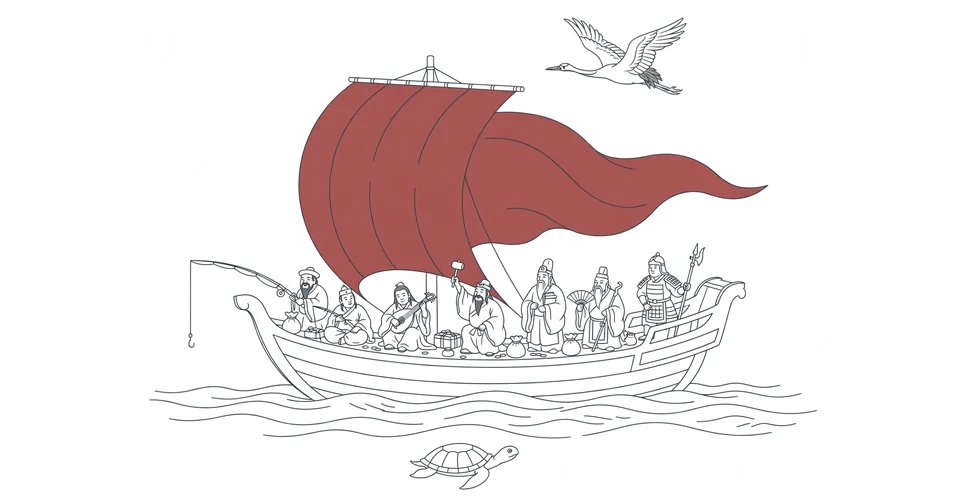
What I love about the Takarabune is how little it asks of the person who uses it. There is no temple to visit, no fee to pay, no priest to consult. A printed picture, a pillow, and a night of sleep are enough, and the luck it promises is available to anyone with a bed. The Takarabune is a piece of good fortune that fits under your head, and that smallness is the reason it has survived for centuries while grander ceremonies have faded.
What the Takarabune carries
The Takarabune is not an empty ship. It sails loaded with takaramono, treasure things, and the old lists of its cargo read like a catalogue of every hope a person in old Japan could hold at once. The best known account of the cargo is given on the Takarabune page on Wikipedia, which lists the treasures one by one, and the list is worth taking slowly, because each object answers a different kind of wish.
First comes the magic mallet, the kozuchi, the small hammer of Daikokuten that is said to grant wishes with a single shake. Then the inexhaustible purse, the kanebukuro, a bag of money that never runs out. Then the hat of invisibility, the kakuregasa, the lucky raincoat, the kakuremino, which protects its wearer from evil spirits, and the bag of fortune, the nunobukuro, carried on the back of Hotei. The list goes on: the secret keys to the treasure shed of the gods, the kagi, scrolls of books of wisdom and life, the makimono, rolls of brocade cloth, the orimono, and the robe of fairy feathers, the hagoromo. Other old lists add precious jewels, sacks and boxes of gold coins, and copper coins, until the Takarabune sits low in the water under the weight of its own generosity.
Nobody who put the picture under a pillow expected to wake up with a purse that never empties, and that was never the point. The cargo of the Takarabune says that luck has many shapes, and that a good year is not one thing. One person needs money, another needs safety, another needs wisdom, and the Takarabune carries something for each of them. I think that is why the picture feels generous rather than greedy. It promises a little of everything to everyone who dreams of it.
The crew of the Takarabune deserves a word of its own, because the ship and its sailors are one story. The seven are Ebisu the fisherman, Daikokuten with his mallet and bag, Bishamonten the warrior, Benzaiten with her lute, Fukurokuju and Jurojin the two old sages of long life, and Hotei with his bag of fortunes. Their full story is told in the tale of the Seven Lucky Gods sailing into the New Year on a treasure ship, and it explains how seven gods from three different traditions came to share one small boat. Seven very different gods, one small boat, and a cargo chosen to cover every kind of life.
The night the Takarabune slides under the pillow
The custom itself is simple. According to custom, placing a Takarabune woodblock print beneath a pillow on the night of 2 January may induce a lucky dream, a sign that the year to come will be fortunate. That is the date given by the Wikipedia account, and it is the date most often quoted in English sources. But the date is not quite as settled as that sounds, and the honest thing is to say so. Some sources give the night of 1 January instead, and the two dates coexist because they come from different ways of counting the first night of the year. In the old practice, the night of 31 December was often passed without sleeping, so the first real sleep of the new year fell on the night of 1 January. Other families count the night of 2 January, and still others count the night of 2 January to 3 January. No single date has ever won the argument outright.
That uncertainty should not trouble anyone who wants to try the custom. The sources that argue over the date agree on the meaning, and the meaning is what matters. The picture goes under the pillow on one of the first nights of January, the sleeper dreams, and the morning tells the story. If you follow the family you are staying with, you will be right, because the Takarabune belongs to the household, and the household is always right about its own traditions. A custom that lets each family choose its own night is a custom built to survive, because it bends instead of breaking.
There is also a remedy built into the custom, and it is as gentle as the custom itself. In the event of an unpleasant dream, the print may be disposed of by throwing it into a river. The bad dream is not carried into the year. It is given to the water, and the water carries it away. That detail matters, because it shows that the Takarabune was never a test you could fail. A good dream was a promise, and a bad dream was a piece of paper that could be floated away before breakfast.
A dream with a ranking: Fuji, a hawk and an aubergine
The Takarabune does not sail alone into the night. It sails into hatsuyume, the first dream of the new year, and hatsuyume has its own ranking of lucky sights. The best dreams, the tradition says, follow the saying ichi Fuji, ni taka, san nasubi, which means first Mount Fuji, second a hawk, third an aubergine. Dreaming of any one of the three is considered particularly good luck, and dreaming of all three together is the best fortune of all. The full story of that ranking is told in the article on hatsuyume, the first dream Japan reads like a fortune, and the Takarabune belongs at the centre of that story, because the ship is the vehicle that carries the dreamer toward those lucky sights.
Each of the three carries its own meaning. Mount Fuji is Japan's highest mountain, and dreaming of it is said to stand for the highest aspiration, for safety, and for a long life. The hawk is second, and it stands for strength, intelligence, and high advancement in life. A hawk sees far, flies high, and strikes with precision, so a dream of a hawk is read as a sign that the dreamer will rise, see clearly, and succeed. The aubergine is third, and it is the strangest of the three until the wordplay is explained. The word for aubergine, nasu or nasubi, sounds like the verb nasu, to achieve or to accomplish something great. Dreaming of an aubergine is therefore a dream of achievement, of a year in which effort bears fruit.
The puns run deeper still. Fuji is said to echo fushi, a word for immortality, and also buji, a word for safety. Taka, the hawk, sounds like the word for high or lofty, so the hawk promises high advancement. Nasu sounds like the verb to accomplish. The puns are not decoration. They are the reason the symbols were chosen, or at least one of the reasons, and they show how Japanese folk belief often works through the ear. A word that sounds like a good thing is treated as a good thing, and a dream that contains that word is treated as a promise.
I think the ranking is wiser than it first looks, because it asks for a whole life rather than a single prize. Fuji gives the year height and safety, the hawk gives it sharpness and rise, the aubergine gives it practical achievement. The Takarabune is the ship that carries the dreamer toward all three at once. One is the vehicle, the other is the destination, and the night is the road between them.
Where the custom began: dream rites of the Muromachi period
The custom of putting a picture under the pillow started around the Muromachi period, and it was at first a custom of the nobility. In those centuries, dreams were not treated as private entertainment. They were treated as messages, and a bad dream was treated as a warning that needed an answer. The older dream rites had names for that answer. Yumechigae was the exchange of a dream, a rite in which a bad dream could be handed over or traded away, and yumebarae was the casting off of a dream, a rite in which the bad dream was sent away from the dreamer. The Takarabune grew out of that world, a world in which a dream was something you did something about in the morning, not something you simply forgot by breakfast.
The custom spread from the nobility to commoners during the later Edo period, and the spread changed it in a practical way. What had been a court rite became a printed picture, and what had needed a priest became something a pedlar could sell in the street. A practice that begins among the few survives by becoming cheap enough for the many, and the Takarabune survived because it made that journey. The picture under the pillow kept the old idea, that a dream can be guided and a bad dream can be sent away, and it dropped the old price.
There is a quiet wisdom in the old rites that the modern world could use. Yumechigae and yumebarae both start from the same humane idea, that a bad dream does not have to be carried into the waking year. A person who wakes frightened is given something to do, a picture to float down a river, a dream to exchange or cast off, and the doing itself is the comfort. The Takarabune is not only a promise of good luck. It is also a small, practical tool for letting go of a bad night, and that second job may be the more important one.
Pedlars, woodblock prints and Hiroshige's Takarabune
By the Edo period, the Takarabune had become a commercial object as well as a religious one. Street vendors sold cheap woodblock prints of the ship, intended for single use, and the prints were bought, slept on, and thrown away, a new one bought each year. Merchants and urban workers also associated the ship with good fortune in business, which is no surprise. A ship that arrives loaded with treasure is a natural emblem for a shopkeeper, and a picture of it under the pillow was a cheap piece of hope for a person whose living depended on the next customer through the door.
The most famous of these prints is the one held by the Victoria and Albert Museum in London. It is a woodblock print called The Treasure Ship, by Utagawa Hiroshige, made in Edo, now Tokyo, in about 1840. The museum's catalogue entry says the Seven Gods of Good Fortune are depicted as humorous deities gathered together in their Treasure Ship, and that a picture of the ship became an essential part of the New Year celebrations, placed under the pillow in order to promote lucky dreams, because legend has it that the original ship sailed at this time of year bearing its treasures. The full entry, with the print itself, is in the Victoria and Albert Museum's collection record for The Treasure Ship by Utagawa Hiroshige, and it is worth reading beside the picture, because the museum notes details a casual viewer would miss.
Hiroshige's print is a full colour woodblock print in the wide yoko-oban format, about 27.7 centimetres high and 37.8 centimetres wide. The sail of the ship carries the character Ju, meaning longevity, and the print features other symbols of longevity, such as the crane, the seaweed adorned turtle known as the minogame, and branches of pine. The museum acquired the print in 1886, and it remains one of the clearest surviving pictures of the Takarabune as ordinary people in Edo would have known it.
I like the fact that the most famous Takarabune was a cheap print sold in the street. There is something honest about a sacred object that was also a piece of ephemera, printed by the thousand, slept on for one night, and thrown into a river if the dream went wrong. The Takarabune was never locked in a temple. It was carried home in a pocket, put under a pillow, and replaced the next year. A god you can afford to print is a god who belongs to everyone, and Hiroshige's print proves that the ship was at its most powerful when it was at its most ordinary.
The crane above and the turtle below
Look closely at a Takarabune print and you will see that the ship itself is only the middle of the picture. Many Takarabune prints show a crane above and a turtle below, representative of longevity and felicity, and the two creatures frame the ship the way a roof and a foundation frame a house. The crane flies over the sail, the turtle rests beneath the hull, and between them the seven gods sail on, carried by the two oldest symbols of long life in Japan.
The crane is the easier of the two to understand. In Japan the crane is said to live for a thousand years, and it stands for long life, good fortune, and fidelity. The turtle is the stranger of the two, because the turtle in the prints is often the minogame, a turtle with a long tail of seaweed that is said to grow only after ten thousand years of life. Pine branches often join them, a third symbol of long life, because the pine stays green through the winter when other trees are bare. The sail adds one more symbol. In the older prints the single mast carries a sail marked with a gold coin or with the character for good luck, and in Hiroshige's print the sail carries the character Ju, meaning longevity.
There is a lesson in that framing, and it is a gentle one. The ship does not sail alone. It sails between a bird and a turtle, between the sky and the water, between the quick and the slow, and the picture suggests that a good life needs both. The crane gives the year its height and its hope, and the turtle gives it its patience and its endurance. A person who dreams of the Takarabune is dreaming of a year that flies and a year that lasts, and the print holds both wishes in a single image.
The poem that reads the same backwards
Many Takarabune prints carry one more feature, and it is the strangest of all. Printed on the picture, often in flowing script, is a poem that reads the same forwards and backwards, a palindrome. The poem tells of a long night in a boat, and at dawn the sound of waves is heard and smooth sailing is seen ahead. It fits the picture exactly, because it describes the very night the sleeper is about to spend, a long night in a boat, ending in a calm morning.
The museum record of Hiroshige's print preserves the poem in its original Japanese, and the words run like this: nakaki yo no, too no ne furi no, mina me same, nami no ri fune no, oto no yoki kana. Read from the end back to the beginning, the sounds return to where they started, and the poem ends where it began. That is a fitting trick for a picture that is meant to be slept on, because a dream has no direction either. It begins in sleep and ends in waking, and the poem, like the dream, comes back to its own beginning.
I think the palindrome is the most beautiful part of the whole custom, because it says something true about the night itself. A long night in a boat sounds frightening at first, but the poem does not end in the dark. It ends at dawn, with the sound of waves and smooth sailing ahead, and the fact that the poem reads the same backwards means the ending was there from the start. The sleeper who puts the Takarabune under the pillow is not asking for a year without darkness. They are asking for a year in which the darkness ends the way the poem ends, in a morning, with waves, and with the way ahead clear.
Why the Takarabune still sails
The Takarabune has been sailing for centuries, and it shows no sign of stopping. Its pictures still hang in shops and restaurants, its prints still sit in museum collections, and its ship still slides under pillows on the first nights of January. It survived because it was never only one thing. A merchant could see a ship full of business luck, a parent could see a ship full of gifts for a child, a scholar could see scrolls of wisdom, and a tired sleeper could see a promise that the morning would be kind.
There is a lesson in that, and it is a plain one. The Takarabune works because it is small, cheap, and private. It does not demand a journey or a fee. It asks for a picture, a pillow, and a night of sleep, and it gives back a dream to talk about over breakfast. Luck, in this telling, is not a prize for the few. It is a ship that sails to every port, carrying something for everyone on board, and it is still worth putting the picture under the pillow and going to sleep hoping for a good dream.
More in Culture & Society
- Seven Lucky Gods Sail Into the New Year on a Treasure Ship
- Ebisu the Rejected Child Who Became Japan's God of Good Fortune
- How Izanagi and Izanami Created Japan From a Drop of Salt Water
- Dohyo-Iri Is the Ring Entering Ceremony That Opens Every Sumo Day
- The Andon Lantern Lit Edo Homes With Oil and Paper
- Akari Lamp Is the Paper Lantern a Sculptor Turned Into Light
Latest posts
- Omakase, the Japanese Meal Where the Chef Decides Everything
- Kayabuki Is the Roof Japan Rebuilds Every Generation
- Chochin Is the Paper Lantern Japan Folds Away and Brings Back to Life
- Odalan Is the Birthday Bali Gives Every Temple
- Japanese Mythology and the Gods Who Shaped an Island Nation
- Mepeed Is the Slow Walk That Carries Bali to the Temple
- Gebogan Is the Tower of Fruit Bali Carries to the Temple
- Banten Are the Offerings Bali Makes Out of Almost Nothing
- Amado Are the Storm Shutters That Close Japan for the Night
- Tama Nuki Is the Rite That Lets a Sacred Object Rest
- Japanese Noh Theatre and the Slowest Drama on Earth
- Tamashii Ire Invites a Soul Into a Sacred Object
- Kaigen Kuyo Is the Ceremony That Wakes a Sacred Object
- Ihai Are the Lacquered Tablets That Keep a Name Alive
- A Butsudan Keeps the Dead Close in a Japanese Home