Forest Bathing in Japan, the Quiet Science of Shinrin-Yoku
· 10 min read
Forest bathing began in Japan in 1982 as a public health idea, and four decades of research have measured what a slow walk among trees does to stress, blood pressure, and the immune system.
Forest bathing is not a bath, and it is not exercise. It is the simple act of spending slow, unhurried time inside a forest, paying attention with all five senses, and letting the trees do the rest. The Japanese call it shinrin-yoku, and the idea was born in Japan in 1982, when the country's Forestry Agency gave a name to something people had always done without naming it.
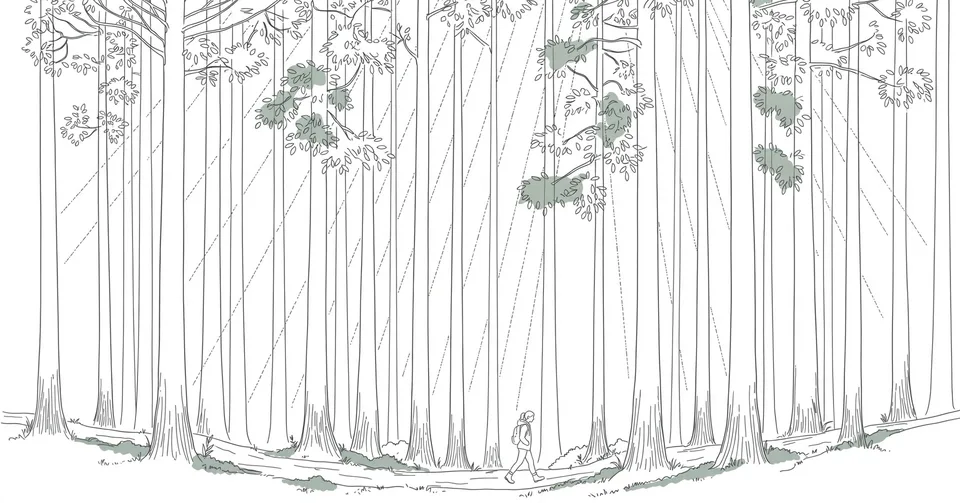
Four decades later, forest bathing has been studied more carefully than almost any other walk in the world. Researchers have measured lower stress hormones, lower blood pressure, and a measurable lift in immune cells after time among trees. The effects are real, but they are also smaller and shorter lived than the slogans suggest, and that honesty is part of what makes the practice worth taking seriously.
Japan is an unusually good place to try it. About two thirds of the country is covered in forest, and the government has spent forty years building the practice into public health, from the first named forest in Nagano to more than sixty certified forest therapy bases across the country today.
Where the name came from
The word shinrin-yoku was coined in 1982 by Tomohide Akiyama, then the director general of Japan's Forestry Agency, part of the Ministry of Agriculture, Forestry and Fisheries. Akiyama was looking at two problems at once: city workers under growing stress, and a forestry industry that needed people to care about forests again. His answer was a campaign that invited people back into the woods, and it needed a name that sounded familiar.
He built it from words everyone already knew. Kaisuiyoku means sea bathing, and nikkoyoku means sunbathing, so shinrin, meaning forest, plus yoku, meaning bathing, gave the campaign its name. The first forest bathing gathering was held that same year at Akasawa Natural Recreation Forest in Nagano, a grove of hinoki cypress trees, some more than three hundred years old, which now calls itself the birthplace of forest bathing.
The campaign worked slowly. Through the 1990s and 2000s, researchers began testing whether forest bathing did anything measurable, and in 2006 Japan began certifying official forest therapy bases and forest therapy roads, trails in forests that had been scientifically checked for measurable health effects. By 2025 there were more than sixty certified locations across the country, and guides trained in the practice now lead sessions on several continents.
What the science actually found
The most thorough field study of forest bathing came from Yoshifumi Miyazaki's team at Chiba University. Published in 2010, it took 280 young men to twenty four forests across Japan. Each man spent about sixteen minutes walking and fourteen minutes sitting in a forest, then did the same in a city area. In the forest, their cortisol, the hormone most closely tied to stress, was between thirteen and sixteen percent lower. Their pulse was lower, their blood pressure was lower, and the part of the nervous system that governs rest was far more active.
The best known immune study came a few years earlier. In 2007, Dr. Qing Li, an immunologist at Nippon Medical School in Tokyo, took twelve middle-aged businessmen on a three day, two night trip into a forest. Before and after the trip, he measured the activity of their natural killer cells, the part of the immune system that targets infected and abnormal cells. Activity rose by about half, and it went up in eleven of the twelve men. A control group that spent the same three days in a city showed no such change, and the effect lasted at least a week after the trip. Later work from the same group found the lift could still be detected more than thirty days later.
The mechanism behind much of this is something you can smell. Trees release organic compounds called phytoncides to defend themselves against insects, fungi, and bacteria. Conifers, the pines, cedars, and cypress that fill Japanese forests, give off more than most. When a person breathes them in, the immune system answers. Alpha-pinene, one of the most studied of these compounds, is also found in hinoki wood oil, which is why a hinoki bath and a hinoki forest smell faintly alike.
Other reviews have been more cautious, and they should be. A 2017 meta-analysis that pooled twenty trials and 732 people found systolic blood pressure about three millimetres of mercury lower after forest time than after time in comparison settings, a real but modest difference. A 2019 review found cortisol lower after forest sessions in nearly every study it gathered, though it also noted the studies were small and could not be blinded. A 2021 review of thirty three studies called the immune signals encouraging and the study designs weak. The honest summary is that forest bathing reliably changes short term stress measures, and that the immune claims are a promising sketch, not a settled fact.
One finding sits outside the forest literature but fits it neatly. A large survey published in 2019 found that people who spent at least two hours a week in nature reported significantly better health and well being than people who spent less. Two hours a week is not a heroic target. It is one slow walk on a Saturday and one on a Sunday, or four half hour visits to a neighbourhood wood.
How to try forest bathing in Japan
Forest bathing has no equipment, no ticket, and no correct technique beyond slowness. The guides who lead sessions in Japan tend to give the same few instructions, and they are worth following even on your own.
Leave the phone in your pocket. The point of forest bathing is attention, and a phone divides it. Walk slowly, far slower than a hike, and stop often. Sit down at some point. A fallen log or a flat rock will do. Use all five senses on purpose: the smell of damp earth and cedar, the sound of wind in the canopy, the texture of bark under your palm, the light coming down between the trunks. If your mind starts planning dinner, notice it and return to the trees. Twenty minutes is enough to feel the shift. Two hours is the dose most of the forest bathing research used.
The practice pairs naturally with the rest of slow Japan. An onsen town like those described in the guide to Japan's hot springs makes an easy base, since many sit at the edge of forested mountains, and a forest walk in the morning followed by a hot bath in the afternoon is the closest thing to a complete reset the country offers. In autumn, the same walk doubles as leaf viewing, and the autumn leaves guide covers where the colours peak and when. I have come to think of forest bathing as the quiet sibling of these better known rituals: less famous, less photogenic, and somehow more useful on an ordinary tired day.
Where to go forest bathing
Akasawa is the obvious forest bathing pilgrimage, and it deserves the trip. The forest sits in the Kiso Valley in Nagano, about three hours from Tokyo by train and bus, and the old hinoki grove is managed as a recreation forest with marked walking trails. Go on a weekday if you can. The trees are the point, and they are easier to hear when the path is empty.
Closer to Tokyo, the forest around Meiji Jingu in Shibuya holds more than a hundred thousand trees, planted a century ago, and it works surprisingly well for a first session because the contrast with the city outside is so sharp. Okutama, at the western edge of Tokyo, offers river valleys and cedar forest within ninety minutes of Shinjuku. In Kyoto, the bamboo grove of Arashiyama is beautiful but crowded, so walk past the main path into the quieter northern trails. In the mountains, the trails around Kamikochi in Nagano and the old cedar forest of Yakushima in Kagoshima are among the most rewarding walks in the country, and both reward the slow pace that forest bathing asks for.
You do not need a famous forest, though. Any wood with a path and a bench will do, and the research was done in ordinary municipal forests as often as in celebrated ones. The practice is portable in a way that most Japanese traditions are not. You can do it in a park in Shizuoka, where I live, or in a woodland back home. The trees do not check your passport.
What forest bathing is not
Forest bathing is not hiking, and it is not a cure. Hiking is about distance, elevation, and reaching a summit. Forest bathing is about staying still enough to notice where you already are. The distinction matters because people who treat it as exercise miss the point and people who treat it as medicine overclaim for it.
It is also not a replacement for rest, sleep, or medical care. The blood pressure changes measured in the studies are small, the immune changes are short lived, and the strongest evidence is for mood and stress in the hours after a walk. That is still a lot. A practice that reliably lowers stress for an afternoon, costs nothing, and asks only that you walk slowly among trees is a good deal by any measure. It does not need to be a miracle to be worth doing.
The guides at Japan's certified forest therapy bases will tell you the same thing in plainer language. They do not promise transformation. They promise two hours in which nothing is asked of you except attention. In a country where the working day has its own word for death by overwork, as covered in the story of karoshi, that promise is not small. It is the whole point.
The quiet part
What I like most about forest bathing is that it refuses to be optimised. There is no app to track it, no leaderboard, no gear to buy, and no way to do it faster. The forest does not care how productive you were this week, and the practice works best when you stop trying to make it work. That is a rare thing in a culture that turns everything into a system, and it may be why a Forestry Agency slogan from 1982 is still being studied, still being practised, and still quietly spreading to forests far from Japan. The science says forest bathing changes your body for a few hours. The experience says it changes the rest of the day too, and that is reason enough to go.
More in Life & Style
- A Kamado Turned the Japanese Kitchen Into a Slow Oven
- Japanese Futon and the Art of Sleeping on the Floor
- A Tanzen Is the Full Length Robe Japan Wears Indoors in Deep Winter
- A Hanten Is the Winter Jacket Japan Wears to Work
- A Hibachi Carries the Hearth Anywhere in the House
- A Kotatsu Turns a Cold Winter Evening Into the Warmest Room in the House
Latest posts
- Tokyo Skytree and How Japan Built the World's Tallest Tower
- Matsumoto Temari Turns Mountain Cocoons Into Wishes You Can Hold
- Nambu Tekki Is the Iron That Outlasted the Lords Who Ordered It
- Tokyo Tower and the Orange Giant That Refused to Be Replaced
- Emoji, the Tiny Pictures Japan Gave the World
- Temari Is the Embroidered Ball Japan Gives for Good Luck
- A Tetsubin Turns Iron and Fire Into Japan's Slowest Kettle
- Hakone and the Hot Spring Town Below Mount Fuji
- Ninja, the Shadow Warriors of Feudal Japan
- Bizen Ware Lets the Fire Do the Painting
- The Japanese Alps and the Mountains at the Heart of Honshu
- Japanese Haiku and the Seventeen Syllables That Hold a Season
- Japanese Wagashi and the Sweets That Mark the Seasons
- A Hohin Is the Handleless Teapot Gyokuro Was Waiting For
- Shigaraki Ware Turns an Ancient Lake Bed Into Japan's Warmest Pottery