Shirakawa-go, the Village of Praying Hands
· 14 min read
Shirakawa-go is a mountain village in Gifu where steep thatched roofs shed metres of snow, and its 1995 UNESCO listing turned a hidden farming community into one of Japan's most loved winter sights.
Shirakawa-go is a small mountain village in Gifu Prefecture where the houses look like they are praying. Their thatched roofs rise at a steep angle, two slopes meeting at a high peak, exactly like hands pressed together. In Japanese the style is called gassho-zukuri, and the name means praying hands construction. It is not decoration. The roofs were built that way so that metres of snow slide off instead of crushing the house underneath.
The village sits in a remote valley of the Shogawa River, surrounded by steep forested mountains, about 500 metres above sea level and close to Mount Hakusan, a 2,702 metre peak that has been treated as sacred since ancient times. Snow falls here from December to March, piling 2 to 3 metres deep in an ordinary winter and reaching a record of 4.5 metres. The average annual snowfall is 972 centimetres, one of the heaviest totals anywhere in Japan. For centuries, that snow kept Shirakawa-go cut off from the rest of the country, and that isolation is exactly what preserved it. In December 1995, UNESCO listed the Historic Villages of Shirakawa-go and Gokayama as a World Heritage Site, and a farming village that almost nobody outside the valley had heard of became one of Japan's most photographed places.
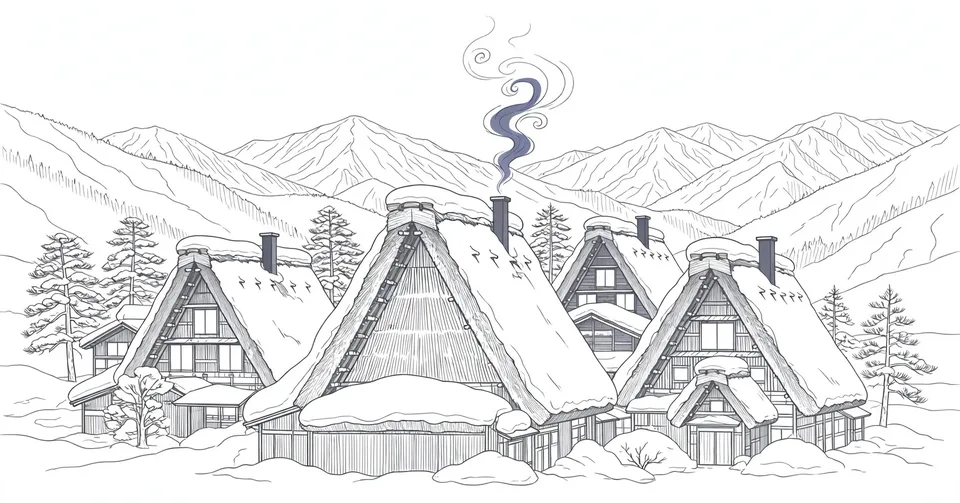
I first heard about Shirakawa-go the way most people do, from a winter photograph. A cluster of dark thatched roofs under deep snow, smoke curling from a chimney, the whole village glowing amber in the dusk. The photo looked too neat to be real, like a model village built for a postcard. The surprise is that it is real, and that people still live in these houses, repair their roofs by hand, and hang their laundry where tourists take pictures. Shirakawa-go is not a museum that happens to look like a village. It is a village that happens to be beautiful enough to be a museum, and that difference matters, because it changes how you should visit.
The roofs that pray
The gassho-zukuri house is one of Japan's most important and rare types of farmhouse, and its shape is a direct answer to the weather. The roof is thatched, steeply sloped, and built without nails, held together by wooden beams and ropes. Snow that would collapse an ordinary roof slides off a gassho roof. The design is exceptionally strong, and the thick thatch insulates the house through winters when the temperature outside drops far below freezing.
The shape also created a second storey that the village turned into an industry. The tall attic spaces under the roof were used for sericulture, the raising of silkworms, which needs warm, dry, well ventilated space. Shirakawa-go and Gokayama were centres of silk production and gunpowder making during the Edo period, and the houses grew large to hold the work. Early prototypes of the style appeared around 1700, and the form we see today settled into place around 1800. Some of the houses standing now are about 300 years old.
The German architect Bruno Taut, who visited Japan in the 1930s, was one of the first outsiders to write seriously about these houses, and his praise helped the rest of the world notice them. But the people who kept the style alive were the villagers themselves, through a system called yui, mutual help. Re-thatching a gassho roof is a job no single family can do alone, so the whole village turns up, and the whole village eats together afterwards. The roof is not just architecture. It is the reason the community exists in the form it does.
Three villages, one listing
The UNESCO listing covers three historic villages across two prefectures, on a site of 68 hectares in the Shogawa River valley. The largest is Ogimachi, in Shirakawa Village in Gifu Prefecture, the village most visitors mean when they say Shirakawa-go. The other two, Ainokura and Suganuma, lie across the border in Gokayama, Toyama Prefecture. UNESCO inscribed the site in 1995 under criteria four and five, as an outstanding example of a traditional human settlement perfectly adapted to its environment.
Across the three villages, 91 gassho-zukuri houses survive. Ogimachi has 59 of them, Ainokura has 23, and Suganuma has 9. At the time of the inscription, Ogimachi had 152 households and a population of 634 people. The numbers are small, and that is part of the point. This is a living settlement, not a theme park, and the people who live there have to balance the income tourism brings against the fact that their front gardens are now in millions of photographs.
Ogimachi is the practical choice for a first visit. It is where the buses stop, where the largest houses stand, and where the famous viewpoint looks down over the whole cluster of roofs. Ainokura and Suganuma are quieter and harder to reach, which is exactly why some travellers prefer them. If Ogimachi is the postcard, the Gokayama villages are the same picture with the crowd removed.
Inside the Wada House
The best way to understand a gassho house is to step inside one, and the Wada House in Ogimachi is the one to choose. It is the largest gassho-zukuri house in Shirakawa-go, built roughly 300 years ago, and the only one in the World Heritage area designated a National Important Cultural Property. The Wada family served as village heads during the Edo period, and their house shows what the style looks like at its grandest scale.
The house opens from 9:00 to 17:00, and entry costs 400 yen for adults and 200 yen for primary school children. The first and second floors are open to visitors, with an audio explanation in Japanese on the first floor and in English on the second. Cash only, so bring yen. Standing under the roof beams, you can see how the structure works, no nails, just joinery and rope and the weight of the thatch itself holding everything in place. The attic, where silkworms were once raised, is the space that makes the steep roof make sense. A low roof would have given the family nowhere to work in winter. A tall roof gave them a factory above their living room.
A short walk away stands the Gassho-zukuri Minkaen, an open air museum that keeps 25 relocated farmhouses, including houses moved here from other parts of the valley when dams and roads threatened them. It takes about 15 minutes to walk there from the bus terminal, and it is the place to go when the main village feels crowded, because the museum grounds are quieter and the buildings are just as old. The Deai suspension bridge over the Shogawa River, about 490 metres from the Wada House, is another easy stop, and it is the crossing the villagers themselves used before the modern road arrived.
The view from Shiroyama
Every famous photograph of Shirakawa-go is taken from the same place, the Ogimachi Castle Ruins Observation Deck on Shiroyama hill, a 60 metre rise above the village. Only earthworks of the old castle remain, but the viewpoint is free and open at all times, and it looks down over the whole cluster of thatched roofs with the mountains behind them. The walk up takes 15 to 20 minutes on the trail behind the Wada House. A shuttle bus also runs from in front of the Wada House, every 20 minutes from 9:00 to 15:40, with a break at midday, and the fare is 300 yen one way for adults.
Go up in the late afternoon if you can. The light drops behind the mountains, the roofs turn dark against the snow, and the village lights come on one by one. That is the hour the postcards are made. It is also worth going up in a season other than winter. In spring the paddies around the houses are flooded and the roofs reflect in the water. In summer the valley is green and the thatch looks almost black against it. In autumn the maples turn, and the village is at its most colourful. Winter gets the fame, but Shirakawa-go is a four season village, and the quieter seasons show it more honestly.
The winter light-up
The most famous spectacle in Shirakawa-go is the winter light-up, held on a handful of selected evenings in January and February, when the snow covered houses are lit against the dark. The 41st light-up runs from 17:30 to 19:30 on 11, 17, 24, and 31 January 2027. It is the single most sought after winter sight in the Japanese Alps, and it is also the hardest to attend, because entry is by advance reservation only. Visitors without a reservation are not let in, even on the day itself.
The rules are strict for a reason. On light-up evenings, day trip tour buses must enter the village by 14:00 and leave by 16:00, and after 14:00 only buses with confirmed event reservations are let in. There are no regular buses back after the event, so you either stay overnight in the village, join a reserved tour, or drive with a parking reservation. Stays in the village during the light-up are allocated by lottery, and applications for the 2027 season closed on 31 October 2026. The observation deck on light-up evenings is open only to holders of an Observation Deck Ticket, which comes with some lodging plans and operator tours and is not sold on its own.
If you cannot get a light-up reservation, do not treat the trip as ruined. A normal winter day in Shirakawa-go, with snow on the roofs and the village going about its business, is already the scene the light-up is trying to improve on. The light-up adds electric light to a place that is beautiful in daylight. It does not create the beauty. Plan months ahead if you want it, check the official schedule, and book early, but do not let the reservation system decide whether the village is worth seeing. For a fuller picture of how Japan does winter light, my guide to Japan's winter illuminations covers the big city displays, which are far easier to walk into without a booking.
Getting to Shirakawa-go
Shirakawa-go has no railway station, so every trip without a car ends on a bus. The standard route is the Nohi Bus from Takayama, about 50 minutes, 2,800 yen one way for adults, rising to 2,900 yen from 1 December 2026. There are 16 round trips a day, and some buses need a reservation, so check before you travel and leave slack before any onward train, because the operator warns that buses on this line can be significantly delayed in winter. From Kanazawa Station the ride is about 1 hour and 20 minutes. From Nagoya it is about 3 hours. Buses continue from Shirakawa-go to Kanazawa, Toyama, or Takaoka, so you do not need to return to Takayama if your route goes onward.
The Takayama-Hokuriku Area Tourist Pass covers the Nohi Bus between Takayama, Shirakawa-go, and Kanazawa or Toyama, and it is valid for 5 consecutive days, which makes it good value if Shirakawa-go is one stop on a longer Hokuriku trip. By car from Takayama the drive is about 1 hour by expressway, and parking in the village costs 2,000 yen. Winter drivers need the right tyres, and the village does not accept tourists at night apart from guests staying overnight.
A day trip from Takayama is the most common plan, and it works. The village walk takes 2 to 3 hours at a comfortable pace, including the Wada House and the viewpoint. But if you can stay a night, do it. The village changes completely after the day buses leave, and an overnight stay in a gassho minshuku is the closest a visitor can get to living in one of these houses. That is the experience the day trippers miss, and it is the one the village itself would probably recommend. If you are building a wider trip around the region, my guide to climbing Mount Fuji is a different kind of mountain Japan, but the same lesson applies, go slowly, stay overnight if you can, and let the place set the pace.
A village that refused to disappear
The history of Shirakawa-go reaches back further than the houses. The oldest traces of human life in the valley are artifacts from between 7000 B.C. and 2300 B.C., and the name Shirakawa-go first appears clearly in history around 1176. Local legend says that members of the defeated Heike clan fled here after the Battle of Dan-no-ura in 1185, at the end of the Genpei War, and hid in these remote mountains. Mount Hakusan, the principal mountain of the area, has been a centre of mountain worship since the 8th century, when the valley became a place for ascetic religious practice.
The settlement as it stands was fully established in the 1700s, when the gassho style spread through the village as silk and gunpowder production flourished. That is a useful correction to the romantic version of the story. Shirakawa-go was not preserved because it was forgotten. It was preserved because it was a working industrial village, rich enough to build big houses and remote enough that nobody bothered to replace them with modern ones. When the industries faded, the houses remained, and the people who lived in them had to decide what to do with a village that the world suddenly wanted to photograph.
That decision is still being made, every day, by the people who live there. The village asks visitors to respect that it is a home first and a sight second, to stay on the paths, to keep the noise down, and to remember that the laundry on the line belongs to someone. It is a small ask, and it is the price of keeping a place like this alive. The alternative is a village that becomes a stage set, and Shirakawa-go has survived for centuries precisely by refusing to become one.
When to go
| Season | What you get | What to watch for |
|---|---|---|
| Winter, January to February | Deep snow, the light-up, the famous view | Reservation only for the light-up, buses can be delayed, cold |
| Spring, April to May | Flooded paddies, reflections, cherry blossom in the valley | Rain, changeable weather |
| Summer, June to August | Green valley, quiet streets, open air museum at its best | Heat, humidity, afternoon rain |
| Autumn, October to November | Maple colour, harvest season, clear mountain air | Peak crowds on weekends |
There is no bad season, only a wrong expectation. Winter is the most dramatic and the most demanding, and the light-up is a lottery, not a guarantee. The other seasons are easier, cheaper, and quieter, and they show the village as a working place rather than a winter postcard. My own preference is late autumn, when the maples turn and the first snow dusts the high roofs, and the village belongs to its residents again. Whatever season you choose, go with time to spare, climb to the viewpoint, step inside the Wada House, and eat something warm in the village before the bus back. Shirakawa-go rewards the visitor who slows down, which is fitting, because slowing down is what the village has been doing for three hundred years.
If the idea of staying overnight in a traditional house appeals to you, my guide to ryokan, Japan's traditional inns, explains how the inn system works and what to expect from a night in a tatami room. And if winter in the mountains is what drew you here, the snow monkeys of Jigokudani offer the same season from a very different angle, wild animals in a hot spring instead of a village in the snow. Both are worth the cold.
Sources and further reading
The history and the listing details in this article follow the UNESCO record for the Historic Villages of Shirakawa-go and Gokayama, which you can read in full on Wikipedia, and the village's own English pages from the Shirakawa Village office, which give the snowfall figures, the history of the name, and the details of the World Heritage registration. Bus fares, light-up dates, and opening hours were checked against current 2026 guides, but prices and schedules on this route change, so confirm them with the operator before you travel.
More in Food & Travel
- Tempeh and the Fermented Bean Cake Indonesia Gave the World
- Gado-Gado, the Peanut Sauce Salad That Feeds All of Indonesia
- Bakso and the Meatball Soup Indonesia Eats Everywhere
- Sapporo Snow Festival and the Ice City That Rises Every February
- Satay and the Smoke That Carries Indonesia to the World
- Tumpeng Is the Rice Cone Java Serves When It Wants to Say Thanks
Latest posts
- Hanafuda Turns Twelve Months of Flowers Into a Card Game
- Nintendo, the Playing Card Maker That Became a Gaming Giant
- Tana Toraja and the Funerals That Last for Days
- The Washlet Made the Japanese Bathroom the Warmest Room in the House
- Kecak Dance and the Hundred Voices That Tell the Ramayana
- Rangda Is the Witch Queen Bali Never Lets Win
- The Japanese School Uniform and the Story Behind the Sailor Suit
- Aikido and the Martial Art That Refuses to Fight Back
- Barong Is the Lion Bali Calls Out When the Village Needs Protection
- Onsen Etiquette and the Unwritten Rules of Japan's Hot Springs
- Japan's Winter Illuminations Turn Dark Nights Into Light
- Setsubun, the Bean Throwing Festival That Chases Winter Away
- Karate, the Empty Hand That Became Japan's Most Exported Martial Art
- Kemari Is the Ball Game Japan Played Without Trying to Win
- Chagama Is the Kettle That Never Leaves the Tea Room