A Shinai Is a Sword That Refuses to Cut
· 13 min read
A shinai is a bamboo sword of four slats that lets kendo practitioners strike at full speed without cutting, and its history explains how the way of the sword survived the end of the samurai.
Pick up a shinai for the first time and your hands will be confused before your brain catches up. It looks like a sword and it is held like a sword, yet it weighs almost nothing and it bends when you press it. The grip is leather, the guard is a simple disc, and the blade is four thin slats of bamboo tied together with string.
That confusion is the whole point. A shinai is a sword that refuses to cut, and because it refuses, two people can strike each other at full speed, hundreds of times in a single evening, and walk away unhurt.
If you have read the story of the way of the sword lives on in kendo, you already know the outline: protective armour called bogu, a bamboo sword called a shinai, and a practice that turned swordsmanship into a way of life. This is the story of the sword itself.
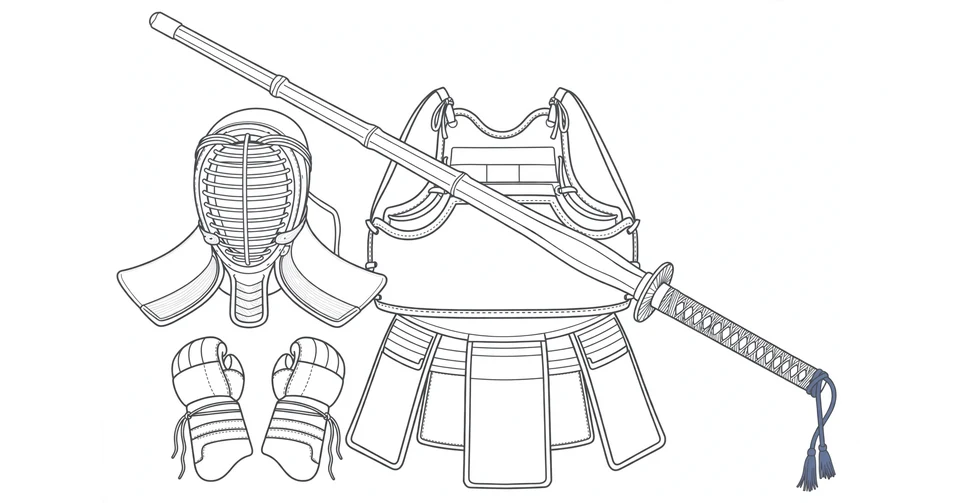
There is something quietly radical about a culture that looked at its most revered weapon and replaced it with bamboo. The katana was an object of almost religious respect in Japan. Setting it aside in practice meant the sword had taught its students everything it could through fear, and the next lesson needed a different teacher. The shinai became that teacher.
The shinai began as a bag of bamboo
The earliest bamboo practice weapons in Japan were not the neat four slat swords we know today. They were fukuro shinai, lengths of bamboo split many times at one end and covered with a leather sleeve, which is what the word fukuro means, a bag or pouch. The split end could flex on impact, so a strike stung instead of breaking bone. The individual most often credited with the invention is Kamiizumi Nobutsuna, a Warring States period samurai and founder of the Shinkage-ryu school, and the first fukuro shinai appeared in the middle to late 1500s.
For a long time the bamboo sword stayed a rough tool. Protective equipment existed only in pieces, and different schools used different gear, so there was no single system anyone could call kendo. The change came in the Shotoku era, from 1711 to 1715, when Naganuma Shirozaemon Kunisato of the Jikishinkage-ryu school developed full protective equipment and a training method built around the shinai. The International Kendo Federation calls this the direct origin of present day kendo. Once a swordsman could wear armour and strike at full force without hurting his partner, practice could be repeated hundreds of times.
The system kept improving. In the Horeki era, from 1751 to 1764, Nakanishi Chuzo of the Itto-ryu school began using an iron headpiece and bamboo armour, and the new way of training spread quickly from school to school. By the early nineteenth century the fukuro shinai had been replaced by the yotsuwari shinai, a sword of four separate bamboo slats bound together, more elastic and more durable than the bag covered bamboo it replaced. The modern four slat shinai is generally credited to Nakanishi Chuzo Tsugutate, who died in 1801, and it was developed for a plain reason: too many practitioners were being seriously injured, and a weapon less dangerous than the hard wooden bokuto was needed.
Anatomy of a shinai
A shinai looks simple from a distance and turns out to be a small machine when you take it apart. It comprises four slats known as take, usually dried bamboo, some treated by smoking or soaking in resin. Bamboo remains the standard, and the best regarded variety in Japan is madake, prized for its dense, fine fibres. Taiwanese keichiku bamboo is now common in mass produced shinai, its grain and density close to madake while easier to split.
The four slats are held together by three leather fittings and a cord. The handle wrapping is the tsuka-gawa, a long leather sheath, and inside the handle a small square of metal called the chigiri keeps the slats aligned. The tip is covered by the saki-gawa, a leather cap, with a small plastic plug called the saki-gomu tucked inside it. A thin leather band called the naka-yui binds the slats about one third of the exposed bamboo length back from the tip, and that band marks the start of the monouchi, the proper striking portion of the sword. All of these parts are secured with a cord called the tsuru, and a hand guard called the tsuba is fitted on the handle, held by a rubber ring called the tsuba-dome. The cord, also called the himo, runs along the side that represents the blunt back of a single edged sword, so it tells the hands which way the edge would face.
The proportions are not left to chance. In competitions that follow the International Kendo Federation rules, an adult shinai must be no more than 120 cm long, and an adult man must use one weighing at least 510 grams, while an adult woman must use one weighing at least 440 grams. The minimum diameter of the saki-gawa for adults is 25 or 26 mm depending on sex, and the maximum diameter of the tsuba is 9 cm. Juniors use shorter and lighter swords, from 92 cm up to the adult 120 cm.
Within those rules there is room for taste. The standard shinai is balanced and resilient, and it suits most beginners. The dobari style has an expanded midsection just ahead of the handle, making the tip thinner and faster, though it splits more easily. The koto style, also called chokuto or straight sword, keeps an even diameter down its length, which makes it tougher and longer lasting. The grip can be round, oval or octagonal, and an oval koban grip helps the hands feel the hasuji, the angle of the blade.
Why bamboo, and not wood or steel
The obvious question about a shinai is why bamboo at all. A solid wooden sword would be simpler to make, and a steel sword would be more honest about what a sword is. The answer is in the physics of the material. Bamboo is light, it flexes, and it is made of long fibres that bend rather than snap. When a shinai lands, the four bundled slats flex and spread slightly, so the force of the blow is dissipated instead of being delivered whole into the target.
A bokuto, the solid wooden sword, cannot do this. It is heavier and sturdier, and a full speed strike with one can break a wrist. That is why the bokuto is used for kata, the slow formal exercises, and never for free sparring. Steel is out of the question for the same reason, only more so. A katana is designed to cut, and even a blunt steel blade carries enough mass and rigidity to injure badly. The word shinai itself comes from the verb shinau, to bend. A sword that bends is a sword that forgives, and forgiveness is what makes repetition possible.
What it feels like to hold one, and to be hit by one
Hold a shinai and the first surprise is the weight, or rather the lack of it. An adult sword weighs a little over half a kilogram, less than a bottle of water, and most of that weight sits in the handle. The tip feels almost weightless. The second surprise is the sound. A shinai does not ring like steel or thud like wood. It cracks, a sharp dry sound that carries across a hall.
Being hit is the third surprise, and it is the one beginners remember. A good strike to the head lands with a crack that you hear inside your own skull. It stings, and on bare skin it leaves a red mark that fades in an hour. It does not injure, because the armour takes the blow and the bamboo gives before the body does. A practice weapon that hurt not at all would teach nothing about courage, and a practice weapon that injured would teach nothing except fear. The shinai sits in the narrow space between those two failures, and that space is where learning happens.
The kiai, the sharp shout that accompanies a strike, belongs to this same bargain. Beginners often think the shout is about intimidation, but its real job is breathing and commitment, and you can read about it in the story of kiai, the voice that turns a swing into a strike. A strike thrown without a kiai is usually thrown without conviction. The shout forces the breath out and commits the whole body to the movement.
Caring for a shinai, and knowing when to retire it
A shinai is a consumable, and every practitioner learns this the expensive way. Bamboo dries out, splinters form along the edges of the slats, and a neglected sword becomes a hazard to the person holding it and to everyone they practise with. The rules of care are simple and they are not optional. A shinai should be inspected for splinters and breaks before and after use, with special attention to the datotsu-bu, the striking portion between the naka-yui and the tip. The saki-gawa should be intact, the tsuru tight so the tip leather cannot slip off mid strike, and the naka-yui tight enough that it does not rotate easily.
Maintenance is a small ritual. The sword is taken apart, the slats are sanded smooth, and then they are coated with a light oil and left to soak, for at least three days and preferably a week, with fresh oil added whenever the bamboo has absorbed what was there. Cracked slats can be glued and taped, and a single damaged slat replaced, but there comes a point when the honest answer is a new sword. A shinai that has been sanded down too many times, or one whose slats have thinned and gone soft, has nothing left to teach. Retiring it is not wasteful. It is the same respect that makes a practitioner bow to a partner.
The shinai in a match and in a grading
In a match, or shiai, the shinai is both the weapon and the instrument of judgement. Two fighters compete in a marked court, and a point is awarded for a strike to the head, the wrist, the body or a thrust to the throat, delivered with the correct part of the sword, in the correct spirit, with correct posture and a clear kiai. Three referees watch, and a point counts only when at least two of them agree. The first fighter to score two points wins, and a standard adult match usually lasts five minutes.
The rules are not judging contact. A strike that lands but is thrown with sloppy posture or a silent voice does not count, even if it hits the target cleanly. The referees are judging a whole action, and the shinai makes that judgement possible, because only a weapon that can be swung at full speed without injuring anyone lets a referee demand spirit as well as accuracy.
The same logic runs through the grading system, where students work from kyu grades toward dan grades that run from first to eighth. Each promotion requires an examination before senior teachers, and the higher the grade, the more it tests character and bearing rather than mere technique. The eighth dan examination is famous for its difficulty, and candidates often attempt it many times before passing. The shinai is present at every one of those examinations, and it is the same sword at the eighth dan as it was at the first kyu. The weapon does not change as you improve. You do.
Shinai, bokuto and katana: three swords, three jobs
It helps to see the shinai next to its two cousins, because each one exists to do a job the others cannot. The bokuto is a solid wooden sword, close in shape and length to a real Japanese sword, and it is used for the Nippon Kendo Kata, the ten formal exercises created in 1912 to preserve the techniques and spirit of the old sword schools. Seven forms use the long sword and three the short sword, practised slowly and precisely, because the bokuto does not forgive a mistake the way bamboo does.
The katana is the real thing, a steel sword with an edge, and it belongs to iaido and to the study of the sword as an object, not to free sparring. The shinai sits between the two. It is lighter than the bokuto, which lets it move faster, and it is safer than the katana, which lets it be used against a resisting partner. Each sword is honest about what it is for, and the honesty is the system.
The International Kendo Federation makes the same point in its own history of the art, which traces the line from the sword schools of the civil war era to the modern federation and notes that the shinai was to be treated as an alternative to the Japanese sword. It does not say replacement, and it does not say imitation. It says that the bamboo sword stands in for the steel one, carrying its spirit while leaving its danger behind. The full account is told in the brief history published by the International Kendo Federation, and it treats the bamboo sword not as a footnote but as the turning point of the whole story.
Why a sword that refuses to cut still matters
So what is a shinai for, in the end? It is for the same thing kendo itself is for, which the All Japan Kendo Federation stated in 1975: to discipline the human character through the application of the principles of the katana, to mould the mind and body, to cultivate a vigorous spirit, and through correct and rigid training to strive for improvement, to hold in esteem human courtesy and honour, to associate with others with sincerity, and to forever pursue the cultivation of oneself. The statement makes no mention of winning. Winning is the test, not the goal, and a weapon that cannot cut lets the test be run a thousand times.
That is why the shinai deserves its own story, rather than a paragraph inside someone else's. It is the most modest object in the dojo, a bundle of bamboo and leather that costs little. Yet without it there would be no full speed practice and no evening practice in a school gym in Jakarta or Paris. The sword that refuses to cut is the reason the way of the sword is still walked.
If you ever get the chance to hold one, take it, and pay attention to what your hands tell you. It is light, it bends, it cracks when it lands, and it asks nothing of you except that you take care of it and treat it as if it were dangerous. That last part is the whole lesson, folded into four slats of bamboo. Treat a harmless thing as if it mattered, and you will be ready when a thing that matters arrives.
More in Culture & Society
- A Kamidana Brings the Shrine Into the Japanese Home
- An Omamori Carries a Shrine's Protection in Your Pocket
- Pachinko and the Neon Rooms Where Japan Plays Its Loudest Game
- Kiai Is the Shout That Turns a Strike Into a Commitment
- Toro Stone Lanterns Light the Way Through Japan's Sacred Places
- An Ofuda Brings the Kami Home on a Slip of Paper
Latest posts
- Kongobuji Still Runs the Mountain Kukai Chose
- Kagura Suzu Are the Bells That Let the Kami Hear the Dance
- Japanese Knives From Samurai Swords to Kitchen Counters
- Tenkasu Turns Tempura Scraps Into Japan's Favorite Crunch
- Goshuin Collects Your Shrine Visits One Red Stamp at a Time
- Hamaya Is the Arrow That Breaks Demons at New Year
- Saisen Is the Small Coin You Offer Before You Pray
- Japanese Gardens and the Quiet Art of Borrowed Scenery
- Tanuki Udon Is the Bowl Named After a Raccoon Dog
- A Himorogi Is the Shrine Before Shrines Had Walls
- Wagyu Beef and Why One Small Steak Costs More Than Dinner
- Inari Sushi Turns Fried Tofu Into a Portable Feast
- Sakaki Is the Sacred Tree Shinto Cannot Do Without
- Aburaage Is the Fried Tofu Japan Simmers Sweet
- Tamagushi Is the Sakaki Branch You Offer to the Kami