Pachinko and the Neon Rooms Where Japan Plays Its Loudest Game
· 13 min read
Pachinko fills thousands of neon halls across Japan with steel balls, flashing screens, and a clever legal workaround for gambling. Here is how the game works, why it is so loud, and what first-timers should know before sitting down.
Walk past a pachinko parlor in Japan and you will hear it before you see it. The sound leaks out through the double doors, a dense metallic roar of thousands of tiny steel balls falling through pins, layered with electronic jingles and jackpot sirens. Step inside and the noise hits you full force, around 80 to 90 decibels, about as loud as standing next to a running lawnmower. Rows of people sit motionless in front of tall glowing machines, watching the balls pour down, and almost nobody looks relaxed.
Pachinko is the most Japanese way to spend an hour that most visitors never try. At the end of 2025 there were 6,464 pachinko halls across the country, and about 6.9 million people played in 2024. The halls sit beside train stations and along shopping streets in every city and country town, open from morning until late at night. Yet many travelers walk past them for years without ever pushing the door open, unsure what the game is, whether foreigners are welcome, or whether playing it is even legal.
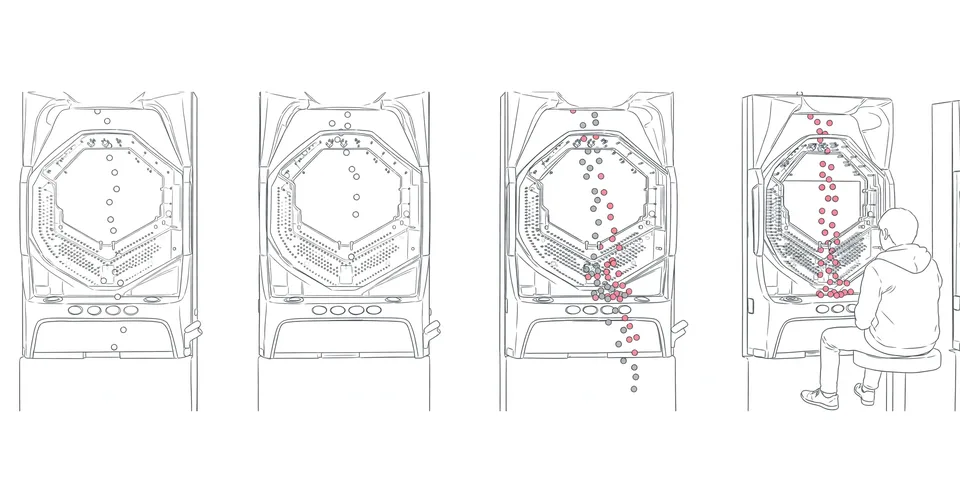
The short answer is that pachinko is a vertical pinball machine with a slot machine built into its center, played with small steel balls instead of coins, and wrapped in a legal structure so ingenious that it has kept the industry running for decades in a country where gambling is banned. This article explains how pachinko works, where it came from, how much a session costs, why the halls are so loud, and what to expect if you try it once, as a visitor, for the experience alone.
What pachinko actually is
A pachinko machine is an upright playing field, about the size of an arcade cabinet, set with hundreds of small pins, ramps, and pockets. You load small steel balls into the machine, each about 11 millimetres across, and turn a spring-loaded dial that fires them one at a time toward the top of the board. Each ball drops through the pins, and most fall into dead zones at the bottom and are lost. The aim is to land balls in particular pockets that start a digital slot machine on a screen built into the center of the machine. Hit the right pocket and the slot spins. Get three matching symbols and the machine pours winning balls into the tray in front of you, sometimes hundreds at once, sometimes thousands, with enough lights and sound to make the machines next to it look asleep.
Pachinko and pachislot are different games, though most halls offer both. Pachislot machines look like Las Vegas slot machines, and you play them with a button and metal medals instead of balls. Pachinko takes some physical skill. You learn how hard to turn the dial to hit particular targets, which is why regulars sit as still as someone threading a needle, making tiny adjustments to the knob while the balls rain down. A jackpot in pachinko is called an oatari, and when it hits, the machine enters fever mode, a long burst of lights, music, and balls that can last several minutes.
The economics are simple at the standard rate. A normal machine charges 4 yen per ball, so 1,000 yen buys 250 balls. Many halls also run a 1 yen section, where the same 1,000 yen buys 1,000 balls and the stakes are lower. Pachislot is usually 20 yen or 5 yen per medal. On a standard machine, 1,000 yen lasts about ten minutes of steady play, so a casual session of an hour can easily cost a few thousand yen. Treat it as entertainment, like a cinema ticket, not as a way to make money, and the numbers stay honest.
A short history of pachinko
Pachinko is not an ancient tradition. It took shape in the 20th century, which makes it unusual among the Japanese pastimes visitors know, like sumo, the tea ceremony, or the climb up Mount Fuji. It grew out of the Corinth game, a bagatelle-style board imported in the 1920s, a tabletop game where balls dropped through pins toward scoring pockets. Nagoya is often called the home of modern pachinko, and the first pachinko hall is usually placed there in the 1930s.
The game spread fast after the Second World War. In the ruined cities of the late 1940s, a cheap machine game that needed little more than steel balls and a wooden board was easy to set up, and the halls multiplied wherever people gathered. By the 1990s, pachinko had become enormous. Around 30 million people played, and at its peak in 1994 the market, pachinko and pachislot combined, was worth about 30 trillion yen. To put that in perspective, it was larger than the annual casino revenue of Las Vegas, Macau, and Singapore combined.
The decline since then has been steady. In 2023 the market was worth roughly 15.7 trillion yen, about half its peak, and the player base had shrunk to under 7 million. The reasons are familiar ones in Japan: an aging player base, stricter regulation of machines, competition from smartphones and other entertainment, and a younger generation that never picked up the habit. The halls that remain have adapted, adding low-stakes 1 yen sections, non-smoking floors, and cleaner, brighter interiors to attract casual players and women, who were once rare inside.
The three-store system and why pachinko is not technically gambling
Japan's Penal Code bans gambling, meaning betting money directly on games of chance. Pachinko works inside a legal structure built around that ban, and you cannot make sense of the industry without it.
When you win balls, the parlor does not pay you cash. You take your tray to a counter inside and trade the balls for prizes, usually everyday goods or small special items that look like gold-plated tokens or playing cards. Then you walk out of the parlor and, usually a few doors down a side alley, you find a small exchange shop, a separate business with a window marked with the characters for exchange. You slide the special prize through the window, and they slide cash back. The exchange shop then sells the prizes back to a wholesaler, which sells them back to the parlor, and the loop closes.
This is the three-store system, santen hoshiki in Japanese: parlor, exchange shop, and wholesaler, three legally independent businesses. No single transaction swaps a game result for cash, so no single step breaks the gambling law. The parlor and the exchange shop are legally required to have no corporate ties, and staff are not allowed to tell you where the exchange shop is, although in practice the small window near the exit is rarely a mystery. Nobody has ever been prosecuted for the system under the Penal Code, and no court has ruled on whether it counts as gambling. The whole industry rests on a legal fiction that everyone involved agrees to maintain, and it has held for decades. Pachinko halls are licensed under Japan's Act on Control and Improvement of Amusement Business, which sets the rules for machine design, opening hours, and advertising.
I find this the most interesting part of pachinko, more than the game itself. Japan has a habit of solving a contradiction not by resolving it but by building a careful structure around it, and the three-store system is that habit in its purest form. The game is gambling in every way that matters to the player, and not gambling in every way that matters to the law, and both statements are true at the same time.
Why the halls are so loud
The noise is the first thing every first-timer mentions, and it is not an accident. A busy parlor runs at 80 to 90 decibels all day, the sound of thousands of steel balls hitting metal pins, multiplied by hundreds of machines, layered with cheerful electronic jingles, anime voice samples, and the occasional jackpot siren. The noise narrows your attention to the machine in front of you and makes you lose track of time outside. It is the same trick Shibuya Crossing plays with crowds and light, and the same logic that fills Japan's convenience stores with bright light and constant music: the environment is designed to hold you in the present moment, and to make leaving feel like stepping out of a spell.
There is also a practical side. The balls themselves are the sound. A machine that has gone quiet is a machine that is not being played, and in a hall of three hundred machines the silence of one is obvious. Regulars say they can hear a jackpot starting two rows away before they see it. Earplugs are a sensible choice for a first visit, and nobody will think twice about them.
One change visitors notice is the air. Since April 2020, Japan's revised Health Promotion Act has required smoking in pachinko parlors to stay inside designated smoking rooms, so the main playing floors are officially smoke-free. Modern, high-end parlors in Tokyo mostly comply, and the choking haze older travelers remember from the 1990s is largely gone. Older neighborhood parlors can be looser about the rule, so if smoke bothers you, a large chain parlor is the safer choice.
How a session works, step by step
Playing pachinko for the first time is easier than it looks, and most of the steps are printed in English in the larger halls. Here is the sequence, in the order you will actually do it.
First, pick a section and a machine. The standard floor charges 4 yen a ball. The 1 yen section is cheaper and calmer, and it is the right choice for a first visit. Do not sit at a machine that has a tray of balls left in it, a bag hanging from the chair, or a drink on the tray. That machine belongs to someone who has stepped away for a moment, and taking it is the fastest way to cause a scene.
Second, insert yen notes into the lending unit beside the machine and press the ball lending button, tamakashi. The machine loads your balls into the tray. Third, turn the handle to fire balls. Start gently and watch where they land. The aim is to land them in the start pocket, the small opening near the center that spins the digital reels. Fourth, watch the screen. A ball in the start pocket spins the reels, and three matching symbols trigger a jackpot, an oatari, and a flood of balls. Fifth, finish up. Press the call button or ask staff to count your balls, then take the record to the prize counter inside the hall.
A few points of etiquette are worth knowing before you go. Do not photograph other players. Do not touch a machine someone else is playing, even to look at it. Do not ask staff where the exchange shop is, because they are not allowed to tell you. And do not expect to win. A random visitor should expect a modest loss, and making money from pachinko consistently means tracking individual machines over many sessions to learn their payout timing, which takes months of regular play. Go for the experience and do not count on winning.
The machines, the anime, and the regulars
Part of the reason pachinko survives is that the machines themselves are a spectacle. Modern machines are built around licensed themes, and the center screen plays animated sequences from popular anime, films, and music acts while you play. A jackpot sequence can feel like a short film, with characters, story, and a song, and the machines compete with each other for the loudest and brightest display. For visitors who grew up with anime, the machines are often the most familiar thing in the hall.
The regulars are the other half of the scene. Most are men in their fifties and sixties, jackets draped over chair backs, plastic trays of silver balls stacked beside them, sitting for hours with the focus of someone threading a needle. They know their machines. They know which ones have been paying out, which ones are due, and which knob angle sends the balls where they want them. Watching them is, for me, the best reason to visit a parlor even if you never play a single ball. It is a portrait of a Japan that the temples and the bullet trains do not show: ordinary, patient, and a little stubborn, finding a small pleasure and repeating it for decades.
If you want a gentle first visit, the larger chains are the easiest entry point. Maruhan is the biggest operator, and its large Tokyo parlors are set up for foreign visitors, with English-language guidance at the machines. Not every hall welcomes tourists with open arms, and small neighborhood parlors can feel unwelcoming to a stranger who does not speak Japanese, but the big halls are used to first-timers and will not mind you watching for a while before you play. A detailed English guide to the game, including current hall counts and costs, is available from Japan Travel Costs, and a Tokyo-focused walkthrough of the experience is on Hinomaru One.
A pastime in slow decline, and why it matters
Pachinko is shrinking, and the numbers leave little doubt. From around 30 million players in the 1990s to about 6.9 million in 2024, from a 30 trillion yen peak to 15.7 trillion yen in 2023, the industry has lost more than half its audience in a generation. Halls close every year, and the ones that remain are cleaner, quieter, and emptier than the packed, smoke-filled rooms of the old stories. Some observers expect the decline to continue until pachinko becomes a niche hobby for older players, like the game itself becoming a museum piece.
I think that would be a loss, and not because of the gambling. Pachinko halls are one of the few places in Japan where strangers of all ages and backgrounds sit side by side for hours, doing the same small thing, in companionable silence. The country has fewer and fewer of those places. Japanese trains move people efficiently, and convenience stores feed them, but neither one gives people a reason to sit still together. The pachinko parlor does, even if the reason is a machine full of steel balls and a legal fiction about prizes.
That is the honest way to see pachinko, I think. It is not a tradition, and it is not really a game of skill, and the money math is against you. But it is a real piece of everyday Japan, loud and bright and a little absurd, and it has survived for almost a century by being exactly what it is. Walk past a parlor on your next evening in Japan, push the door open, and listen for a minute. You will understand something about the country that no temple can teach you, and you will not need to spend a single yen to learn it.
More in Culture & Society
- A Kamidana Brings the Shrine Into the Japanese Home
- An Omamori Carries a Shrine's Protection in Your Pocket
- A Shinai Is a Sword That Refuses to Cut
- Kiai Is the Shout That Turns a Strike Into a Commitment
- Toro Stone Lanterns Light the Way Through Japan's Sacred Places
- An Ofuda Brings the Kami Home on a Slip of Paper
Latest posts
- Kongobuji Still Runs the Mountain Kukai Chose
- Kagura Suzu Are the Bells That Let the Kami Hear the Dance
- Japanese Knives From Samurai Swords to Kitchen Counters
- Tenkasu Turns Tempura Scraps Into Japan's Favorite Crunch
- Goshuin Collects Your Shrine Visits One Red Stamp at a Time
- Hamaya Is the Arrow That Breaks Demons at New Year
- Saisen Is the Small Coin You Offer Before You Pray
- Japanese Gardens and the Quiet Art of Borrowed Scenery
- Tanuki Udon Is the Bowl Named After a Raccoon Dog
- A Himorogi Is the Shrine Before Shrines Had Walls
- Wagyu Beef and Why One Small Steak Costs More Than Dinner
- Inari Sushi Turns Fried Tofu Into a Portable Feast
- Sakaki Is the Sacred Tree Shinto Cannot Do Without
- Aburaage Is the Fried Tofu Japan Simmers Sweet
- Tamagushi Is the Sakaki Branch You Offer to the Kami