An Omamori Carries a Shrine's Protection in Your Pocket
· 24 min read
An omamori is a small cloth pouch from a Japanese shrine or temple, blessed and carried close for protection, and this guide explains what is inside, which kind to choose, and how to return one when its year is done.
An omamori is a small cloth pouch you carry with you, and inside it, sealed and unseen, is a slip of paper or wood that a priest has blessed. The pouch is the part you see. The blessing is the part you trust. An omamori does not ask you to understand how it works. It asks only to be kept close, in a bag or a pocket, while you go about your day.
That is the whole idea, and it is older than the bright brocade suggests. The word comes from mamoru, to protect, and an omamori is protection made portable. A shrine's main talisman, the ofuda, stays at home on the household altar. An omamori is the smaller version of the same thing, made to travel with the person it protects. You buy one for a reason, health or safe travel or an exam or love, and then you carry it until the reason is fulfilled or about a year has passed.
Most visitors meet an omamori at a shrine counter, where rows of small pouches hang on pegs in pink and blue and gold. The choice can feel overwhelming, because every pouch looks like a souvenir and every label names a different wish. The trick is to slow down and read the label. An omamori is chosen by purpose, not by colour, and the right one is the one that matches what you actually need.
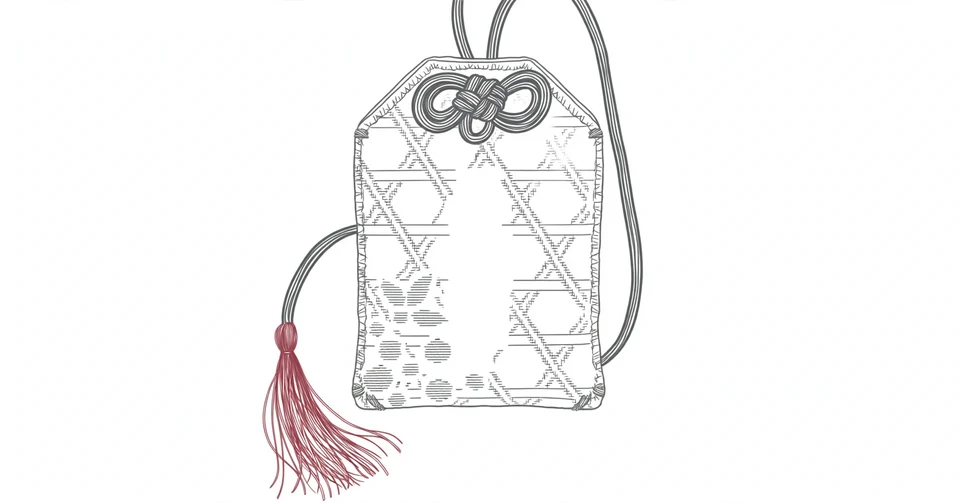
The pouch itself is small enough to fit in the palm of your hand, usually a few centimetres across, made of brocade or embroidered silk, tied shut with a cord. What matters is not the fabric but what the fabric holds. Inside is the blessed slip, and the pouch is never meant to be opened. That sealed quality is the point. The protection is inside, out of sight, and it works by being carried rather than by being examined.
What an omamori is
An omamori is a small charm given out by a Shinto shrine or a Buddhist temple in Japan, made to protect the person who carries it or to help with one particular wish. The Tokyo Prefectural Shinto Association explains it plainly: an omamori is a small version of an ofuda, the paper or wooden talisman kept at home, and inside the bag is a slip of wood or paper carrying the shrine's name. A priest purifies and blesses the charms before the shrine gives them out, so they are treated as holding a share of the kami's spirit. That is why the counter where you receive one is called a juyosho, the place where charms are given, and why the amount you hand over is called hatsuhoryo, a first fruits offering, rather than a price.
The distinction matters. You do not buy an omamori the way you buy a keychain. You receive it, with an offering, from a place that has blessed it. The Association of Shinto Shrines, known as Jinja Honcho, describes an omamori as something you keep with you at all times for the kami's protection, while an ofuda protects the home. One guards the house. The other guards the person walking out of it. The two work together, and many shrines sell both side by side. Yushima Tenmangu in Tokyo even offers sets that pair an omamori with an ofuda, so the home and the traveller are covered by the same shrine.
Shrines and temples both give out omamori, and the practice is woven into ordinary life in a way that surprises first time visitors. At Meiji Jingu in Tokyo in January, shrine staff in white robes hand charms across a long wooden counter to a queue of visitors, and the scene is less like a shop than like a station at rush hour, orderly and unhurried. Almost every shrine in Japan has such a counter, from tiny neighbourhood shrines to major pilgrimage sites, and the pouches on the pegs are part of the furniture of the place.
The idea of a small protective charm is an old one in Japan. Writing in 1899, the writer Lafcadio Hearn noted that mamori had as many meanings as the English word amulet, and he described being shown a tiny figure of Kannon in an iron case that an officer had carried through the Satsuma war of 1877. The figure had stopped a bullet, and the dent was still visible. That story is almost a hundred and fifty years old, and it captures the same logic that an omamori carries today. The charm is small, the danger is real, and the protection is something you carry on your body rather than something you hang on a wall.
The kinds of omamori
Most omamori name their purpose on the front, so learning a few words tells you what you are looking at. The kanji on the pouch is the label, and it matters more than the colour or the pattern. A pink pouch is often for love, and a blue one is often for travel, but the label is the reliable guide, and shrine staff will help if you ask. The core lineup is much the same across the country, and the examples below come from the price lists of Yushima Tenmangu, Tokyo Daijingu, and Fushimi Inari Taisha, read on 1 November 2026.
| Type | Japanese | Protects or helps |
|---|---|---|
| Traffic safety | kotsu anzen | Safe driving and travel |
| Health and recovery | kenko, byoki heiyu | Good health, recovery from illness |
| Study and exams | gakugyo joju, gokaku | Success in study, passing exams |
| Love and matchmaking | en-musubi, renai joju | Finding a partner, a good relationship |
| Money and business | kinun, shobai hanjo | Prosperity, a thriving business |
| Safe childbirth | anzan | A safe birth |
| Warding off misfortune | yakuyoke | Protection from bad luck |
| General good fortune | kaiun | Luck in general |
A standard cloth omamori usually costs between 500 and 1,500 yen. At Yushima Tenmangu, the academic charm is 1,000 yen, the health charm is 1,000 yen, the recovery charm is 1,500 yen, the matchmaking charm is 1,000 yen, and the money luck charm is 1,000 yen. At Fushimi Inari Taisha, the study charm is 800 yen, the business prosperity charm is 1,000 yen, and the car charm is 1,500 yen. At Tokyo Daijingu, the lily of the valley love charm is 800 yen. Special designs cost more, and prices change, so treat these as a guide rather than a menu. The offering is modest either way. An omamori is not a luxury good. It is priced so that anyone can carry one.
Some kinds are newer than they look, and they show how the tradition bends without breaking. Kanda Myojin in Tokyo, a short walk from the electronics shops of Akihabara, sells an IT charm for 1,000 yen to protect computers and guard against information leaks. The same shrine sells a business success charm for 1,000 yen, or 1,500 yen with a business card case. Yushima Tenmangu's range includes a Hello Kitty good fortune charm at 800 yen. A charm for a computer sits on the same counter as a charm for childbirth, and nobody at the shrine finds that strange. The wishes change with the times. The pouch stays the same.
There are also shapes that break the usual pouch form. Tokyo Daijingu sells a pair of interlocking love charms whose lids fit together for 1,000 yen, and a key shaped charm for 1,200 yen. Naritasan Shinshoji, a Buddhist temple near Narita Airport, sells a signature charm for 500 yen that is said to take misfortune on itself in place of the person who carries it. The variety is part of the pleasure, but it is also a trap for the careless shopper. Choose by the wish written on the label, not by the prettiest design on the peg, or you may come home with a beautiful pouch for a wish you never made.
Why the pouch stays closed
The single most important rule of an omamori is also the simplest. Do not open it. The pouch is tied shut for a reason, and the reason is the blessing inside. Meiji Jingu's guidance, published in the Japan Tourism Agency's multilingual explanation database, says plainly that an omamori should not be opened, and should be attached to a bag, purse, or pocket, or kept inside one, until it has fulfilled its purpose. The slip inside is the blessed part of the charm, so the bag stays closed even when curiosity pulls at the cord.
This is the mistake almost every visitor is tempted to make, and it is worth understanding why the rule exists rather than just obeying it. An omamori is not a souvenir pouch with a fun surprise inside. It is a sealed blessing. A priest consecrates a small inscribed slip, places it in the fabric pouch, and ties it shut. The seal is the mechanism. Opening it does not reveal anything interesting to look at. It only breaks the protection. The charm works by being carried, not by being understood, and the closed pouch is a small daily exercise in trusting something you cannot see.
There is a practical side to the rule too. A sealed pouch survives a year in a bag, a pocket, or a car far better than an open one would, and the cord keeps it attached to whatever it protects. Do not wash it, and do not untie it to peek. If the pouch frays or the cord breaks after long use, that is a sign its time is coming to an end, and the right response is to return it to a shrine rather than to repair it yourself. The charm is a guest in your bag, not a piece of luggage, and it is treated with the same care you would give a gift from someone you respect.
I find something quietly instructive in this rule. We live in a time when everything is expected to be opened, examined, and explained, and a small pouch that refuses to be opened feels almost defiant. Yet the refusal is the teaching. Some things keep their power precisely because they are left alone, and an omamori asks its carrier to accept that. You do not need to see the blessing to carry it. You only need to remember that it is there.
How to carry an omamori
Carrying an omamori is simple, and the simplicity is the point. Keep it close to whatever it protects. A traffic safety charm belongs in the car or clipped to a bag. A study charm belongs in a school bag or a pencil case. A health charm belongs in a pocket or a purse. A love charm belongs wherever you keep the things that matter to you. The Meiji Jingu guidance says an omamori can be attached to a bag, purse, or pocket, or kept inside one, and that is the whole instruction. There is no posture to learn and no hour to observe. The charm goes where you go, and it does its work quietly.
Car charms deserve a note of their own, because they are the one kind with a safety rule attached. Naritasan Shinshoji asks drivers to place the talisman from its car blessing somewhere in the vehicle where it will not get in the way of driving. A charm that dangles into your line of sight is not protecting you. It is distracting you. The temple runs its own hall for car blessings, and the hall blesses the car and then the driver, for an offering of 5,000 or 10,000 yen, from 8am to 4pm on weekdays and 8am to 5pm at weekends and on holidays. The ritual is thorough, and the charm that comes out of it is meant to sit still and be forgotten until it is needed.
One worry comes up often, and the shrines answer it with unusual warmth. Many people wonder whether carrying charms from different shrines together will make the kami quarrel. Jinja Honcho answers that Japan has countless kami, each with their own virtues, and that they work together to protect us, so there is no need to worry. Ise Jingu goes further and says the quarrelling kami story is a folk belief that grew out of an old warning, that people with too many charms stop taking care of them. Carrying several charms means receiving protection from each kami, and Ise Jingu even suggests carrying charms from both its Inner Shrine and Outer Shrine together. The real risk is not conflict between gods. It is neglect by the carrier, a bag full of charms that no one remembers or respects. Keep the number small enough that each one still means something, and the kami will manage the rest.
An omamori can also be worn close to the body. The Tokyo Prefectural Shinto Association lists, among many other kinds, the hada-mamori, a charm worn against the skin. Most people never need one, but its existence says something about how seriously the tradition takes closeness. The charm is not a decoration hung on a wall. It is a companion, and the closer it sits to the person it protects, the better it does its job.
Omamori, omikuji, and ema
Three things at a shrine get mixed up constantly, so here is the clean split. You draw an omikuji, you write and leave an ema, and you buy and carry an omamori. The difference is worth keeping straight, because each object does a different job, and confusing them means missing what each one offers.
An omikuji is a slip of paper that tells your fortune, drawn by chance from a box or a drawer. You read it, and if the fortune is good you keep it, and if it is bad you tie it to a rack at the shrine and leave the bad luck behind. An ema is a wooden plaque on which you write a wish and hang it up for the kami to receive. The word literally means picture horse, and the plaques stand in for the real horses once offered to shrines. An omamori is the one that goes home with you, a small cloth amulet believed to carry a little divine protection, made for health, safe travel, success at school, love, and childbirth. The full story of the fortune slip is told in the guide to omikuji and the fortune on a slip of paper, and the three objects appear side by side in the account of hatsumode and the New Year shrine visit, where the yearly exchange of old charms for new ones is one of the quiet engines of the season.
The three work as a set, and the omamori is the only one of the three that travels. The omikuji tells you where you stand, the ema lets you say what you want, and the omamori goes home with you as a reminder. None of them is expensive, and none of them is required. They are souvenirs of a state of mind, and their real value is the few minutes of attention they ask of you. A visitor who understands the three will never again stand at a shrine counter wondering which pouch to pick, because the choice will already be clear. Pick the wish, read the label, and carry the pouch home.
The year of an omamori
An omamori is said to last about a year, and the custom is to bring last year's charm back to the shrine and have it burned with respect, then receive a new one. That yearly exchange is one of the quiet engines of the shrine calendar. It gives people a reason to return, and it gives the shrine a way to mark the passing of the year. The New Year visit called hatsumode is the traditional moment for the swap, when crowds bring old charms back and leave with fresh ones, but the return can happen at any time of year.
It helps to be precise about what the year means, because the common version of the rule is stricter than the shrines themselves state. There is no official expiry date. Jinja Honcho says omamori, like ofuda, are returned to a shrine at the end of the year to be burned in the ceremony called otakiage, and a new one is received, but it is also fine to keep carrying one until your wish comes true. Meiji Jingu's sign says charms are usually returned once they have served their purpose or are more than a year old, often around the New Year. One shrine's guidance puts it plainly: the effect has no clearly fixed deadline, but one year is a good guide. The year is a custom, not a countdown clock, and a charm does not turn harmful at midnight on its anniversary. It simply reaches the point where renewal is the respectful thing to do.
Returning one is easy. Many shrines keep a box or a small building for old charms, called a kosatsu osamesho, and the box is for old charms, house talismans, and the decorative hamaya arrows of New Year only, never for rubbish. Meiji Jingu's sign at its return box says exactly that. Everything collected is burned in a sacred fire, the ceremony known as otakiage. The burning is an old custom. Writing in 1923, Helen Gunsaulus described the New Year festival closing with the burning of the kadomatsu pine decorations and other New Year ornaments on the 14th or 15th day of the first month, and many shrines still hold their fire rituals in mid January. Jinja Honcho notes that many shrines hold fire rites called sagicho or dondo-yaki between New Year's Eve and January 15, the Little New Year, where New Year decorations, old talismans, and charms are burned together.
It is best to return a charm to the shrine where you received it, but the Tokyo Prefectural Shinto Association says charms from a far away place you travelled to may be returned to a shrine near you, even a different one. Shrine amulets go back to shrines, and temple ones to temples, as a general rule, but most sites are relaxed about accepting either from travellers who cannot make it back to the exact place. If you live outside Japan, Jinja Honcho's guidance says you can ask a shrine near you, or send the charm to the shrine where you received it with a note of thanks. Before you mail anything, check the shrine's website or contact it to see whether it accepts charms by post. And whatever you do, never throw an omamori in the trash. The pouch held a blessing, and the blessing deserves a better ending than a bin bag. A thorough guide to the whole cycle, from choosing to returning, is given in the Japan Nakama guide to omamori types and returns, and the practical questions of carrying several charms and returning them from abroad are answered with shrine sources in the Sumimasen guide to choosing, carrying, and returning an omamori.
When a wish comes true, Yushima Tenmangu and Naritasan Shinshoji both invite a thank you visit, called orei mairi, and that is a natural moment to hand the charm back. The return is not only a disposal. It is a closing of the loop, a small act of gratitude for a year in which the wish was carried and, in the best cases, answered. The charm protected you. You bring it home. The fire takes it, and the year begins again.
Famous shrines for particular omamori
Most shrines sell charms for many purposes, but each is known for what its deity looks after, and visitors go to the shrine whose deity matches their wish. Matching the shrine to the wish is half the pleasure of choosing, and it turns a simple purchase into a small piece of research. A student does not buy a study charm anywhere. A student buys one from a Tenmangu shrine, because Tenmangu shrines enshrine Sugawara no Michizane, the scholar and statesman revered as the god of learning.
Yushima Tenmangu in Tokyo, in Bunkyo near Ueno, is the classic choice for exams. Its price list runs from the 1,000 yen academic charm to study pencils, a headband for academic success, and a charm for children's school bags. The charm counter to the right of the main hall opens from 9am to 5pm, and the shrine office to the left from 9am to 7.30pm, every day. Dazaifu Tenmangu in Fukuoka calls itself the head shrine of all Tenmangu shrines in Japan, and it holds a special prayer festival for exam success every October, with prayers offered through the month. Students travel to both, and the pencils and headbands on the counter show that the shrine understands exactly who its visitors are.
Tokyo Daijingu, near Iidabashi, is closely linked with Ise Jingu and is known for love charms. Its most popular is the en-musubi lily of the valley charm at 800 yen, shaped like the white flower whose meaning in Japanese flower language is that happiness will come. Others include the pair of interlocking charms whose lids fit together at 1,000 yen and a key shaped charm at 1,200 yen. The shrine enshrines the musubi deities, who preside over the binding together of all things, which is why so many of its charms are for love. A couple who buy the interlocking pair each carry half of a single charm, and the charm is only complete when the two halves are together. It is a small piece of design that says more about love than any label could.
Meiji Jingu, the great shrine in the forest in the middle of Tokyo, offers traffic safety and study charms alongside one of its own, the sowa mamori, a love charm scented with camphor from the shrine grounds and linked to the Meoto Kusu, the pair of husband and wife camphor trees in the inner precinct. The scent is the signature. A charm that smells of the shrine's own trees carries the place with it in a way that no embroidery can, and opening a bag months later to catch a faint trace of camphor is a small return journey in itself.
Fushimi Inari Taisha in Kyoto, the head shrine of Inari and famous for its tunnels of vermilion torii gates, is the shrine for business and the household. It describes its blessings as prosperity in business and safety at home, and its counter offers business prosperity charms at 1,000 yen, a charm for the car body at 1,500 yen, a charm for cyclists and the person at 1,000 yen, and a study charm at 800 yen. It is also the shrine that spells out the once a year rule most clearly, asking visitors to receive new ofuda and omamori once a year. Kanda Myojin in Tokyo, the guardian shrine of old Edo, sells business success charms and names Daikoku and Ebisu, gods of good fortune and trade, on its business talisman. It also runs an online charm office, for those who cannot visit in person, though a shrine's own omamori can only truly be received there or through its own postal service, and the services checked serve Japanese addresses only.
These famous counters are worth a visit even if you buy nothing. They are a map of what Japan worries about and hopes for, laid out in small pouches on pegs: exams in January, safe driving all year, a good marriage, a healthy baby, a thriving shop. The wishes are ordinary, and that is the point. An omamori is not for grand ambitions. It is for the ordinary hopes that fill an ordinary life, and the shrines that specialise in them have been answering those hopes for centuries.
Giving an omamori as a gift
An omamori makes a popular gift, and it is easy to see why. It is small, beautiful, inexpensive, and it carries a wish for the person who receives it. A study charm for a student before exams, a traffic safety charm for a new driver, a health charm for a parent, a love charm for a friend: each one says, I was thinking of you, in a form that fits in a pocket. For a gift, choose the purpose for the person, not the design you happen to like, and pass on the basics with it: keep it with you, do not open it, and return it to a shrine when the time comes.
There is an honest limit to what can be said here, and it is worth stating. No official shrine page that the guides consulted rules on giving an omamori as a gift one way or the other, so there is no rule to quote, only practical hints drawn from what the shrines do say. An omamori is made for a particular wish and is meant to be carried by the person it protects, so the gift works best when the wish is the other person's wish, not yours. A charm bought for someone else's exam, chosen because they are sitting that exam, carries the giver's care in a way that a charm bought for its colour never will. The gift is not the pouch. The gift is the attention behind the choice.
As a memory of your own visit, an omamori needs no defence at all. Ise Jingu describes its talismans and charms as given out as a sign of your visit, wishing you health and happiness, and taking one home from a shrine that meant something to you fits that well. The pouch on your bag becomes a small piece of the place, a reminder of a morning spent in a quiet courtyard, of the smell of incense and the sound of a bell. It is a souvenir, but it is a souvenir with a job to do, and that is what sets it apart from everything else in the gift shop.
Why a small pouch carries such weight
An omamori is a small thing, and its smallness is the whole argument. The great hall bell is loud enough to be heard across a courtyard. The drum is deep enough to be felt in the chest. An omamori is small enough to hold in one hand, and its protection is thin enough to be missed if you are not paying attention. Yet it carries the part of a shrine visit that nothing else can carry, the blessing that goes home with you and stays with you through an ordinary year.
I think there is a lesson in that disproportion, and it is not only a religious one. We tend to assume that importance scales with size, that a bigger charm means a bigger blessing, and that a louder promise matters more than a quiet one. An omamori argues the opposite. It argues that a small thing, chosen with care, carried with attention, and returned with gratitude, can carry more meaning than a grand gesture made once and forgotten. The pouch does not need to be large to be real. It needs to be remembered, and the remembering is the work.
The yearly cycle is part of that work. A charm that lasted forever would eventually be forgotten in a drawer, and a blessing that never ended would stop being noticed. The custom of returning an omamori after about a year keeps the relationship alive. You carry it, you live with it, you bring it back, and you begin again. The fire takes the old pouch, and the new one takes its place, and the year is measured not in months but in wishes made and wishes answered. It is a gentle discipline, and it asks very little: a small offering, a little attention, and a willingness to let go of what has served its purpose.
That is, in the end, what an omamori is for. It is a reminder that protection does not need to be large to be real, and that attention, carried quietly in a pocket, is itself a form of prayer. The shrine gives you a small pouch, the pouch holds a blessing you will never see, and you carry it through traffic and exams and hospital corridors and ordinary days, until the year is done and it is time to bring it home. It is a small pouch, and it is enough. It has been enough for generations, and if you carry one yourself, you may find that it is enough for you too.
More in Culture & Society
- A Kamidana Brings the Shrine Into the Japanese Home
- A Shinai Is a Sword That Refuses to Cut
- Pachinko and the Neon Rooms Where Japan Plays Its Loudest Game
- Kiai Is the Shout That Turns a Strike Into a Commitment
- Toro Stone Lanterns Light the Way Through Japan's Sacred Places
- An Ofuda Brings the Kami Home on a Slip of Paper
Latest posts
- Kongobuji Still Runs the Mountain Kukai Chose
- Kagura Suzu Are the Bells That Let the Kami Hear the Dance
- Japanese Knives From Samurai Swords to Kitchen Counters
- Tenkasu Turns Tempura Scraps Into Japan's Favorite Crunch
- Goshuin Collects Your Shrine Visits One Red Stamp at a Time
- Hamaya Is the Arrow That Breaks Demons at New Year
- Saisen Is the Small Coin You Offer Before You Pray
- Japanese Gardens and the Quiet Art of Borrowed Scenery
- Tanuki Udon Is the Bowl Named After a Raccoon Dog
- A Himorogi Is the Shrine Before Shrines Had Walls
- Wagyu Beef and Why One Small Steak Costs More Than Dinner
- Inari Sushi Turns Fried Tofu Into a Portable Feast
- Sakaki Is the Sacred Tree Shinto Cannot Do Without
- Aburaage Is the Fried Tofu Japan Simmers Sweet
- Tamagushi Is the Sakaki Branch You Offer to the Kami