Kongobuji Still Runs the Mountain Kukai Chose
· 15 min read
Kongobuji is the head temple of Shingon Buddhism on Mount Koya, and after more than 1,200 years it still governs the mountain Kukai chose, from its great rock garden to its gilded audience rooms.
Kongobuji still runs the mountain. That is the simplest way to describe the head temple of Shingon Buddhism on Mount Koya, and it is also the most accurate. More than 1,200 years after the monk Kukai was granted this high plateau in the Kii Mountains, Kongobuji remains the administrative and spiritual headquarters of the sect he founded, overseeing some 3,600 branch temples across Japan.
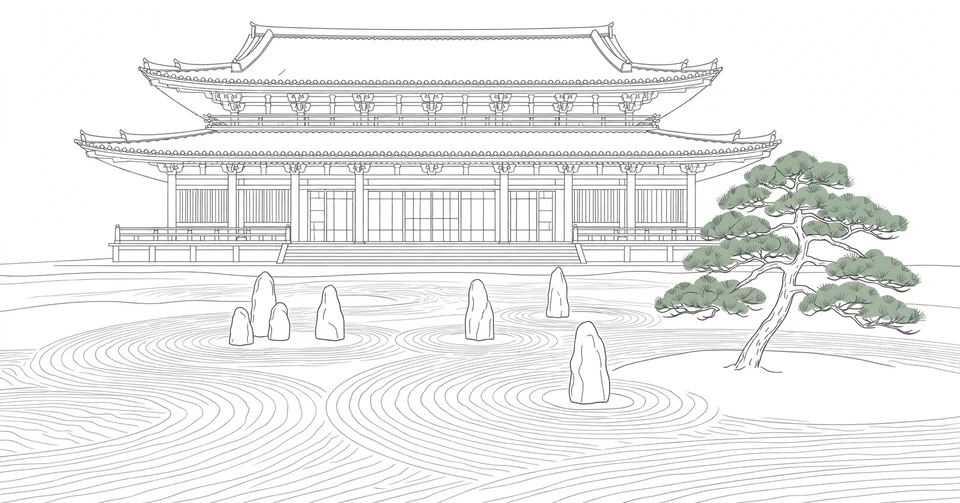
Most visitors come for the rock garden. The Banryutei, built in 1984, is the largest rock garden in Japan, a sea of white gravel where 140 granite stones rise like two dragons out of clouds. But the garden is only the most famous room of a working headquarters. Behind it stand gilded audience halls, a kitchen built to feed 2,000 people, and a small willow-painted room where a warlord's nephew was ordered to end his own life.
To walk through Kongobuji is to walk through the whole story of Koyasan in a single building: a founder's vision, a warlord's grief, an act of political murder dressed as ritual, and a garden so new it is younger than many of its visitors, yet already feels ancient. The mountain town around it exists because of this temple, and the temple still behaves as if the mountain is its responsibility.
How kongobuji became the head temple
The story starts with Kukai, the monk Japan remembers as Kobo Daishi. In 804 he sailed to Tang China as a young monk looking for teachers, and he returned in 806 carrying the texts, mandalas and ritual implements of Shingon, the esoteric school of Buddhism he had received there. He wanted a headquarters far from the politics and noise of the capital, a place where training could come before everything else. In 816, Emperor Saga granted him this remote plateau in the Kii Mountains, and construction began a few years later, in 819.
The settlement that grew on that plateau became Koyasan, a temple town of more than a hundred temples, and Kongobuji became its head. The name has changed and the buildings have burned and been rebuilt several times, but the function has not. The temple that stands at the centre of the town is still the office from which the Koyasan Shingon sect is run, still the residence of its chief priest, and still the place where the sect's major ceremonies are held. That continuity is the first thing to understand about Kongobuji. It is not a monument to a headquarters. It is the headquarters.
The scale of that job is easy to miss from the street. The Japan Tourism Agency notes that the temple oversees around 3,600 branch temples across the country, and the temple's own guide describes Kongobuji plainly as the headquarter of the Shingon sect of Esoteric Buddhism. Everything else on the mountain, the cemetery at Okunoin, the Danjogaran precinct with its great pagoda, the dozens of temple lodgings where visitors sleep, answers in some way to the authority that sits in this building. When the monks carry Kukai's meals to his mausoleum twice a day, as described in the story of the founder who is said to be still meditating, they do so under the authority of Kongobuji.
I find that grounding. A place can be old without being in charge, and it can be in charge without being old. Kongobuji is both, and the combination is rarer than it sounds. Plenty of Japanese temples are older than their present buildings and prouder of their past than their present. Here the past is not a display. It is a job description that has been handed down, abbot to abbot, for twelve centuries.
A name that arrived late, after fire and a merger
The name Kongobuji itself is younger than the mountain. It dates to 1869, one year after the Meiji Restoration, when two neighbouring temples on this spot were consolidated into one and given the name that means Diamond Peak Temple. Before that, the site had a different history, and the temple is honest about it.
In 1593, the warlord Toyotomi Hideyoshi built a temple here called Seiganji, in memory of his mother. Hideyoshi had first prepared to attack and destroy Koyasan, and only the negotiation of a monk named Mokujiki Shonin, also known as Ogo, saved the mountain. Hideyoshi relented, allowed Mokujiki to build a temple in the precinct, and raised Seiganji on the ground where Kongobuji now stands. For nearly three centuries, Seiganji and its neighbour stood side by side as two separate temples.
Fire kept rewriting the buildings. The main temple visitors see today was rebuilt in 1863 after several fires, and the main gate was rebuilt in 1862. In the old days the main gate was reserved for emperors, members of the imperial family and the chief priests of Koyasan, while ordinary monks and visitors used a side gate. That strictness about doors is worth remembering when you visit, because Kongobuji still runs on rules about who enters where, and the rules are part of the architecture.
Two crests hang at the entrance, and they tell the same story as the merger. On the right is the three comma crest of Nyutsuhime Shrine, whose Shinto deities guard Koyasan. On the left is the paulownia flower, the crest of the Toyotomi clan. The temple adopted the Toyotomi crest as its own alongside the shrine's, so the warlord who once threatened to destroy the mountain is now remembered on the lanterns at its front door. I like that detail more than any single painting inside. It is the mountain's way of saying that even its enemies, once absorbed, become part of the household.
Inside kongobuji, the rooms do the talking
Visitors enter through the large entrance, take off their shoes, pay the admission fee, and step into the Ohiroma, the great hall used for important rituals and ceremonies. Its gilded sliding doors are painted with cranes by Kano Tanyu, the great painter of the Kano school, and the room sets the tone for everything that follows. This is not a temple that hides its treasures in a museum annex. The treasures are the walls you walk past.
Next to the Ohiroma sit two smaller rooms named after their paintings. The Plum Room holds Kano Tanyu's painting of plum, moon and stream. The Willow Room holds a painting of a willow tree and a heron by Yamamoto Tansai. The Willow Room is the one most Japanese visitors pause at, because it is where Toyotomi Hidetsugu, the nephew of Hideyoshi and the second Kampaku, or chief imperial adviser, committed ritual suicide in 1595 on his uncle's orders. Hidetsugu was 27. The room is quiet and beautifully painted, and the beauty does not soften the fact. It sharpens it.
Further along, the Jodan no Ma, the higher platform room, was once the reception room for visiting emperors. Its walls are covered in gold leaf, its ceilings are coffered, and behind small tasseled sliding doors sits a hidden room called the Musha Kakushi, where samurai bodyguards waited in case of a surprise attack on the emperor. Emperors sat on the raised platform. The guards sat behind the wall. The room is a small lesson in how power worked in old Japan, built into the floor plan.
The visit ends, fittingly, in the kitchen. The great hearth and the kamado stoves there are large enough to feed up to 2,000 people at once, a reminder that a head temple is also a household that feeds crowds on festival days. Above the roofs sit rain barrels called tensuioke, an old fire defence unique to this temple, filled with rainwater that monks would have splashed over the cypress bark roofs if sparks flew. The roofs themselves use hiwadabuki, countless pieces of cypress bark nailed with bamboo nails, laid with a tiny overlap so the graceful curve of the roof is possible.
Other rooms reward a slow walk. The scripture storehouse, built in 1679 with the donation of a merchant from Osaka, stands on a raised floor apart from the main building so that sutras and temple records could survive a fire. The Ajikan Dojo is a hall for the meditation on the Sanskrit syllable A, a practice Kukai brought back from China that is unique to Shingon. The Shin Betsuden, the new annex built in 1984, has a hall of 169 tatami mats where visitors are served tea and a rice cracker and may hear a priest deliver a sermon. The Okuden, the inner hall at the centre of the rock garden, was built in 1934 for the 1100th anniversary of Kukai's entrance into eternal meditation, and its sliding doors carry the last great works of the painter Ishizaki Koyo. Most of these rooms are not spectacles. They are working spaces, and Kongobuji lets you walk through them the way you would walk through a house whose owners happen to have been in charge of a mountain for a thousand years.
Banryutei, the largest rock garden in Japan
Then there is the garden. The Banryutei was created in 1984, at the time of the 1150th anniversary of Kukai's entrance into eternal meditation, and it was designed by the modern garden master Mirei Shigemori. It covers 2,340 square metres, which makes it the largest rock garden in Japan, and it uses 140 granite stones brought from Shikoku, the island where Kukai was born, set in white gravel brought from Kyoto.
The stones are arranged to suggest two dragons rising from a sea of clouds to protect the temple. That is the official reading, and it is a good one, but the garden works even if you do not know it. What you notice first is the scale. Most rock gardens are small, enclosed, and meant to be contemplated from a single seat. This one is vast enough to walk beside, and the gravel has been raked into long waves that run the whole length of the garden like a current. The stones do not sit on the gravel. They rise out of it, the way islands rise out of the sea.
The garden is best seen from the veranda of the Shin Betsuden, with the Okuden standing at its centre, a private room that opens only on Kukai's birthday and on special occasions. In late spring the rhododendrons around the garden bloom red and white. In autumn the maples turn. In winter the gravel holds the snow the way it holds the light in summer, which is to say patiently. The garden is enjoyable in every season, as the temple's guide puts it, and the sentence is truer than it sounds, because a garden made of stone and gravel has no season in which it fails. It only changes its mood.
Here is the thing that stays with me about the Banryutei. It was built in 1984, which means it is younger than the cassette tape and younger than most of the people who visit it, yet nobody treats it as new. It has already been absorbed into the mountain's sense of itself, the way the Toyotomi crest was absorbed into the temple's lanterns. Kongobuji has a gift for making new things feel as if they were always there, and that gift is the reason the temple still feels alive rather than preserved.
A headquarters that still works
It is worth saying plainly what Kongobuji does all day, because the building can look like a museum if you walk through it too fast. It is not a museum. It is the office of a religious organisation with thousands of branch temples, and its rooms are used for ceremonies, receptions, meditation training and administration. The chief priest of Koyasan lives and works here. Priests gather here for the sect's major observances. The Ajikan Dojo is still used for the meditation practice Kukai introduced. The kitchen still feeds crowds.
That working character is what separates Kongobuji from the grand temples that survive mainly as tourist sights. A tourist sight asks you to admire it. A headquarters asks you to keep your voice down because people are working. The distinction matters, and visitors feel it without being told. Shoes come off at the door. Voices drop in the corridors. The gold leaf in the Jodan no Ma is not there to impress you. It is there because emperors used to sit in that room, and the room still remembers its job.
The Japan Tourism Agency puts the scale of that job in one sentence, noting that the temple was first established on this spot in 816 by Kukai and today oversees around 3,600 branch temples, a figure that makes the quiet corridors feel less quiet once you think about it. Every one of those branch temples traces its lineage back to this address. When a priest in a small Shingon temple anywhere in Japan performs a ritual, the authority for that ritual runs, in the end, through Kongobuji. The building is modest about this. It does not advertise. It simply continues.
Kongobuji inside the UNESCO listing
Since 2004, Koyasan has been protected as part of the UNESCO World Heritage listing for the Sacred Sites and Pilgrimage Routes in the Kii Mountain Range, together with Yoshino and Omine and the Kumano Sanzan shrines, linked by some 307 kilometres of pilgrimage trails through the forest. The listing recognises a tradition of sacred mountains documented for more than 1,200 years, and Kongobuji sits at the administrative heart of the Koyasan part of that listing.
The UNESCO citation describes three sacred sites linked by pilgrimage routes to the ancient capitals of Nara and Kyoto, forming a cultural landscape that reflects the fusion of Shinto and Buddhism, and it praises the Kii Mountains for a persistent and extraordinarily well documented tradition of sacred mountains maintained over 1,200 years. That last phrase is the one that fits Kongobuji best. The temple is not only a monument inside the listing. It is one of the institutions that does the maintaining.
It helps to see the listing that way. World Heritage status can make a place feel finished, as if the important work is done and the plaque is the point. On Koyasan the plaque is not the point. The point is that the rituals, the administration, the meditation training and the daily timetable all continue, and the listing protects the conditions that let them continue. Kongobuji is the address where that continuity is managed, and the UNESCO listing is, in effect, the world agreeing that the management matters.
Visiting kongobuji
Kongobuji stands in the centre of Koyasan town, about a five minute walk from the Senjuinbashi intersection and a few steps from the Danjogaran precinct, where the great pagoda rises 48.5 metres at what Shingon teaching treats as the centre of a mandala. It is open from 8:30 to 17:00, with entry until 16:30, and it has no closing days. Admission is 1,000 yen for Kongobuji alone, or 2,500 yen for a combination ticket that includes other sights on the mountain. Prices and hours can change, so it is worth checking before you travel, but the temple has kept this pattern for years.
Give it an hour, and give it your attention rather than your camera. Photography is restricted in parts of the interior, and the rooms repay looking more than they repay photographing. Walk the route in order: the Ohiroma first, then the Plum and Willow Rooms, then the long corridor to the new annex, the tea in the great tatami hall, and the Banryutei from the veranda. Finish in the kitchen, where the stoves built to feed 2,000 people remind you that this was always a household as well as a headquarters.
The etiquette is simple and it is the same as everywhere on the mountain. Remove your shoes where asked, speak quietly, do not touch the sliding doors or the paintings, and treat the monks you pass as people at work rather than as part of the display. Kongobuji is not a theme park of old Japan. It is the office of a living sect, and it receives visitors the way a busy office receives guests, with courtesy and with the expectation that you will behave.
From Kongobuji it is a short walk to the Danjogaran and a longer, quieter walk to Okunoin, the largest cemetery in Japan and its quietest forest, where the founder the temple serves is believed to sit in eternal meditation. The two places belong together in a visit, and they explain each other. Okunoin is where Kukai rests. Kongobuji is where his work is carried on. One is the heart of the mountain's faith, and the other is its hands.
That is, in the end, why the temple matters. Mountains in Japan are full of beautiful buildings that no longer do anything. Kongobuji still does its job, and it does it in the same rooms, under the same roofs, with the same crests on the lanterns, that it has used for generations. The dragons in the rock garden have not moved since 1984. The meals for the founder have not stopped for 1,200 years. And in the centre of the town, behind a gate that was once reserved for emperors, the head temple of Shingon Buddhism goes on running the mountain Kukai chose, one ceremony, one sermon and one cup of tea at a time.
More in Food & Travel
- Tenkasu Turns Tempura Scraps Into Japan's Favorite Crunch
- Tanuki Udon Is the Bowl Named After a Raccoon Dog
- Wagyu Beef and Why One Small Steak Costs More Than Dinner
- Inari Sushi Turns Fried Tofu Into a Portable Feast
- Aburaage Is the Fried Tofu Japan Simmers Sweet
- Japanese Cheesecake and the Fluffy Cake That Jiggles
Latest posts
- A Kamidana Brings the Shrine Into the Japanese Home
- An Omamori Carries a Shrine's Protection in Your Pocket
- A Shinai Is a Sword That Refuses to Cut
- Pachinko and the Neon Rooms Where Japan Plays Its Loudest Game
- Kiai Is the Shout That Turns a Strike Into a Commitment
- Toro Stone Lanterns Light the Way Through Japan's Sacred Places
- An Ofuda Brings the Kami Home on a Slip of Paper
- Kagura Suzu Are the Bells That Let the Kami Hear the Dance
- Japanese Knives From Samurai Swords to Kitchen Counters
- Goshuin Collects Your Shrine Visits One Red Stamp at a Time
- Hamaya Is the Arrow That Breaks Demons at New Year
- Saisen Is the Small Coin You Offer Before You Pray
- Japanese Gardens and the Quiet Art of Borrowed Scenery
- A Himorogi Is the Shrine Before Shrines Had Walls
- Sakaki Is the Sacred Tree Shinto Cannot Do Without