Kiai Is the Shout That Turns a Strike Into a Commitment
· 23 min read
Kiai is the sharp shout that turns a martial arts strike into a commitment, and it is far more than noise. It is breath, timing, and intent made audible.
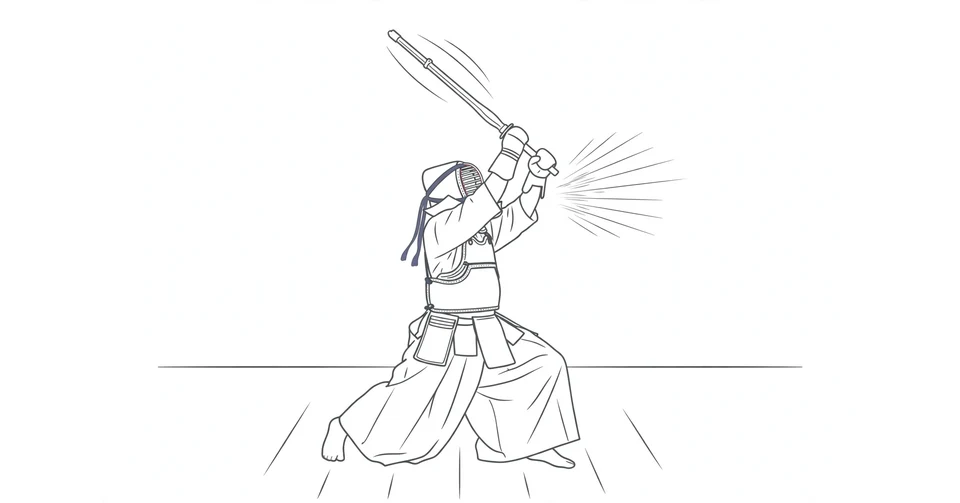
Walk into a kendo dojo during practice and the first thing that reaches you is not the sight of the bamboo swords. It is the sound. A sharp cry cuts across the hall at the exact moment a strike lands, and then another, and another, until the whole room seems to breathe in rhythm with the fighting. That sound is kiai, and it is the most misunderstood part of Japanese martial arts.
A kiai is not a scream of anger, and it is not a war cry meant to frighten an enemy, though it can do both of those things by accident. At its simplest, a kiai is a short, sharp shout released at the moment a technique lands, and it turns a movement of the arms into a decision of the whole person. The strike says what the body is doing. The kiai says that the person means it.
If you have ever watched two kendoka meet in the middle of a dojo, you have heard this bargain in action. The armour lets them strike at full speed, and the shout tells everyone in the room, including the referees, that the strike was deliberate. The sound is the signature on the technique, and without it the technique is incomplete.
The idea behind this article began with a single passing phrase in the article about bogu on this site, which described "the kiai, the sharp shout that accompanies a strike". That one clause deserved a whole article of its own, because the shout is not decoration. It is a technique in itself, with its own mechanics, its own history, and its own rules, and a beginner who learns to shout well learns to fight well at the same time.
What kiai actually means
The word kiai is written with two Japanese characters, and the characters tell the whole story. Ki means energy, spirit, or vital force. Ai means to meet, to join, or to unify. Put together, kiai means the meeting of energy, the moment when breath, body, and intention arrive at the same place at the same time.
That definition matters because it draws a line between a kiai and ordinary shouting. A person can shout loudly and still produce nothing but noise. The shout is not measured by volume. It is measured by unity. When the breath leaves the belly, the body drives forward, and the mind commits to the strike in a single instant, the sound that comes out is a kiai. When any of those three parts is missing, the sound is just noise.
A good guide to the subject puts it plainly, saying that the shout is not about volume but about presence, and that a true kiai reflects the unity of mind, body, and spirit in a single moment of expression. That is the standard every practitioner is measured against, and it is a harder standard than simply being loud. Anyone can be loud. Being present takes practice.
The sound itself is usually short, often a single syllable such as ei, ya, toh, or ha. In kendo the shout is often the name of the target itself, men, kote, or do, called out as the strike falls. The exact syllable matters less than the quality of the sound. It should be sharp and clean, easy to repeat without straining the voice, and it should come from the belly rather than the throat. A shout that tears at the throat is a shout done wrong.
What kiai is not
The first misunderstanding is that the shout is about intimidation. A sudden shout can startle an opponent, and in a match that startled half second can matter, but intimidation is a side effect, not the purpose. A practitioner who shouts only to frighten an opponent is using the tool backwards. The shout is first a tool for the person making it, and only second a message to anyone else.
The second misunderstanding is that kiai is magic. Old stories sometimes describe the shout as a kind of power in itself, a sound that could stop an enemy or break a board on its own. It cannot. The shout does not add force that the body did not produce. What it does is organise the force the body already has, the way a good grip organises the strength of a hand. The power comes from training, not from the sound.
The third misunderstanding is that kiai is only for show, something done in demonstrations and grading examinations to impress the judges. In fact the shout is used in every corner of practice, in basic drills, in kata, in sparring, and in solo training. A practitioner who only shouts when someone is watching has missed the point entirely. The shout is a habit of the body, and habits are built in private, not on stage.
I think the clearest way to put it is this. The shout is not a performance. It is a promise, made out loud, that the technique is real. And a promise made out loud is harder to break than one made in silence.
The breath behind the shout
Every honest explanation of kiai starts in the same place, the breath. Before the shout, the practitioner draws air deep into the lower abdomen, the area the Japanese call the hara. The belly expands, the diaphragm drops, and the body gathers itself. Then, at the moment of the strike, the air is driven out in a single forceful exhalation, and the sound rides out on that breath.
This is why teachers insist that a kiai comes from the abdomen and not the throat. The throat can make a loud noise, but it cannot make a strong one, and a throat shout leaves the practitioner gasping. A belly shout does the opposite. The abdominal muscles tighten as the air leaves, the core locks into place, and the body becomes a single solid column at the instant of impact. That tightening is not a side effect. It is one of the main jobs of the shout.
The breathing has a second job, which is rhythm. A full exhalation empties the lungs, and an emptied lung can take a full breath in return. A practitioner who shouts properly never runs out of air in the middle of a long exchange, because every shout is also a reset. The breath goes out with the strike, and the next breath comes in clean. A practitioner who holds the breath instead, tense and silent, tires quickly, and the tiredness shows in the arms before it shows anywhere else.
There is a simple drill for this, and it is the first one most teachers give. Inhale for four slow counts, feeling the belly rise. Pause. Then exhale in one sharp ha, feeling the belly pull in. Repeat it until the exhale feels natural and the throat stays relaxed. The drill looks like nothing, and it is the foundation of everything that follows. A shout built on shallow chest breathing will always sound thin, because the body underneath it is thin as well.
Kiai in kendo
Kendo is the art where kiai is most visible, and most strictly judged. In kendo, a practitioner does not simply shout. The shout names the target. Before the shinai lands on the head, the attacker calls men. Before it lands on the wrist, kote. Before it lands on the torso, do. This practice is called kakegoe, and it serves several purposes at once. It declares the intention, it focuses the energy, and it lets the opponent know that the attack is coming from a person who has decided, not from a person who is guessing.
The naming matters because a valid point in kendo requires more than contact. The strike must land on a legal target, with the correct part of the shinai, with good posture, and with spirit. A strike that lands silently, even cleanly, is often not counted, because the judges read the silence as a lack of commitment. The shout is part of the evidence. It is the audible half of the strike, and the judges listen for it the way they watch for the posture.
That is why the kendo shout sounds different from the shout in other arts. It is loud, and it is sustained. It begins before the strike and continues through it, carrying the attacker forward into the follow through. A short bark would end too soon, and the technique would look finished before it is finished. The long shout holds the body in the technique until the technique is complete.
The connection between the shout and the equipment is direct. The article about the shinai on this site explains how the bamboo sword teaches before it strikes, and the shout is the other half of that lesson. The sword is the tool, the armour is the permission, and the shout is the commitment. Take away any one of the three and the practice changes its character entirely.
Kiai in karate
Karate uses the shout differently, and the difference shows how one idea can take different shapes in different arts. In karate there is no armour and no bamboo sword, so the shout does not need to be sustained through a long cut. Instead it is short and explosive, a single sharp syllable at the peak of a punch, a kick, or a block.
In kata, the formal sequences of movement practised alone, the kiai marks the decisive points. A kata may run for a minute or more in near silence, and then the shout lands on the technique that matters most, and the whole sequence suddenly has a spine. Judges in kata competition listen for the timing and the intensity of the shout when they score a performance, because a well placed shout shows that the performer understands which moments in the form are real and which are preparation.
In kumite, sparring against a partner, the kiai becomes a tactical tool. A sudden sharp shout can break an opponent's rhythm, mask the sound of footwork, and signal a commitment to attack that makes the opponent hesitate. It is not about being louder than the other person. It is about being fully committed to the movement, and letting the opponent hear that commitment before the technique arrives.
In kihon, the basic drills repeated hundreds of times, the kiai is a training device. Every punch in a line drill gets its own shout, and the shout teaches the beginner to breathe out at the moment of impact instead of holding the breath. Over months of repetition, the timing becomes automatic, and the body learns to exhale with effort the way it learned to blink. That is the quiet purpose of kihon, to make the right thing automatic, and the kiai is the metronome that keeps the timing honest.
A detailed guide to kiai in karate explains that the shout in kata, kumite, and kihon all serve the same root purpose, to unify breath, movement, and intention into one moment, and that a kiai should feel like a verbal exhale of intent rather than a forced roar. The phrasing is worth remembering, because it captures the difference between a shout that helps and a shout that only makes noise.
Kiai in aikido and other arts
Kendo and karate are the arts where kiai is loudest, but the idea reaches further. In aikido, the shout is often softer and shorter, used at the moment of a throw or a pin to focus the technique and to release tension. Aikido is an art of blending rather than meeting force with force, and its kiai matches that character, a short exhalation of intent rather than a long battle cry.
In judo, the shout appears at the moment of a throw, when the whole body commits to the movement. In iaido, the art of drawing the sword, the kiai is often silent altogether, a sharp internal exhalation with no voice at all. That silent version is called the inner kiai by some teachers, and it is considered the most advanced form, because it proves that the energy does not depend on the noise. The sound was only ever a vehicle. When the practitioner is ready, the vehicle can be set aside.
The same principle shows up outside martial arts entirely. Tennis players grunt when they strike the ball, weightlifters exhale sharply when they lift, and singers project from the diaphragm when they need a note to carry. The body already knows that a sharp exhalation organises effort. Martial arts simply gave that instinct a name, a shape, and a discipline.
What the referees and teachers listen for
A kiai is judged, and the judging is stricter than a visitor might expect. In kendo, three referees watch a match, and they listen as much as they look. A strike with a weak or absent shout will often be passed over, even when it lands on target, because the referees read the sound as part of the technique. The same is true in karate competition, where a kata performed without a convincing kiai loses marks, and a kumite point scored without spirit can be questioned.
Teachers listen for different things than referees do. A teacher in a dojo is not scoring a match. The teacher is listening for the health of the student's practice. A shout that comes from the throat tells the teacher that the student's breathing is wrong. A shout that comes too early tells the teacher that the student's timing is wrong. A shout that fades at the end of a long practice tells the teacher that the student's stamina is failing. The kiai is a diagnostic tool, and an experienced teacher can hear a student's whole condition in a single shout.
This is also why teachers correct the shout so often, and why beginners find the corrections frustrating. A beginner expects to be corrected on footwork or grip, things that can be seen. Being told that the shout is wrong feels like being told that the voice is wrong, and that feels personal. But the teacher is not judging the voice. The teacher is judging the breath, the posture, and the commitment underneath the voice, and the voice is simply where those things become audible.
There is a kindness in that kind of listening. A teacher who corrects a kiai is telling a student that the spirit of the technique matters as much as the shape of it, and that the dojo is a place where the inside of a person is taken as seriously as the outside. That is a rare thing in a world that mostly judges people by what can be seen.
The roots of kiai in kotodama and Zen
The shout did not appear from nowhere. Its roots run into old Japanese ideas about the power of the voice. One of those ideas is kotodama, the belief that words carry a spirit of their own, and that a word spoken with full intent has a force beyond its dictionary meaning. In that view, a kiai is not just a sound. It is a word with no dictionary entry, a pure expression of will, and its power comes from the sincerity behind it.
A second root runs through Zen. Zen masters were known to use a sudden sharp shout, called katsu, to jolt a student out of a stuck thought, a loud and unexpected sound that cut through hesitation the way a sword cuts through cloth. The shout was not an argument. It was an interruption, a way of waking a person up to the present moment. The kiai in martial arts carries a trace of that same idea. It interrupts doubt at the exact moment doubt would be most dangerous, the moment of the strike.
These roots should be held lightly. The history of kiai is not a single clean line from ancient warriors to the modern dojo. The shout was formalised in many schools during the Edo period, from 1603 to 1868, when martial arts were taught as peacetime disciplines rather than battlefield skills, and it was carried into modern arts like kendo and karate as those arts took their present shape. Some of the older stories about the shout are legend rather than record, and a careful reader should treat them as legend. What is certain is that the shout survived because it worked, and it kept working in every art that adopted it.
What I find most interesting about those roots is that they point in the same direction. Kotodama says that a sincere word has power. Zen says that a sudden sound can wake a person up. The dojo says that a shout at the moment of impact focuses the body. Three different traditions, three different vocabularies, and all three arrive at the same conclusion, that the voice is not separate from the person. It is the person, made audible.
What science says about kiai
Modern research has begun to test what martial artists have claimed for generations, and the results are more modest than the legends. The honest summary is that a kiai does some things reliably and other things only sometimes, and the difference matters.
On the reliable side, a forceful exhalation with abdominal contraction raises pressure inside the abdomen, stabilises the core, and braces the body at the moment of impact. That is straightforward physiology, and it is the same reason a weightlifter grunts during a heavy lift. The shout also sharpens attention. A person who commits to a shout at a precise moment is a person whose mind is on that moment, and that focus is itself a performance advantage.
On the less certain side, the claim that kiai increases striking power has mixed evidence. One study of 16 male karate athletes tested vertical jumps and reaction times for punches and kicks, and found that using a kiai did not significantly improve performance in those actions. Another study, looking at the mechanics of karate punches, found small differences, with some measures of force and speed slightly higher with a kiai and some slightly lower, depending on the punch. The overall picture is that the shout may help a little, or not at all, and that the effect depends on the person and the technique.
That uncertainty should not disappoint anyone. It tells us something important about what kiai is for. If the shout were only a way to hit harder, the mixed results would be a problem. But if the shout is a way to commit fully, to breathe properly, and to be present at the moment of action, then the numbers matter less than the practice. A tool can be worth using even when its physical effect is small, because the mental effect is large, and the mental effect is the one that keeps a practitioner training for years.
A survey of the research on kiai notes exactly this split, that some studies find no significant performance change while others find small improvements, and it treats the shout as a tool for focus and confidence as much as for power. That seems to me the right balance. The kiai is not a shortcut to strength. It is a discipline of attention, and attention is the thing that makes all the other training work.
Your first practice with kiai
For a beginner, the first practice is a strange experience. The dojo is quiet at the start, the teacher speaks softly, and then suddenly the whole room erupts. The first shout from a senior student is startlingly loud, louder than any sound a beginner expects to make in a room full of strangers, and the beginner's first instinct is to stay quiet and hope nobody notices.
That instinct is the first thing to overcome. Most teachers will not force a beginner to shout on the first day. They will let the beginner watch, and listen, and get used to the sound. Then, during a basic drill, the teacher will ask for a shout, and the beginner will produce something small and apologetic, a sound that comes from the throat and dies halfway out. Everyone in the room has made that sound. Everyone remembers it.
The improvement comes quickly once the breathing is right. The teacher will put a hand on the beginner's belly and ask them to breathe into it, to feel it rise and fall. Then the teacher will ask for a shout from that place, and the sound changes at once. It is deeper, it lasts longer, and it does not hurt the throat. The beginner looks surprised, because the sound does not feel like shouting. It feels like exhaling with purpose, and that is exactly what it is.
After a few weeks, the shout becomes part of the rhythm of practice. The beginner stops thinking about it, and that is when it starts to work. The kiai stops being a performance and becomes a habit, and the habit carries the beginner through the moments when doubt would otherwise take over. I think that is the real lesson of the first practice. The shout is not something you do to show that you are brave. It is something you do until bravery stops being something you have to think about.
How to train a kiai
A kiai is trained the way any technique is trained, slowly, in small pieces, and with attention to the parts that cannot be seen. There is no shortcut, and there is no single drill that fixes everything. But there are a few practices that teachers return to again and again.
Start with the breath. Practise deep abdominal breathing every day, away from the dojo, until the belly rises on the inhale without any thought. Inhale through the nose, let the belly expand, and exhale through the mouth in a slow, controlled stream. This is not dramatic, and it is not fun, but it is the ground everything else stands on.
Then add the sound. On the exhale, let a short ha escape, sharp and clean, from the belly rather than the throat. Do it ten times, quietly, in a room alone. The goal is not volume. The goal is a sound that feels effortless and can be repeated without strain. A kiai that hurts the voice is a kiai that will not survive a long practice, and a kiai that cannot survive a long practice is not a kiai worth having.
Then add the timing. Practise a single technique, a punch or a cut, and shout at the exact moment the technique reaches its peak. Too early, and the shout is a promise made before the work is done. Too late, and it is an apology after the fact. The right moment is the moment of contact, and the body learns it by repetition, not by thinking.
Then add the silence. Advanced practitioners train a silent kiai, the same breath and the same focus, with no voice at all. This is not a party trick. It is a test. If the energy is real, it should be present whether or not it makes a sound. A practitioner who can only commit when shouting is a practitioner whose commitment depends on the audience, and that is a fragile kind of commitment.
Finally, keep the kiai in every part of practice, not just the parts where someone is watching. Shout in the basic drills. Shout in the kata. Shout in the quiet solo practice at home. The shout is a habit, and habits are built by repetition in ordinary moments, not by effort in special ones. A guide to training kiai makes the same point, that the sound should feel like a verbal exhale of intent, and that it should be practised until it arises naturally from the movement rather than being added on top of it.
The other kiai
There is one more kiai worth a brief mention, because it shows how far a single word can travel. The same spelling appears in Java, where Kanjeng Kiai Ageng Plered is the honorific name of a famous court heirloom. It is a different world from the dojo, a world of courts and ceremony rather than strikes and shouts, and it deserves its own story rather than a footnote here. But the shared spelling is a small reminder that words do not belong to one place. They move, they gather new meanings, and they carry their old ones along.
The martial arts kiai is the subject of this article, and it is enough. It is a sound, a breath, and a decision, all at the same instant, and it has been enough to fill a lifetime of practice for the people who study it.
A sound that says you are here
A kiai is a small thing. It lasts less than a second, it costs nothing, and it leaves no mark on the world. Yet it sits at the centre of Japanese martial arts, and every art that uses it treats it as essential rather than optional. That is because the shout does something that no piece of equipment and no amount of drilling can do on its own. It makes the invisible visible. It takes the commitment that lives inside a person, the decision to act fully and without hesitation, and it puts that decision into the air where everyone can hear it.
The next time you hear a kiai, whether in a dojo or in a film or in a demonstration at a festival, listen for what is underneath the volume. Listen for the breath that drives it, the timing that places it, and the stillness that follows it. A good kiai is not the loudest sound in the room. It is the clearest. It says, in a single syllable, that a person is here, that the person is focused, and that the person is ready. There is not much else in life that says so much with so little, and that is why the shout has survived for centuries, unchanged in its purpose even as the arts around it changed their shape.
More in Culture & Society
- Toro Stone Lanterns Light the Way Through Japan's Sacred Places
- An Ofuda Brings the Kami Home on a Slip of Paper
- Kagura Suzu Are the Bells That Let the Kami Hear the Dance
- Japanese Knives From Samurai Swords to Kitchen Counters
- Goshuin Collects Your Shrine Visits One Red Stamp at a Time
- Hamaya Is the Arrow That Breaks Demons at New Year
Latest posts
- Tenkasu Turns Tempura Scraps Into Japan's Favorite Crunch
- Saisen Is the Small Coin You Offer Before You Pray
- Japanese Gardens and the Quiet Art of Borrowed Scenery
- Tanuki Udon Is the Bowl Named After a Raccoon Dog
- A Himorogi Is the Shrine Before Shrines Had Walls
- Wagyu Beef and Why One Small Steak Costs More Than Dinner
- Inari Sushi Turns Fried Tofu Into a Portable Feast
- Sakaki Is the Sacred Tree Shinto Cannot Do Without
- Aburaage Is the Fried Tofu Japan Simmers Sweet
- Tamagushi Is the Sakaki Branch You Offer to the Kami
- The Miko Who Dance Between People and Kami
- Kotodama and the Spirit That Lives Inside Japanese Words
- Japanese Cheesecake and the Fluffy Cake That Jiggles
- Kagura Is the Sacred Dance Shinto Still Performs
- Norito Give a Shinto Ceremony Its Voice