A Koko Is a Donko Caught Halfway
· 8 min read
A koko is a dried shiitake picked at the halfway stage, its cap partly open, between the tight closed donko and the wide open koshin. It is the grade nobody talks about, and it may be the most practical one in the shop.
Every dried shiitake in a Japanese shop was picked at one particular moment of its short life above the log, and the price tag mostly records when. Picked young, its cap still rolled into a tight dome, it becomes a donko and sells for serious money. Left on the log to spread wide and flat, it becomes a koshin, fragrant, useful and cheap. Between those two mornings there is a third one that almost nobody talks about, and the mushroom picked on it is a koko.
A koko is a shiitake caught halfway. Its cap has begun to open but has not finished, the rim still curled under, no longer a bud and not yet an umbrella. The Shizuoka shiitake trader Marusho defines it in one clean sentence: a shiitake with a partially open cap is called a koko, while a shiitake with a wide open cap is a koshin. Halfway is not a metaphor in this trade. It is a grade.
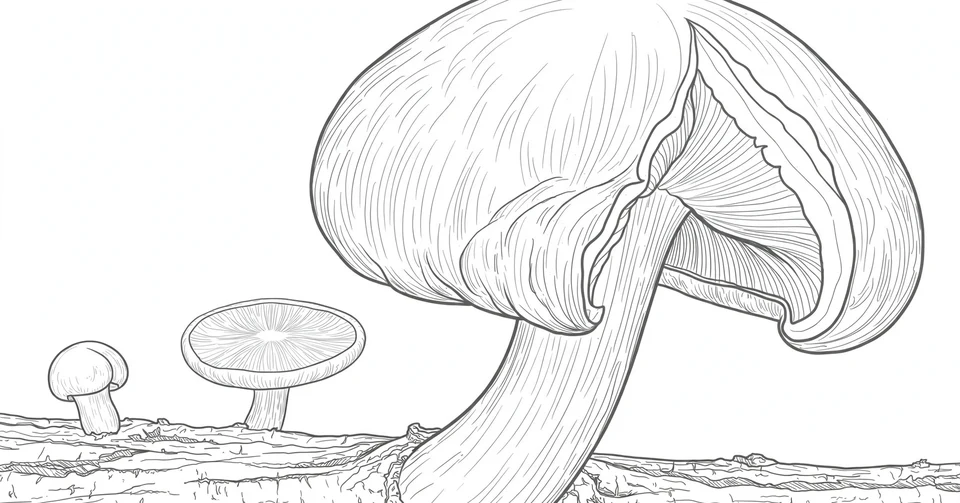
I find the koko the most interesting of the three, precisely because the system that names it barely does. Grading loves extremes, the youngest and tightest at the top of the price list, the oldest and most open at the bottom. The koko belongs to neither celebration. It is the middle stage of a mushroom's life, and like most middle stages, it turns out to be where a great deal of the usefulness is hiding.
The halfway stage the rulebook skips
Ask the official paperwork and the middle disappears. Under the Shiitake Quality Labeling Standards of the Ministry of Agriculture, Forestry and Fisheries, dried shiitake come in mainly two types, as the Kyushu producer Sugimoto explains in its dried shiitake FAQ. A donko is harvested before its cap has fully opened, and a koshin is harvested after its cap has opened. Two boxes, one on each side of a single line. A koko falls exactly on the line, which is presumably why the rulebook leaves it to growers and traders to name.
That is not a complaint about the standards. A shopper needs simple labels, and two honest categories are better than five fussy ones. But it does mean the koko survives as a word spoken in sorting sheds rather than printed on packets, a stage everyone in the business can see at a glance and almost nobody outside it has heard of. The continuum underneath is real enough. On a single log, in a single week, mushrooms stand at every point between dome and dinner plate, and the names are only marks we draw across a smooth gradient.
I have written about the two ends of that gradient before, about the donko, the premium shiitake that never got the chance to open, and about the koshin, the same mushroom left alone until its cap opened wide. The koko is the sentence between those two stories, and it deserves a paragraph of its own.
What a koko does in the kitchen
The cap tells a cook most of what needs knowing. A donko, Sugimoto says, is harvested in a bud-like state, thick, meatier and chewy. A koshin, taken after the cap has expanded, has a large diameter and thin flesh, which makes it easy to cut to match other ingredients and quick to rehydrate. A koko is, by construction, the average of those two descriptions. Its flesh is thinner than a donko's and thicker than a koshin's, so it still slices into honest pieces instead of shreds. Its cap has opened enough to drink water faster than a dense donko does, without surrendering its body the way a fully opened cap does.
The flavour itself does not take sides. Drying a shiitake breaks down its cells, and soaking it before cooking wakes up enzymes that build guanylic acid, one of the great savoury compounds of Japanese cooking, to roughly ten times its fresh level. Marusho describes that chemistry, and it runs identically in every grade on the shelf. What changes along the gradient is emphasis. Much of a shiitake's aroma lives in the gills under the cap, and Marusho notes that the fully opened koshin, a name written with the character for fragrance, has the strongest aroma of any shiitake. A koko has opened its gills only partway, so its scent is quieter than a koshin's and clearer than a shut donko's. In a soup or a pot of seasoned rice, that middle register is often exactly the one a cook wants: present, not shouting.
This is why, in my own kitchen, the koko has quietly become the default. A donko asks to be the main event, simmered whole until it turns glossy. A koshin dissolves happily into whatever it touches. A koko can do a passable version of both jobs, sliced thick into a pan or soaked and cut small for mixed rice, and it does not punish you for reaching for it on a Tuesday. Versatility is an unglamorous virtue, but it is the one that decides what actually gets cooked.
A koko is a decision made at dawn
None of this grading would matter if the mushroom waited politely, but it does not. Log grown shiitake are perishable, and Sugimoto notes that producers dry them within half a day of harvest, in hot air at 40 to 55 degrees for about 20 hours. So every morning of the season a grower walks the rows of logs making hundreds of small judgements by eye: this one today, that one tomorrow, this one is already past it. The difference between a donko, a koko and a koshin is often nothing more than which morning the hand arrived.
The logs themselves took far longer to be ready. About 90 percent of Japan's dried shiitake grow outdoors on natural logs, mostly kunugi oak, and roughly 70 percent of the crop comes from Oita, Miyazaki and Kumamoto in Kyushu. Marusho describes logs cut from oak and beech trees already 20 to 25 years old, inoculated with the fungus and then left in the forest for anywhere from half a year to two years while it spreads through the wood. High ground does the seasoning, with days hot enough to dry the mushrooms and nights cold enough to make them drink the damp air. Against years like that, the final call is almost absurdly brief. Two years of patience, and the grade of the mushroom is settled in the seconds it takes to look at a cap.
Weather keeps redrawing the line. Sugimoto says about 80 percent of the log grown harvest comes in spring, when colder air slows the mushrooms down and coaxes out thicker donko. A warm spell hurries the caps open instead, and a grower who planned a donko picking can find a row of koko by the weekend and koshin the week after. The middle grade is, among other things, the visible record of a week that warmed up.
Priced in the middle, too
The money follows the same gradient. Sugimoto explains that prices differ with the degree of cap opening and with cap size, each grade being split again into large, medium and small. A large donko is the most expensive mushroom in the system because a big, thick cap needs a big, fresh, nutrient rich log to grow on. The koko takes the middle seat at this table as it does at every other: worth more than the wide open grades, worth less than the tight buds, priced by the same unglamorous arithmetic of size and timing.
There is a fairness in that, and also a small opportunity. What the price of a koko is really measuring is scarcity, and a halfway mushroom is not scarce. It is what every mushroom briefly is. The cook who buys one is paying for the same logs, the same mountain air and the same drying sheds as the buyer of a gift box of donko, at the rate charged for the most ordinary moment of a mushroom's life. Even the supporting numbers lean toward the middle. Sugimoto finishes its mushrooms under ultraviolet light, which lifts their vitamin D, and lists its donko at 34 micrograms per 100 grams against its koshin's 48, the opened cap catching more of the light. Nobody publishes a figure for the grade in between, but a cap standing partway open to the sky would land between those two numbers, because landing between numbers is the whole of its character.
Buying a good koko uses the same eyes as buying any dried shiitake. Sugimoto advises choosing mushrooms that feel heavy and full bodied, hard and dry, with a bright yellow underside to the cap. On a koko, add one check of your own: a rim that is intact rather than torn, since the curled edge is the whole biography of the grade, the visible proof that it was picked mid gesture.
I have come to like the koko for what it refuses to be. It is not the ceremony mushroom and not the bargain mushroom, not the youngest or the oldest thing on the log. It is a shiitake caught in the middle of becoming, and a reminder that every grading system is a story we tell about a gradient. Most mushrooms pass through koko on their way somewhere else. The ones picked there are not the leftovers of a better plan. They are the plan, caught at its most useful moment.
More in Food & Travel
Latest posts
- Hashigo-Nori Is Riding a Ladder Someone Else Holds
- At a Goma, Prayers Are Written to Be Burned
- The Sekaa Teruna Builds the Monsters
- A Lembaga Perkreditan Desa Is a Bank the Village Owns
- Every Melasti Goes to Fetch Tirta Amerta
- Kaburiyu Is How You Talk Your Body Into the Bath
- When the Kulkul Stops Sounding for You
- A Caru Is an Offering for the Ones You Fear
- Tatsuko Wished for Beauty and Became a Statue
- Warangan Is the Wash That Reveals the Pattern
- Ganbanyoku Is Bathing Without Water
- The Obuki Throws Out Nine Thousand Litres a Minute
- Every Village Writes Its Own Awig-Awig
- Sainokawara Is a Bath You Share With a Hundred Strangers
- Rwa Bhineda Keeps Opposites From Going to War