Yuzu Kosho Is Not a Sauce
· 9 min read
Yuzu kosho is a coarse fermented paste of yuzu peel, green chilli and salt from Kyushu, and a teaspoon of it can rebuild a whole bowl of soup. This is what it is, where it came from, and how to use it without overdoing it.
The first thing to get straight is that yuzu kosho is not a sauce. It does not pour, it does not drizzle, and it will not behave if you treat it like one. What comes in the little jar is a thick, coarse paste, closer in texture to wet sand than to anything you would shake out of a bottle, and it is taken by the dab rather than by the spoonful.
It is also not a kind of ponzu, whatever the supermarket shelf suggests. The two often stand side by side, both built on the same sour citrus, and that is roughly where the resemblance ends. Ponzu is a thin dipping liquid of juice and soy sauce. Yuzu kosho is peel, chilli and salt, ground together and left to ferment until the three stop tasting separate.
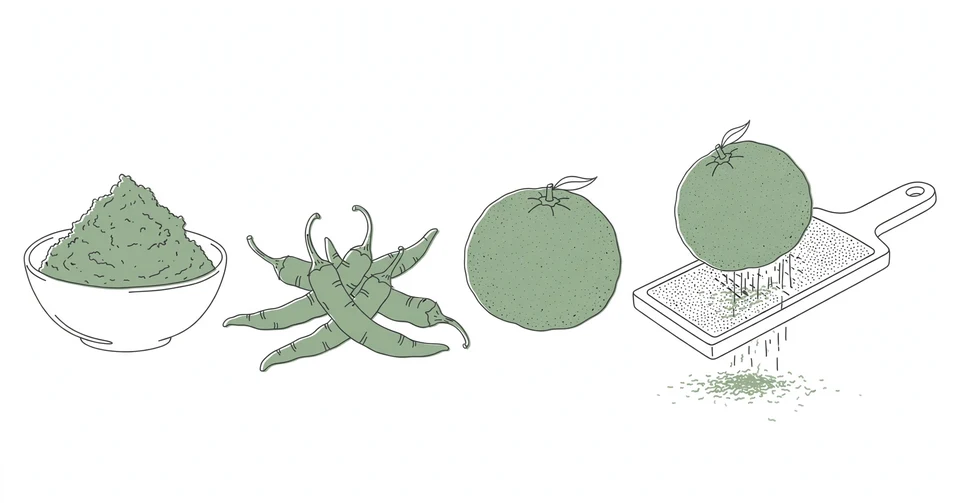
Yuzu kosho comes from Kyushu, the southernmost of Japan's four main islands, where for a long time it was something farm families made at home rather than something companies sold. The ingredient list could hardly be shorter. Grated yuzu peel, fresh chilli peppers and salt: that is the whole recipe, and everything interesting about yuzu kosho follows from how little there is to hide behind. The yuzu itself is treated by Japanese cooks as a perfume rather than a fruit, and this paste is that perfume, weaponised.
What yuzu kosho actually is
Even the name is a small deception. The second half of it, kosho, is written with the characters for black pepper, and everywhere else in Japan that is what the word means. In the dialects of Kyushu, though, kosho means chilli pepper, so the name promises one spice and delivers another. There is no black pepper in yuzu kosho at all, and there never has been.
What there is, is concentration. A dab of yuzu kosho delivers salt first, then the bitter, floral punch of citrus peel, and then a chilli heat that arrives a second late and stays. Reference descriptions sometimes call it mildly spicy, which is true of the dab and misleading about the jar. The heat scales with your generosity, and the paste rewards restraint in a way that thin sauces never have to. Its job is not to coat food but to interrupt it.
Two pastes wearing one name
Most yuzu kosho sold today is green, and green is the version to start with. It is made from unripe yuzu picked while the fruit is still green, ground with green chillies, and the result is sharp in every direction at once: the peel is more bitter, the chilli is fresher and hotter, and the whole paste tastes like it was made yesterday. Beside a winter hot pot, that sharpness is exactly the point.
The second version is red, though the paste itself often comes out orange. It waits for the yuzu to ripen yellow and swaps the green chillies for red ones, and everything softens a degree. The heat steps back, the citrus turns rounder and more fragrant, and the paste leans toward grilled fish and lighter dishes where the green version might shout. Cooking references such as Just One Cookbook's pantry guide describe the red as the gentler of the two, and in my own kitchen that is how it has worked out: green for hot pots and fatty meats, red when the food is delicate. Neither is the correct one. They are the same idea at two different moments of ripeness.
Kyushu argues about where it began
Ask where yuzu kosho was invented and Kyushu gives you more than one answer, which is usually a sign that a food is genuinely old and genuinely local. Wikipedia's entry on yuzu koshō collects two main theories, and neither cancels the other out.
The first points to the villages around Hita in Oita Prefecture, where yuzu cultivation took hold early and where, the theory goes, farming families had been grinding yuzu kosho at home for generations before anyone thought to sell it. The second points up a mountain: Mount Hiko, one of Japan's sacred peaks, which straddles the border of Fukuoka and Oita near the town of Soeda. There, a yuzu tree in a mountain garden is said to be where yamabushi, the ascetic monks of the peaks, first made the paste, passing the method down among themselves.
Oita sits inside both stories, which is probably why it gets most of the credit in the popular telling. The honest summary is that yuzu kosho has disputed origins across northern Kyushu, born wherever yuzu orchards and chilli harvests overlapped and somebody's grandmother ground them together first. Foods with a single documented inventor tend to be young. This one behaves like something a region arrived at together.
A short ferment for a loud flavour
For a fermented food, yuzu kosho is in a hurry. Homemade versions are pounded or processed with a splash of yuzu juice, sealed up, and rested in the fridge for about a week before eating. Compare that with the years some fermented chilli pastes spend ageing, and the intent becomes clear: yuzu kosho is eaten young, while the citrus peel still smells like the fruit it came from. Ageing would round it off, and rounding off is the last thing it wants.
Making it at home is mostly a test of patience at the grater. The peel has to come off the yuzu without dragging the bitter white pith with it, the chillies have to be ground fine enough to disappear into the paste, and the salt has to be worked through until the mixture holds together. A mortar and pestle is the traditional tool and a food processor the honest modern one, and either way the active work takes minutes. The week in the fridge does the rest, softening the raw edges of chilli and peel into a single flavour. Anyone who has made it once understands immediately why farm families kept making it: the effort is trivial and the result is unmistakably itself.
The salt that drives that short ferment also makes the paste a patient resident of the fridge door. Unopened jars keep for up to a year in a cool dark place, and an opened one lasts a couple of months refrigerated, longer in the freezer, because a paste this salty gives spoilage very little to work with. In practice it disappears long before any of those limits, one small dab at a time.
How a souvenir became a staple
The turn from farmhouse staple to national product ran through a hot spring town. Yuzu kosho began travelling when it was offered as a souvenir in Yufuin, the onsen resort inland from Oita's coast, and visitors carried the little jars home to parts of Japan that had never heard of it. The bigger leap came when Fundokin, a major Kyushu producer of soy sauce and miso, started manufacturing yuzu kosho at scale. After that the paste moved into supermarkets in the Kanto region around Tokyo, and then roughly everywhere.
Now the big national brands all make it, House Foods and S&B and even McCormick among them, and it comes in tubes as well as jars. The flavour has escaped the paste entirely: there are yuzu kosho potato chips, yuzu kosho Pretz, and a yuzu kosho Kit Kat sold only in Kyushu. Abroad, the paste has been picked up by non-Japanese chefs as a marinade for prawns, chicken and fish, and in 2024 Trader Joe's began selling a house brand version in the United States. For a three ingredient farmhouse condiment, that is a long way from the mortar.
Buying a jar takes one skill, which is reading the back of it. The honest versions of yuzu kosho list three ingredients and nothing else: chilli, yuzu and salt. Once a label starts adding flavourings and colourings to stretch the citrus further, the paste tends to taste like an impression of the real thing, all heat and no perfume. The good jars are rarely the biggest ones, either. A small jar that you finish while it still smells loud beats a large one ageing quietly at the back of the fridge.
A teaspoon is a serving
The classic seat for yuzu kosho is beside a nabemono hot pot, especially the plain chicken hot pots of Kyushu, where a dab stirred into your own dipping bowl seasons the broth you lift out with each piece. It is equally at home dabbed on yakitori and grilled tsukune, laid in a small smear beside sashimi, or stirred into miso soup. The common thread is that yuzu kosho is added at the table, by the eater, in amounts the eater controls.
That control matters, because the single most reliable way to ruin a dish with yuzu kosho is to season the whole pot at once. Put the dab on the side of your bowl instead, and take a little of it with each bite. A teaspoon of yuzu kosho stirred through one bowl of soup changes that bowl completely: the broth gets brighter, the salt lands differently, and the heat threads through it. Two teaspoons changes it into a different and worse soup, dominated by peel. I learned this the way most people learn it, by being greedy exactly once.
My own favourite use is the plainest: a small green dab on grilled chicken with nothing else involved, where the paste has to do all the work and turns out to be entirely capable of it. It also earns its place whisked in tiny amounts into dressings, where the citrus peel does what lemon zest does but with a slow chilli echo behind it.
Yuzu kosho is three ingredients, a disputed hometown and about a week of patience, and yet a teaspoon of it can take over a meal. That is not a failure of subtlety. It is a different philosophy of seasoning, one that trusts concentration over coverage, and trusts the person eating to decide how much of the interruption they want. Kyushu ground its citrus and its chillies together and ended up with something that refuses to be a sauce, and is much more interesting for refusing.
More in Food & Travel
Latest posts
- Hashigo-Nori Is Riding a Ladder Someone Else Holds
- At a Goma, Prayers Are Written to Be Burned
- The Sekaa Teruna Builds the Monsters
- A Lembaga Perkreditan Desa Is a Bank the Village Owns
- Every Melasti Goes to Fetch Tirta Amerta
- Kaburiyu Is How You Talk Your Body Into the Bath
- When the Kulkul Stops Sounding for You
- A Caru Is an Offering for the Ones You Fear
- Tatsuko Wished for Beauty and Became a Statue
- Warangan Is the Wash That Reveals the Pattern
- Ganbanyoku Is Bathing Without Water
- The Obuki Throws Out Nine Thousand Litres a Minute
- Every Village Writes Its Own Awig-Awig
- Sainokawara Is a Bath You Share With a Hundred Strangers
- Rwa Bhineda Keeps Opposites From Going to War