The Kitamaebune Came Home Loaded With Kelp
· 9 min read
The kitamaebune were wooden cargo ships that linked Osaka with Hokkaido for two centuries, sailing north with rice, salt and sake and returning heavy with herring, salmon and dried kelp. Their slow circuit built fortunes along the Sea of Japan and quietly decided how much of Japan would season its soup.
For roughly two hundred years, some of the most refined cooking in Japan depended on a wooden sailing ship. The kitamaebune, the northern bound ships, worked a slow circuit between Osaka and the far north, and in their holds rode an ingredient that refined Japanese cooking could not grow for itself: dried kelp from the cold seas around Hokkaido.
Outbound, a kitamaebune carried the goods of the settled south and west: rice, salt, sake and cotton for a frontier island that grew little of any of them. Homebound, the same hull came back low in the water with the produce of the cold sea, herring, salmon, and bale after bale of dried kombu. It is hard to think of another cargo that changed a national cuisine so quietly.
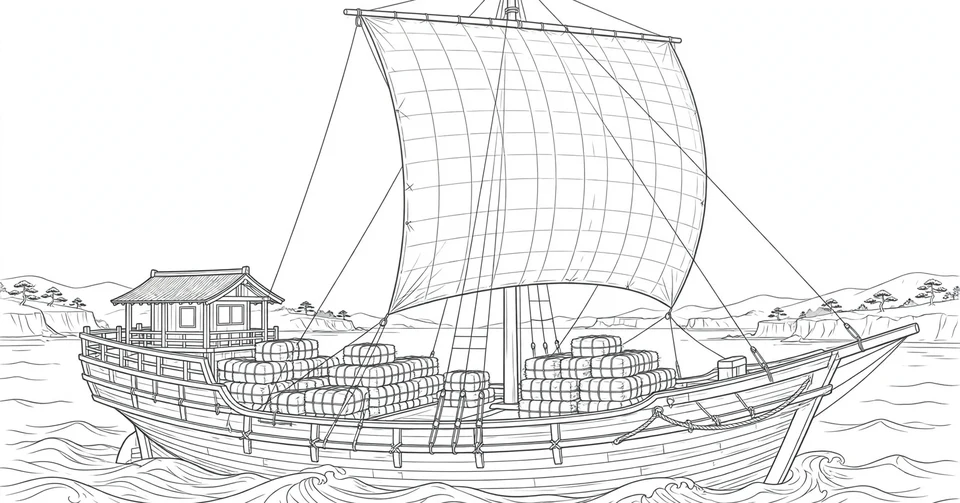
What made the kitamaebune unusual was not the route but the business model. These were not freight carriers hauling other people's goods for a fixed fee. The owners and captains traded on their own account, buying where things were cheap, selling where they were dear, and treating every port on the coast as a market stall. A voyage was a season of small gambles strung along a coastline.
A circuit, not a voyage
The circuit ran from Osaka through the Seto Inland Sea, out through the Kanmon Straits, and then north along the Sea of Japan coast, calling at the ports of Hokuriku and, as the trade matured, pushing on to Hokkaido itself. The name was Osaka geography. From the Inland Sea, everything up that far coast was simply the north.
Boats from the Kaga domain, in what is now Ishikawa Prefecture, first rounded the southern tip of Honshu to trade rice in Osaka in 1639. A generation later the Tokugawa shogunate was moving northern rice south through the merchant Kawamura Zuiken. The road was proven, and for two centuries the kitamaebune made it a road in the fullest sense, worn smooth by use.
The ships themselves were built for the work: wooden hulls under a single mast and one large square sail, small enough in the early days to seem fragile for the cargo of a cuisine. They grew across the centuries. By the 1870s a kitamaebune could carry hundreds of tons of goods under as many as four sails and make three or four return journeys in a year.
But for most of the route's life, wind and season ruled everything. An early kitamaebune could manage only one round trip between the north and Osaka in a year, and the full circuit could swallow most of a sailing season, roughly spring to autumn. Winter on the Sea of Japan was no time for wooden hulls and square sails. One voyage a year concentrates the mind wonderfully. There was no next shipment coming to fix a mistake.
What a kitamaebune carried north, and what it brought home
The northbound holds read like the shopping list of a cold frontier. Hokkaido in the Edo period was sparsely settled and grew little rice of its own, so the ships carried rice and salt, sake and cotton cloth, ceramics and manufactured goods, the ordinary equipment of life that the north could not make for itself. The ports along the way fed their own produce into the same flow, and the Kaga domain shipped its rice and salt down the road as well.
Southbound was where the money was. The cold northern sea gave up herring in enormous quantity, pressed for oil and ground down into fertiliser for the fields of the south, and salmon, and above all, for the kitchen, kelp. As the Japan Tourism Agency's account of the kitamaebune trade puts it, among the most profitable goods out of Hokkaido were herring, used for oil and fertiliser, and kombu kelp, used for dashi cooking stock.
I have written here before about kombu, the quiet half of dashi, and about why a kelp that grows only in cold water ended up flavouring cities that never saw the sea it came from. The short answer is these ships. Drying had made kelp light, flat and nearly indestructible, a cargo that could survive a season in a damp hold and still arrive as food. Fresh produce would have rotted on the way. Kombu just waited.
The destination of most of that kelp was a pot of dashi, the quiet stock under almost everything Japan cooks. Before the kitamaebune, kombu had reached the old capitals only in small and precious quantities, close to a court luxury. The ships turned it into a commodity, regular and affordable enough for ordinary households, and once a flavour becomes ordinary it tends to become permanent.
Two capitals learned two different tastes
The route did not deliver one national flavour. It delivered regional ones, because the kelp arrived by different roads. Osaka, the great commercial port at the end of the sea route, took the bulk of the trade and built its everyday cooking on the broad, generous ma-kombu. Kyoto, the old capital, was fed overland. Its kelp was unloaded at Tsuruga and Obama on the Wakasa coast, carried by packhorse over the pass to Lake Biwa, ferried across the lake and brought into the city, less than a hundred kilometres of land travel in all. Kyoto's cooks, serving temples and tea masters, settled on Rishiri, the grade that draws the clearest broth of all.
Edo, modern Tokyo, sat on the wrong side of the country for any of this. The warm current washing the Pacific coast grows no kelp, so Edo built its seasoning on katsuobushi instead, darker and fishier. The pale soup of Kyoto and the dark soup of Tokyo still announce themselves in noodle shops today, and the difference between them is, at bottom, a shipping route.
The ports in between kept their own souvenirs of the trade. In Ishikawa, kombu is still used to wrap sashimi and kamaboko fish cakes. In Nanao, on the Noto Peninsula, the candle makers depended on the wax and washi paper that arrived on kitamaebune hulls, and Wajima's lacquerware travelled outward on the same ships to find buyers across the country. And the kelp did not always stop at Osaka. Traded onward through Satsuma hands and the Ryukyu court, it reached Okinawa, which grows no kombu at all and eats more of it per household than anywhere else in Japan, with some travelling on from there toward China. The standard reference summary of the kitamaebune route makes the circuit sound tidy on the page. On the water it was a web, and half of Japan ate from it.
Fortunes, one markup at a time
The economics were simple and, for a while, wonderful. Prices differed enormously between ports because news travelled at the speed of the ships themselves. A captain who bought cheap in one harbour and sold dear in the next kept the whole difference, and a single season of good guesses could set a family up for good. By the middle of the 1800s, kitamaebune owners were counted among the wealthiest merchants in Japan.
Their money is still standing. In Hashitate, in the city of Kaga, and in the Kuroshima district of Wajima, the owners built large houses that survive as museums and preserved streets, red tiled roofs in one town and black tiled roofs in the other. The Kitamaebune Ship Museum in Kaga keeps its exhibits in a prosperous shipowner's home built in 1878, tatami rooms arranged around an irori hearth, with the solid beams and lacquered wood that kelp money bought.
There is a softer trace, too. Captains and crews wintered at Yamanaka Onsen, a hot spring town in the Kaga hills, and the shanties they sang there fed into the local song called Yamanaka-bushi, which geisha still perform daily in the town's theatre. A trade route that leaves its mark in the soup, the roofline and the songbook has done considerably more than move cargo.
I confess I find the one voyage a year the most attractive part of the whole system. Modern logistics treats slowness as a defect to be engineered away. The kitamaebune turned slowness into the business itself. Prices, seasons and appetites all moved at sailing speed, and everyone along that coast planned around a ship that came once, like weather.
Steam, wires and rails
What killed the kitamaebune was not, in the end, a better ship. It was information. The telegraph let prices travel faster than hulls, and once a merchant in Osaka could learn the price of herring in Hokkaido the same day it was landed, the wide gaps between regional markets, the gaps the whole sailing trade had lived on, closed up. Railways then competed directly for the freight along the Sea of Japan coast, and steamships kept schedules that no square sail could promise.
By the 1890s the circuit was mostly finished, and around the turn of the twentieth century the kitamaebune slipped into memory, kept by port town museums and the ferry routes that still trace their stops up the coast. The world they were built for, a world of slow news and local prices, had ended around them.
The kelp, of course, never stopped travelling. It just changed vehicles, from sail to rail to truck, and the kitchens at the far end never gave it up. Kyoto still grades its kombu by Hokkaido place names. Okinawa still eats the most of a plant its own warm waters cannot grow. Every bowl of clear soup in Japan is, in a sense, a late delivery from a kitamaebune, and proof that a trade route can vanish completely and still be tasted every day.
More in Food & Travel
Latest posts
- Edo's Hikeshi Wore Their Dragons Into the Fire
- A Yubatake Cools a Spring With Nothing but Wood and Gravity
- Toji Meant Moving to a Hot Spring Until You Got Better
- Sodoran Treats an Heirloom Like an Honoured Guest
- You Can Read a Pecalang From Across the Street
- Nyuto Onsen Hides Seven Inns at the End of a Snow Road
- Nobody Just Watches a Panigyria, Everybody Dances
- When the Gara-Gara Starts, the Puppets Drop the Plot
- Forty Pounds of Cowbells, and the Mamuthones Say Nothing
- The Oarfish Still Answers to a Name From the Dragon Palace
- Manza Onsen Bathes at 1,800 Metres
- Irezumi Was an Art Before It Was a Warning
- The Oshi Kept Fuji's Pilgrims Fed, Housed, and Devout
- Japan's Population Decline and the Villages It Leaves Behind
- KRL Commuterline and the Trains That Move Jakarta