Loma Linda's Long Lives Run on Saturdays
· 9 min read
Loma Linda is the only American place on the blue zones list, and its Adventist residents point to something other than food or terrain. Here is what Saturday looks like in Loma Linda, and what decades of health studies there have found.
Every Friday evening, a small city in California quietly switches itself off. Work tools are put away, errands are finished early, and in Loma Linda a large share of the population begins a full day of rest that lasts until the sun goes down again on Saturday. Researchers who study long lives keep returning to this city, and the thing they find most interesting about it is not a recipe. It is a day of the week.
Loma Linda is the only American entry on the blue zones list, the five places where writer Dan Buettner says people grow old at unusual rates. I have written here before about the blue zones and the five places where people live the longest, and about old age in Nicoya, where life runs on a plan de vida built from corn, beans, and work outdoors. In those places the explanation is mostly food and terrain. In Loma Linda, residents will politely tell you the explanation starts on Friday at sundown.
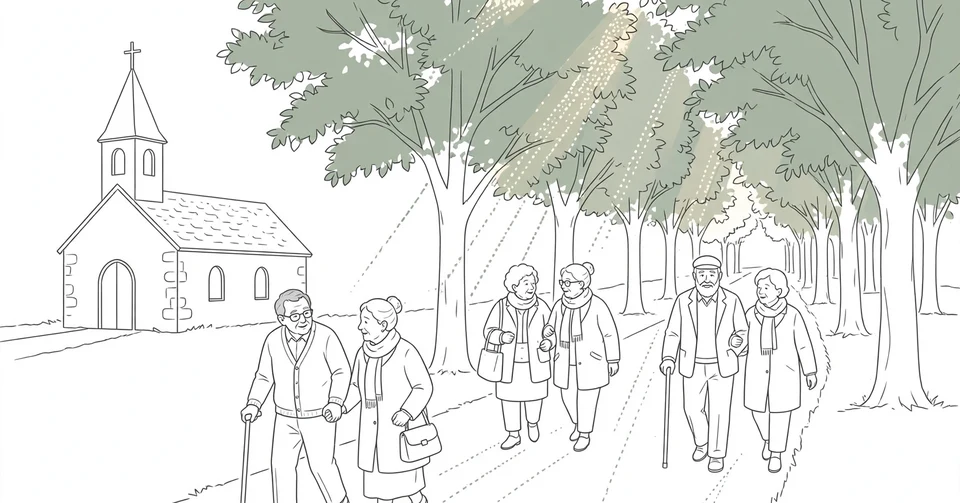
The city itself is unremarkable to drive through, which is part of its charm. Loma Linda, Spanish for beautiful hill, is home to roughly 25,000 people in San Bernardino County, east of Los Angeles. Nearly half of them are members of the Seventh-day Adventist Church, and the city grew up around Adventist institutions. Its skyline is a hospital and a university rather than an office tower, and on Saturday mornings its streets carry people walking to church in family groups instead of the usual weekend traffic.
A blue zone built around a church
Most blue zones stories begin in a kitchen or on a hillside. This one begins with a failed holiday resort. In the late 1800s the hill was developed as a tourist spot called Mound City, and when that project collapsed, a group of physicians turned the hotel into a convalescent home and gave it the name Loma Linda. Then, in 1905, Adventist leaders John Burden and Ellen G. White bought the property and reopened it as a sanitarium. A nursing school followed, then a school of medicine, and the settlement that grew around them eventually became Loma Linda, incorporated as a city in 1970.
The church never really left the centre of the place. The Loma Linda University Church is described as the largest Adventist congregation in the world, and the university and its medical centre are still run by the church. The city motto is Serving Man, and it fits the local pattern. This is a town built by a church that treats health as a religious duty, and then staffed by generations of doctors, nurses, and teachers who belong to that same church. Work, faith, and daily routine were never separate compartments here.
Buettner labelled the city a blue zone in his 2008 book, and he was clear about the reason. The longevity he reported was attributed to Adventist cultural, health, and diet practices, not to anything in the local water or soil. The city itself reinforces those practices quietly. It strictly controls the sale of alcohol, it has banned public smoking, and the church owned grocery store in town does not sell meat at all. A visitor looking for the secret of Loma Linda will not find a special ingredient. They will find a calendar.
What Saturday looks like in Loma Linda
The Adventist Sabbath runs from sundown on Friday to sundown on Saturday, and observant families in Loma Linda treat those hours as genuinely off limits to work. There is no shopping, no housework, no catching up on email, and no errands, because the whole community has agreed in advance that this day is not for any of that. Friday afternoon has its own rhythm of cooking and preparation so that Saturday itself can stay empty.
The morning belongs to church. Services are social as much as they are religious, full of people who have known each other for decades and notice immediately when someone is missing. Then comes the big shared meal of the week, often a table of relatives and guests eating food cooked the day before. The afternoon is deliberately unhurried. Families rest, visit each other, and spend time outdoors, and the walking groups in the photograph above are a normal Saturday sight rather than an organised fitness programme.
What strikes me about this arrangement is that nobody has to defend it. In most modern cities, rest is a private negotiation that you usually lose. Your phone, your employer, and your own guilt all get a vote. In Loma Linda the vote was taken generations ago, and the answer is the same every week. Rest there is not something an individual squeezes in. It is something a whole city does together, on schedule, whether the week has been good or bad.
The other six days have habits too
Saturday is the headline, but the rest of the week in Loma Linda is hardly careless. Adventist teaching has encouraged a health conscious lifestyle for well over a century, and it shows up in daily habits that researchers can actually measure. Many Adventists eat no meat at all, and those who do eat it sparingly. Beans, whole grains, and vegetables carry most meals, and nuts are eaten several times a week rather than as an occasional snack.
Smoking is essentially absent, and alcohol is strongly discouraged on top of being hard to buy in the city. Regular exercise is treated as part of the same health message, and the church community keeps people socially connected on the other six days too, through schools, volunteering, choirs, and study groups. None of this requires willpower of an unusual kind, because the people around you are doing the same things. The habits are ordinary. It is the agreement behind them that is rare.
What the studies found
Loma Linda is unusual among blue zones because its claims do not rest only on travel writing. Loma Linda University has run a series of long term research projects, the Adventist Health Studies, following Adventists for decades and comparing their health with their neighbours. The first big effort, the Adventist Mortality Study, began in 1960 and tracked 22,940 California Adventists. Its life table analyses found that Adventist men lived 6.2 years longer than non Adventist men in a comparison study, and Adventist women had a 3.7 year advantage.
A later study, running from 1974 to 1988 with about 34,000 Californian Adventists, put the gap at 7.3 extra years for men and 4.4 for women compared with other Californians. The researchers also reported that five simple behaviours promoted by the church for more than a century, not smoking, eating a plant based diet, eating nuts several times a week, regular exercise, and keeping a normal body weight, were linked to as much as ten added years of life. A second generation study that began in 2002 widened the lens to Adventists across the United States and Canada, with more than 96,000 people enrolled by 2006.
The disease numbers from the earlier work were striking too. Comparing Adventists with other Californians, the mortality study reported death rates from all cancers combined that were 40 percent lower for Adventist men and 24 percent lower for women, with lung cancer deaths 79 percent lower and coronary heart disease deaths 34 percent lower among men. Later analyses from the health studies linked eating nuts several times a week with a cut in heart attack risk of up to half. These are associations from observational research, not proof that any single habit caused the difference, and the researchers themselves frame them that way.
What old age looks like in Loma Linda occasionally becomes visible to the rest of the world. Ellsworth Wareham, a heart surgeon who lived in the city, was still being filmed as an advertisement for the Adventist way of life in the 2009 documentary How to Live Forever, decades into his retirement from the operating room. He is the kind of example that makes the statistics feel less abstract. The studies count years. The city can point at people.
Those numbers deserve their attribution. They come from the university's own researchers studying a self selected religious population, and they describe Adventists as a group rather than proving which single habit does the work. No study has isolated Saturday. Rest, diet, community, and clean living arrive as one package in Loma Linda, and honestly the package may be the point. It is also fair to remember that blue zone record keeping in general is debated, as I noted when writing about the five zones. The Loma Linda evidence is stronger than most because it comes from named studies with published methods, not just from counting birthdays in a village.
Why the day off might matter most
Of everything on the list, the Sabbath is the piece I keep thinking about, because it is the one that cannot be bought, bottled, or imported. You cannot order a day of rest the way you can order Sardinian wine or Okinawan sweet potatoes. It only exists if a community agrees to protect it, and it only works because everyone stops at the same time. One person resting while the world emails them is just a person falling behind. A city resting together is something else entirely.
There is a quieter benefit hidden in the arrangement too. A weekly day built around church, shared food, and unhurried visiting is also a weekly roll call. People are seen. Absences are noticed. Help arrives early because someone spotted the problem on Saturday, over lunch, rather than months later. Researchers talk about social connection as a factor in long lives, and in Loma Linda that connection is not left to chance or to personality. It is scheduled, fifty two times a year.
Loma Linda will not settle the argument about blue zones, and its residents, to their credit, do not seem to be trying to. They were keeping Saturdays long before anyone drew a circle around their city on a map, and they will presumably keep them long after the label fades. What the place suggests, calmly and without selling anything, is that a long life might depend less on adding new efforts than on protecting one old one. A day, every week, that the world is not allowed to take.
More in Life & Style
Latest posts
- Kombu Is the Quiet Half of Dashi
- Irezumi Was an Art Before It Was a Warning
- The Oshi Kept Fuji's Pilgrims Fed, Housed, and Devout
- Every Prefecture Argues About What Goes in Ozoni
- Japan's Population Decline and the Villages It Leaves Behind
- Kecap Manis and the Sweet Soy Sauce of Indonesia
- In Mamoiada, Two Hundred Families Still Make Wine at Home
- Shochu and the Quiet Spirit of Japan
- A Dried Shiitake Is Louder Than a Fresh One
- Maruten Numazu and the Towering Kakiage Bowl of the Port
- The Three Sisters Grow Better Together
- Half the Old Springs in Japan Thank Kobo Daishi
- Tatamiishi Terraces Filter a River Through Stone
- Wasabi-Zuke Puts the Whole Plant in Sake Lees
- Karo Is the Tengger's Other Great Gathering