Japan's Population Decline and the Villages It Leaves Behind
· 11 min read
Japan's population decline has shrunk the country from 128 million to under 123 million, and the change shows first in its villages: empty houses, closed schools, and streets that grow quieter every year.
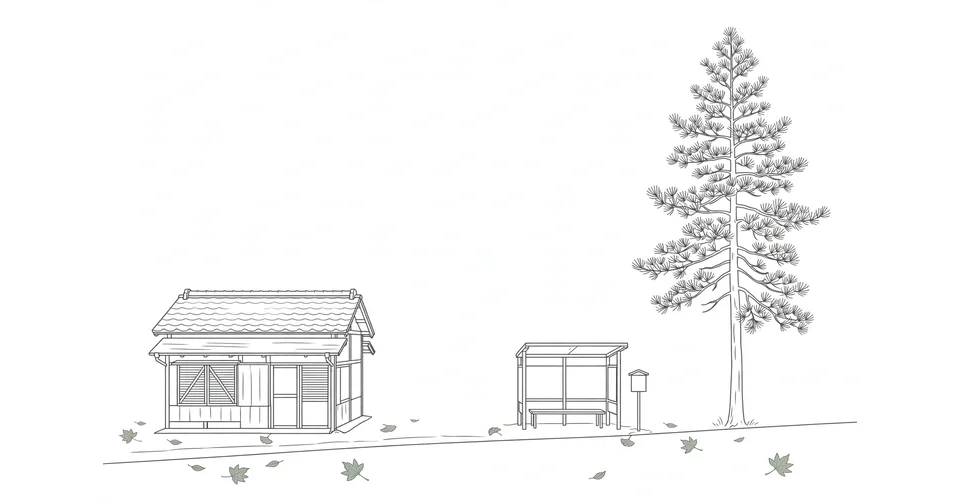
Walk down a side street in a small Japanese town on a weekday afternoon and the quiet is the first thing you notice. The shutters of one house are closed at two in the afternoon. The next house has a garden that has gone to seed. A bus stop stands empty, its timetable faded, and the primary school at the end of the road closed years ago. Nothing dramatic has happened here. No disaster, no evacuation. Japan's population decline did this, slowly, one family at a time, and it is still doing it.
The numbers behind the quiet are stark. Japan counted 122,972,528 people in its census of 1 October 2025, the fastest five year fall in the country's modern record, down 3,173,571 from 2020. The census population peaked at 128,057,352 in 2010. Sixteen years later, Japan has about five million fewer people, and the decline has now shown up in three censuses in a row. The annual estimate tells the same story in a different way. The population peaked at around 128 million in 2008 and has fallen every year since.
The most recent year of births explains why Japan's population decline is accelerating. In 2025, 671,236 babies were born to Japanese nationals living in Japan, according to final figures from the Ministry of Health, Labour and Welfare published on 30 September 2026. That is the lowest number since records began in 1899, and the tenth year in a row that births set a new record low. In the same year, about 1.59 million people died. For every baby born, about 2.4 people died, and the gap between births and deaths took about 918,000 people out of the population in a single year. It was the nineteenth straight year that deaths outnumbered births.
Japan's Population Decline in Numbers
| Indicator | Figure | Year and source |
|---|---|---|
| Total population | 122,972,528 | 2025 census, Statistics Bureau of Japan |
| Census peak | 128,057,352 | 2010 census |
| Births | 671,236 | 2025, Ministry of Health, Labour and Welfare |
| Deaths | About 1,589,000 | 2025, Ministry of Health, Labour and Welfare |
| Natural decrease | About 918,000 | 2025, the nineteenth straight year |
| Total fertility rate | 1.14 | 2025, a record low |
| People aged 65 and over | 36,141,613, or 29.4 percent | 2025 census |
| Children under 15 | 13,349,001, or 10.9 percent | 2025 census |
| Median age | 50.5 years | 2025 census |
| Projected population | About 87 million | 2070, IPSS medium variant |
The table makes Japan's population decline look like an accounting exercise. It is not. Every row is a street like the one at the start of this article, a school with fewer children, a clinic with more elderly patients. That is what Japan's population decline looks like up close. The fertility rate of 1.14 means the average woman is now expected to have 1.14 children over her lifetime. A country needs about 2.07 children per woman just to hold its population steady, according to the National Institute of Population and Social Security Research. The institute also tracks the net reproduction rate, which counts how many daughters each woman has after allowing for deaths. It was 0.56 in 2024, which means each new generation is on track to be just over half the size of the one before it.
Why So Few Babies
Japan's population decline did not begin yesterday. The total fertility rate has been below 2 since 1975, more than fifty years ago. The problem only became a public issue in 1989, when the rate fell to 1.57 in what became known as the 1.57 shock. The rate bottomed out at 1.26 in 2005, recovered very slowly until the mid 2010s, and has been falling again since 2015. In 2024 it was 1.15. In 2025 it was 1.14.
The reasons behind Japan's population decline are familiar to anyone who lives in Japan, and none of them has a quick fix. People marry later, and a growing number do not marry at all. Raising a child in a big city is expensive, and the cost of housing and education weighs on young couples. Long work hours make it hard to imagine adding a baby to the week. The government points out that marriages rose for a second straight year in 2025, to about 505,000 including marriages involving foreign nationals, yet births still fell. Demographers read this as a sign that Japan's population decline will ease only slowly, if at all. The average time between marriage and a first child has stretched to about 2.8 years, so even a recovery in weddings takes years to show up in the birth figures.
There is one small piece of hopeful news, and it deserves to be reported honestly. Births in the first half of 2026 rose 0.8 percent from a year earlier, to 342,068, the first first half rise in eleven years. Nobody who studies the figures calls this a turnaround. It is a flicker, and the long term trend still points down, because the number of women of childbearing age keeps shrinking. But it is a reminder that Japan's population decline is a trend, not a law of nature, and trends can bend.
The Oldest Country on Earth
Japan's population decline has a twin, and the twin is ageing. The 2025 census counted 36,141,613 people aged 65 and over, or 29.4 percent of the population, against 12.1 percent in 1990. Children under 15 now make up only 10.9 percent, down from 18.2 percent in 1990. The median age is 50.5 years. Put a hundred Japanese people in a room in the proportions of the 2025 census and you get 11 children, 60 people of working age, and 29 people over 65. In 1990, the same room would have held about six working age people for every person over 65. Today it holds two. That shift is the human shape of Japan's population decline.
The ageing is visible in the workforce as well as in the census. In 2024, a record 9.3 million people aged 65 and over were in work, the twenty first straight year that figure rose, and they made up 25.7 percent of all workers. Walk into a convenience store in the countryside and the person behind the counter is often well past retirement age. That is not a failure of the system. In many cases it is a choice, and it keeps small towns running. But it also shows how far Japan's population decline has pushed the balance between those who work and those who are cared for.
The census also counted 96,940 people aged 100 or over. Japan has the highest share of people aged 65 and over in the world, and the number of centenarians keeps climbing even as the total population falls. A country can shrink and grow old at the same time, and Japan's population decline is happening alongside the fastest ageing any large country has experienced.
What Japan's Population Decline Does to Villages
The cities feel Japan's population decline as a slow squeeze. The villages feel it as an emptying. Young people leave for school and work in Tokyo, Osaka, and Nagoya, and most do not come back, and that steady outward flow is the engine of Japan's population decline in the countryside. The people who stay grow older. The shops that served them close one by one, then the bus routes thin out, then the school merges with the next town's school, then it closes altogether.
The empty houses are the most visible sign. The 2023 housing survey counted about 9.0 million vacant homes across Japan, or 13.8 percent of all homes, and the share is far higher in rural towns than in the cities. Some of these houses are holiday homes or homes held for sale. Many are simply abandoned, left behind by families that moved away or died out. Japan has tried to turn the problem into an opportunity through akiya banks, local lists of cheap rural houses for sale, but a cheap house in a town with no jobs and no school is a hard sell, and the lists keep growing.
It is worth saying plainly that the villages are not all dying. Some are finding new life as remote workers move in, as guesthouses open, as old farmhouses become cafes. But the arithmetic of Japan's population decline is unforgiving. A town that loses a few percent of its people every year cannot keep the same number of shops, schools, and clinics. Japan's population decline forces every small town to decide what it can still be, and some of those decisions are painful.
The 8050 Problem, in Brief
One of the quietest consequences of Japan's population decline has a name that sounds like a code: the 8050 problem. It describes parents in their eighties caring for adult children in their fifties, children who never left home, never found steady work, or withdrew from society altogether. The children are often part of the generation that stopped going out, the people Japan calls hikikomori, and the parents are the only safety net they have.
No single figure captures how many families live this way, and this article will not invent one. What is certain is that the problem grows as Japan's population decline continues, because the parents grow older while the children they care for grow older too. When an eighty five year old parent falls ill, there is often nobody else to step in. Local governments have started to look for these households before a crisis, rather than after one, and that shift from reaction to prevention is one of the more humane responses Japan's population decline has produced.
What the Government Is Trying
The Japanese government has been trying to raise the birth rate and slow Japan's population decline for more than thirty years, and it has not worked yet. The child allowance was greatly expanded in October 2024, when the income limit was abolished, the payment was extended to children of high school age, and the amount for a third child and beyond rose to 30,000 yen a month. High school tuition support has been widened too. Public high schools became effectively free from fiscal 2025, and from fiscal 2026 private high school tuition support rose to as much as 457,200 yen a year with no income limit. These are large sums of public money, and they remove real barriers. They have not yet moved the birth figures.
In November 2025, Prime Minister Sanae Takaichi set up a Population Strategy Headquarters and called the situation a quiet state of emergency, with a comprehensive population strategy promised by the end of 2026. The government is also opening the door wider to workers from abroad. The Specified Skilled Worker visa brings in workers for sectors that cannot find enough Japanese staff, and foreign residents passed four million for the first time at the end of 2025, reaching 4,125,395, up 9.5 percent in a year. That is a large change for Japan, and still small next to Japan's population decline, which removes about 900,000 people a year through births and deaths alone.
Regional revitalisation grants try to give small towns a reason for young people to stay or return, paying for childcare, remote work facilities, and local businesses. The results so far are mixed, and even the successes have not changed the direction of Japan's population decline. Some towns have used the money well. Others have built facilities that stand empty. Money can slow Japan's population decline in a village. It cannot reverse it on its own.
What the Numbers Point To
The official projections say Japan's population decline continues for decades. The National Institute of Population and Social Security Research, in its 2023 medium variant, projects that the population drops below 100 million in 2056 and reaches about 87 million by 2070. The share of people aged 65 and over reaches 38.7 percent by 2070, and the number of people over 65 peaks at 39.53 million in 2043. Reality has been running below even that medium path. The projection assumed a fertility rate of 1.27 in 2025. The actual rate was 1.14.
Those projections are not fate. They are what happens if nothing changes, and they assume the migration levels of the early 2020s. A different immigration policy, a real change in working hours, or a generation that chooses to have children earlier could bend the curve. But the shape of the next twenty years is already largely fixed, because the children who are not born today cannot become the parents of twenty years from now. Japan's population decline will continue for a long time whatever the government does next.
That is the hard part to sit with, and it is also where the story stops being only about loss. A country of 87 million people is still a large country. It would be about the size of Germany today. The question Japan faces, as Japan's population decline continues, is not really how to get back to 128 million. It is how to live well with fewer people. The villages that survive will be the ones that stop measuring themselves against their busiest decade and start asking what a smaller community can do well: care for its old people, keep its school open with fewer children, turn empty houses into homes for newcomers, and let the quiet be a quality rather than a failure. I think the deepest lesson of Japan's population decline is that a place is not finished when it gets smaller. It is finished only when the people who remain stop believing it is worth caring for, and in the villages I have read about, that belief is still very much alive.
More in Culture & Society
Latest posts
- Kombu Is the Quiet Half of Dashi
- Manza Onsen Bathes at 1,800 Metres
- Every Prefecture Argues About What Goes in Ozoni
- KRL Commuterline and the Trains That Move Jakarta
- Kecap Manis and the Sweet Soy Sauce of Indonesia
- In Mamoiada, Two Hundred Families Still Make Wine at Home
- Shochu and the Quiet Spirit of Japan
- A Dried Shiitake Is Louder Than a Fresh One
- Loma Linda's Long Lives Run on Saturdays
- Maruten Numazu and the Towering Kakiage Bowl of the Port
- The Three Sisters Grow Better Together
- Tatamiishi Terraces Filter a River Through Stone
- Wasabi-Zuke Puts the Whole Plant in Sake Lees
- Konyoku Is Still Out There, Past the Last Train Station
- Dry January Lasts a Month on Purpose