Konyoku Is Still Out There, Past the Last Train Station
· 9 min read
Konyoku, the Japanese tradition of mixed bathing, was the norm for centuries and still survives at remote mountain inns that run it on strict house rules. Here is where it survives, and how it works today.
For most of Japanese history, asking whether men and women should share a bath would have drawn a blank look. Konyoku, mixed bathing, was simply how bathing worked. At the village spring, at the town bathhouse, at the mountain inn where travellers soaked the road out of their legs, everyone got into the same water. It was not daring and it was not a statement. It was plumbing, plus hot water, plus neighbours.
Almost all of that world is gone. Separation is now so normal that a mixed pool reads as an oddity, and the surviving konyoku baths sit where the old Japan sits, in the mountains, past the last train station, up a bus route that runs a handful of times a day. What is left is small, scattered and unusually well mannered, and it is worth understanding before the last of it closes.
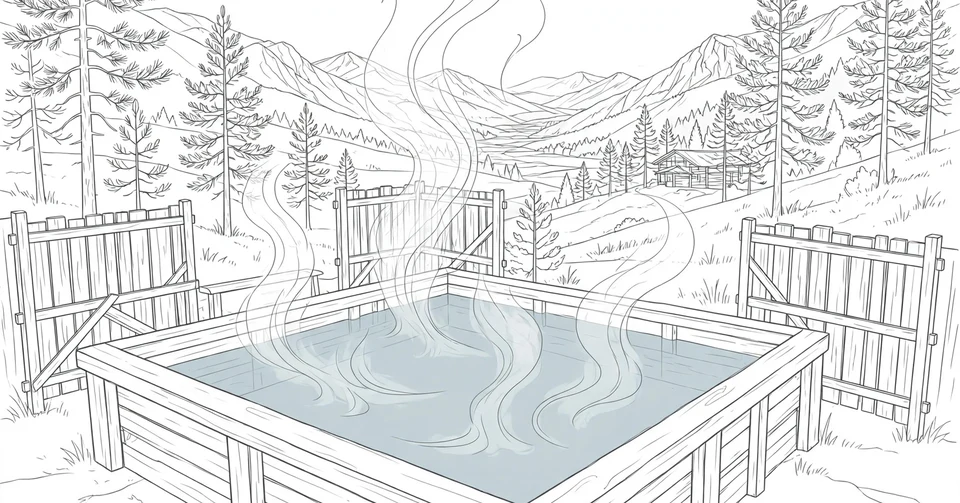
I have written before about the rotenburo, the open air bath, and many of the great rotenburo turn out to be konyoku pools, because the two old customs overlap in the same remote places. This piece stays on the mixed side of the fence. It looks at where konyoku came from, why it retreated, and the quiet set of rules that keeps it alive at the inns that still offer it.
Konyoku was the default for centuries
Start with how ordinary it was. Bathing in Japan was communal before it was anything else. Hot spring water was treated as medicine, and the old custom of toji, staying at a spring for a week or more to take the cure, put farmers, merchants, monks and local lords into the same pools for days on end. In the Edo period the habit spread further. Springs were drawn in woodblock prints, trips to the waters became a pleasure as much as a treatment, and the bath settled into its lasting role as social infrastructure, the warm room where a village washed, thawed out and caught up with itself.
The town sento worked the same way. Families arrived together, neighbours arrived together, and nobody involved thought the arrangement needed defending. Modesty was handled by behaviour rather than by walls. You kept your eyes down, your voice low and your soak businesslike, and the water did the rest. Writers who have studied the surviving konyoku pools make the same point about them today. The atmosphere in a mixed bath is generally calmer and less charged than in an ordinary swimming pool, because everyone present is there for the hot water and behaves accordingly.
The Meiji retreat
The change came from outside. When Japan opened to the West in the Meiji era, foreign diplomats and visitors were scandalised by mixed bathing, and a government anxious to be seen as civilised began pushing the sexes apart. The standard summaries of onsen history note that gender separation has been enforced at most institutions since the opening of Japan to the West, which makes separation, in the long view, the import, and konyoku the older tradition underneath it.
It was never a single clean break. Tokyo and the treaty ports complied first, because that was where foreign eyes were. The countryside complied slowly, partly or not at all, and a remote inn whose pool had been mixed for two hundred years had little reason to rebuild it for the sake of visitors who never came. Modern rules keep separation as the default in public baths, with young children commonly allowed across, roughly up to the age of seven, though the exact number is set prefecture by prefecture. But the regulation mostly settled what custom was already doing in the cities. Out in the mountains, konyoku simply carried on.
Where konyoku survives
The map of surviving konyoku is the map of rural Japan. As one long-running guide to mixed bathing in Japan puts it, what remains is almost entirely rural, mountain inns and old spring villages, almost never a city and almost never a modern hotel. To find a konyoku pool today you generally ride the train to the end of the line, then take a bus, then walk.
The name most people start with is Nyuto Onsen, a cluster of seven inns in the mountains of Akita. The oldest of them, Tsurunoyu, is a place of thatched roofs that once hosted the lords of Akita on their cures, and its outdoor pool is filled with opaque milky water that hides everything a few centimetres below the surface. Women reach the pool through a corridor at water level, so the water itself covers them from the moment they enter. The design answers the modesty question with architecture and cloudy water instead of argument.
At the other end of the scale sits Takaragawa Onsen in Gunma, where four enormous pools run along a clear river and the spring water pours through at around 1,800 litres a minute. Three of the pools are konyoku, with simple bathing garments handed out at the door, and the fourth is reserved for women. Between those poles there are stranger survivals. Hoshi Onsen in Gunma keeps its mixed bath indoors, under the high timber roof of a Meiji era hall that looks more like a chapel than a bathroom. Shirahone Onsen in the Northern Alps fills its wide, shallow outdoor pool with bluish white sulfur water gentle enough to sit in for an hour. Every one of these places is a working inn first and a curiosity second, which is exactly why the custom survived there.
The house rules do the work
Nothing about a surviving konyoku pool is casual. Each runs on the rules of the house, and the rules are posted, specific and enforced. You wash your whole body before you get in, as in every Japanese bath. The small towel never touches the water. Cameras and phones are banned outright, a rule applied more strictly here than anywhere else in the building. You keep your eyes on the scenery, your conversation low, and your soak reasonably short. Linger too long in the wrong spot and the staff will know, because the whole system depends on nobody treating the pool as a place to wait and watch.
That last point deserves honesty, because it is the real reason the map keeps shrinking. Innkeepers and writers on the subject are blunt about it. A small number of men took to settling into mixed pools for hours, motionless, waiting for women to arrive, and bathers in Japan have a name for them, wani, crocodiles. Women quietly stopped coming, pools that had been mixed for generations filled with men waiting for women who no longer came, and many inns eventually partitioned the bath or closed it. Modesty did not finish konyoku. Behaviour did, and the surviving inns guard against it accordingly.
The adaptations are practical rather than dramatic. Milky, opaque water does half the work by itself, which is why so many famous konyoku pools are sulfur springs. Some inns hand everyone a yuamigi, a thin bathing garment worn in the water. Takaragawa does this, and the big thousand person bath at Sukayu in Aomori ran a trial in November 2021 in which every bather, men included, wore one for five days. The share of women using the bath rose. The lesson the inn took from it was plain. Women had never been avoiding the water. They were avoiding being watched, and a cheap cotton garment fixed it.
Many inns also set women only hours, often in the early evening, and keep a separated pool alongside the mixed one, so no guest is ever trapped by the arrangement. Read the rules board when you arrive, because they differ from inn to inn and they change more often than guidebooks do. The one constant is that the rules are not decoration. They are the load bearing part of the whole tradition, the thing that lets a konyoku pool stay open at all.
If it is your first time, the practical advice from people who know these pools is simple. Choose opaque water, because milky or sulfur rich water settles the modesty question in about a second. Go in the early morning or the mid afternoon rather than on a Saturday evening, and stay the night if you can, because once the day visitors leave, inn guests often have a konyoku pool almost to themselves. And check the inn's own website before you set out. A mixed pool can gain a yuamigi rule, a new women only schedule or a partition between one season and the next, and two hours of mountain road is a long way to drive for old information.
The private alternative
None of this makes konyoku compulsory, and Japanese bathing culture has always kept an exit door open. Family baths, kazokuburo, can be reserved for your own group, and the rental system I described in my guide to kashikiri, the private onsen bath you book by the hour, gives couples and families the open air and the hot water with nobody else in either. At the modern end, a few seaside pools, like the free stone pools on Shikinejima in the Izu islands, run mixed bathing in swimsuits, which is konyoku with the difficult part designed out. The idea is not dying so much as splitting, into a preserved old form in the mountains and easier new forms nearer home.
I find something worth keeping in the old form. A konyoku pool runs on the assumption that a body is unremarkable and that behaviour is everything, and it enforces that assumption with soap, signage and cloudy water rather than with sermons. It is a fragile arrangement. It survives only where an inn is willing to police it and where guests are willing to be policed, which is why it has retreated to the ends of bus routes. If you are ever offered the chance, take the rules seriously and follow them to the letter. You will be soaking in the oldest version of Japanese bathing there is, and there is less of it every year.
More in Life & Style
Latest posts
- Kombu Is the Quiet Half of Dashi
- Irezumi Was an Art Before It Was a Warning
- The Oshi Kept Fuji's Pilgrims Fed, Housed, and Devout
- Every Prefecture Argues About What Goes in Ozoni
- Japan's Population Decline and the Villages It Leaves Behind
- Kecap Manis and the Sweet Soy Sauce of Indonesia
- In Mamoiada, Two Hundred Families Still Make Wine at Home
- Shochu and the Quiet Spirit of Japan
- A Dried Shiitake Is Louder Than a Fresh One
- Maruten Numazu and the Towering Kakiage Bowl of the Port
- The Three Sisters Grow Better Together
- Half the Old Springs in Japan Thank Kobo Daishi
- Tatamiishi Terraces Filter a River Through Stone
- Wasabi-Zuke Puts the Whole Plant in Sake Lees
- Karo Is the Tengger's Other Great Gathering