The Oshi Kept Fuji's Pilgrims Fed, Housed, and Devout
· 8 min read
Before pilgrims climbed Mount Fuji, they spent the night at the house of their oshi, a priest and innkeeper in Fujiyoshida who fed them, prayed for them and sent them up the mountain. This is how that quiet profession worked, and what remains of it.
Every pilgrimage needs someone waiting at the bottom of the mountain. For two centuries, at the northern foot of Mount Fuji, that someone was the oshi, a Shinto priest who kept a pilgrims' inn in Fujiyoshida and treated the care of climbers as a sacred duty and a family trade at once.
A party arriving in town did not shop around for a room. They went to their own oshi, the same house their fathers and grandfathers had used, where they were washed, fed, preached to and put to bed early, because the climb began before dawn and the mountain, in their belief, was a god.
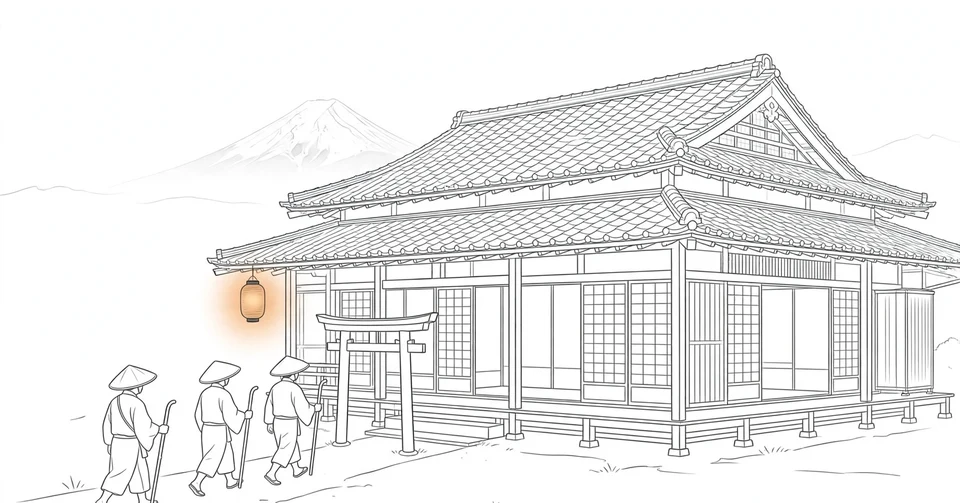
The system belonged to the world of the fuji ko, the pilgrim societies of Edo townspeople who saved all year to send a few of their number up the peak. Each society kept a standing arrangement with an oshi, a priest and innkeeper at the mountain's foot, who lodged the pilgrims when their turn came. Neither side treated the tie as a booking. It was closer to kinship, renewed every summer for generations.
What an oshi actually did
Strip away the incense and the job description is oddly modern. The oshi lodged the party in his own home, cooked for them, supplied equipment for the climb, performed the rites that prepared them for it, and prayed to the mountain on their behalf. Japan Guide's account of the Former Togawa Residence, one surviving oshi house, describes the oshi as low ranking priests who promoted the worship of Mount Fuji, performed religious rites and even maintained the trail to the peak.
So the same man who blessed you also changed your bedding and kept the path you were about to walk. I find that mixture easy to respect. The oshi was not a priest with a side business. He was a one man ministry of hospitality, and the faith he served understood that tired, hungry people do not pray well.
His flock, though, was not local. Each oshi served particular fuji ko in particular towns, sometimes far away in Edo, and the relationship ran in both directions all year round, as the next sections show.
A street of eighty six inns
At the height of the faith, in the eighteenth and nineteenth centuries, the Japan Tourism Agency counts as many as 86 oshi inns in Fujiyoshida, packed side by side in the Kamiyoshida district along the street that climbs toward Kitaguchi Hongu Fuji Sengen Shrine and the northern trailhead.
The street itself was planned for them. Prefectural archaeologists date the settlement's move to Kamiyoshida to 1572, when long plots were laid out for some seventy households of oshi, priests, merchants and craftsmen. Fujiyoshida, in other words, was not a town that happened to host pilgrims. It was built, plot by plot, as the mountain's front hall.
Land was sliced into long, narrow plots so that as many houses as possible could face the road. The Togawa house, the best documented survivor, is only a few metres wide but runs some 40 metres back. A channel of water drawn from mountain streams ran in front of each inn, where arriving pilgrims purified their hands and feet before stepping inside.
Inside, the economics were as devotional as the prayers. Lodging 20 to 30 people a day took mountains of tableware, bedding and utensils, and the fuji ko supplied them. Chapters donated sets of plates and bowls to their own oshi house, each trying to outdo the others in generosity, and when a group arrived it was served, as a point of honour, on the tableware it had given. At the peak of the season the crowds overflowed anyway, and some pilgrims slept in the corridors.
The night before the climb
An oshi house was arranged like the pilgrimage itself, practical things first and the sacred waiting at the back. Rank announced itself at the door. The inns had several entrances, and the grandest were kept for high ranking officials, for visitors of great spiritual attainment, and for the oshi himself, while ordinary pilgrims came in by lesser ways and washed in the channel outside.
Behind the doors, the front building, the omoya, held the kitchen and dining rooms. Behind it lay the urazashiki, the rear rooms where the pilgrims slept, and at the very back the room called the goshinzen, meaning before the divine.
There, on the last night, the oshi preached to his guests about the faith and the discipline the climb demanded, and prayed to Mount Fuji for them while the party's leader, the sendatsu, led the chants. Then everyone slept, one final night of relative comfort before straw sandals, a staff and a white garment stamped at stations on the way up.
The Togawa house shows the trade growing in timber. Its main building went up in 1768, and the rear rooms, the pilgrims' sleeping quarters and the goshinzen, were added a century later, around 1860, when the flow of fuji ko was at its strongest. An oshi rebuilt his own home around his guests, generation by generation, and the floor plan remembers it.
The white garment, the gyoi, says much about how seriously the house took its work. The same clothing was used to dress the dead, because in this faith the summit was a realm beyond the living world, and the oshi was preparing his guests to enter it and, just as importantly, to come back.
Keeping the faithful through the winter
When the season closed, the work reversed direction. The oshi spent the off season on the road, travelling to Edo and elsewhere to visit his fuji ko chapters in their own homes, carrying news, prayers and talismans, and collecting the loyalty, and the donations, that kept the house alive.
The Fujisan Museum displays the travelling case a Togawa oshi used on those rounds, apparently for carrying talismans and gifts to the households that supported him. It is a small object that explains the whole system. The pilgrims came up to his house for one night a year. He went down to theirs for the rest of it.
To my mind this is why the arrangement lasted so long. An inn can be replaced by a cheaper inn. A relationship in which the priest knows your street, your grandfather's name and your society's donated plates cannot, and the fuji ko clearly felt the difference, because they kept the same oshi for generation after generation.
How the oshi faded
What ended the system was not disbelief but convenience. After the Meiji restoration, travel no longer needed a religious excuse, and better transport, above all the railway, let climbers reach the mountain and start almost at once. As Japan Guide notes of the Togawa house, the inns catered to pilgrims before improved transportation made it unnecessary to stay a night at the foot of the mountain before the ascent.
As the societies thinned, so did their hosts, since each existed for the other. A few fuji ko never stopped meeting and climbing, but most dissolved into ordinary tourism, and a priest innkeeper whose whole year was shaped around other men's devotion found the year emptying around him.
The houses closed one by one across the twentieth century. The Togawa family, remarkably, kept receiving pilgrims until 1962, within living memory of the space age. By then climbing Mount Fuji had become what it is today, a matter of fifth station trailheads, booked huts and headlamps, with no priest waiting at the bottom and no sermon the night before.
What is left of the oshi houses
A handful of the houses still take guests in Fujiyoshida, run by the same families, though now they welcome travellers rather than confraternities, and the city's own listings record at least one house, the Tsutsuya, still receiving fuji ko groups as its ancestors did. The Togawa house went another way. It is kept as a living museum and forms part of the Mount Fuji World Heritage site, its small shrine, guest rooms and pilgrim gear intact. Among its treasures is a statue of Jikigyo Miroku, the Edo merchant whose fast on the mountain in 1733 made the faith famous, a reminder that the house served a movement, not just a trade. In the goshinzen at the back, the museum plays recordings of the old ceremonies, so the room where pilgrims once heard their oshi preach is not left entirely silent.
A faithful copy of another oshi house, the Osano family's, stands in the grounds of the Fujisan Museum. Putting the two side by side shows something the old pilgrims would have taken for granted. Within the shared outline of the faith, each oshi lineage kept its own traditions, its own ways of receiving people, which is exactly what you would expect of houses that were homes first and institutions second.
Standing in such a house, narrow as a corridor and deep as a story, you can feel how the old climb actually worked. It did not begin at a trailhead. It began the evening before, in someone's home, with clean water, a hot meal and a man whose family had promised yours, long ago, that he would be there. The mountain has not changed. The welcome has, and something in me thinks the mountain was better served when the two came together.
More in Culture & Society
- Sodoran Treats an Heirloom Like an Honoured Guest
- You Can Read a Pecalang From Across the Street
- When the Gara-Gara Starts, the Puppets Drop the Plot
- Forty Pounds of Cowbells, and the Mamuthones Say Nothing
- The Oarfish Still Answers to a Name From the Dragon Palace
- Irezumi Was an Art Before It Was a Warning
Latest posts
- Nyuto Onsen Hides Seven Inns at the End of a Snow Road
- A Donko Never Got the Chance to Open
- The Milpa Is a Garden That Thinks Like a Forest
- The Kitamaebune Came Home Loaded With Kelp
- Nobody Just Watches a Panigyria, Everybody Dances
- Ponzu Began With a Fruit Too Bitter to Eat
- Kombu Is the Quiet Half of Dashi
- Manza Onsen Bathes at 1,800 Metres
- Every Prefecture Argues About What Goes in Ozoni
- Japan's Population Decline and the Villages It Leaves Behind
- KRL Commuterline and the Trains That Move Jakarta
- Kecap Manis and the Sweet Soy Sauce of Indonesia
- In Mamoiada, Two Hundred Families Still Make Wine at Home
- Shochu and the Quiet Spirit of Japan
- A Dried Shiitake Is Louder Than a Fresh One