The Three Sisters Grow Better Together
· 9 min read
Corn, beans and squash planted in one mound are the three sisters, an Indigenous planting system from the Americas. Each crop feeds, shades or holds up the others, in the field and on the plate.
Plant corn, beans and squash in separate rows and you have three ordinary crops, each with its own demands and its own ways of failing. Plant them together in a single mound and they start behaving like family. The corn stands tall and offers its stalk as a ladder. The beans climb, and as they climb they pull nitrogen out of the air and park it in the soil. The squash sprawls at their feet, covering the ground with wide leaves that keep the earth shaded and damp. Indigenous farmers across the Americas understood this arrangement so well that they gave it a name that has outlived empires: the three sisters.
It is not a metaphor pasted onto a gardening trick. Among the Haudenosaunee, the confederacy of Iroquoian peoples in the northeast of North America, the three sisters were treated as inseparable in story, ceremony and daily work, and the planting itself was designed around their cooperation. Modern agronomy, arriving centuries late, has mostly confirmed what the mound already knew.
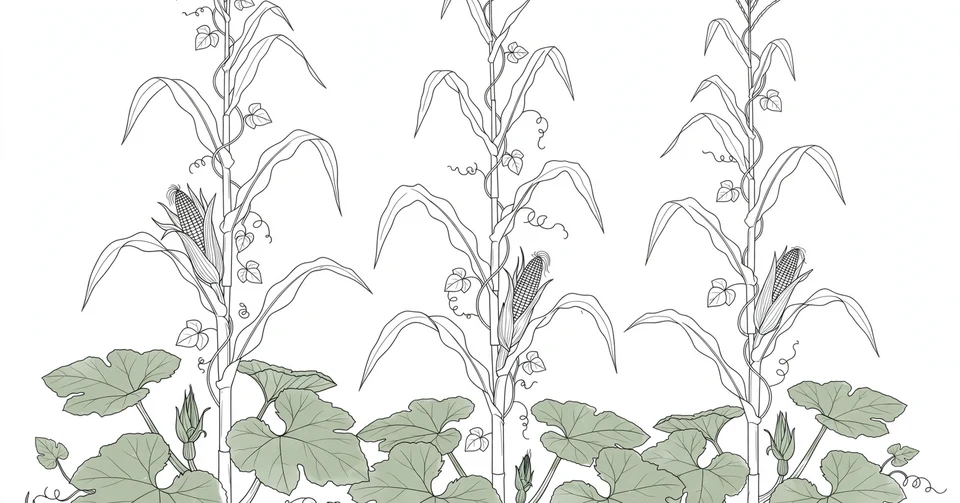
This article looks at how the three sisters work in the ground, how the system travelled from Mesoamerican fields to the kitchens of Costa Rica, and why three humble plants still add up to one of the most complete diets ever grown in a single patch of soil.
How the three sisters help each other grow
The basic unit is not a row but a hill. Traditional growers sowed several corn kernels into a small mound of soil, in the Haudenosaunee case roughly a foot high and two feet wide, and piled the earth up around the young plants as they grew. The raised mound warms faster in spring and drains better after rain, both kindnesses to corn in a northern climate.
Beans come second. Two or three weeks after the corn goes in, bean seeds are planted into the same hills. By then the corn is tall enough to serve as a living pole, and the climbing beans wind around the stalks instead of needing cut timber or string. The arrangement works in reverse too, since the twining vines brace the corn against high winds, so the whole structure holds together in weather that might flatten a lone stalk.
The beans also pay rent. Like other legumes, they host bacteria in nodules on their roots that take nitrogen from the air and convert it into forms plants can use. Corn is a hungry crop, and some of that fixed nitrogen becomes available in the shared soil. Researchers are careful to note that the amounts are modest and that the science behind some companion planting claims remains thin, but in the three sisters system the effect, combined with everything else the trio does, has been measured in real harvests.
Squash takes the floor. Planted between the mounds, it sends out broad leaves that work as living mulch. They shade out weeds, slow evaporation from the soil and keep the ground cooler through dry spells. Some squash varieties add another defense, since their stems carry prickly hairs that discourage deer and raccoons from wandering through the patch. Three plants, three jobs, and almost no wasted space between them.
Households also tinkered at the edges. Several peoples planted sunflowers along the northern side of the garden, tall enough not to steal light, and sometimes called them a fourth sister. In the Southwest, the Tewa and their neighbours added the Rocky Mountain beeplant, whose flowers draw in bees to pollinate the beans and squash. The core of the three sisters stayed fixed, but the supporting cast could change with the climate.
Just as notable is what the growers did not do. Haudenosaunee fields were not tilled, and leaving the soil unturned limited erosion and kept organic matter in the ground. When the agronomist Jane Mt. Pleasant and her colleagues recreated the historical three sisters system of the Haudenosaunee with heritage varieties in New York, the polyculture returned more energy and more protein than the local monocultures they compared it with. The mound, it turns out, was a technology, refined over generations rather than written down.
The sisters in story and ceremony
For the Haudenosaunee, the three sisters were never only agriculture. In the Seneca language they are Diohe'ko, often translated as "our sustainers" or "these sustain us", and under that name they run through tales, myths and ceremonies, including the Thanksgiving Address that still opens gatherings. In 1910 the Seneca scholar Arthur Parker recorded that bean and squash seeds were sown among the corn because the spirits of the three plants were thought to be inseparable, guarded by three spirits who would not let them thrive apart.
The creation story gives the plants a mother. In Haudenosaunee tradition, the crops sprouted from the body of Sky Woman's daughter: corn from her breasts, beans from her hands and squash from her navel, a gift of agriculture planted on a grave. A United States Department of Agriculture review of the three sisters gathers these accounts and notes that the model was a cultural and spiritual construct as much as a planting method, which is a dry way of saying the field was also a story people lived inside.
Other tellings make the relationship between the sisters the whole point. In one widespread version, the three sisters are women who drift apart and only flourish again once they are reunited. In another, they are sisters of different ages and tempers, a tall eldest, a climbing middle child and a youngest who stays close to the ground, and they learn they are stronger together. Either way, the moral of the story is the method itself: the three sisters stay together.
There was labour behind the reverence. Among the Haudenosaunee, women were responsible for cultivating and distributing the three crops, working communally in related groups after men had cleared the ground, and that responsibility carried real social weight. The Handbook of North American Indians calls the three sisters the foundation of Iroquois subsistence, the base that allowed settled village life to develop at all.
From Mesoamerican milpas to a Nicoya kitchen
The three plants are older than the name. Squash was domesticated in Mesoamerica roughly 10,000 years ago, with maize and then beans following, and the three were combined into a single way of farming over a period of some 5,000 to 6,500 years. In Mesoamerica the same partnership, scaled up from garden mounds to whole fields, is the milpa, the farming system that fed Maya cities and still feeds villages across Mexico and Central America today. From there the technique spread north over many generations, changing varieties as it crossed climates, until by the time Europeans arrived it was the dominant way of farming across much of eastern North America.
Surveying this hemisphere wide pattern, the geographer Carl O. Sauer called the three sisters a symbiotic plant complex of North and Central America without an equal elsewhere. It is a large claim, but the geography supports it. Almost everywhere the three crops could grow, somebody was growing them together.
The trail does not end in the northeast. Follow the milpa south into Central America and the same three crops are still on the table on the Nicoya Peninsula of Costa Rica, where corn cooked in lime, beans and squash form the working core of the local diet. I wrote about Nicoya in my article on the plan de vida, the reason for living philosophy of the peninsula's elders, and the three sisters appear in that story quietly, as the food underneath the philosophy. Nicoya is one of the five blue zones, and researchers who study its long lived residents keep coming back to the same plain plate of corn, beans and squash.
A complete meal from one patch of ground
The cooperation continues after harvest, which might be the most elegant part. Corn protein is short on two essential amino acids, lysine and tryptophan, and beans carry both in useful amounts. Beans are weaker in the sulphur containing amino acids where corn is comparatively fine. Eaten together, the two cover each other's gaps, and researchers note that the three sisters between them supply all nine essential amino acids that a human body cannot make for itself.
Squash rounds out the plate in other directions. Its flesh is rich in vitamin A, and its seeds add protein and fat to a diet that otherwise runs lean. In Mt. Pleasant's reconstruction of the Haudenosaunee system, the three sisters yielded roughly the same energy per hectare as a maize monoculture while delivering more protein, which is exactly the trade a community wants from land it depends on. Protein is usually the hard part of a plant based diet, and the mound quietly solves it.
There is a storage logic too. Dried corn and dried beans keep for months without refrigeration, and hard winter squash sits in a cool corner long after softer vegetables have rotted. A harvest of the three sisters is not just a meal but a pantry, and in a world of short growing seasons that difference is measured in winters survived.
Why the three sisters still matter
It would be easy to file the three sisters away as a charming piece of folk wisdom, and industrial farming mostly did, replacing the mound with the plough, the row and the fertilizer bag. Something real was gained in yield and convenience. But something was also lost, which is why researchers, schools and Indigenous seed keepers have spent recent decades planting the three sisters together again, and why a study published in 2025 was still testing how the old intercrop could be adapted to mechanised row planting. The system refuses to stay in the museum.
What I take from the three sisters is not nostalgia. It is the habit of asking what a plant can do for its neighbours before asking what can be sprayed, spread or bolted on from outside. Most modern problems in a field are solved by adding something. The mound solved them by arranging things, which feels less like a technique than a temperament, and maybe that is why it lasted thousands of years while empires of monoculture rose and fell around it.
Corn still stands, beans still climb, and squash still keeps the ground cool beneath them. The three sisters asked very little of the people who planted them, beyond being kept together, and they have been keeping that bargain for a very long time.
More in Food & Travel
Latest posts
- Manza Onsen Bathes at 1,800 Metres
- Irezumi Was an Art Before It Was a Warning
- The Oshi Kept Fuji's Pilgrims Fed, Housed, and Devout
- Japan's Population Decline and the Villages It Leaves Behind
- KRL Commuterline and the Trains That Move Jakarta
- Loma Linda's Long Lives Run on Saturdays
- Maruten Numazu and the Towering Kakiage Bowl of the Port
- Half the Old Springs in Japan Thank Kobo Daishi
- Tatamiishi Terraces Filter a River Through Stone
- Wasabi-Zuke Puts the Whole Plant in Sake Lees
- Konyoku Is Still Out There, Past the Last Train Station
- Karo Is the Tengger's Other Great Gathering
- Dry January Lasts a Month on Purpose
- Urashima's Dragon Palace Had a Name, Ryugu
- Petruk's Nose Arrives Before He Does