Manza Onsen Bathes at 1,800 Metres
· 9 min read
Manza Onsen sits at 1,800 metres on an active Gunma volcano, the highest hot spring in Japan that can be visited all year. Its milky sulphur water runs free-flowing into open air baths that float above the valley cloud.
Some hot springs announce themselves with a shopping street. Manza Onsen announces itself with altitude. This small resort in the mountains of Gunma is the highest hot spring in Japan that stays open all year, a cluster of hotels and ryokan gathered at about 1,800 metres on the slopes of Mt. Kusatsu-Shirane, an active volcano.
The water matches the setting. It comes out of the ground at around 80 degrees Celsius, too acidic to drink, loaded with sulphur, and the colour of milk. On a clear night the steam from its open air baths rises into a sky so dark that the resort markets itself, with some justification, as the hot spring closest to the stars.
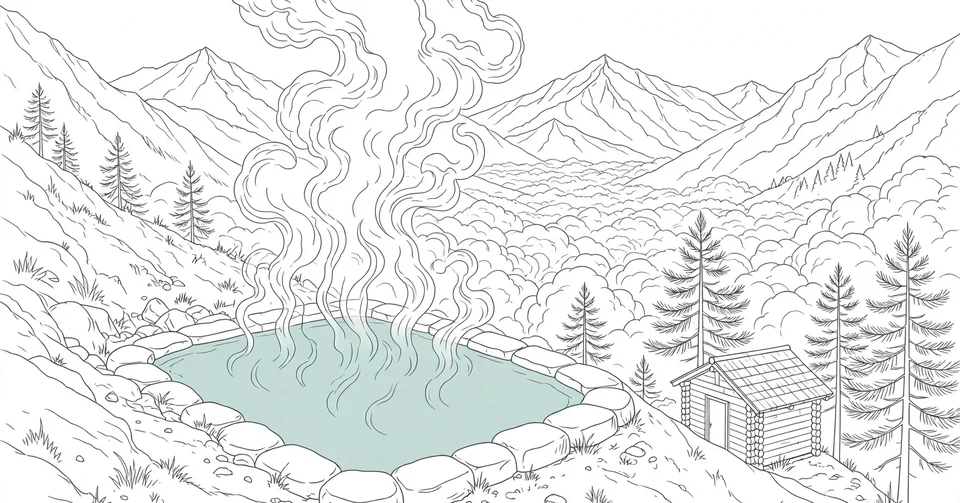
Getting there is part of the character of the place. The roads climb in switchbacks through volcanic country, and they close when the mountain grumbles or the snow piles too deep. Manza Onsen rewards the effort with something few Japanese resorts can offer, which is a bath that genuinely feels like it belongs to the top of a mountain, because it does.
A resort that lives on a volcano
Administratively, Manza Onsen belongs to Tsumagoi Village in the Agatsuma district of Gunma, but the village centre is far below and the resort keeps its own high counsel. Up here the landscape is bare rock, steaming vents and channels of hot water, a working yubatake where the spring is cooled and shared out among the baths. The first thing you notice is the smell. Fumaroles around Manza Onsen vent sulphurous steam all day, and the eggy scent soaks into the whole shelf of mountain.
Walking paths follow the hot stream past the vents, and one trail leads to Kumashiro Cave, where a small shrine stands in the dark and pieces of prehistoric pottery were once dug up. In summer these paths are the green season's quiet entertainment. In winter they rest under the snow, closed until the melt. On a clear day, though, the real view is outward, range after range of mountains falling away below a resort that sits higher than most of the peaks around it.
The volcano is not decoration. Kusatsu-Shirane is monitored, its activity levels are published, and the Japan Airlines guide to the area advises checking conditions before you travel, because access can be limited or roads closed at short notice. Life at this height, on a mountain that is still awake, comes with that small print, and Manza Onsen lives with it calmly.
Water too strong to drink
The spring water at Manza Onsen is classified as an acidic sulphur spring, of the hydrogen sulphide type, and local publicity calls it the most concentrated hot spring in Japan. That is a marketing claim, but the bath makes it plausible within a minute of lowering yourself in. Your body disappears beneath the milky surface, the heat is assertive rather than soothing, and the smell of sulphur follows you back to your room and into your clothes.
Oddly, the water leaves the ground clear. According to the Manza Prince Hotel's spa notes, the source water is transparent and only turns cloudy white once it meets the air, as its dissolved minerals crystallise into the soft white flakes that drift in the tubs. The main source drawn on by the two big Prince hotels, the Ubayu spring, delivers its water at about 80 degrees, and the group puts the flow at some 5.4 million litres a day, a river of hot water arriving whether anyone bathes or not.
The hotels credit the water with easing neuralgia, muscle pain, sensitivity to cold and plain fatigue, the standard litany of Japanese spring lore, and I am in no position to grade those claims. What anyone can verify is the strength. This is not a gentle bath, and it does not pretend to be. Ten or fifteen minutes is enough for most people, and the rhythm of a Manza Onsen soak is to climb out, cool off in the thin mountain air, and then decide whether to go back in.
Manza Onsen and the free-flowing ideal
Purists in Japan judge a spring by whether its water is used once and thrown away, or pumped around in a loop with the same water reheated for days. I have written on this site about gensen kakenagashi, the ideal of water that runs from source to bath to drain without ever circling back, and it is a harder ideal to honour than it sounds, because most springs simply do not produce enough.
Manza Onsen has no such excuse. With millions of litres a day coming up out of the volcano, all twenty baths at the Prince hotels run free-flowing, around the clock. The heat is managed the honest way, by letting the water cool as it travels and by heat exchange in the pipes, with cold water added only as a final adjustment. Staying guests can bathe at any hour, and day visitors are welcomed at both of the big hotels, while a wooden yumeguri pass from the tourist association lets the committed hop between the baths of the smaller inns as well.
At the Manza Prince Hotel, the open air Sekitei bath blends four different sources, the Ubayu, the Dainigayu, Ryusen no Yu and Tsumatori no Yu, and each stone tub holds a slightly different shade of white. It is a small, telling detail. Even on one mountainside, fed by one volcano, no two springs are quite the same water, and the blending is done openly, as a feature rather than a shortcut.
Day trippers are not an afterthought here. Every hotel in Manza Onsen opens its baths to non-guests during the day, from the big resorts down to the humble local ryokan, with day bathing at the Manza Prince Hotel priced at 1,500 yen for adults at the time of writing. The Prince also rents private baths by the session for those who want the water to themselves, and a few inns in the resort still keep mixed baths, for which the hotels sell the special bathing garments that are worn in them. For a place this small and this high, the bathing culture is remarkably complete.
Two resorts in one, summer and winter
Altitude does something simple and valuable in a Japanese summer. While the lowlands simmer in humid heat, Manza Onsen sits in highland air that rarely feels hot, and the green season belongs to walking, to the cave trail, the vent fields and the long views over the strange bare desert of Shirane. The resort is a refuge in August in a way no lowland onsen town can be.
Winter reverses Manza Onsen entirely. The same shelf of mountain becomes a ski base, fiercely cold and deep in snow, and the pattern of the day changes to slopes first and bath second. There is a particular pleasure in lowering yourself into near-scalding sulphur water while snow lands on your hair and melts, and in that season the bath earns its keep in a way a summer soak never has to.
Night is Manza Onsen's third act, in any season. In an earlier piece I walked through what makes a rotenburo work, and this resort was the example that closed it, because Manza Onsen markets itself as the hot spring closest to the stars. At this height, so often above the cloud that fills the valleys in the morning, there is little light pollution to compete with the sky. The claim, for once, reads less like advertising and more like a measurement.
The quiet side of Kusatsu's volcano
On the other side of the same volcano sits Kusatsu Onsen, one of the most famous hot springs in Japan and busy in proportion to its fame. When Route 292 over Mt. Shirane is open, the drive between the two resorts takes about fifty minutes. When it is closed, as it often is in winter and whenever the volcano stirs, the way up is the long way, by bus or car from Karuizawa, or up the Manza Highway on the Tsumagoi side.
The Karuizawa approach is the one most visitors end up taking. The drive up the toll highway over the shoulder of the volcano runs to about an hour and a quarter, and the bus from Karuizawa station to the Manza bus terminal costs around 2,750 yen. Neither route is difficult, exactly. Both simply take long enough, and climb steeply enough, that the casual day tripper tends to choose somewhere easier, which is precisely how Manza Onsen stays quiet.
The two resorts share a mountain and almost nothing else. Kusatsu has a town, a steaming central field ringed with shops, crowds and ceremony. Manza Onsen has hotels, baths and weather. I have come to think the quieter deal is the better one for an actual soak. Fame fills a bath with people. Altitude, distance and a winding road keep this one honest, filtering for bathers who really wanted to be there.
That filter is worth respecting rather than resenting. A resort that can be closed off by its own volcano, that smells of sulphur from the first step out of the bus, and whose water is too strong to sip, is not trying to please everyone. It knows exactly what it is.
Manza Onsen will never be the easiest hot spring in Japan to reach, and it should probably stay that way. A bath at 1,800 metres asks something of you before it gives anything back: a climb, a cold walk from the changing room, water strong enough to set its own terms. What it gives in return is a soak that feels earned, milky, fierce and quiet, at the top of a volcano that has not finished speaking.
More in Life & Style
- Toji Meant Moving to a Hot Spring Until You Got Better
- Nyuto Onsen Hides Seven Inns at the End of a Snow Road
- Nobody Just Watches a Panigyria, Everybody Dances
- KRL Commuterline and the Trains That Move Jakarta
- Loma Linda's Long Lives Run on Saturdays
- Konyoku Is Still Out There, Past the Last Train Station
Latest posts
- Sodoran Treats an Heirloom Like an Honoured Guest
- You Can Read a Pecalang From Across the Street
- A Donko Never Got the Chance to Open
- The Milpa Is a Garden That Thinks Like a Forest
- The Kitamaebune Came Home Loaded With Kelp
- When the Gara-Gara Starts, the Puppets Drop the Plot
- Forty Pounds of Cowbells, and the Mamuthones Say Nothing
- The Oarfish Still Answers to a Name From the Dragon Palace
- Ponzu Began With a Fruit Too Bitter to Eat
- Kombu Is the Quiet Half of Dashi
- Irezumi Was an Art Before It Was a Warning
- The Oshi Kept Fuji's Pilgrims Fed, Housed, and Devout
- Every Prefecture Argues About What Goes in Ozoni
- Japan's Population Decline and the Villages It Leaves Behind
- Kecap Manis and the Sweet Soy Sauce of Indonesia