Karo Is the Tengger's Other Great Gathering
· 9 min read
Karo is the Tengger people's other great festival, a season of open doors around Mount Bromo when ancestors are welcomed home, a sacred heirloom comes out of storage, and every guest is expected to eat.
Ask an outsider about Tengger festivals and they will describe one night at the crater of Mount Bromo. Ask a Tengger family, and they may well answer with Karo, the festival that fills their own month, their own village, and their own living rooms. Karo is the Tengger's other great gathering, less photographed than Kasada and, for the people who keep it, just as important.
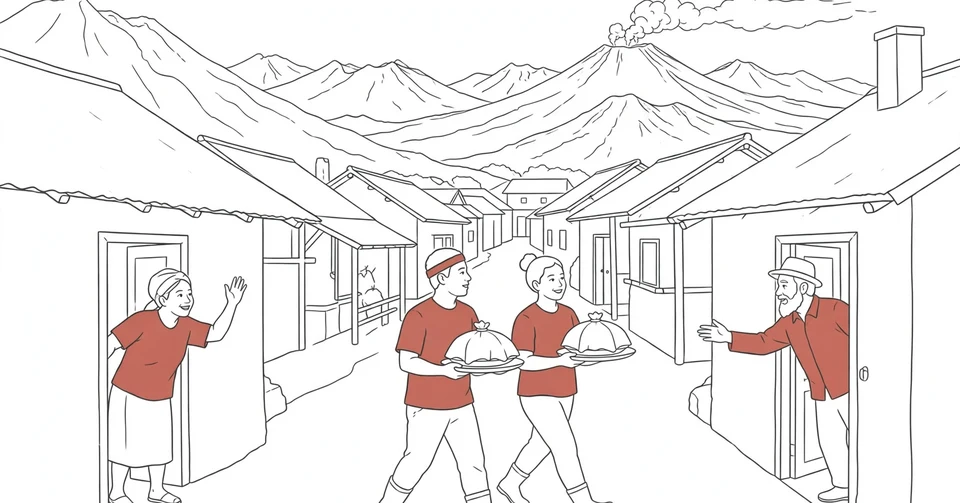
One point of clarity first. This Karo is a month in the calendar of the Tengger people of East Java, not the Karo people of North Sumatra, who are a different community entirely. The Tengger Karo, also called Pujan Karo, falls in the second month of the Tengger year, and it is at heart a homecoming. The community gives thanks to Sang Hyang Widi Wasa, the creator, for the blessings of the year behind them, and it honours the spirits of the ancestors, who are believed to come back for a while and join the celebration.
That double duty, gratitude upward and gratitude backward, runs through the whole Tengger calendar. We have written before about the Tengger people and the faith they have kept on Bromo's slopes for five centuries, and Karo sits inside the same cycle of ancestor honouring as their funeral rites and harvest thanksgivings. Where those rites are solemn, Karo is joyful. It is the festive face of the same obligation.
Kasada climbs the mountain, Karo stays home
The contrast with Kasada is the easiest way to see what Karo is. Yadnya Kasada belongs to the twelfth month and to the volcano. The whole community converges on one temple in the sea of sand and one crater rim, at night, and the offerings travel upward and outward, thrown into the smoke. Karo belongs to the second month and to the village. Nothing is thrown away. The offerings are cooked, blessed, carried home, and eaten, and the sacred geography is not a crater but a round of shrines, graves, crossroads, water sources, and front doors.
The calendar arithmetic underlines the pairing. Kasada closes the Tengger year in the twelfth month, and Karo opens the social year in the second, so the festival arrives roughly two months after the crater offerings, as if the community first settles its account with the mountain and then settles in with itself. Kasada is also a single appointment. When the full moon of the Kasada month rises, everyone goes. Karo has no single date at all, and I find that looseness part of its character. Each village works out its own timing within the Karo month, so the festival rolls across the highlands village by village rather than landing everywhere at once. Neighbouring villages often coordinate instead of competing: Ngadisari, Wonotoro, and Jetak, for example, celebrate together and take turns hosting the shared rites. Length varies just as much. In Ngadisari, Wonotoro, and Jetak, three villages in Sukapura district studied closely by researchers from Universitas Negeri Surabaya, the sequence of rites runs from the seventh day of the month to the twenty-second, a full fifteen days. In other accounts the heart of the celebration lasts about a week. Either way, Karo is not a day you attend. It is a season you live inside.
The ancestors arrive before the guests
Before the visiting starts, the dead have to be welcomed. In the villages the Surabaya researchers documented, Karo opens with tekane ping pitu, held on the seventh day of the month, when incense that has been blessed by the dukun, the Tengger ritual priest, is burned and the ancestors are believed to arrive. Processions go to the sanggar punden, the shrine at the grave of the village founder, where thanks are given for the harvest and offerings are set out for the ancestral spirits. Gamelan plays over the dukun's mantras, and the offerings follow an old recipe: cakes called juadah and pipis, bananas, and a tumpeng crowned with roast chicken. Once blessed, that food is not left behind. Families carry it home and eat it together, the first of many Karo meals in which the ancestors and the living effectively share a table. The same archive of East Java tradition describes families carrying tumpeng, the cone shaped mounds of rice, along with cakes and other dishes, some for the shrine and some simply to be eaten together.
At home, every household prepares sesanding, its own set of offerings, and the dukun goes from house to house speaking the prayers that make them ready. Later in the season comes nyadran, when the whole village walks to the family graveyards with food and drink to pay homage at the graves themselves. Only when the festival closes, in the rite called mulihe ping pitu, are the ancestors sent home again, with incense carried to the dukun's house, blessed, and burned to speed them on their way. The shape of Karo is exactly that arc: the ancestors arrive, they are feasted and honoured, and then they are politely seen off. The living do their visiting in between, while the house is full.
Sodoran, and the heirloom that comes out once a year
The most public moment of Karo is sodoran, a sacred dance performed in and around the village hall. Villages process with gamelan, dancers from different villages meet and face each other in pairs, and the dancing honours the descent of the Jimat Klontong, a bundle of sacred heirloom objects that spends the rest of the year in storage and is brought out, cleansed, and shown only at Karo. The bundle is strange and specific: long bamboo poles tipped with coconut fibre, buffalo horns, a small black earthenware flask, and stone axes. Local belief holds that it was never made by human hands at all, but found, an heirloom that arrived by itself, which is why it is handled with such care and why its annual outing matters. The heirloom's keeping rotates between villages, and the sodoran gathering is treated almost like a wedding between the host village and its guests, with the village heads cast as in-laws receiving one another.
Ask what sodoran commemorates and the answer depends on which side of the caldera you ask. Around Ngadisari, people tell of Satya and Setuhu, two servants of legendary loyalty. Around Tosari and Wonokitri, the dance is linked to Ajisaka, the culture hero of Javanese tradition. Both stories are really about the same virtue, faithfulness kept over a long time, which is also what the festival itself practises. After sodoran, the petinggi, the village head, hosts the tumpeng gede, the great rice cone to which every family contributes. The dukun blesses it, and people carry their portions home for the family meal, so even the grandest offering of Karo ends up where everything in Karo ends up: on a family table.
Karo runs on visiting
If the rites belong to the dukun, the days belong to anjangsana, the round of visits from house to house. This is the part of Karo that fills the streets. The work starts well before the first guest arrives. Houses are cleaned top to bottom, because a clean house is itself part of the welcome, and kitchens run for days producing the cakes and dishes the season demands, pasung, pipis, juadah, sticky rice cakes, and full meals besides. Strings of pennant flags go up along the lanes, and families put on new clothes or their best ones, sarongs and shawls over the shoulder. Relatives who have moved away come back for it. Doors are opened to neighbours, to kin, and to outsiders who have a family tie or even just an invitation, which is usually delivered in person, well in advance.
And here is the rule every guest learns quickly: you must eat. Refusing the food is not an option, because eating is not really about hunger. In the understanding recorded by the Surabaya study, a guest who eats and drinks what the host has prepared brings the host happiness and blessing, so the full table is a kind of prayer that only works if someone sits down to it. An Indonesian teacher who was invited to a student's home in Wonokerso village for Karo wrote about the experience with some amazement: table after table of cakes, drinks, and full dishes, at house after house, with no polite way to say no.
The arithmetic is formidable. Devout visiting can mean twenty to forty houses in a single day, so experienced guests develop a technique. Visits last five to ten minutes: greetings, a seat in the front room, a token bite, one small dish, a quail egg, a spoonful of something, and then farewells and on to the next door. Elders in the East Java archive compare the season to Idul Fitri, and the comparison is earned. Like Lebaran in the rest of Indonesia, Karo is the year's great reset of relationships, done through open doors and obliged eating, except that here the guests of honour include the ancestors, who were invited first and leave last.
What the season is really for
Strip away the dance, the heirloom, and the forty plates of food, and Karo is a machine for keeping a small community knitted together. The ancestors are thanked because the Tengger believe respect for them is what brings welfare, tranquillity, and peace, and the neighbours are fed because the same logic applies horizontally: nobody in the village is allowed to drift out of the circle of obligation. Even unjung-unjungan, the exuberant dance in which men strike each other's backs with rattan, carries the moral in plain sight. The blows stand for the hardships of life, and the teaching is that a burden struck together is lighter than one carried alone. Children are everywhere in Karo, watching the dances, joining the visits, learning the route from door to door, and that is not incidental either. A festival built on visiting only survives if the young learn it as a pleasure before they learn it as a duty.
What I like most about Karo is how unembarrassed it is about all this. Gratitude, in this festival, is not a feeling you keep privately. It is a table you set, a door you open, a bite you accept in a house you have already eaten in six times that morning. Kasada may be the Tengger promise the world knows, the one thrown into the crater. Karo is the quieter promise kept at home, renewed every year in the second month, one visit at a time.
More in Culture & Society
Latest posts
- Kombu Is the Quiet Half of Dashi
- Manza Onsen Bathes at 1,800 Metres
- Every Prefecture Argues About What Goes in Ozoni
- KRL Commuterline and the Trains That Move Jakarta
- Kecap Manis and the Sweet Soy Sauce of Indonesia
- In Mamoiada, Two Hundred Families Still Make Wine at Home
- Shochu and the Quiet Spirit of Japan
- A Dried Shiitake Is Louder Than a Fresh One
- Loma Linda's Long Lives Run on Saturdays
- Maruten Numazu and the Towering Kakiage Bowl of the Port
- The Three Sisters Grow Better Together
- Tatamiishi Terraces Filter a River Through Stone
- Wasabi-Zuke Puts the Whole Plant in Sake Lees
- Konyoku Is Still Out There, Past the Last Train Station
- Dry January Lasts a Month on Purpose