KRL Commuterline and the Trains That Move Jakarta
· 10 min read
KRL Commuterline carries more than a million people a day across Greater Jakarta. Here is how the network works, what it costs, and why it still matters.
Jakarta has a way of humbling every plan you make on its roads. A trip that looks like twenty minutes on a map can take two hours in the rain, and the same traffic jam greets you whether you leave at seven or at nine. That is why, for more than a million people every weekday, the answer is not a car or a motorbike at all. It is the KRL Commuterline, the red and white electric trains that slide past the traffic on their own tracks and turn a sprawling megacity into something a commuter can actually cross.
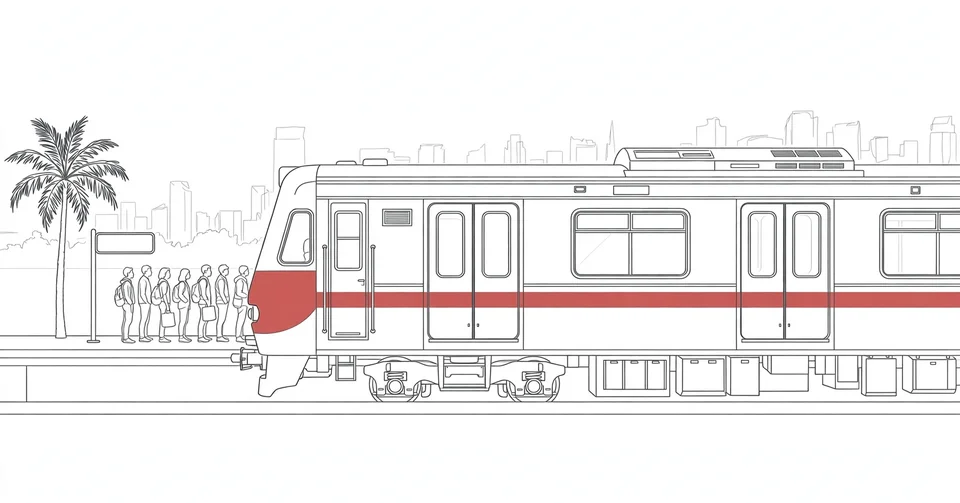
The KRL Commuterline is the commuter rail network of Greater Jakarta, the region Indonesians call Jabodetabek, short for Jakarta, Bogor, Depok, Tangerang and Bekasi. It is operated by KAI Commuter, a subsidiary of the national railway company Kereta Api Indonesia, and it runs on tracks that have carried electric trains since 1925. In 2025 the network marked its centennial, a hundred years of moving workers, students and traders between the capital and the satellite cities that ring it.
This is a guide to the KRL Commuterline: the five lines, the fares, the rush hour, the stations, and the small daily culture that has grown up around the trains. It is written for anyone planning to ride, and for anyone who wants to understand how Jakarta actually works once you step off its roads.
KRL Commuterline and a Hundred Years of Electric Trains
The story of the KRL Commuterline starts in 1917, when the Dutch colonial railway company Staatsspoorwegen drew up a plan to electrify the railways of Batavia, the city we now call Jakarta. The first line to be converted ran from Tanjung Priok, the port, to Meester Cornelis, the district now known as Jatinegara. It became the first narrow gauge electric railway in Southeast Asia. Construction began in 1923 and finished on 24 December 1924, powered by 1,500 volt direct current overhead wires, and the line opened on 6 April 1925.
Electrification spread quickly after that, and the young KRL Commuterline grew into a network. By 1 May 1927 every rail line around Batavia had been converted. Batavia Zuid station, today Jakarta Kota, closed in 1926 for rebuilding and reopened on 8 October 1929 to handle the new electric trains. The final piece of the colonial project, the line from Batavia Zuid south to Buitenzorg, today Bogor, was completed in 1930. The railway itself was older than the wires: the Jakarta to Bogor line had been built between 1871 and 1873 by the Nederlandsch-Indische Spoorweg Maatschappij, and electrification simply gave a nineteenth century railway a twentieth century engine.
The modern KRL Commuterline took its current shape much later. For years the network ran as KRL Jabotabek under the national railway. Then in 2008 the Jabotabek Urban Transport Division was spun off to form KAI Commuter, known at the time as KCJ, which began operating the network on 15 September 2008. The routes were reformed in 2011, and the routing was adjusted again in May 2022, the first change since that reform. A hundred years after the first electric train ran, the KRL Commuterline officially marked its centennial in 2025, and it did so as the busiest commuter railway in the country.
Five Lines and One Million Daily Riders
Today the KRL Commuterline runs five main lines across Greater Jakarta. The Bogor Line runs from Jakarta Kota to Bogor, 54.8 kilometres, and it is the oldest and busiest of them. The Cikarang Line serves Bekasi and Cikarang to the east. The Tangerang Line runs west, the Rangkasbitung Line runs southwest, and the Tanjung Priok Line serves the port. Together the lines of the KRL Commuterline connect the capital with the satellite cities where millions of Jakartans actually live.
| Line | Route | Who rides it |
|---|---|---|
| Bogor Line | Jakarta Kota to Bogor | Commuters from Bogor and Depok |
| Cikarang Line | Kampung Bandan to Cikarang | Commuters from Bekasi and Cikarang |
| Tangerang Line | Duri to Tangerang | Commuters from Tangerang |
| Rangkasbitung Line | Tanah Abang to Rangkasbitung | Commuters from South Tangerang and Lebak |
| Tanjung Priok Line | Jakarta Kota to Tanjung Priok | Port workers and north Jakarta |
In 2025 the KRL Commuterline carried 349,311,251 passengers, a record for the network. The weekday average in 2026 was about 1,030,610 riders, and the daily average across the year was just over a million. In June and July 2025 the figure surged to 1.3 million a day. For comparison, the 2019 daily average was 1.04 million, with a record day of 1,154,080, so the KRL Commuterline has now passed its pre-pandemic peak. The busiest single day on record reached 1,671,031 riders, a number that says more about Jakarta than any skyline photograph ever could.
The KRL Commuterline serves 82 stations, according to a 2023 count, and trains run in formations of eight, ten or twelve cars. Frequency is every few minutes at peak times on the busiest lines, and services run from about 4:00 AM to around midnight. Crowding is a real problem on the Cikarang Line, where commuter trains share tracks with long-distance services, so intervals cannot be as short as on the Bogor or Rangkasbitung routes. In November 2026 commuters on that line were complaining about eight-car trains at rush hour, and KAI Commuter said formations were being adjusted as new rolling stock arrived.
Manggarai and the City's Great Interchange
If the KRL Commuterline has a heart, it is Manggarai station in South Jakarta. It is the interchange between the Bogor Line and the Cikarang Line, and it also serves the airport train to Soekarno-Hatta. In 2023 it handled about 230,860 transfers a day, the highest of any station in the network, with Tanah Abang second at about 155,000.
Manggarai is being rebuilt to match the role the KRL Commuterline has given it. Work began in 2016 to turn it into Jakarta's central station, and the first phase was inaugurated on 26 December 2022, doubling the tracks from seven to fourteen, ten at ground level and four elevated. A second phase is planned to take the station to eighteen tracks, with Bogor-bound commuter trains and long-distance trains on the elevated level and Bekasi-bound trains and the airport train at ground level. The long-term plan is for Manggarai to replace Gambir as the terminus for most intercity trains, while Gambir becomes a commuter-only station. The LRT Jakarta extension from Velodrome to Manggarai opened on 26 August 2026, and a skybridge linking the LRT station with Manggarai was targeted for completion in October 2026, so the interchange keeps growing.
For a first-time rider, Manggarai is the station where the KRL Commuterline shows both its strength and its strain. The platforms are crowded, the announcements come fast, and the transfer between lines can feel like crossing a small city. But it works, and on a weekday morning it works at a scale few railway stations in Asia can match.
How to Ride the KRL Commuterline
Riding the KRL Commuterline is simple and cheap. Fares are distance-based: a short hop costs about Rp3,000 for the first 25 kilometres, then Rp1,000 for each additional 10 kilometres, with the longest trips staying under about Rp14,000. One 2026 guide lists a base fare of Rp5,000 instead, so treat the exact figure as something to confirm at the station, but either way a cross-city trip costs less than a cup of coffee in a Jakarta mall.
You pay with a contactless card, and the KRL Commuterline accepts several kinds. The dedicated card is the Kartu Multi Trip, or KMT, which typically costs Rp30,000 to Rp50,000 including starting balance, depending on the package. Bank e-money cards work too: Mandiri e-Money, BCA Flazz, BRI Brizzi, BNI TapCash and Bank DKI JakCard, plus JakLingko cards. Tap the same card in and out, because the fare is calculated from your entry and exit stations. The KRL Access app shows schedules and live train positions, which is worth having before you travel.
The first and last carriages of every train on the KRL Commuterline are women-only, marked with pink decals, and they are strongly recommended for solo women during rush hour. Rush hour itself runs roughly from 6:30 to 9:30 in the morning and 4:30 to 7:30 in the evening, when the cars fill shoulder to shoulder. If your schedule allows it, travel outside those windows and the KRL Commuterline is a calm, air-conditioned ride.
The Daily Life of Anak Kereta
Regular riders call themselves anak kereta, literally children of the train, or ankers for short. The name captures how completely the KRL Commuterline shapes their days: the same platform, the same departure, the same faces, the same small rituals of coffee and fried snacks bought from vendors near the gates. Stations are meeting points and small economies at once, with food stalls, phone credit sellers and ojek drivers waiting outside for the last stretch home. The food around the stations is part of the ritual too, and a plate of nasi goreng from a stall near the gates tastes better after a long ride than it has any right to.
Ride-hailing has folded itself into this routine, and the KRL Commuterline is now the spine the rest of the city's transport attaches to. Gojek's GoRide Transit feature, launched in 2023, lets a passenger book a ride to the station, buy a KRL ticket and book a ride onward in a single transaction, and it served 82 KRL stations around Greater Jakarta. The train is no longer a separate world from the rest of the city's transport. It is the centre that the other services orbit.
There is a democratic quality to the cars that Jakarta's roads do not have. Students, office workers, traders and domestic workers stand in the same carriage on the KRL Commuterline, holding the same straps, watching the same city slide past. The air conditioning is a small mercy in a hot city, and on a rainy evening the train is the driest place in Jakarta. That shared, unglamorous comfort is the real product the KRL Commuterline sells, and it is why a million people a day choose it over the traffic.
Why the KRL Commuterline Still Matters
Jakarta now has an MRT as well, and the Jakarta MRT has changed the centre of the city in ways the KRL never could. But the MRT is young and its network is small, while the KRL Commuterline is a century old and reaches the satellite cities where most of Greater Jakarta actually lives. The two systems do different jobs, and the KRL Commuterline's job is the bigger one: moving the workforce of a megacity every single day.
I think the honest way to judge a city is by how its ordinary people move through it, not by how its skyline looks from an aeroplane. By that measure the KRL Commuterline is one of the best things Jakarta has built, and also one of the most honest: it does not pretend to be luxurious, it simply carries a million people a day for the price of a snack, on tracks laid down a hundred years ago. The crowding is real, and the capacity problem on lines like Cikarang deserves the investment it is getting. But a city that can move a million people a day on electric trains has already solved the hardest part of being a megacity. The rest is a matter of keeping the trains coming, and of remembering that every carriage full of strangers on the KRL Commuterline is a small, moving piece of Jakarta itself.
More in Life & Style
Latest posts
- Kombu Is the Quiet Half of Dashi
- Irezumi Was an Art Before It Was a Warning
- The Oshi Kept Fuji's Pilgrims Fed, Housed, and Devout
- Every Prefecture Argues About What Goes in Ozoni
- Japan's Population Decline and the Villages It Leaves Behind
- Kecap Manis and the Sweet Soy Sauce of Indonesia
- In Mamoiada, Two Hundred Families Still Make Wine at Home
- Shochu and the Quiet Spirit of Japan
- A Dried Shiitake Is Louder Than a Fresh One
- Maruten Numazu and the Towering Kakiage Bowl of the Port
- The Three Sisters Grow Better Together
- Half the Old Springs in Japan Thank Kobo Daishi
- Tatamiishi Terraces Filter a River Through Stone
- Wasabi-Zuke Puts the Whole Plant in Sake Lees
- Karo Is the Tengger's Other Great Gathering