Half the Old Springs in Japan Thank Kobo Daishi
· 10 min read
All over Japan, old hot springs tell the same founding story, and the hero is almost always Kobo Daishi. The tales are legends rather than history, but the pattern behind them says a great deal about the monk, his faith, and the towns that keep his name.
Visit enough old hot spring towns in Japan and their pamphlets start to blur into one story. A monk arrives in travelling clothes. He finds villagers suffering, or good water hidden under stone. He strikes the ground, or points, or simply knows, and hot water comes up out of the earth. The monk is Kobo Daishi, and the claim in the title of this article is the claim those pamphlets make, in town after town, from one end of the country to the other.
To be clear at the start, nobody has ever counted, and no honest historian believes one man personally opened hundreds of springs. Half is a traveller's exaggeration, not a statistic. What is true, and more interesting, is the pattern itself. Kobo Daishi is the posthumous name of Kukai, a real monk who lived from 774 to 835 and founded the Shingon school of Buddhism. The springs credit him anyway, century after century, and the reasons why say a lot about Japan.
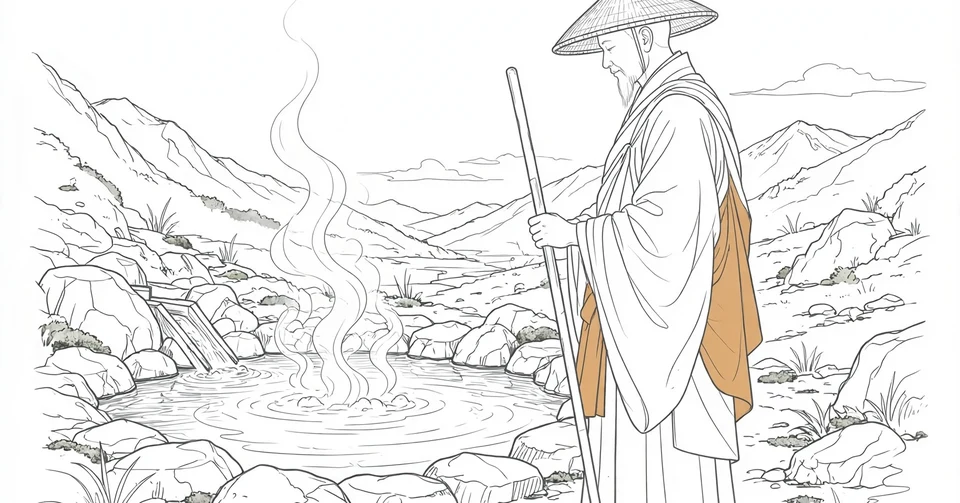
The pattern is worth following properly. It starts with the man himself, who was remarkable enough without miracles. It peaks in one famous legend, at a spring in a river in the Izu hills that Shizuoka people know well. And it spreads through a network of temples and pilgrims that carried the name of Kobo Daishi into valleys the living Kukai almost certainly never saw.
The man the springs call Kobo Daishi
Kukai was born in 774 in Sanuki Province, on the island of Shikoku, into a family of minor aristocrats. In 804 he joined an official mission to China, studied esoteric Buddhism in the capital under the master Huiguo, and came home in 806 carrying texts, paintings and a complete lineage of teaching. Back in Japan he founded Shingon, the Japanese form of that esoteric tradition, and in time the court granted him Mount Koya, south of Osaka, as his mountain headquarters. The name Kobo Daishi was given to him after his death. It means, roughly, the grand master who spread the Buddhist teaching, and ordinary Japan has called him Kobo Daishi ever since. His life and work are unusually well documented for a figure of his century, which makes the size of the legend that grew on top of them even more striking.
He was also, usefully for our story, a practical man around water. Kukai ran building projects, opened a school in the capital that admitted students of any rank and fed the poor ones, and in 821 he took charge of restoring the Manno Reservoir in his home province, a large irrigation dam whose repair had been failing. The project succeeded under him, and the reservoir is still the largest of its kind in Japan. A monk who genuinely fixed the water supply of a province was always going to attract stories about water. Some of the earliest legends about Kobo Daishi grew from exactly this kind of remembered competence.
When he died on Mount Koya in 835, he was entombed there rather than cremated, at his own wish. Tradition then added one more turn. When the tomb was opened some time later, the story goes, he looked as if he were still sleeping. Devotion settled on the kindest interpretation. Kobo Daishi had not died at all. He had entered a deep meditation and sits there still, waiting for the Buddha of the future, and monks at his mausoleum on Mount Koya carry meals in to Kobo Daishi every day, as they have for centuries. A saint who never quite left the world is a saint who can keep turning up at springs.
One strike in a cold river
The most precise of all the spring legends of Kobo Daishi, and the one closest to home for me, sits in the middle of the Katsura River at Shuzenji, in the Izu hills. The town dates the story to the year 807. Kukai was travelling through the mountains when he saw a boy washing his sick father in the cold water of the river. Moved by the boy's care, the monk struck a rock in the stream with the ritual implement in his hand, a tokko, which is a small single pronged vajra used in esoteric rites. Hot water came up out of the stone. The father bathed in it, and in the fuller versions of the tale his long illness lifted within days.
The spring is still there, in a small roofed stone pool on a sandbar in the river, and the town has organised itself around it ever since. It cannot be bathed in now. You stand on the bank or a bridge and look, which turns out to be enough. We told this story in full in our piece on Tokko no Yu, including the gilt bronze tokko kept in the temple treasure hall across the water, and the town around it gets its own walk in our article on Shuzenji, the oldest hot spring town in Izu. Tradition also credits Kobo Daishi with founding that temple, Shuzenji Temple, on the opposite bank in the same year. It began as a temple of his own Shingon school and became a Zen temple in later centuries, which is a tidy summary of how his name survives changes of ownership.
What I like about Shuzenji is that the town itself frames all of this as legend. The pamphlets do not pretend there is a document from 807. The story is presented the way it deserves to be, as the account a community gives of its own beginning, repeated carefully for twelve centuries. Kobo Daishi functions here less like a historical claim and more like a signature on the town's founding charter.
The same monk keeps turning up
Travel south to his home island and the stories thicken. At Cape Ashizuri, the southernmost point of Shikoku, local tradition says that in 822, while Kobo Daishi was founding Kongofukuji Temple on the cape, hot water gushing from a stream eased his tired body, and Ashizuri Onsen began. A footbath on the cape still promises visitors the water that once healed the tiredness of Kobo Daishi. The area around the cape still markets a set of Seven Wonders of Kobo Daishi along its walking paths. Local accounts add a melancholy footnote. The spring is said to have stopped flowing after the great Ansei Nankai earthquake of 1854 shifted the ground, and the modern resort only began again after drilling brought the water back in 1999. Even the gap in the story gets folded into the legend, as if the spring had merely been waiting.
Travel north instead, into the mountains of Gunma, and a venerable wooden inn called Chojukan tells the same kind of story about its bath, Hoshi no Yu. The water there wells up through rounded stones at the bottom of the bath at 43 degrees, and the inn's own account of the spring says it was discovered during the preaching tour of Kobo Daishi and named in his honour. No rock was struck in this version. The monk simply passed through, and the finding was enough.
Between these poles, the formula flexes. Sometimes Kobo Daishi strikes stone with his staff and water answers. Sometimes he notices steam that everyone else had walked past. Sometimes, as at Ashizuri, he is just the first famous bather. What never changes is the name. By the time a town wrote its history down, attaching the spring to Kobo Daishi had become the standard way of saying the water was ancient, blessed and safe.
Why this one name spread so far
Three engines carried the name. The first was institutional. Shingon became one of the great schools of Japanese Buddhism, with temples across the country and Mount Koya at its head. Every Shingon temple kept the memory of its founder warm, and travelling monks of Koya carried his stories from valley to valley for centuries. Where the school went, the legends of Kobo Daishi went with it, and local wonders were gathered into his biography the way rivers gather streams.
The second engine was the pilgrimage of his home island. The Shikoku pilgrimage links 88 temples associated with Kukai in a circuit of roughly 1,200 kilometres, walked for centuries by pilgrims in white clothing, conical sedge hats and walking staffs modelled on his own travelling figure. Every one of those temples maintains a hall dedicated to him. A pilgrim walking the circuit passes through hundreds of communities, and each community along the route had every reason to place its own spring, well or waterfall inside the same sacred geography. The pilgrimage did not just commemorate Kobo Daishi. It industrialised his presence.
The third engine was usefulness. A founding legend is not decoration for a hot spring town. It is a certificate. A spring blessed by Kobo Daishi, the most trusted name in Japanese Buddhism, could draw bathers, patrons and eventually whole resort economies, and a young town with hot water and no pedigree could acquire twelve centuries of history in a single sentence. I do not think this makes the legends cynical. The water usually was old, and it usually did make people feel better. A community that owed its living to a spring needed a founder worthy of the gift, and it reached for the best name it knew.
His real travels, meanwhile, were modest. The documented Kukai moved between Shikoku, the capital and a handful of commissions. The legendary Kobo Daishi, released from one lifetime by the belief that he still sits in meditation on Mount Koya, has had twelve centuries to walk. By that arithmetic, the pamphlets are almost restrained.
What the legends are really recording
So the honest answer to the title is that Kobo Daishi opened very few springs, if any, and is credited with a number nobody can verify, at places scattered the length of Japan. But I have come to think the legends are accurate about something else. They record, town by town, the moment a community understood what it had. Hot water rising out of cold ground is a strange and generous thing. It heals stiff joints, it warms winter houses, it builds inns and feeds families. Faced with that, people did not write geology. They wrote gratitude, and they signed it with the name of the monk who, in the national memory, brought help to strangers in out of the way places.
That is why the name has lasted longer than most of the inns built on it. The next time a pamphlet in a steaming little town tells you that Kobo Daishi found this water, read it the way Shuzenji tells its own story, as legend and as truth at the same time. The monk has been gone, or meditating, for nearly twelve centuries. The water is still warm, and the town is still grateful. In the end that gratitude, repeated at spring after spring, is the real discovery he left behind.
More in Culture & Society
Latest posts
- Kombu Is the Quiet Half of Dashi
- Manza Onsen Bathes at 1,800 Metres
- Every Prefecture Argues About What Goes in Ozoni
- KRL Commuterline and the Trains That Move Jakarta
- Kecap Manis and the Sweet Soy Sauce of Indonesia
- In Mamoiada, Two Hundred Families Still Make Wine at Home
- Shochu and the Quiet Spirit of Japan
- A Dried Shiitake Is Louder Than a Fresh One
- Loma Linda's Long Lives Run on Saturdays
- Maruten Numazu and the Towering Kakiage Bowl of the Port
- The Three Sisters Grow Better Together
- Tatamiishi Terraces Filter a River Through Stone
- Wasabi-Zuke Puts the Whole Plant in Sake Lees
- Konyoku Is Still Out There, Past the Last Train Station
- Dry January Lasts a Month on Purpose